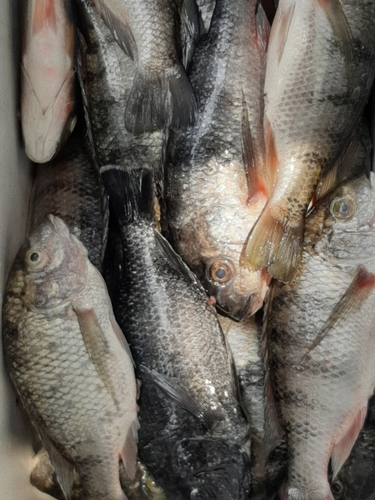
Taxonomy & naming
The species was described by Ethelwynn Trewavas in 1941 as Tilapia karongae, the name pointing to Karonga at the northern end of Lake Malawi, where the type series was collected. It is now placed in Oreochromis — a genus of maternal mouthbrooding tilapias — within the subgenus Nyasalapia, and Eschmeyer's Catalog of Fishes lists it as valid as Oreochromis karongae (Trewavas, 1941).
The taxonomy of the Malawi chambo has long been knotty. "Chambo" is a single market name covering three closely related endemics: Oreochromis karongae, Oreochromis squamipinnis, and Oreochromis lidole. The forms are so similar that females and non-territorial males of karongae and squamipinnis cannot be told apart reliably in the hand. Turner and Robinson concluded in 1991 that Oreochromis saka is a junior synonym of Oreochromis karongae, folding what had been treated as a fourth chambo into this species. Earlier morphometric work had even disagreed about which forms were most alike — a reminder that this is a young, still-radiating species flock rather than a set of tidily distinct lineages.
Morphology
Oreochromis karongae is a heavily built tilapia with a wide, rounded head and short jaws. FishBase records a maximum of about 16.5 in total length, though the IUCN assessment cites a smaller maximum near 14.5 in TL, and average catch sizes have shrunk under fishing pressure. Fin counts run to 15–17 dorsal spines, 10–12 dorsal soft rays, and three anal spines. Dentition is notably variable: some fish carry very wide bands of jaw teeth, and a so-called "multitooth" morph at Cape Maclear has especially broad tooth fields.
Color is strongly sex- and mood-dependent. Females and juveniles are a plain greyish-brown with four or five faint vertical bars — the camouflage of a sand-and-weed fish. Breeding males are the showpiece: jet black, with a clean white margin to the dorsal and tail fins. The genital "tassel" of a ripe male can be long, branched, and colored pink to bright yellow, functioning as an egg-dummy lure during spawning. One isolated population in the Tanzanian crater lake Ikapu is unusual in that even females and quiet males are a bright golden color.
Habitat
This is a lacustrine endemic of the Lake Malawi (Niassa/Nyasa) basin. Beyond the main lake it occurs in Lake Malombe and the upper and middle Shire River downstream, and it has been recorded from the small Tanzanian crater lakes Ikapu and Itamba. Its native range spans the three riparian countries — Malawi, Mozambique, and Tanzania — but its estimated area of occupancy is modest, on the order of a few thousand square kilometres.
Oreochromis karongae is a habitat generalist by Lake Malawi standards, turning up in shallow vegetated bays, over open sand, in intermediate zones, and even in purely rocky biotopes. At most sites it stays shallow, rarely below about 33 ft, but it ranges from the surface down to roughly 130–165 ft. The lake's surface waters sit warm and stable, around 72–82 °F, with the alkaline, well-buffered chemistry typical of the Rift lakes — pH on the order of 7.7–8.8; a general hardness near 6–10 °dH is a common keeping target. Breeding males have been found digging nests from the shallows down to at least 92 ft, and Lake Malombe, a shallow satellite lake on the Shire, is now one of its main breeding grounds.
Feeding
Chambo are low on the food web — FishBase places Oreochromis karongae at a trophic level near 2.0, the mark of a primary consumer. It feeds chiefly on phytoplankton and on the diatom-rich sediment film that coats sandy bottoms, supplemented by detritus and zooplankton taken from the water column. Feeding mechanics vary with habitat: over sand it sifts sediment, while the multitooth Cape Maclear morph rasps the surfaces of rocks and weeds, apparently harvesting loose aufwuchs (the algal felt that mats hard surfaces).
Ecologically the three chambo species seem to have partitioned the open water and bottom between them — Oreochromis lidole was considered the form most adapted to feeding up in the water column and in deeper water, while Oreochromis karongae works shallower, mixed habitats. As an abundant mid-water and benthic grazer, chambo historically converted the lake's plankton into the single most important protein source for the human population around it, which is exactly why the fishery mattered so much.
Mating
Like all Oreochromis, Oreochromis karongae has a breeding system built around lekking males. They can be seen in loose shoals across the lake, but at spawning time males become territorial and excavate large nests on a range of substrata. These are sometimes huge craters — typically 1–6 ft across, with nest size correlating to the male's body size — finished with a characteristic slightly raised, bowl-shaped spawning cone at the center. Nests have been recorded from about 2 ft down to at least 92 ft deep.
Courtship happens mainly in the early morning: a territorial male, flushed jet black with a white-edged dorsal and tail, leads a following female to his cone and then tilts and quivers head-down. The male's long, branched genital tassel — colored pink to yellow — acts as an egg dummy that helps coordinate fertilization as the female mouths at it. Breeding males have been found displaying on their bowers across a long season and a wide depth range, congregating on the leks where females choose among them.
Breeding
Oreochromis karongae is a maternal mouthbrooder. After spawning over the male's cone, the female takes the fertilized eggs into her mouth and broods them there, incubating the clutch and then sheltering the hatched fry in and around her mouth until the young reach roughly 1 in. One brooding female was found carrying 324 young of about 0.5 in, giving a sense of the modest clutch a fish of this size produces — a small investment per offspring offset by the safety of oral incubation.
The breeding season is long, running from around July to March in Lake Malawi with peaks near September and February, and a single mid-year peak in Lake Malombe. Because spawning is tied to nearshore sand and rock, the breeding grounds are exactly the zones most exposed to fishing pressure and to sedimentation off deforested catchments — a vulnerability that bears directly on the species' decline.
In the aquarium
Oreochromis karongae is essentially never kept as an ornamental cichlid, and that omission is honest rather than an oversight. This is a large, plain-bodied, food-fish tilapia: females and juveniles are a drab grey-brown, and only territorial males flush black-and-white. A fish approaching 14–16 in (14–16.5 in) that wants to dig metre-wide craters needs a pond or a very large tank, not a typical Malawi community aquarium, and it carries none of the jewel-toned appeal that drives the mbuna and Aulonocara trade. Hobbyists who keep "Malawi cichlids" are almost always keeping those rock-dwellers, not chambo.
Where Oreochromis karongae is reared in volume, it is as aquaculture, not a hobby. It is widely cultured in Malawi — often in earthen ponds or, increasingly, lake cages, and sometimes in polyculture with the African catfish Clarias gariepinus or alongside Oreochromis shiranus. Pond trials show its growth slows markedly when water temperature drops, consistent with a warm-water tropical fish. If you keep one as a grow-out tilapia rather than a display animal, the realistic notes are the same as for the wild fish: warm water in the mid-20s °C, soft sand it can sift and mound, plenty of room, and an expectation of strong male territoriality at spawning time.
Conservation
The IUCN Red List assesses Oreochromis karongae as Critically Endangered (criterion A2d), in an assessment dated 22 May 2018 by Kanyerere, Phiri & Shechonge (published 2018, with a 2019 errata correction). That is a sharp deterioration from its 2004 listing of Endangered, and it is driven almost entirely by the collapse of the chambo fishery. Catch records show chambo declines exceeding 70% between 1990 and 2000, and inferred declines in catch-per-unit-effort of roughly 94% over 2006–2016 in the southern arms of the lake — the assessors describe the species as close to commercial extinction. Average fish size is falling too, and of the three chambo species one, Oreochromis lidole, may already be extinct. Overfishing is the primary threat; a secondary one is hybridization with introduced Nile tilapia (Oreochromis niloticus), which has spread into the Malawi catchment. The chambo collapse has become a textbook African fisheries-management cautionary tale: an open-access nearshore fishery, growing human pressure, and gear that targets breeding aggregations combined to outrun every attempt at regulation.
That species-level crisis sits inside a lake-wide squeeze. The Chavula et al. (2023) basin review in the Journal of Great Lakes Research (49(6):102241) flags fishery health, invasive species, and climate change as the priority stressors for Lake Malawi/Niassa/Nyasa, with anthropogenic and climatic pressures driving rising sediment and nutrient loading off deforested catchments. Shallow waters have warmed by roughly 33 °F, which strengthens density stratification, slows the deep mixing that returns nutrients to the surface, and so tends to cut the very phytoplankton productivity that chambo depend on. For a shallow- to mid-water planktivore that breeds over nearshore sand and rock, those pressures land squarely on its habitat and food base: sedimentation smothers spawning grounds, warming erodes the plankton it grazes, and the Nile tilapia introduction threatens its genetic integrity directly. Here the lake's strain and the fish's status point the same way — this is not a Least Concern species in a healthy lake, but a Critically Endangered endemic in a basin under real and compounding stress.