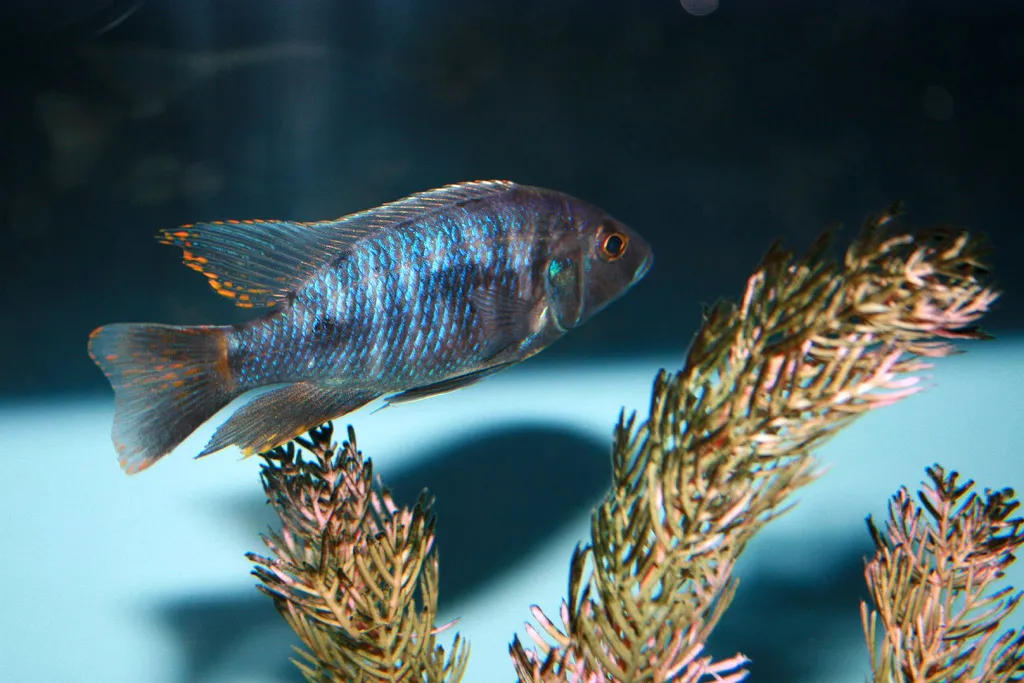
Taxonomy & naming
Otopharynx lithobates was described by Michael K. Oliver in 1989, in the monograph 'Malaŵian cichlid fishes — the classification of some Haplochromine genera' edited by D. H. Eccles and Ethelwynn Trewavas, in a joint account titled 'Otopharynx brooksi and Otopharynx lithobates.' Its holotype (BMNH 1974.7.5.1) was taken at Thumbi Island West in the southwestern arm of the lake, near Cape Maclear. The genus Otopharynx was erected by Regan in 1920; the name combines Greek 'otos' (ear) and 'pharynx' (throat), a reference to the participation of the prootic bone in the articulation of the upper pharyngeal jaw. The species sits in the family Cichlidae, subfamily Pseudocrenilabrinae, tribe Haplochromini — the great Malaŵi 'hap' radiation. Catalog of Fishes treats Otopharynx lithobates Oliver, 1989 as a valid species. In the aquarium trade the fish is almost always sold under the misleading name 'Aristochromis' or 'Yellow Blaze Aristochromis,' a relic of older hobbyist identifications; it has no connection to the genus Aristochromis, which contains a single large predatory species.
Morphology
A small-to-medium hap, Otopharynx lithobates reaches about 6.5 in total length in males, with females staying smaller (around 4 in TL); FishBase gives a maximum of 6.5 in TL. The body is the moderately deep, laterally compressed shape typical of the genus. Coloration is strongly sex- and mood-dependent. Non-breeding fish, females and subdominant males are a drab brown-grey marked with the dark midlateral blotches characteristic of Otopharynx. A dominant, displaying male is transformed: the body darkens to a metallic blue-black scattered with iridescent neon-blue spangles, the dark flank spots fade into that ground colour, and — most distinctively — the top of the head, snout and the whole dorsal fin flush an intense sulphur-yellow to orange. This 'blaze' is the source of the hobby names 'Sulphur-head' and 'Yellow Blaze.' Several geographic colour forms are traded, the best known being the 'Zimbabwe Rock' (or 'Zimbawe Rock') variant from that locality. Sexual dimorphism is pronounced in colour and somewhat in size; the sexes are otherwise similar in fin counts and proportions.
Habitat
True to its name — 'lithobates' translates roughly as 'one that frequents rock' — this is a rock-zone fish. It has been recorded at a scatter of southern localities including the waters between Domwe Island and Monkey Bay, at Thumbi East and West, Mumbo, Chinyamwezi and Zimbabwe Rock, all in the southern part of the lake. It inhabits caves, crevices and the shaded recesses of rocky reefs, and according to hobby and field accounts is hardly ever seen out in open water — it stays close to rock, even in aquaria. Within the rock biotope it favours the sediment-rich zone where a thin layer of fine sediment overlies the rock, in moderate depth (FishBase records it to about 33 ft). This is the cooler, clearer, alkaline water typical of Lake Malaŵi as a whole: temperatures of roughly 75–82 °F, a well-buffered chemistry and a stable pH on the alkaline side of neutral.
Feeding
Otopharynx lithobates is a micro-predator and opportunistic omnivore of the sediment-rich rock zone. In the wild it gleans small invertebrates, insect larvae, crustaceans and other tiny animals from the sediment film and crevices of the rocks, along with some plankton and incidental plant and algal material. FishBase places it at a moderate trophic level consistent with a small invertebrate-feeder rather than a piscivore — despite the 'Aristochromis' trade name, it is not a fish-eater of any consequence. In captivity it is unfussy and readily takes prepared foods, though keepers are advised to base the diet on live and frozen invertebrate foods (such as mysis, brine shrimp and other small crustaceans) supplemented with a good-quality cichlid pellet or flake.
Mating
Like the great majority of Malaŵi haps, Otopharynx lithobates is a polygynous maternal mouthbrooder with no lasting pair bond. A dominant male establishes and defends a territory among the rocks, typically centred on a flat rock or a sheltered spot within a cave, and there assumes his full nuptial dress — the dark blue body and blazing yellow head and dorsal fin. He courts passing females with lateral displays and quivering, leading receptive females to the cleaned spawning site. The species is best kept and bred in a harem of one male to several females, which both spreads the male's attention and reflects the natural polygynous mating system.
Breeding
Breeding follows the classic Malaŵi-hap, maternal-mouthbrooding pattern. The female lays a modest clutch — hobby accounts cite roughly 25–50 eggs — on a flat rock, taking the eggs into her mouth as they are fertilised by the male, often following the familiar egg-spot 'dummy' sequence seen across the haplochromines. She then carries and incubates the developing eggs and larvae in her buccal cavity for around three to four weeks, taking no food, before releasing free-swimming fry in a sheltered, rocky spot. The fry are comparatively large and well-developed at release. The species is a reliable and productive aquarium breeder, and a brooding female can be left in a well-structured tank or, for higher fry yields, gently stripped and the fry reared separately.
In the aquarium
Otopharynx lithobates is a long-established and rewarding aquarium fish — one of the more peaceful Malaŵi haps and an excellent choice for an alkaline, well-buffered rock-cichlid community. A group needs a roomy tank (a minimum footprint of around 120 × 17.5 in / a 75-gallon-plus tank is a sensible floor for a harem) aquascaped with plenty of rock built into caves and crevices that reach well up toward the surface, over a sandy substrate — exactly the cave-and-crevice structure the fish seeks in the wild. Water should be alkaline and well-buffered (about pH 7.5–8.5) and kept warm and clean, around 75–82 °F; like all Malaŵi cichlids it needs good filtration and disciplined maintenance to hold nitrate down. Keep it as a harem of one male with three or more females to spread aggression, and choose tankmates of similar temperament — other moderate Malaŵi haps and peaceful utaka — rather than boisterous mbuna. The pay-off is a hardy, free-spawning fish whose dominant males rank among the most striking blue-and-yellow cichlids in the hobby.
Conservation
The IUCN Red List assessed Otopharynx lithobates as Least Concern in 2018. It has a relatively wide distribution across rocky localities in the southern part of Lake Malaŵi and is not considered threatened at the species level. The general caveats that apply to the whole Lake Malaŵi flock apply here too: the lake faces mounting pressure from a heavy artisanal fishery, sedimentation from catchment deforestation and agriculture, shoreline development, and the long-term threat of warming and falling lake levels, all of which bear on the rock-zone habitat these fish depend on. Collection for the ornamental trade is long-standing but, for a widespread and captive-bred species like this one, is not regarded as a significant pressure. No species-specific conservation measures are in place, and none are currently considered necessary.