Taxonomy & naming
The Egyptian mouthbrooder was described in 1903 by C. H. Schöller as Chromis multicolor, in the German aquarium periodical Blätter für Aquarien- und Terrarienkunde — a telling debut, because the species entered science by way of the hobby rather than a museum expedition. Schöller worked from living aquarium specimens and the type locality is Lake Mareotis (Lake Mariout), a brackish-margined lake just south of Alexandria in the Nile delta of Egypt; the syntype series is held at the Vienna and Berlin museums (NMW 80461 / ZMB 16091). It is that Egyptian provenance, not the bulk of the species' range, that gave the fish its enduring English name. The same year the name reappeared as Paratilapia multicolor (Hilgendorf, 1903), the first of several generic reshufflings. P. H. Greenwood, the foremost student of the East African haplochromines, moved it to Hemihaplochromis in 1965, and Skelton's 1991 CLOFFA treatment fixed it in its modern combination, Pseudocrenilabrus multicolor (Schöller, 1903). The genus Pseudocrenilabrus itself was erected by Fowler in 1934 to hold the small African dwarf mouthbrooders previously scattered through Haplochromis and allied genera; the multicolor complex is its type-species lineage. Two subspecies have long been recognized and remain in use: the nominate P. m. multicolor of the lower Nile and Egypt, and P. m. victoriae Seegers, 1990 of the Lake Victoria region, which differs in colour pattern (notably blue lips and a black-and-red dorsal margin in males). The genus is widely regarded as in need of revision, and several authors expect the two forms may eventually be elevated to full species.
Morphology
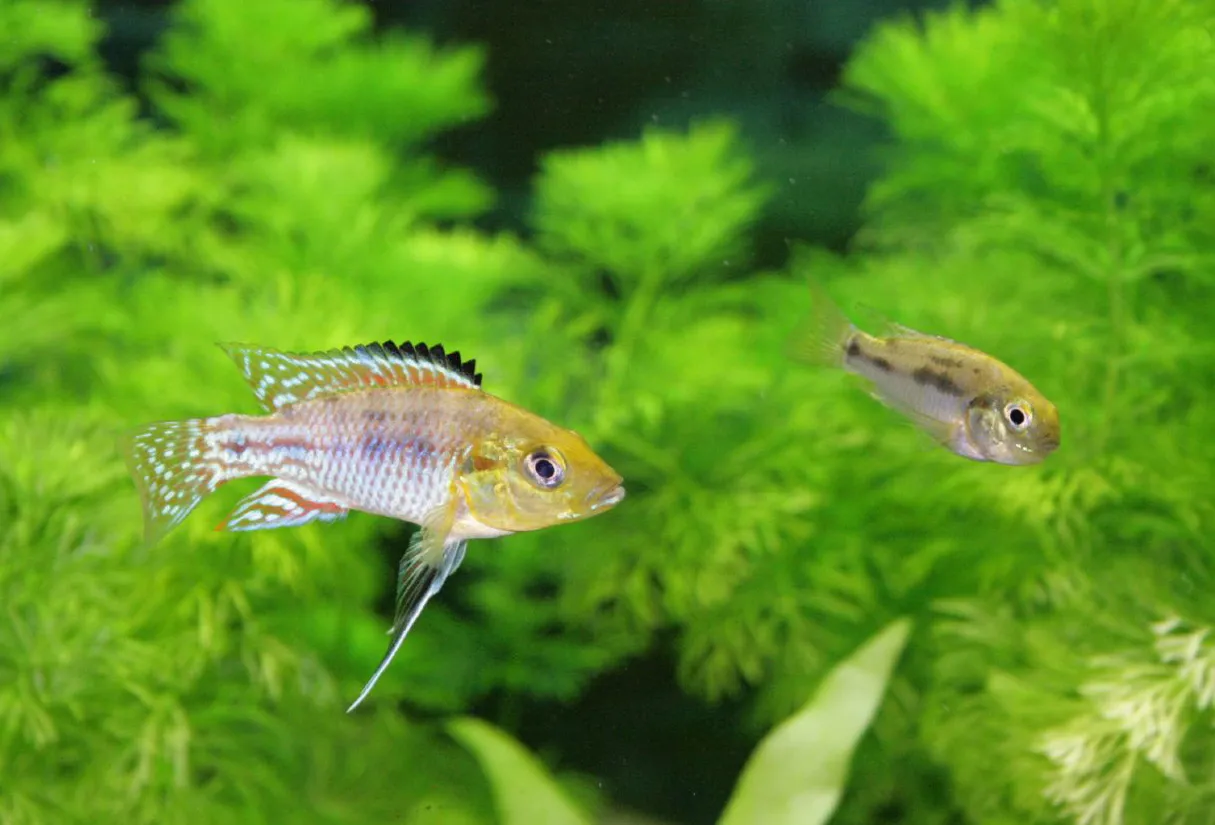
This is a small, deep-bodied dwarf cichlid with a fusiform profile, an oval cross-section, and a rounded caudal fin. Maximum length is about 3 in total length, with males running larger than females; aquarium accounts commonly cite males around 3–4 in and females nearer 2.5–3 in. Out of breeding condition the fish are unremarkable — a silvery to greyish body with a faint sheen — and it is easy to overlook why the species earned its name. In nuptial dress the male is transformed: Schöller's original account described upper sides and back a bright coppery purple, the lower flanks white, the scales hung with a pearly, nacreous iridescence, and breeding males glowing a magnificent sky-blue, all set off by a vivid vermilion blotch at the tip of the anal fin. That orange-red anal spot is functionally important (see Mating). The fish can also drop its colour abruptly when frightened or aggressive, shifting to a grey-green ground crossed by dark longitudinal and vertical bars — the rapid mood-driven colour change that the epithet multicolor, 'many-coloured,' was coined to capture. Sexual dimorphism is pronounced: males are larger, far more colourful, and develop the breeding livery and anal spot, while females stay comparatively plain silver. The two subspecies are separable largely on these male nuptial details, P. m. victoriae carrying blue lips and a black-edged, red-banded dorsal fin.
Habitat
Pseudocrenilabrus multicolor is broadly distributed across the upper Nile system and the great-lakes country of East Africa. The Catalog of Fishes summarizes its range as extending from the Nile basin to the Lake Victoria catchment; in detail it occupies the Lakes Victoria, Albert, Edward and Kyoga basins, the Aswa and Malawa river systems, Lakes George and Nabugabo, and the swampy intermediate lakes (Kachira, Kijanebalola, Nakavali) between Lakes Edward and Victoria, reaching down the White and Blue Niles into Sudan, South Sudan and historically the Egyptian delta. It is notably absent from Lake Turkana. Within these waters it is a fish of quiet shallows rather than open lake — streams, ponds, lake tributaries, papyrus-fringed swamp margins and seasonal pools, typically among the stems of aquatic plants or beneath floating vegetation. The IUCN assessment characterizes its habitat as inland wetlands, occurring among submerged plants and in the open-water lanes enclosed by papyrus swamp; it treats large permanent lakes only as marginal habitat. Recorded water chemistry is near-neutral and moderately hard — FishBase gives a pH around 6.8–7.2 and hardness of roughly 10–14 dH — at warm tropical temperatures, with FishBase citing about 68–75 °F though the species tolerates a wider band in the field and in captivity. As a shallow-water, vegetation-associated fish its functional depth range is essentially the upper metre or two of the water column; it has no documented deep-water occurrence. In the Lake Edward system specifically, field surveys record it as one of only a handful of non-endemic cichlids shared across Lake Edward, Lake George and the connecting Kazinga Channel — alongside Astatoreochromis alluaudi, Haplochromis nubilus and the two Oreochromis species also native there — in contrast to the dozens of Haplochromis species endemic to that basin alone (Konings, Cichlids Yearbook Vol. 5).
Feeding
The Egyptian mouthbrooder is a small generalist omnivore that forages low in the water column and through marginal vegetation. Published diet records list aquatic worms, crustaceans and insects alongside algae, vegetable fragments and the occasional small fish — a catholic menu that places it at a trophic level near 3.0. The IUCN account echoes this, describing the species as omnivorous and feeding on insects, worms, algae and small fish; hobby accounts add snails and other invertebrates picked from plant stems and the substrate. There is no specialized feeding apparatus here — it is an opportunistic micropredator and grazer rather than a dedicated sand-sifter, scale-eater or piscivore — and in the swamp-margin and stream communities it inhabits it functions as a mid-level forager on small invertebrates and soft plant material. This dietary flexibility is a large part of why the fish is so undemanding in captivity, where it accepts virtually any prepared, frozen or live food offered.
Mating
Like all Pseudocrenilabrus, this species is a polygynous, non-pair-bonding maternal mouthbrooder, and its mating system is built around a transient male territory rather than a lasting partnership. When a male comes into condition he stakes out a patch of bottom and excavates a shallow spawning pit, then advertises from it in full nuptial colour, displaying to and herding passing females. Males are notably forceful suitors and intensely aggressive toward rival males, which is why the species is best spawned as a harem — one male to several females — so that no single female bears the brunt of his attention. Courtship culminates in the classic haplochromine 'T-position' circling, the male presenting his flank and quivering before the female. The orange-red spot at the tip of his anal fin has long been interpreted as an egg-dummy: as the female snaps up the just-laid eggs and then mouths the male's vent to take in milt, the bright anal spot is thought to draw her toward the source of sperm and so improve fertilization, an elegant signal famously associated with this group of cichlids. (Close observation suggests the mechanics are not always so tidy, since the spot and the genital opening do not perfectly coincide, but the egg-spot remains a hallmark of the lineage.) No parental bond forms between the sexes; once spawning ends the male's role is over and he resumes displaying to other females.
Breeding
Reproduction is by maternal (agamous, ovophilic) mouthbrooding — the female alone incubates. Spawning follows the genus pattern: in the male's pit the pair circle, the female lays a small batch of eggs and immediately takes them into her mouth, and fertilization is completed in the buccal cavity as she mouths the displaying male. Clutches are small and scale strongly with female size; one keeper recorded just six eggs from a one-inch female and about thirty-five from a three-inch fish, and aquarium accounts generally report broods on the order of 5–100 eggs. The female then broods the developing eggs and larvae in her mouth — a notably short incubation for a mouthbrooder, on the order of 10–14 days — neither feeding nor (initially) releasing the young, before letting go free-swimming, fully formed fry. The fry are small but robust and are easily reared on baby brine shrimp, microworm and powdered dry foods; they begin to colour up at around half an inch and grow quickly, reaching an inch within a couple of months. As a holding female may continue to shelter young briefly after release, and because the species matures early (Borstein records spawning in fish barely an inch long) and breeds readily across a wide range of conditions, captive populations build fast. This combination of small size, early maturity and undemanding spawning is exactly why Pseudocrenilabrus multicolor was one of the first cichlids ever bred in aquaria, more than a century ago.
In the aquarium
Pseudocrenilabrus multicolor has been a hobby fixture for over a hundred years and remains an excellent, if underappreciated, beginner's cichlid — tolerant, colourful in the male, and easy to spawn. Its one genuine pitfall is temperament: for such a small fish it is remarkably aggressive, and the management of that aggression dictates almost every husbandry decision.
A single pair can be housed in a tank of around 23.5 in (roughly 20 US gal), but a single male with three or more females in a larger aquarium is the far better arrangement. Keeping one male alone with too few females usually ends with him harassing or killing them; spreading his attention across a harem keeps the females in condition and less stressed. Where space allows, keeping a spare male or two can actually help, as the dominant male then directs his aggression at rivals rather than concentrating it on the females. Two males in close quarters without room to separate, by contrast, is a recipe for loss.
The tank should be well structured with hiding places — clay-pot caves, roots, driftwood and plants all serve to break sightlines and give subordinate fish refuge. A sand or fine-gravel substrate is preferred, since the male digs a spawning pit; coarse gravel is less suitable for a digger. Plants are not essential but are appreciated and help diffuse aggression. Water chemistry is undemanding: the species thrives at pH near neutral (about 6.5–7.5), moderate hardness (roughly 5–15 dH), and warm temperatures in the low-to-mid 20s °C, with around 75–77 °F ideal for breeding. It is genuinely tolerant of a wide chemical envelope, which is much of its appeal for newcomers.
Feeding presents no difficulty — a good cichlid pellet as a staple, varied with regular live and frozen foods (bloodworm, brine shrimp, daphnia) for colour and breeding condition. For tankmates, avoid small, slow or lower-dwelling fish that will be bullied; in a large tank robust dither species such as African tetras, or surface-dwellers, work, and experienced keepers have even housed it successfully alongside the more robust Lake Malawi mbuna and haplochromines, whose own boisterousness it matches. The two subspecies (multicolor and victoriae) should never be kept together, as they hybridize readily and the distinct wild forms are easily muddied. Overall this is a forgiving, rewarding fish whose only real demand is that the keeper respect how much fight is packed into so small a body.
Conservation
The IUCN Red List assesses Pseudocrenilabrus multicolor as Least Concern (assessed 30 March 2021 by V. Natugonza and L. Musinguzi, reviewed by J. Snoeks, published 2022), and both previously assessed subspecies carry the same status. The justification is straightforward: the species is common and widely distributed across the Lake Victoria, Albert, Edward and Kyoga basins, the Aswa drainage and the lower Nile, with no widespread threats likely to diminish the overall population, which is presently considered stable (trend unknown). It is not CITES-listed. The assessment does flag localized pressures rather than range-wide ones — conversion and drainage of the swamps and wetlands the fish depends on, and agricultural runoff that drives erosion and increased turbidity. The species also enters the international aquarium trade, but at a level the assessment does not treat as a population-level threat; indeed its hardiness and ease of captive breeding mean trade demand is largely met by tank-raised stock. The Egyptian populations at the historical type locality are flagged only as 'possibly extant,' a reminder that the heavily modified lower-Nile and delta wetlands are the part of the range where this otherwise secure little cichlid is most exposed.