Taxonomy & naming
The blue African mouthbrooder has a tangled nomenclatural history that turns on a single year. In 1928 the American ichthyologist John Treadwell Nichols, curator of fishes at the American Museum of Natural History, described a small cichlid from the Congo as Paratilapia ventralis. That name, however, was already occupied: George Albert Boulenger had used Paratilapia ventralis in 1898 for a different African species, rendering Nichols' combination a junior homonym and therefore invalid. In the same year the French ichthyologist Jacques Pellegrin published a replacement name, Paratilapia nicholsi, honouring Nichols himself; it is Pellegrin's 1928 name that stands. The type locality is Ankoro, in the southeastern Democratic Republic of the Congo at the confluence of the Luvua and Lualaba rivers; the holotype is held at the American Museum of Natural History (AMNH 9252), with four paratypes in the Paris museum (MNHN). The species was later moved into the genus Pseudocrenilabrus, erected by Henry Weed Fowler in 1934 for the small African maternal mouthbrooders previously scattered among Haplochromis, Hemihaplochromis and Paratilapia. Skelton's 1991 treatment in the Check-list of the Freshwater Fishes of Africa (CLOFFA) fixed it as Pseudocrenilabrus nicholsi, the placement followed by Kullander and Roberts (2012) and by Katongo and colleagues (2017), who revised the genus and described additional Congo-basin species. Within Pseudocrenilabrus it sits alongside the widespread Pseudocrenilabrus multicolor, Pseudocrenilabrus philander and a handful of more recently named forms, all of them small, sexually dimorphic, polygynous mouthbrooders of the Pseudocrenilabrinae.
Morphology
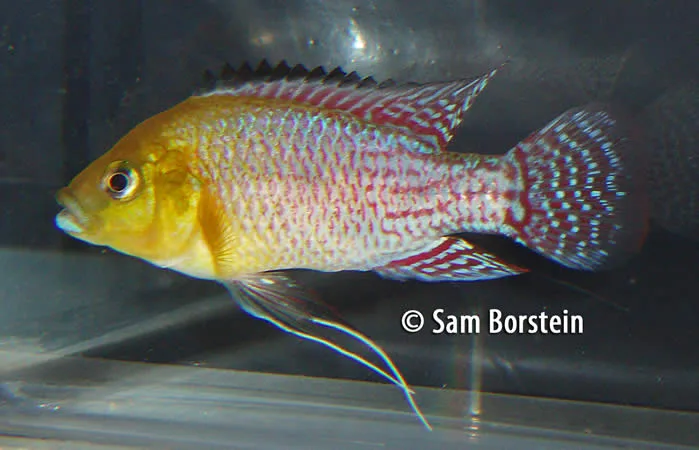
Pseudocrenilabrus nicholsi is a compact, deep-bodied dwarf cichlid reaching about 3.5 in in standard length, with most aquarium specimens settling around 3–3.5 in in total length. The body is the typical short, laterally compressed haplochromine form, with a moderately steep forehead and a terminal mouth suited to picking at small prey. Colour is where the species earns its name and its keepers: a dominant male wears rows of glittering electric-blue to turquoise scales laid over a pale fawn-to-golden ground, with iridescent flecking across the flanks, cheeks and unpaired fins, and a conspicuous orange to red blotch on the anal fin. Females and subordinate fish are far plainer, a silvery to pale brassy grey that lets them disappear among plant stems. The orange anal-fin marking of the male is the classic 'egg-spot' analogue of the haplochromine mouthbrooders, and some males also develop drawn-out extensions to the pelvic (ventral) fins, adding to the display. Sexual dimorphism is pronounced and reliable: males grow slightly larger and are dramatically more colourful, while ripe females are fuller-bodied and muted. There is no settled, distinct juvenile pattern beyond the generally cryptic colouration of young and non-dominant fish.
Habitat
The species is endemic to the Democratic Republic of the Congo, where it ranges across a broad stretch of the Congo (Zaire) drainage from around Yangambi on the middle Congo upstream to the Upemba lakes of the upper Lualaba, taking in the type locality at Ankoro on the Luvua–Lualaba confluence. This spans two freshwater ecoregions: the Upper Lualaba, centred on the Kamolondo Depression and the swamps and shallow lakes of the Upemba wetlands, and the Upper Congo to the north. It is a fish of quiet, warm, shallow water rather than the main river channel — ponds, creeks, marsh margins, floodplain pools and even drainage ditches, where it stays close to the banks or among the stems of aquatic vegetation. Reported in-situ and preferred water chemistry is soft to moderately hard and near-neutral: FishBase gives a pH range of roughly 6.0 to 8.0, hardness of about 9 to 19 dH, and a cool tropical temperature band of around 72–77 °F, lower than the figures usually quoted for rift-lake cichlids and consistent with shaded, slow-moving lowland habitats. Documented occurrence depth is shallow, on the order of 0–7 ft, reflecting its life among marginal plants and over soft bottoms.
Feeding
In the wild Pseudocrenilabrus nicholsi is a small benthic-to-midwater omnivore that gleans the bottom and the plant zone for whatever invertebrate life it can fit in its mouth. FishBase places it at a trophic level near 3.4, the level of a micropredator that takes aquatic insect larvae, small crustaceans and worms, supplemented by algae and organic detritus — the same broadly opportunistic diet documented in detail for its congeners (Pseudocrenilabrus multicolor is recorded eating worms, crustaceans, insects, algae and vegetable fragments). Its terminal mouth and picking habit make it a forager of surfaces and crevices rather than a substrate-sifter. In captivity this translates directly into an undemanding feeder: it readily accepts good-quality cichlid pellets or flake as a staple, and shows its best colour and condition on a varied menu enriched with live and frozen foods such as bloodworm, brine shrimp and daphnia, with the occasional addition of vegetable matter.
Mating
Pseudocrenilabrus nicholsi is a polygynous, non-pair-bonding species — FishBase characterises it as an 'agamous maternal mouthbrooder,' meaning no lasting bond forms between the sexes. Reproduction is organised around a single dominant male, who establishes and vigorously defends a territory and excavates a shallow spawning pit in the substrate. From this pit he displays to passing females, flaring his blue flanks and orange anal flash to entice them. The system is strongly harem-based: only one male will hold a territory and breed in a given space unless the area is large, and rival males are met with severe aggression. The male can also be roughly insistent toward females that are not yet ready, which is why keepers spawn the fish with several females and a buffer of dither or target fish to divide his attention. When a female is receptive she enters the pit, the pair circle, and the male nuzzles her vent; the orange anal blotch has long been hypothesised to function as a 'dummy egg' drawing the female's mouth toward the male's vent during the fertilisation sequence, though close observation suggests the female actually mouths the vent itself rather than the marking.
Breeding
Breeding follows the classic haplochromine maternal-mouthbrooding pattern and is considered relatively easy in the aquarium. Spawning takes place in or beside the male's pit: as the female releases her eggs she immediately turns and takes them into her mouth, then mouths the area around the male's vent, prompting him to release milt that fertilises the clutch inside her buccal cavity — and because the fish circle quickly, some eggs may already be fertilised before pickup. Clutches are small, as expected of a dwarf mouthbrooder; congeneric and first-spawn reports in the genus run to only ten to fifteen or so eggs, with brood sizes rising as a female matures, and Pseudocrenilabrus throat capacity caps the number well below that of larger cichlids. The female carries the developing eggs and larvae for roughly ten days, neither feeding nor spawning again during that time, until the fry are fully free-swimming, at which point she releases them. Parental care is entirely maternal; the male contributes nothing beyond fertilisation and defence of the wider territory. Carrying females draw unwelcome attention from the dominant male and are best moved to a separate tank to brood in peace. Newly released fry are large enough to take Artemia nauplii, microworm and powdered dry foods from day one, and grow readily; a brooding female is typically rested for a few weeks before being conditioned to spawn again.
In the aquarium
The blue African mouthbrooder is an uncommon but rewarding aquarium fish — a small, hardy, brilliantly coloured cichlid that is not difficult to keep, provided its temper is respected. A tank of about 35.5 in length (the commonly cited 36-inch minimum, roughly 20 US gal) suits a single male with a group of females; anything smaller invites trouble, because males are intensely territorial toward one another and pushy toward conspecifics generally. The standard recommendation is to keep one male with three or four females, or to raise a group of six to eight youngsters and let a hierarchy sort itself out. The aquarium should be furnished with plenty of broken sightlines and cover — clay-pot caves, driftwood, roots and rockwork — over a substrate of sand or fine gravel that the male can dig when in spawning mode. Plants are not strictly required but are appreciated and will not be damaged, and they help recreate the marginal-vegetation biotope the species favours.
Water chemistry is forgiving within the species' natural envelope: a temperature of 72–77 °F, pH 6.0 to 8.0, and moderate hardness (around 5 to 20 dH) all work, with near-neutral, soft-to-medium water and a temperature near 75 °F being a sensible target for general maintenance and breeding alike. This is a cooler-running cichlid than many tropicals; there is no need to push the heater into the high twenties. Like all cichlids it is a fairly heavy waste producer, so reliable filtration and regular partial water changes are important to keeping it in condition.
The key husbandry caution is behavioural rather than chemical. Pseudocrenilabrus nicholsi can be aggressive toward other bottom-oriented species and toward its own kind, so tankmates are best chosen from the upper and middle water column — larger African tetras, rainbowfish and surface-dwellers such as hatchetfish make good company in modest tanks, while keeping it alongside other dwarf cichlids, catfish or loaches calls for considerably more room. A single male should be kept unless the tank is large enough to let a second establish a separate territory. Feeding is straightforward: a quality cichlid pellet or flake staple, varied with live and frozen bloodworm, brine shrimp and daphnia and the occasional vegetable supplement, keeps the fish healthy and brings up the male's electric-blue and orange colours.
Conservation
The IUCN Red List assesses Pseudocrenilabrus nicholsi as Least Concern (assessed 16 February 2009 by T. Moelants, published 2010). The listing reflects a relatively wide distribution through the upper and middle Congo basin and the absence of any documented range-wide threat; the species carries no CITES listing and is not evaluated under CMS. As a small, adaptable inhabitant of ponds, creeks, marshes and floodplain pools it is less exposed than narrow-range endemics, and its high reproductive resilience (a short population-doubling time and low fishing vulnerability) further buffers it. That said, the assessment is now well over a decade old, and the freshwater systems of the Democratic Republic of the Congo face mounting pressures from deforestation, artisanal and industrial mining, sedimentation and the wetland modification that accompanies a fast-growing human population — diffuse stresses that bear on the shallow marginal habitats this fish depends on, even where no specific threat to the species itself has been recorded.