Taxonomy & naming
Teleocichla prionogenys was described by the Swedish ichthyologist Sven O. Kullander in 1988, in the same Copeia paper (volume 1988, number 1, pages 196–230) that established the genus Teleocichla for six new species of South American rheophilic cichlids. The species account appears on page 203, illustrated by figures 1 and 5, and rests on a single specimen: the unique holotype, MZUSP 36951, held at the Museu de Zoologia da Universidade de São Paulo. The type locality is the Rio Tapajós at São Luis, above Itaituba, in the State of Pará, Brazil — one of only a handful of localities known for the whole genus when Kullander wrote. Kullander designated Teleocichla centrarchus, from the Rio Xingu, as the type species of the genus; Teleocichla prionogenys and its Tapajós neighbour Teleocichla proselytus were the two species he drew from that drainage. The genus name itself is a deliberate piece of comparative anatomy: 'Teleo-' nods to the African rheophilic cichlid genus Teleogramma, whose elongate body and unbroken lateral line Teleocichla parallels through convergence, while 'cichla' signals the close South American relationship to the pike cichlids of Crenicichla. The species has had a quiet nomenclatural life with one wrinkle — in his 1991 revision of Crenicichla, Anthony Ploeg treated prionogenys as a junior synonym of Crenicichla proselytus, folding both names into the pike-cichlid genus, but that arrangement was not followed; Eschmeyer's Catalog of Fishes and every subsequent author (Staeck 2003; Kullander in Reis et al. 2003; Varella & Moreira 2013; Varella et al. 2016, 2023) list it as a valid Teleocichla. The genus has since grown to nine described species, placed in the eartheater tribe Geophagini of subfamily Cichlinae.
Morphology
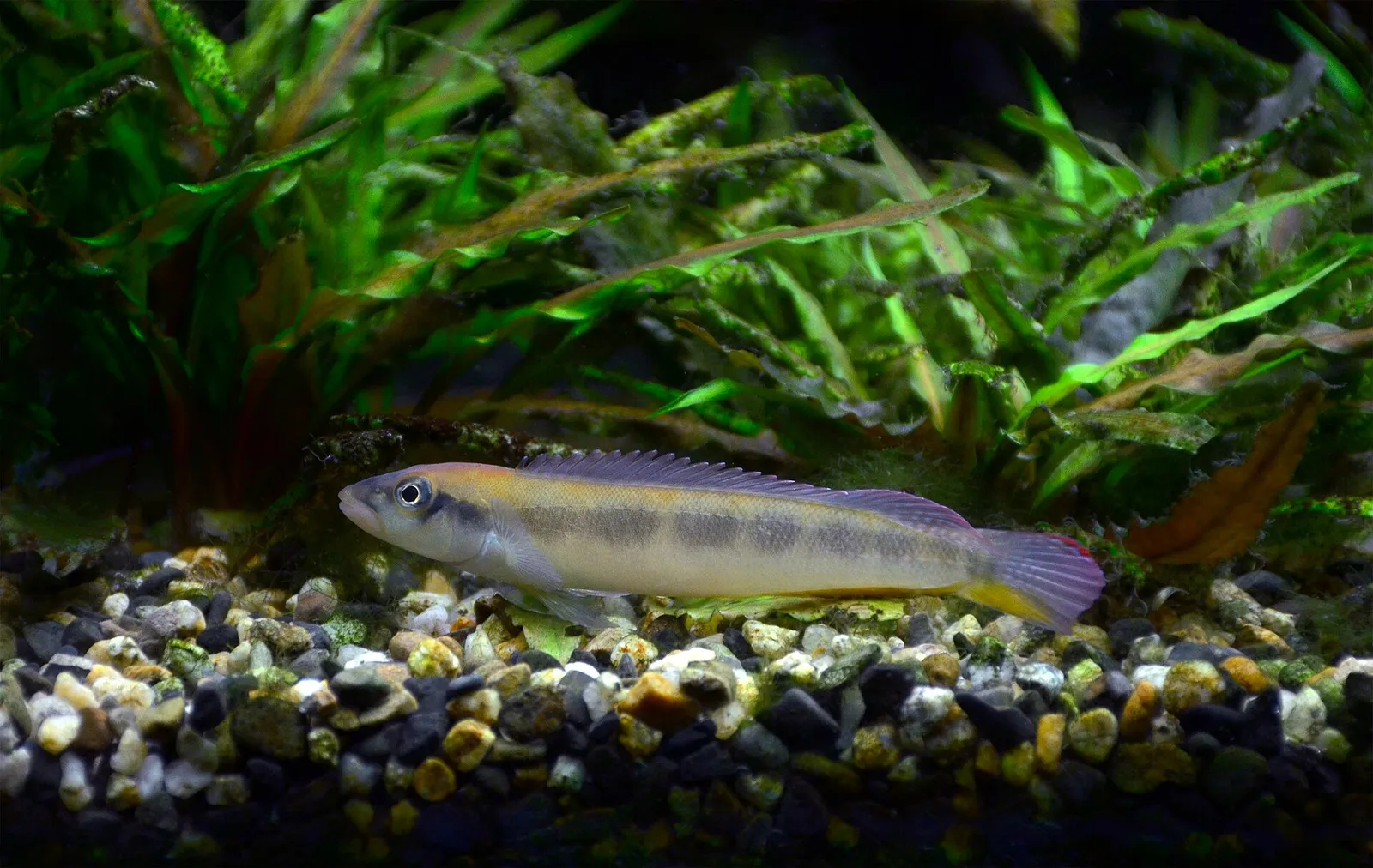
This is a dwarf cichlid. FishBase records a maximum of about 2 in standard length for males and 2 in for females, so a fully grown adult is barely longer than a thumb — and even at that size it is among the larger of the small species Kullander measured. The body is elongate, slightly tapered and only moderately compressed from side to side, with a short, downturned snout and a small mouth set with a protruding lower jaw. The overall impression is, as Kullander put it, 'goby-like': a fish shaped to lie along the bottom rather than to cruise the open water. Two features unify the genus and are well shown here. The first is the swim bladder, which is greatly reduced — an adaptation to a current-swept rocky habitat where buoyancy is a liability — and which gives all Teleocichla their characteristically clumsy, hover-then-sink swimming style. The second is the pelvic fins: long, relatively stiff, with the middle ray the longest and a thickened outer margin, forming props the fish use to perch on stone. The diagnostic feature that names this species sits on the head — a serrated, saw-toothed posterior edge to the preopercle (the cheek bone), the 'saw-cheek' of its epithet. Live coloration in this species is poorly documented from photographs, but the genus runs to muted browns, greys and greens, often with darker barring or a midlateral stripe and scattered iridescence, patterns that read as camouflage against algae-coated rock. Sexual dimorphism in Teleocichla is subtle: the sexes are very similar in size and shape, with ripe females recognisable mainly by a fuller, rounder belly, and there are no large, reliable external differences specific to prionogenys.
Habitat
Teleocichla prionogenys is a Brazilian endemic known only from the Rio Tapajós drainage, a major clearwater tributary on the south side of the Amazon. It belongs to the Tapajós–Juruena freshwater ecoregion, where the river rises off the hard crystalline basement of the Brazilian Shield, carries little suspended sediment, and runs clear, soft and low in conductivity with a pH that swings across the season from roughly 4.5 to 7.8. The defining feature of the upper and middle Tapajós and its tributaries is rapids: formidable stretches of cataract and broken water cutting through granite and sandstone, and it is precisely this habitat the genus occupies. No detailed field observations of Teleocichla prionogenys itself were available when it was described — Kullander stressed that the genus had not been watched in nature — but every Teleocichla collection comes from rapids, former rapids, or rocky-bedded streams, and the closely studied Xingu congeners give a good picture of the conditions. There Rainer Stawikowski measured clearwater of about pH 6.5, very soft (around 1 °dGH general and under 1 °dKH carbonate hardness), conductivity near 120 µS/cm, and water temperatures reaching 90 °F in the September low-water season, with the fish living over rocky bottoms in roughly a metre of water in the main channel. These are warm, shallow, fast, well-oxygenated, mineral-poor waters — an environment as far from a still blackwater pool as Amazonia offers.
Feeding
Teleocichla are not the ambush piscivores their pike-cichlid relatives are. Their gape is modest and their lower jaw protruding, the equipment of a fish that picks small prey from the substrate rather than seizing other fish, and FishBase places this species at a trophic level near 3.1 — a benthic invertivore rather than a predator of vertebrates. In life that means working the surfaces of the rapids: gleaning aquatic insect larvae, small crustaceans and other invertebrates from among and beneath the rocks and from the algal and biofilm growth that coats stone in fast, sunlit, oxygen-rich water. The reduced swim bladder and propping pelvic fins suit this exactly, letting the fish hold station on the bottom in current and forage stone by stone rather than feed in midwater. In the rapids community it fills the niche of a small, rock-associated benthic picker, sharing the habitat — sometimes the very same boulder — with other Teleocichla and with the loricariid catfishes and rheophilic characins that crowd these specialised, food-rich but physically demanding waters.
Mating
Direct courtship observations for Teleocichla prionogenys have not been published, and what is known of reproduction in the genus comes from its better-studied relatives and from the few aquarists who have worked with Teleocichla. Across the genus the fish are territorial, with adults — males in particular — defending small shelters: a chosen stone, a pit, a hole in a rock, or the space beneath a flat slab into which they retreat when threatened. Sociability varies from species to species, and in the wild several Teleocichla can be strongly territorial yet pack into the same stretch of rapids at high density, so that Stawikowski once found three different species sheltering under a single rock; presumably behavioural cues keep their breeding separate. In aquaria the genus is described as either monogamous or polygamous depending on species and circumstance, with pairs or harems forming around a defended cavity. The general pattern of the genus is therefore a cave- and crevice-based territorial system in which a shelter in the rock, rather than open substrate, is the focus of both refuge and reproduction. Aggression is modest in young fish but climbs sharply as they mature and breed, and the occasional dominant adult — more often among the Teleocichla than the related Retroculus — will harass tankmates relentlessly.
Breeding
Teleocichla prionogenys has not, on the available record, been bred in a documented way, and even at the genus level captive spawnings are rare events achieved mostly by experienced European keepers. The genus follows the substrate-spawning pattern of its eartheater and pike-cichlid kin rather than mouthbrooding: like the African rapids cichlid Teleogramma it resembles by convergence, Teleocichla are cave or crevice spawners, laying their eggs hidden inside a hole, pit or sheltered space among the rocks and guarding the brood there. Clutches in these dwarf rapids cichlids are small — fitting fish that mature at only a few centimetres — and parental care is biparental or, in polygamous settings, female-centred, with the eggs and then the free-swimming fry defended within and around the spawning cavity. Specific figures for clutch size, egg and larval development, and spawning triggers in Teleocichla prionogenys are simply not on record; the honest position is that its breeding has been inferred from the genus rather than observed. German aquarists reported the first spawnings of Teleocichla species in the late 1980s (Schliewen & Stawikowski, DATZ 1989), but fry have rarely been raised in numbers and the species treated here is not among those known to have been propagated.
In the aquarium
Teleocichla prionogenys is, for practical purposes, a fish almost no one keeps. The whole genus is rare in the trade, expensive when it appears, and notoriously hard to handle: the fish are difficult to catch in their rapids, ship very badly, and do poorly when moved into still, low-oxygen water unlike anything in their natural range. American aquarists who have managed to import Teleocichla have repeatedly watched most or all of a shipment die within days of arrival, and prionogenys specifically — known from a single locality on the Tapajós and seldom collected — is even less available than the Xingu species. None of this should be read as encouragement; it is a fish for the rare specialist who can source healthy stock, not a general aquarium subject.
For anyone who does take it on, the husbandry follows from the biotope. The tank should be long with a large floor area rather than tall, since these fish live almost entirely on the bottom; a base of fine sand strewn with smooth stones and driftwood gives them the territories, perches and crevices they need, and undemanding plants such as Anubias or Microsorum tied to the décor add cover without being uprooted. Water must be warm — around 82 °F — soft and slightly acidic, best prepared with reverse-osmosis water to mimic the mineral-poor clearwater of the Tapajós. Above all the fish need brisk, highly oxygenated flow: a powerhead aimed across a favourite stone reproduces both the current they perch against on their stiff pelvic fins and the oxygen levels they depend on. They are sensitive to dissolved wastes, so strong biological filtration and a light hand with feeding are essential — it is easy to overfeed a fish with this good an appetite. Diet should centre on small live and frozen foods (Cyclops, adult brine shrimp, glassworm, bloodworm, mosquito larvae) with sinking granules or Spirulina as a supplement, all taken from the bottom. Keep them in a group of six or more on a roomy floor with plentiful hiding places, choosing mid- and upper-water tankmates to fill the space above them, and watch for the solitary dominant individual that, as the fish mature and breed, can turn lethally aggressive in a confined tank.
Conservation
The IUCN Red List assesses Teleocichla prionogenys as Least Concern, in an assessment carried out on 7 November 2018 by Brazil's Instituto Chico Mendes de Conservação da Biodiversidade (ICMBio) and published in 2022; the population trend is listed as unknown and the species' range is given as Brazil alone. The threats the Red List records for it are precisely those bearing down on Amazonian rapids habitats generally — mining and quarrying, renewable-energy development, and dams and water management. That last is the central long-term concern for any rheophilic Tapajós cichlid. Teleocichla are obligate rapids fish: their entire biology, from the reduced swim bladder to the propping fins to the crevice-spawning behaviour, is bound to fast, rocky, free-flowing water, and that is exactly the habitat hydroelectric impoundment destroys. The genus already carries a cautionary case — the type locality of its congener Teleocichla cinderella, on the Rio Tocantins near Tucuruí, was obliterated by the Tucuruí dam, and the Belo Monte complex has transformed long reaches of the Xingu rapids that other Teleocichla depend on. The Tapajós basin has itself been the focus of repeated large hydropower proposals. For a small-bodied fish known from a single locality and tied to a habitat type squarely in the path of dam building, a Least Concern listing reflects current knowledge rather than long-term security, and habitat loss to impoundment, mining and altered flow is the pressure to watch.