Taxonomy & naming
The species was described by Franz Steindachner in 1864 as Heros maculipinnis, from the Río Jamapa in the Papaloapan drainage of Mexico (syntypes NMW 17368-70). The epithet combines Latin macula, "spot," with pinnis, "fin," referring to the yellow-and-blue spots scattered across the anal, dorsal and caudal fins. The fish has had an unusually convoluted nomenclatural history: maculipinnis was at various times synonymised under Cichlasoma helleri, under Thorichthys aureus, and under Thorichthys ellioti (the latter described by Meek in 1904 from Motzorongo, Veracruz, also in the Papaloapan). The case for treating ellioti as a synonym rests partly on a geographic wrinkle worth spelling out: the Río Jamapa, though within the wider Papaloapan drainage area, is not a direct tributary of the main river but empties separately into the Gulf of Mexico, which on its own could argue for keeping the two type localities' fish apart as distinct species. Field naturalists familiar with the Papaloapan cichlid fauna have judged that argument insufficient, concluding from firsthand knowledge of the area and its fishes that maculipinnis and ellioti are the same animal. Modern revisions of the Middle American cichlids (Allgayer 2010; McMahan et al. 2015; Říčan et al. 2016; Fricke et al. 2024) recognise maculipinnis as the valid name for this Papaloapan endemic, with ellioti relegated to synonymy because maculipinnis has priority. FishBase notes the residual debate — ellioti was for so long in prevailing usage that the older name's adoption represents a genuine change for hobbyists — but the current consensus is firmly Thorichthys maculipinnis. Because of this history, fish sold as "Thorichthys ellioti" and this species are the same animal.
Morphology
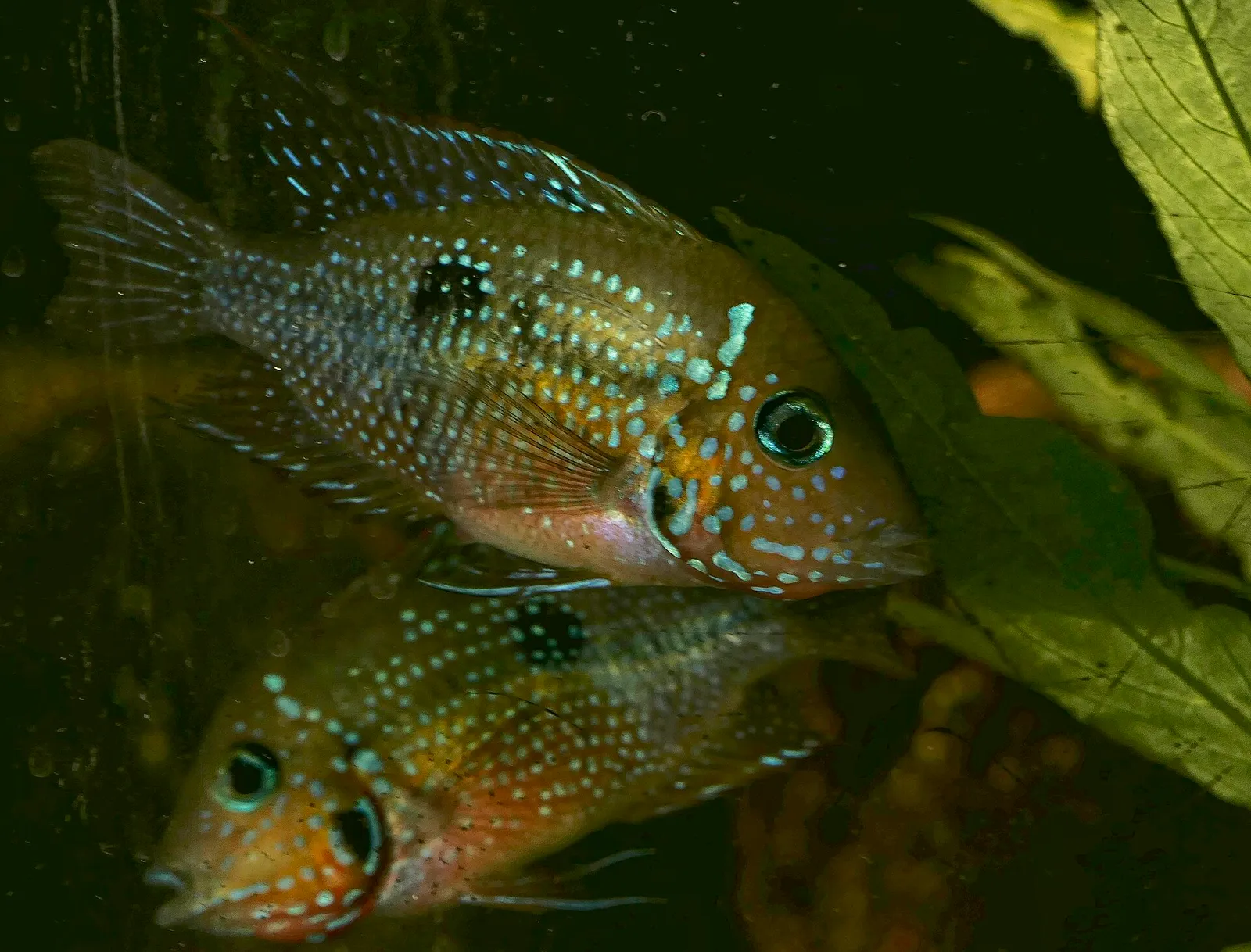
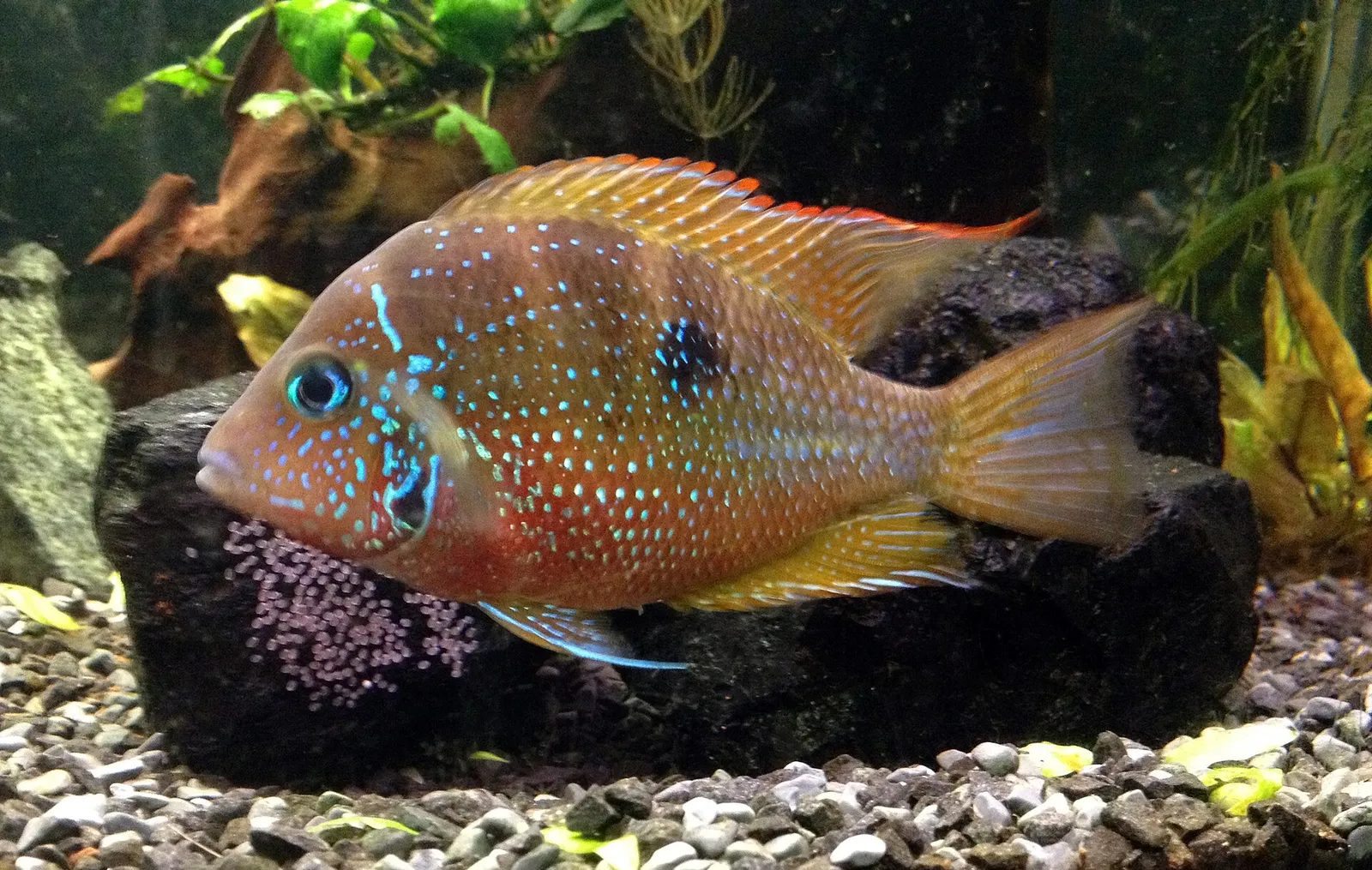
Thorichthys maculipinnis is a deep-bodied, laterally compressed firemouth reaching about 6 in standard length (FishBase). It is one of the brightest members of the genus: the golden to grey-olive body is overlaid with rows of metallic blue-green spangles, the lower head, throat and breast carry a vivid red that approaches the firemouth's in intensity, and — true to its name — the dorsal, anal and caudal fins are spotted and flecked with orange-red and electric blue. Each gill cover bears a dark, light-ringed ocellus used in frontal threat display. A dark midline marking and a caudal-base spot are typically present. Males are larger and develop more produced dorsal- and anal-fin filaments and the strongest colour; females are smaller and rounder. The combination of red breast and heavily spotted fins makes well-coloured specimens conspicuously handsome and is the basis for the species' popularity in the hobby. The species also varies geographically across its Papaloapan range: fish from the Río San Juan Evangelista and its tributaries, in the eastern arm of the drainage, show an intense, distinctive yellow coloration along the scale rows of the flanks, a steeper head profile and a somewhat longer snout, while populations from the western side of the basin — the Río Blanco and separate rivers such as the Jamapa — instead carry more numerous and brighter bluish-green dots across the cheeks and lower flanks.
Habitat
The spotcheek cichlid is endemic to the Río Papaloapan basin on the Atlantic slope of Mexico, spanning parts of Veracruz and Oaxaca. Its known range stretches from the Gulf of Mexico coast in the east inland to the Mexican plateau in the west, and from the volcanic mountain chain and Punta del Morro on the coast in the north down to the watershed of the neighbouring Coatzacoalcos river system in the south. Within that footprint the species occupies the entire Papaloapan lowlands below about 984 ft elevation, occurring in any watercourse that averages above 75 °F — a range spanning the wide main channel of the Papaloapan itself down to affluent creeks barely a metre across and 4 in deep. FishBase describes it as inhabiting the lower and middle river valleys over sandy and rocky substrate, occupying warmer, slower-flowing reaches near cover. Recorded conditions are temperatures of about 77–82 °F and hard, alkaline water — FishBase gives a pH range of roughly 7.0–8.5 and hardness from about 8 °dH upward — consistent with the limestone-influenced lowland rivers of the Papaloapan system. Its restriction to a single drainage gives it a narrower natural range than wide-ranging congeners such as the firemouth, though it remains common within that basin.
Feeding
Thorichthys maculipinnis is a benthic omnivore, foraging over sandy and rocky bottoms by taking in mouthfuls of substrate and sifting out small invertebrates, insect larvae, crustaceans, worms and organic detritus, supplemented by algae and plant matter. The genus's protrusible, slightly down-turned mouth and bottom-grubbing technique suit it to this sifting habit. FishBase places it at a trophic level around 3.3. In the Papaloapan rivers it occupies the small-generalist bottom-feeding niche shared by the other firemouths.
Mating
Like its relatives, the spotcheek cichlid is a monogamous pair-spawner that relies on the genus's spectacular frontal threat display — flared gill covers, presented eyespots and a flushed red throat and breast — to confront rivals and to court mates. Pairs form after mutual display, then choose and clean a spawning surface and defend a surrounding territory, with the male's red breast and spotted fins serving as condition signals. Outside breeding the fish is comparatively peaceful and inclined to bluff. Detailed in-situ behavioural studies are scarce, and most accounts of its mating come from aquarium observation, where it pairs and displays readily.
Breeding
Thorichthys maculipinnis is a biparental open-substrate spawner. A pair cleans a flat rock or shallow pit and deposits a clutch on the order of a few hundred eggs; both parents guard the eggs and then move the hatched larvae to pits in the substrate before escorting the free-swimming fry. FishBase carries fecundity and reproduction data for the species consistent with this moderate clutch size. Parental care is shared through the early fry stage, with the female typically staying closest to the brood while the male patrols the territory. It is a willing and reliable spawner in the aquarium, and a determined pair will raise its own young given suitable cover and water quality.
In the aquarium
The spotcheek cichlid — still widely sold as "Thorichthys ellioti" — is one of the more popular firemouths in the hobby, valued for its red breast and brightly spotted fins. It can be kept and even bred in aquaria as small as 20 US gal, but a keeper aiming to see natural behaviour rather than just survival should not go below about 80 US gal; in cramped quarters the fish falls back on the shy, defensive habits it shows toward larger tankmates, whereas a large tank lets it display and interact normally. Furnish it with a soft sand bed for natural sifting, driftwood and rockwork for cover, and a dither fish or two to help a naturally shy fish settle in and lose its wariness.
Water chemistry is more forgiving than many keepers assume: pH and hardness are not critical for this species, and it thrives across the moderate-to-hard, neutral-to-alkaline range typical of the Papaloapan (FishBase gives roughly pH 7.0–8.5). What genuinely matters is cleanliness — water completely free of ammonia and nitrite — and warmth, around 75–82 °F. As with all Thorichthys, poor water quality quickly shows up as internal or external bacterial infection and head-and-lateral-line erosion, so efficient filtration and regular partial changes are essential regardless of the exact pH or hardness on tap. Feeding needs particular care too: the fish will greedily take almost anything offered, and overfeeding a rich, high-protein diet is an easy mistake with this genus, so a varied diet weighted toward sinking pellets, flake and some vegetable content, with only occasional bloodworm or brine shrimp, suits it better than constant meaty feeding.
Temperament is firemouth-like: generally peaceful outside breeding and reliant on display rather than real aggression, though a spawning pair becomes territorial and will defend its corner. Large, boisterous cichlid companions are best avoided in a normal-sized tank (around 80 US gal), though they present less of a problem once the aquarium is considerably larger. It otherwise mixes well with sturdy, even-tempered tankmates of similar size — larger characins, robust barbs, peaceful catfish and other moderate Central Americans — making it a rewarding and colourful choice for a New World community.
Conservation
The IUCN Red List assesses Thorichthys maculipinnis as Least Concern (assessed 13 August 2018, published 2019). Despite being restricted to the single Papaloapan drainage, the species is common within that basin and is not considered to face species-level threats. Eschmeyer's Catalog of Fishes records it as a Papaloapan endemic of the Atlantic slope of Mexico. Field naturalists working the basin corroborate this from firsthand experience: despite deforestation and heavy pollution across many of the rivers the species inhabits, its existence is not currently considered directly threatened, though that could change if habitat destruction in the region continues to accelerate. The broad pressures on the Papaloapan system — pollution, agricultural runoff, water extraction, habitat modification and introduced species — form the backdrop to its status, and a single-basin endemic is inherently more exposed than a wide-ranging fish; but at present the species is judged secure and abundant within its range.