Taxonomy & naming
Xenotilapia spiloptera was described by Max Poll and Donald J. Stewart in 1975 from specimens collected at Nyika Bay on Nkumbula Island, roughly two kilometres north of Mpulungu at the southern tip of Lake Tanganyika in Zambia, taken in about two metres of water. The genus name blends the Greek xenos, "strange," with thiape, a southern-African word for fish; the species epithet refers to the spotted or blotched fin (Greek spilos, "spot," and pteron, "fin") that marks the dorsal.
There is a small orthographic wrinkle worth flagging, because it surfaces across the literature. Eschmeyer's Catalog of Fishes treats the valid name as Xenotilapia spilopterus Poll & Stewart 1975, noting that the epithet was incorrectly treated as an adjective and re-spelled "spiloptera" by later workers including Marechal & Poll (1991), Takahashi (2003), and Konings. Hobbyists and much of the aquarium trade therefore know the fish as Xenotilapia spiloptera, while the taxonomic authority keeps spilopterus. Both names point to the same species; this article follows the common spelling.
The genus sits within the tribe Ectodini, the sand-dwelling lineage of Tanganyika's cichlid flock — one of the seven seeding lineages that diversified within the lake over the last several million years. Phylogenetic work on the Ectodini suggests their biparental mouthbrooding evolved convergently rather than from a single origin, which makes a modest sand-sifter like this one quietly interesting to evolutionary biologists. Konings splits the genus informally into maternal mouthbrooders and biparental mouthbrooders, but flags that split as a useful first cut rather than a hard rule — some populations blur the line, as documented for the related X. ornatipinnis — so it is best read as describing typical behavior rather than a firm taxonomic boundary.
Morphology
This is a small cichlid, slender and slightly tapered, reaching roughly 3.8 in total length in the measured material on FishBase and around 4 in by the reckoning of field workers and breeders. Males run a touch larger than females, but the sexes are otherwise close enough that telling them apart by eye is genuinely difficult — a recurring complaint among keepers.
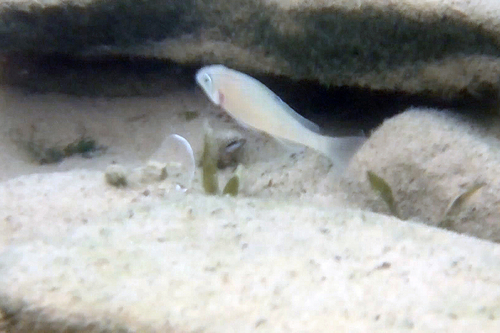
The ground colour is pale and pastel, a light body dusted with iridescent blue speckling, which fits a fish that spends its life over bright sand in the upper, well-lit reaches of the lake. The diagnostic feature is the dorsal fin, which in all known populations of true Xenotilapia spiloptera carries blotchy markings. That detail does taxonomic work: an undescribed sister form known informally as Xenotilapia sp. 'spilopterus north' replaces the blotches with tiny coloured spots, and several authors treat it as a separate species on that basis.
Colour varies by locality, as it so often does in Tanganyika. Populations differ mainly in the dorsal fin — the well-known Lyamembe fish, for instance, show a gold-and-blue dorsal, and a striking yellow variant occurs between Lyamembe and the Lubulungu River. These are the kinds of differences that drive the collector trade in named geographic variants.
Habitat
Xenotilapia spiloptera is endemic to Lake Tanganyika and, within it, to the southern and central basin. The IUCN assessment places it broadly through the southern lake between Moba in the Democratic Republic of the Congo and Kigoma in Tanzania; mapped in more detail, it runs the full Zambian shoreline, north in Tanzania from the Lubulungu River to the Kalambo River, and into the southern Congolese coast at least as far as Tembwe. North of the Lubulungu the related 'spilopterus north' form takes over, and no spiloptera-like fish is currently known from Burundi or the far northern Congo shore.
Its habitat is the intermediate, or transition, zone — the patchy interface where rocky shoreline gives way to open sand, rather than the pure sand flats or the rock face proper. Most accounts put day-to-day activity in the shallow part of that zone, though FishBase records the species across a broad demersal depth band down to about 328 ft. Depth use also splits by breeding status: biparental care carries a cost the genus's maternal mouthbrooders don't pay — a pair must jointly hold and defend one territory for the whole incubation, rather than leaving only the strongest males to guard ground while brooding females disperse into food-safe nursery schools. Field observers link this to a depth pattern, with breeding X. spiloptera typically found deeper than breeding events of the genus's maternal-mouthbrooding species, commonly around 50–130 ft — read as the biparental pair trading the crowded, contested shallows for a less competitive stretch of the reef slope while tied to a single patch of ground. In all of these settings the water is the same hard, alkaline, stable medium that the rest of the lake's fauna is built for: pH around 8.5–9, high mineral content, and very little seasonal swing.
Feeding
Functionally, Xenotilapia spiloptera is a sand-sifter, and the mechanics are the genus signature. The fish takes a mouthful of sand or fine sediment, then expels it through the gill openings, trapping the edible fraction on its gill rakers while the clean grains stream back out. The principal prey is benthic insect larvae living in and on the substrate.
It is not rigidly tied to the bottom, though. The same fish that grub through sand for larvae will, on occasion, gather into large mid-water schools to feed on zooplankton — a flexibility that lets a small predator exploit two very different food sources in the same neighbourhood. FishBase places the species at a trophic level of about 3.2, squarely carnivorous but at the low end of it, consistent with a diet of small invertebrates rather than fish.
In the lake's wider community these sand-sifters do real ecological work, turning over and aerating the sediment as they feed and converting an otherwise hard-to-reach larval crop into fish biomass. Outside the breeding season they live socially in groups, sometimes in sizeable schools, which both improves foraging and dilutes individual risk over the exposed open bottom.
Mating
For most of the year these are schooling fish, ranging over the sand in loose aggregations and showing little aggression. The picture changes as the breeding season approaches — it isn't known whether Xenotilapia spiloptera spawns on a fixed annual schedule or whether some external cue triggers the shift — and the school moves closer to the rocky habitat and splits into pairs. A pair peels off and sets up a small territory in the more structured, rocky part of the intermediate zone — roughly two metres across — which they defend together, overwhelmingly against other members of their own species rather than against the broader community; once a pair actually commits to spawn, the defended area roughly doubles.
Courtship builds gradually, sometimes for days before spawning itself, and both fish develop a subtle tell as it intensifies: dark pigment gathers in the upper and lower part of the iris, forming a black bar across the eye. The mark shows up mostly during spawning or shortly before it, which makes it a plausible readiness signal, though its exact function isn't established.
There is no constructed nest and no fixed spawning pit; eggs are laid within the territory and the exact spot can shift during the act of spawning. The mechanics run opposite to the genus's maternal mouthbrooders, in which male and female circle one another before eggs appear: an X. spiloptera female instead lowers her body to the substrate and deposits a batch of eggs with no apparent signal from the male, who waits close by — about three centimetres above the bottom — until she clears the site. He then positions himself over the eggs to fertilize them in place, and only once he moves off does she return to gather the clutch into her mouth, picking up eggs in bouts and, if her mouth fills before she has cleared the site, shuffling the load to make room for the rest. Pairs form out of the school rather than being assembled by a dominant male holding a lek, and the bond that forms is durable: the same two fish stay together through the long, shared parental effort that follows, which sets this courtship apart from the brief, promiscuous spawnings of the lake's maternal-only mouthbrooders.
Breeding
The breeding mode is the genuinely remarkable part. Xenotilapia spiloptera is a biparental mouthbrooder, one of a relatively small set of cichlids in which both parents carry the brood in turn. The female mouthbroods first, for about 9–12 days, going without food the whole time, then transfers the developing young to the male, who continues to brood for another 6–10 days while she stays at his side. When the male finally releases the fry, both parents guard them in the territory for some weeks afterward.
What prompts the female to hand the brood over is thought to be simple hunger: she fasts for the entire 9–12 days she carries the eggs, and the handoff to the male is presumed to come before she has to resume feeding. Read against the genus's maternal mouthbrooders — where brooding females can take small bites of food partway through incubation and expend far less energy since they needn't also defend a territory — the biparental arrangement looks costly on paper. But in a lake as densely populated as Tanganyika, packing many small paired territories into a compact stretch of reef, rather than spreading solitary males over a wide one, may let a biparental species hold its own at a density the arithmetic of individual cost wouldn't predict.
This relay system is widely read as an evolutionary refinement: by splitting the fast between two adults, neither parent is run down the way a lone maternal brooder would be. Clutch size is typically reported around 40 eggs, with figures up to about 50 cited for the species — a small brood that fits the heavy, divided investment each pair puts into it.
In the aquarium
Among aquarists, Xenotilapia spiloptera has a reputation as the most robust and forgiving member of a genus otherwise known for being delicate — the Xenotilapia people recommend for a first attempt. "Robust" is relative, however. Like its relatives it is sensitive to water quality and to stress, and keepers consistently describe Xenotilapia as easily spooked and as accomplished jumpers, so a tightly covered tank is non-negotiable. Sudden swings in water conditions are a common cause of loss.
Give them a sand bottom; it is essential both for natural feeding and for the courtship and brooding behaviour to unfold. A footprint matters more than sheer volume: a single pair can be managed in a tank around 40 in long, but in any community a length of at least 4 ft is the sensible floor, and breeders comfortable with the fish run them in larger systems still. Water should mirror the lake — pH of 8 and up, hard and alkaline, temperature around 75–79 °F, and nitrate kept low. Because the species is more tolerant of structure than most Xenotilapia, it adapts well to a mixed Tanganyikan community with calm tankmates such as smaller Neolamprologus, Cyprichromis, and shell-dwellers; what it does not tolerate well is its own kind at close quarters once a pair turns territorial, so crowding conspecifics in a small tank invites injury. Start with a group of young (something like ten) to let a pair form, feed a varied menu of small frozen and live foods — cyclops, Artemia, insect larvae, copepods — alongside a good prepared food, and be patient: first spawns often fail before a pair learns the brood-transfer routine, and the fish are slow to mature, reaching adult size at around two years.
Conservation
Xenotilapia spiloptera is assessed by the IUCN Red List as Least Concern (assessed 23 February 2025, assessor L. Mabo of the Lake Tanganyika Fishes group), an upgrade in confidence from its 2006 listing as Data Deficient. The assessment's reasoning is straightforward: the species is endemic to Lake Tanganyika but widely distributed across the southern basin and reported as common at all known sites, with no major widespread threat identified. Its population trend is recorded as unknown. The chief species-specific pressure noted is the aquarium trade — several geographic variants are collected and exported — but that harvest is not considered to threaten the species, and it carries no CITES listing. Localised water pollution, sedimentation from soil erosion, and habitat deterioration are flagged as factors that may affect it in places.
That last point is where this small fish meets the larger story of its lake. Tanganyika is under measurable strain. Sediment-core work by O'Reilly and colleagues (Nature, 2003) found that climate-driven warming has reduced mixing and primary productivity by roughly 20%, implying on the order of a 30% drop in fish yields. A later paleoecological study by Cohen and colleagues (PNAS, 2016) tied lake warming to declines in commercially important fishes and endemic molluscs and to a substantial loss of oxygenated bottom habitat. These pressures sit on top of nearshore sedimentation from deforestation and shoreline development, and the intense clupeid-and-Lates pelagic fishery that feeds four bordering nations, governed jointly through the Lake Tanganyika Authority.
Most of those basin-scale threats fall hardest on the deep benthos and the open-water fishery, not on a shallow sand-sifter of the upper littoral. But Xenotilapia spiloptera is not insulated from them. Its transition-zone habitat is exactly the kind of nearshore substrate most exposed to sediment loading and shoreline disturbance, and its food base of benthic insect larvae depends on a clean, well-oxygenated sand bottom. So the honest summary is the one the IUCN gives: the species itself is Least Concern and locally common, even as the lake it cannot leave is being reshaped by warming, sedimentation, and fishing pressure — a reminder that a stable status line for one fish does not mean the system around it is stable.