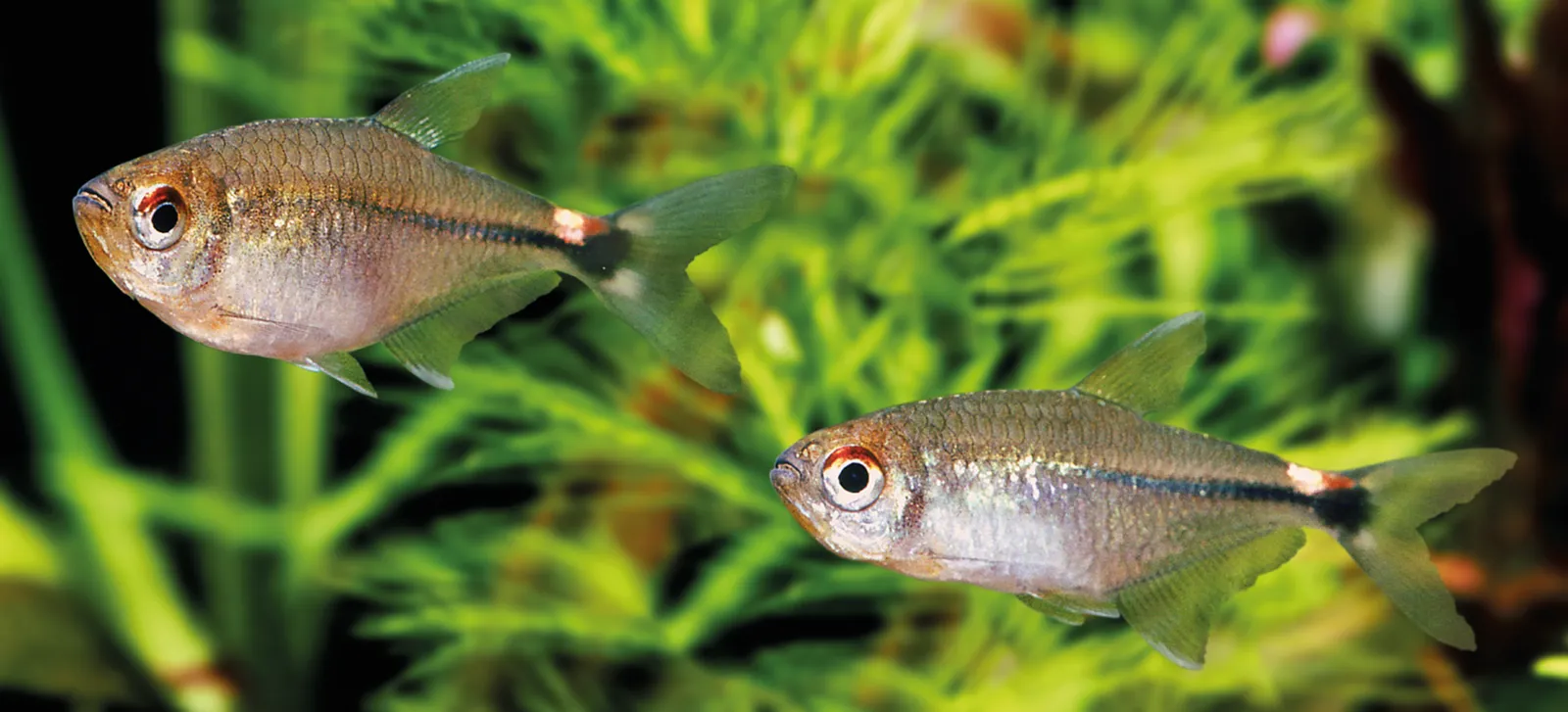
Taxonomy & naming
Holopristis falsa was described by the German aquarist and ichthyologist Hermann Meinken in 1958. The species is placed in the genus Hemigrammus, one of the most speciose characid genera and a persistent taxonomic challenge, as many of its members are difficult to distinguish on external characters alone. The name is treated as valid in the Catalog of Fishes (Eschmeyer, Fricke & van der Laan), and OBIS records the valid combination as Holopristis falsa Meinken, 1958 within Characiformes: Characidae.
FishBase also lists this species under the former combination Holopristis falsa, reflecting the complex synonymy history within Hemigrammus and allied genera; the currently accepted name is Holopristis falsa. A 2015 paper by Zarske (noted in FishBase) contributed to the revalidation of the species. There are no currently recognised subspecies.
This fish was long listed as Hemigrammus falsus; Eschmeyer's Catalog of Fishes now treats that name as a synonym of Holopristis falsa, the valid name followed here.
Morphology
Holopristis falsa is a small, fusiform, laterally compressed tetra in the typical mould of the genus. Exact maximum recorded length is not well established in the literature surveyed, but the species falls within the small-tetra range typical of Hemigrammus — likely in the region of 1–2 in total length, comparable to related species of similar body plan.
Key external characters noted in the FishBase summary include a dorsal fin whose origin sits above or slightly anterior to the mid-body point; the caudal fin carries scales only at its base; a shoulder spot (humeral spot) is absent or only weakly indicated. A longitudinal black band runs along the posterior half of the body from roughly below the dorsal-fin insertion to the caudal spot, and the upper surface of the caudal peduncle shows iridescence. The flanks are otherwise fusiform and moderately compressed, without the deep body depth seen in some related genera.
Habitat
Holopristis falsa is recorded from South America, with distributional records from the Amazon basin and from Surinam. It inhabits freshwater environments and is categorised in FishBase as a benthopelagic tropical species, occupying the lower to mid water column in still and flowing freshwater systems.
Like the majority of Amazonian characids in its size class, it almost certainly favours the soft, acidic to neutral conditions common across much of the lowland Amazon and Guiana drainage systems — blackwater and clearwater streams, floodplain lakes, and marginal vegetation zones. Exact locality data and detailed habitat records for this species are sparse in the accessible literature, and the typical generalised Hemigrammus habitat parameters serve as the best available guide.
Feeding
FishBase assigns Holopristis falsa a trophic level of 3.0, indicating an omnivorous diet of small invertebrates, consistent with the feeding ecology of Hemigrammus broadly. In natural habitats, small characids of this type graze on microcrustaceans, aquatic insect larvae, worms, and organic detritus, with opportunistic feeding on small surface prey.
In the aquarium the species accepts the same range of foods as any small, undemanding Hemigrammus: good-quality dried foods (flake and micro-pellets) form a practical staple, with periodic offerings of small live or frozen invertebrates — Daphnia, newly hatched brine shrimp, micro-worm — improving condition and colour. A varied diet rather than a single food type is advisable for all small characids.
Mating
Holopristis falsa, as a member of Hemigrammus, is expected to follow the egg-scattering open spawning strategy universal in the genus. Males typically display to females with intensified lateral posturing and chasing behaviour, driving females through fine-leaved vegetation or among plant roots where eggs are released.
Spawning is non-seasonal in captivity and can occur continuously under good conditions, with no pair bond formed and no site prepared by either sex. Specific courtship observations for this species are not documented in the literature accessed, but the general Hemigrammus pattern — competitive male pursuit, female scattering adhesive eggs among dense vegetation, no parental recognition of eggs — applies.
Breeding
As with other small Hemigrammus, Holopristis falsa produces adhesive eggs scattered among fine-leaved aquatic plants or synthetic spawning mops. Eggs are small, semi-transparent, and adhesive, attaching to plant leaves and substrate material. Both parents ignore eggs and fry immediately after spawning, and adults will consume eggs if not removed.
Breeding temperatures in the mid-to-upper range of the species' thermal tolerance — around 79–82 °F — are typically used to bring small Hemigrammus into spawning condition. Eggs hatch within 24–48 hours at these temperatures; the yolk-sac fry become free-swimming after a further 2–3 days and require very fine first foods. Specific clutch-size data for this species are not documented in the accessible literature.
In the aquarium
Holopristis falsa is suited to a community aquarium housing small, peaceful fish. As a schooling characid it should be kept in a group of at least six individuals, ideally more, to express natural shoaling behaviour and to reduce timidity. A planted tank with subdued lighting, dark substrate, and some open swimming space provides an appropriate environment.
Water chemistry should reflect the species' South American origin: soft to moderately soft, slightly acidic to neutral water (pH approximately 6.0–7.5) at tropical temperatures around 72–81 °F suits it well. It is not demanding with respect to filtration or current, but good water quality is important given the small body size of the fish. It mixes readily with other small tetras, rasboras, corydoras, and similarly sized peaceful species.
Conservation
Holopristis falsa has not been assessed by the IUCN Red List and carries a status of Not Evaluated (NE). No conservation-specific data for the species — population trends, threat assessments, or protected-area coverage — were located in the sources surveyed.
The Amazon and Surinam drainage systems that the species inhabits face broad-scale pressures from deforestation, agricultural runoff, gold mining, and freshwater pollution, which affect the majority of Amazonian freshwater fish diversity. Without a formal assessment it is not possible to characterise the conservation situation for this species specifically; a targeted survey of its distribution and abundance would be needed to evaluate its status.