Taxonomy & naming
Holopristis ocellifera was originally described by Franz Steindachner in 1882 from material collected in South America, and Eschmeyer's Catalog of Fishes records the authority with parenthetical brackets — (Steindachner, 1882) — indicating the species was placed in a different genus at original description. It has been referred to Hemigrammus for most of its taxonomic history, but FishBase currently lists the species under the name Holopristis ocellifera, reflecting an older placement that some treatments recognize. Seriously Fish and much of the hobby literature continue to use Holopristis ocellifera, and the species page here follows that working name pending a full revision.
Hemigrammus is a large, heterogeneous genus of small characins that functions partly as a repository for species that do not fit neatly elsewhere in the family. Seriously Fish notes that the genus is Incertae Sedis — of uncertain placement — and that with roughly 70-plus species it is overdue for a comprehensive molecular and morphological revision. That unsettled state means the accepted name may change again as the broader Characidae systematics are resolved. For practical purposes, the common names head-and-taillight tetra and beacon tetra identify the species unambiguously in the trade.
This fish was long listed as Hemigrammus ocellifer; Eschmeyer's Catalog of Fishes places the species in Holopristis, and the current combination Holopristis ocellifera is followed here.
Morphology
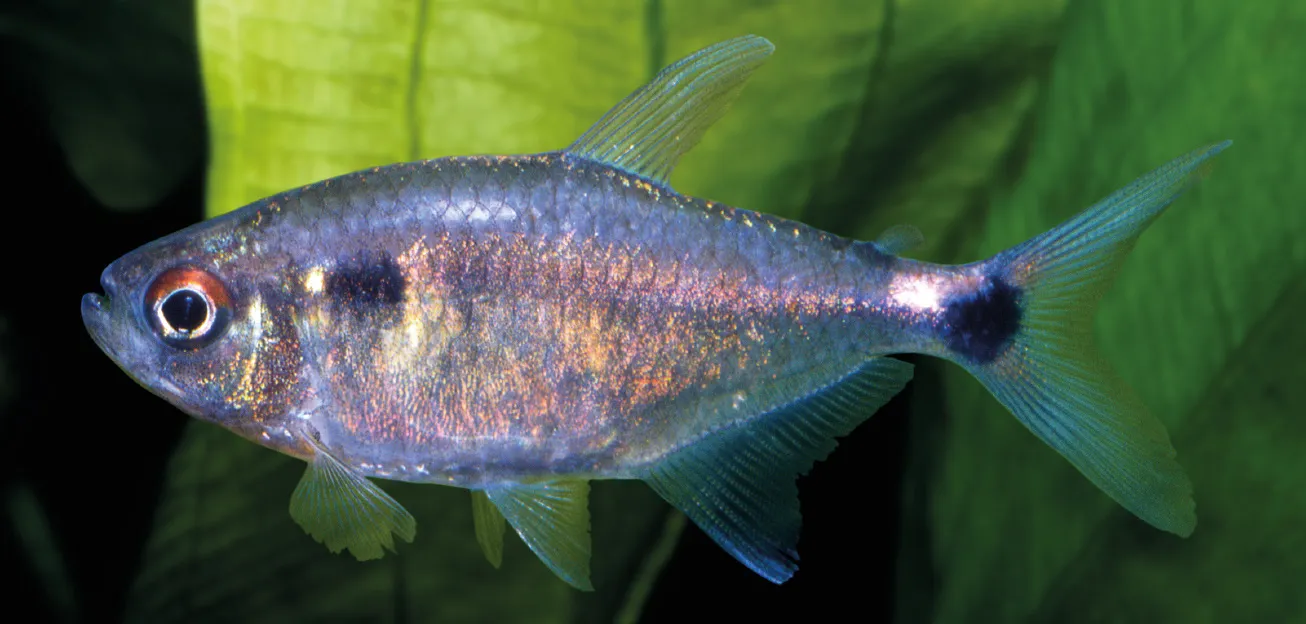
Holopristis ocellifera is a slender, laterally compressed small tetra reaching approximately 2 in standard length (about 2 in total length at maximum). The body is translucent silver, with a faint lateral stripe and a dark shoulder blotch that varies in prominence. The fish's signature marks are a pair of conspicuous ocelli: a copper-gold and red spot above the eye, and a matching spot at the upper lobe of the tail base. In good light and health these spots catch the light like polished brass and account for both common names.
Sexual dimorphism is subtle but consistent. Males are slightly more slender and smaller; females are heavier-bodied and noticeably rounder through the abdomen when in breeding condition. The swim bladder can be used to sex fish held against strong light: it tapers to a point in males but is blunt and rounded in females. Fin shape and colouration are otherwise similar between the sexes.
Habitat
The species ranges widely across lowland northern South America, recorded from Guyana, Suriname, French Guiana, and the Amazon basin of Brazil and Peru. It occupies slow-moving rivers, forest tributaries, floodplain lakes, and associated still waters — the kind of dark, tannin-stained, leaf-littered environments typical of the Guiana Shield and the broader Amazonian lowland system.
Water conditions across this range vary but tend toward soft and acidic in the more interior forest habitats, with harder, more neutral water tolerated in coastal zones and modified environments. FishBase gives pH 6.0–8.0 and hardness 5–19 dH; Seriously Fish notes that colours are best and the species most comfortable below neutral pH, suggesting the soft-water forest streams rather than the harder, seasonally variable coastal reaches represent its preferred habitat. Temperature throughout the natural range runs approximately 72–82 °F.
Feeding
In the wild Holopristis ocellifera is an opportunistic omnivore taking small invertebrates — worms, insect larvae, small crustaceans — along with plant matter and other organic material drifting in the water column or found among leaf litter. Adults forage in groups near the middle and lower water column, though they will rise to the surface for fallen insects.
In captivity the species is straightforwardly easy to feed. It accepts good-quality flake and micro-pellets readily, and the diet can be rounded out with frozen or live bloodworm, Daphnia, brine shrimp, and similar small invertebrates. Live and frozen foods improve colour and bring females into breeding condition faster than a flake-only diet. Like most small tetras it benefits from several small meals throughout the day rather than one large feeding.
Mating
Holopristis ocellifera is an egg-scattering open spawner with no parental care. Courtship is a vigorous, chasing affair: males pursue females through vegetation, flashing their flanks and extending fins to display the glowing tail spot. A receptive female will allow a male to press alongside her and the pair release eggs and milt simultaneously, the adhesive eggs falling or sticking to fine-leaved plants, roots, or substrate.
Spawning activity peaks in the early morning hours, and groups kept in good condition will spawn spontaneously and repeatedly. Because the adults have no parental instinct and will eat their own eggs as readily as any other food, sustained reproduction in a community tank generally yields few surviving fry without intervention.
Breeding
The head-and-taillight tetra is considered one of the easier small tetras to breed deliberately in captivity, which partly explains how it became commercially available in such large numbers. A dedicated breeding setup uses a small tank — around 17.5–23.5 in — with soft, acidic, very clean water: pH 5.5–6.5, hardness below 5°dH, and temperature raised to around 81–82 °F. Fine-leaved plants such as Java moss or synthetic spawning mops provide the egg-laying surface; dim lighting reduces stress and egg predation during spawning.
A conditioned pair or small group is introduced in the evening and typically spawns over the following morning. The adhesive eggs hatch in 24–48 hours depending on temperature; fry become free-swimming roughly three to four days after hatching. First foods are infusoria or commercial liquid fry food, followed by microworm and freshly hatched brine shrimp as the fry grow. Adults should be removed after spawning to protect the eggs. Growth is steady and young fish can be moved to a grow-out tank within a few weeks.
In the aquarium
Holopristis ocellifera is an excellent community fish: peaceful, active, and sociable, it poses no threat to tankmates and is rarely a target of fin-nipping itself. It shows its best colour and most natural behaviour in a group of at least six, and a school of ten or more in a well-planted tank is a genuinely attractive display. A tank of 23.5 in or longer is the practical minimum for a small group; larger volumes allow bigger schools and more stable water chemistry.
Compatible tankmates span most of the peaceful community spectrum: livebearers, danios, rasboras, other tetras, Corydoras, small Loricariids, dwarf gouramis, and dwarf cichlids all co-exist without difficulty. The species adapts well to a range of water conditions given its wide natural range — FishBase allows pH 6.0–8.0 — though it shows the best colours in soft, slightly acidic water with good planting. Captive-bred stock, which makes up virtually the entire trade supply, is robust and tolerates typical tapwater parameters. A selectively bred albino form exists and appears occasionally in the trade.
Decor that echoes its forest-stream habitat — driftwood, dried leaf litter, subdued lighting, and dense planting — brings out natural behaviour and deepens colouration. The species is long-established in the hobby, inexpensive, and reliably available; it remains one of the most sensible choices for a beginner's first planted community.
Conservation
Holopristis ocellifera is assessed as Least Concern (LC) on the IUCN Red List, with the assessment dated 4 March 2021. Its wide distribution across Guyana, Suriname, French Guiana, and the Amazon basin of Brazil and Peru, combined with its tolerance of a broad range of freshwater environments, supports this status. No range-wide population declines or habitat-level threats severe enough to warrant a more precarious listing have been documented.
The species is one of the most commercially significant small ornamental fish in the world. The vast majority of the trade supply is produced by aquaculture operations — particularly in Eastern Europe — rather than wild collection, which considerably reduces pressure on wild populations. This commercial success has made it a model of how a popular aquarium species can be sustainably supplied without significant wild harvest, and its status is unlikely to change in the foreseeable future barring major degradation of Amazonian and Guiana Shield freshwater systems.