Taxonomy & naming
Polypterus endlicherii was described by Johann Jakob Heckel in 1847 and is placed by the Catalog of Fishes in the genus Polypterus, family Polypteridae, order Polypteriformes. The Polypteridae — the bichirs and the reedfish — are the most basal living lineage of the ray-finned fishes (Actinopterygii), an ancient branch that split from all the others deep in the fossil record; they are true "living fossils," carrying a suite of primitive features the rest of the ray-finned fishes long ago lost. Like its relatives it is a bony fish, but a strikingly unusual one.
The species epithet honours Stephan Ladislaus Endlicher, the Austrian botanist and orientalist who directed the Vienna botanical garden and was a contemporary of Heckel's in the city's scientific circles — a common practice of the period, naming a new species after a respected colleague rather than a place or feature. Older literature sometimes split the species into two subspecies: the nominate P. endlicherii endlicherii across the Nilo-Sudanian rivers, and a Congo-basin form, P. endlicherii congicus, that grows considerably larger and is now generally recognised as its own full species, Polypterus congicus. In the aquarium trade this fish is sold simply as the saddled bichir, for the broad, saddle-like blotches across its back.
Morphology
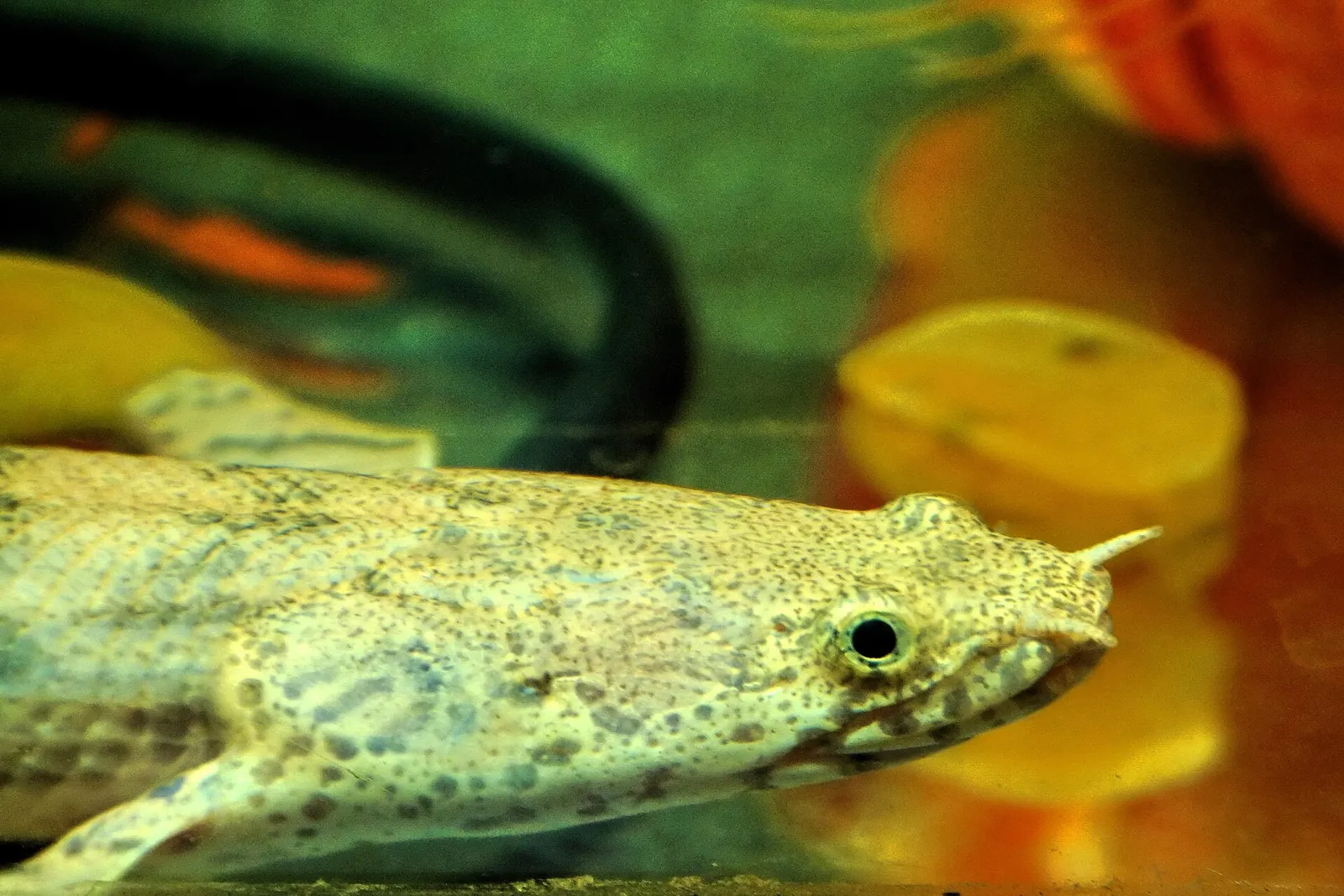
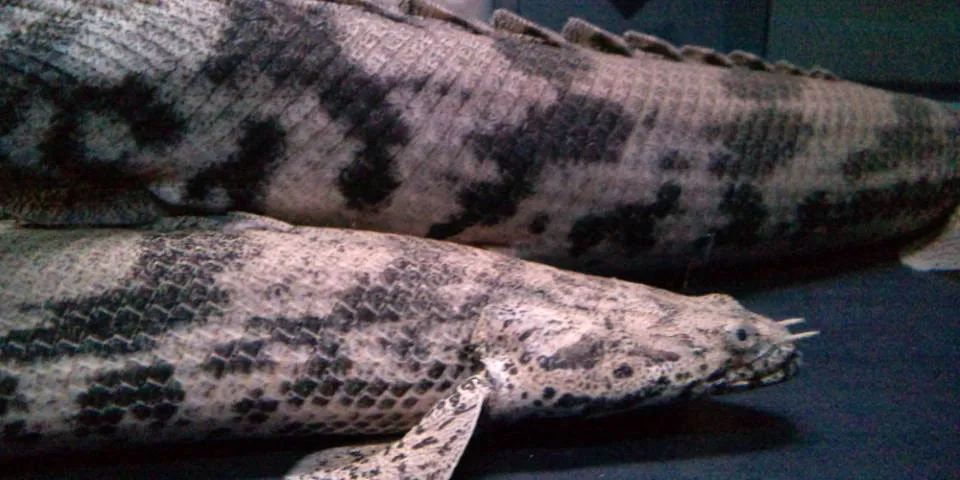
The saddled bichir carries the unmistakable bichir body plan — long, cylindrical, slightly flattened beneath — but in a heavier, more thickset build than most of its relatives, olive to tan above with irregular dark brown to blackish saddle-shaped blotches running down the back and flanks, fading to a pale cream belly. In place of a single dorsal fin it carries a row of separate finlets, each a small spine trailing a flag of membrane; this species typically shows 11 to 14 of them, more than the eight or nine of the smaller Senegal bichir, and finlet count is a useful character for telling bichir species apart. The paired pectoral fins sit on thick, muscular lobes that work almost like limbs, letting the fish prop itself up and shuffle across the substrate. The whole body is sheathed in thick, interlocking ganoid scales — rhombic plates of bone capped with a hard, enamel-like layer — forming a flexible suit of armour.
It is one of the largest species in the genus. FishBase records a maximum of 26 in standard length in the wild, and hobby sources cite total lengths to around 29.5 in for exceptional wild fish, though aquarium specimens typically settle in the 15.5–18 in range, with fish beyond about 22 in distinctly uncommon in captivity. Internally, a pair of primitive lungs opens off the gut behind the gills, letting the fish breathe air at the surface as well as underwater — a bichir cut off from the surface can actually drown. Eyesight is poor, and the fish instead hunts primarily by smell; its larvae, like those of other bichirs, hatch bearing feathery external gills behind the head before these are absorbed with growth.
Habitat
Polypterus endlicherii ranges widely across West and Central Africa, recorded from the Nile, the Lake Chad basin and the Niger, as well as a cluster of smaller Upper Guinea rivers — the Volta, Bandama, Comoé and Ouémé. Across this range it occupies warm, slow-moving freshwater: river channels, floodplain margins, marshes and, in coastal reaches, occasionally brackish water where rivers meet the sea, including mangrove-fringed stretches. It is described as demersal and potamodromous, meaning it lives near the bottom and undertakes migrations within fresh water, likely tied to seasonal spawning.
These floodplain and marsh habitats are exactly where its paired lungs pay off: Sahelian and Sudanian waters run hot and can turn still and oxygen-poor in the dry season, conditions that would suffocate a gill-only fish but that a surface-breathing bichir tolerates readily. The wide geographic spread of the species across several major river systems, rather than confinement to one basin, is a large part of why it is assessed as being of no particular conservation concern.
Feeding
The saddled bichir is a carnivore and a nocturnal ambush predator of the bottom. With weak eyesight but an acute sense of smell, it cruises slowly after dark, locating prey by scent before seizing it with a quick sideways snap of the jaws. In the wild its diet is opportunistic — aquatic insect larvae, worms, crustaceans, molluscs, amphibians and any fish small enough to overpower — and the same rule applies in captivity: if it fits in the mouth, it is potential food.
In the aquarium it takes meaty foods readily, including earthworms, prawn, mussel and whole fish or frozen bloodworm, and many individuals learn to accept sinking pellets over time. Because it hunts by smell and moves deliberately, it can lose out to fast, greedy tankmates at feeding time, so meals are often best offered after dark or dropped near where the fish is resting.
Mating
As in other bichirs, reproduction begins with a nudging courtship in which the male follows and noses the female before the pair settle near cover to spawn. The male then cups his anal and caudal fins into a shallow pouch, and the female releases a small batch of eggs into it at a time; the male fertilises them there before they are released, adhesive and sticky, onto plants and the substrate. The sequence is repeated many times over the course of the spawning bout.
The sexes are distinguished chiefly by this spawning apparatus, with mature males showing a broader, thicker anal fin than females — the same dimorphism seen across the genus. There is no lasting pair bond and no territory defence; the relationship ends once the eggs are laid.
Breeding
Polypterus endlicherii is an egg-scatterer with no parental care: the small, adhesive eggs are simply left among plants and across the substrate, and the adults take no further interest in them — indeed they will eat both eggs and fry if given the opportunity. The eggs hatch in roughly three to four days, and the resulting fry become free-swimming shortly afterward, feeding on microscopic live foods as they grow.
Deliberate breeding in home aquaria is rarely achieved; spawning is generally believed to need seasonal or flood-like cues that are hard to replicate in a tank. Unlike the Senegal bichir, which is now widely farmed, the saddled bichir is very rarely produced commercially, and essentially all specimens in the aquarium trade are still wild-caught from West and Central Africa.
In the aquarium
The saddled bichir is a fish for an experienced keeper with real floor space to offer: given its adult size, a tank in the region of 250 US gallons (roughly 250 US gal) or more is recommended, furnished with a soft substrate, driftwood and cave-like hides, and kept dim to suit a nocturnal hunter. It tolerates a fairly wide range of water chemistry, from about 72–81 °F and pH 6.0 to 8.0, and its ganoid armour makes it noticeably tougher and more forgiving of medications than scaleless catfishes.
Two points matter above all else. First, the lid: bichirs are determined escape artists that will exploit the smallest gap, and a fish found dried out on the floor is the most common way keepers lose them — the aquarium must be fully and tightly covered while still leaving an air gap at the surface for the fish to breathe. Second, tankmates: this is a genuine predator that will swallow anything small enough to fit in its mouth, so companions need to be too large to eat and robust enough to share space with it — large cichlids, arowana, Synodontis catfish and knifefish are commonly cited as compatible, while anything small is at risk. Given these accommodations, the saddled bichir is hardy and long-lived, with a captive lifespan commonly cited at ten to fifteen years or more.
Conservation
Polypterus endlicherii is assessed as Least Concern on the IUCN Red List, an assessment made around 2019 to 2020 by Lalèyè, Entsua-Mensah and Getahun. The species is widespread across multiple major West and Central African river systems — the Nile, Niger, Lake Chad basin and several Upper Guinea rivers — with stable populations reported across its range and no major documented threats.
That broad distribution and lack of dependence on any single river system gives it more resilience than narrow-range bichir species, though the West African floodplains and wetlands it relies on are not immune to pressures such as damming, water abstraction and habitat drainage seen elsewhere in the region. Because captive breeding of this species remains rare, the aquarium trade continues to draw on wild populations, making the accuracy of future range-wide assessments worth watching even though the species faces no current elevated risk.