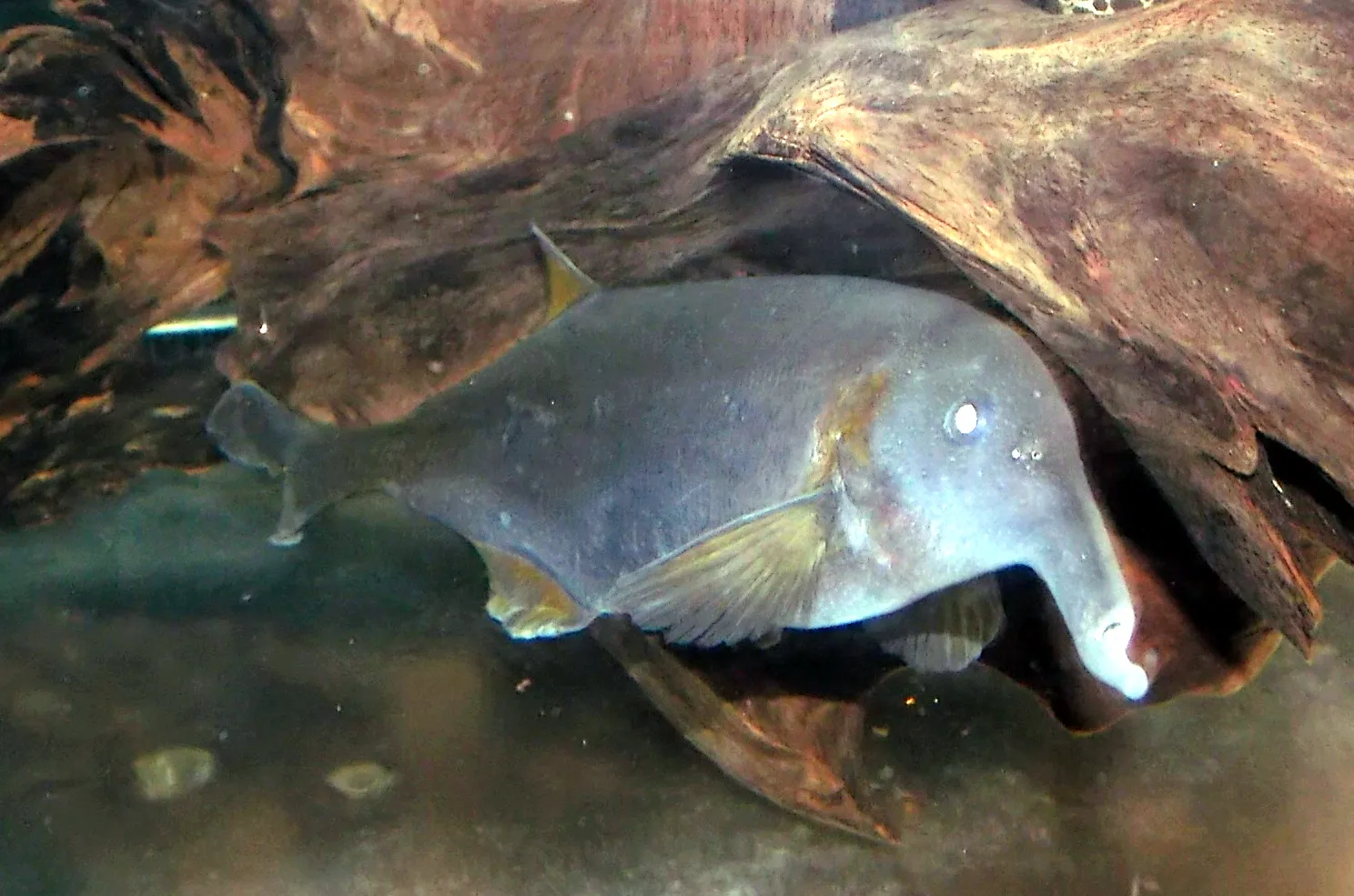
Taxonomy & naming
Campylomormyrus rhynchophorus was described by the Belgian-British ichthyologist George Albert Boulenger in 1898. It belongs to the family Mormyridae — the elephantfishes or mormyrids — within the order Osteoglossiformes, the bonytongues, one of the most ancient lineages of living ray-finned fish and a group that split into separate radiations on four continents deep in geological time. The family's diagnostic feature, and the one that gives the whole order its name, is a bony, toothed structure on the floor of the mouth (the "tongue") that bites against a matching toothed plate on the roof — a jaw-within-a-jaw unrelated to the true tongue of other vertebrates.
The genus name Campylomormyrus combines the Greek kampylos, "curved, bent", with Mormyrus, the type genus of the family and itself an old Greek fish name, referencing the down-curved, trunk-like snout shared by most species in the genus. The specific epithet rhynchophorus derives from the Greek rhynchos, "snout" or "beak", and -phoros, "bearing" — literally "snout-bearing", a fitting name for a fish whose elongated nose is its most obvious feature. Campylomormyrus is a Congo-basin genus of more than a dozen species that are notoriously difficult to separate on external appearance alone; in this genus, as in mormyrids generally, the electric organ discharge (EOD) is often the most reliable way to confirm identity, so field and museum identifications should be treated with some caution. The name Campylomormyrus compressirostris is treated as a synonym of this species in Eschmeyer's Catalog of Fishes.
Morphology
Campylomormyrus rhynchophorus has the elongated, laterally compressed body typical of the Mormyridae, with a small, nearly toothless mouth set beneath a long, curving snout — the feature that gives the genus its common "elephantnose" name and this species its trade names. The body is a plain blackish-brown to grey-brown without bold pattern, and the dorsal and anal fins sit far back on the body opposite one another ahead of a deeply forked caudal fin, a build shared across the family and suited to the slow, often reverse-swimming style that lets a mormyrid read its own electric field without disturbing it.
Like other mormyrids, it carries a weak electric organ in the caudal peduncle, built from modified muscle cells (electrocytes), that fires a species-specific, pulse-type electric organ discharge (EOD). Its head and body are described as densely set with electroreceptors for sensing that field, letting the fish electrolocate prey, obstacles and other fish in dark water despite small eyes and modest vision. Mormyrids as a group are also known for having among the highest brain-to-body mass ratios of any fish, driven largely by an enormously enlarged, elaborately folded cerebellum that processes the constant stream of electrosensory input — the family's reputation as a "thinking fish" in the literature. Reported maximum size for C. rhynchophorus is a modest 8.5 in total length (FishBase), making it one of the smaller members of its genus.
Habitat
Campylomormyrus rhynchophorus is native to the Congo River basin in Central Africa, recorded from Cameroon, the Democratic Republic of the Congo and Angola. It is a demersal, bottom-associated fish, living close to the substrate rather than in open water.
FishBase records water conditions of roughly 72–75 °F and an acidic pH around 5.0 — soft, warm water, and almost certainly tannin-stained given the wider Congo basin's blackwater-influenced tributaries, the kind of dim, low-visibility habitat in which an electric sense is most valuable for finding food and avoiding obstacles. As with much of the Congo basin's fish fauna, detailed, site-specific habitat descriptions for this species are sparse in the available literature.
Feeding
Like other elephantnose-type mormyrids, C. rhynchophorus is a benthic forager, most active at dusk and after dark, hunting soft-bodied invertebrates — insect larvae, worms and small crustaceans — buried in sediment or hidden among detritus, which it locates by electrolocation rather than by sight.
In the aquarium it should be offered live or frozen invertebrate foods — bloodworm, brine shrimp and similar sinking, meaty items — matching its natural diet; it will not do well on flake or pellet food alone. As a nocturnal forager it often feeds best once the tank lights are off, particularly in a community setting where it may otherwise be out-competed.
Mating
Mating in the mormyrids is built around the electric organ discharge: the EOD is thought to function in courtship and species recognition, letting a fish identify a potential mate of the correct species by waveform alone in water too dark or turbid for visual cues to work. Beyond that general picture, the courtship and spawning behaviour of Campylomormyrus rhynchophorus specifically has not been documented in the available sources; wild mormyrid reproduction is generally understood to track seasonal, flood-driven cues, but the particulars for this species are simply not known.
Aquarium accounts of this fish also note that it does not tolerate other mormyrids well, which further limits any chance of observing courtship or spawning behaviour in a mixed-mormyrid tank; it is generally kept as the only elephantnose in the aquarium rather than alongside potential mates.
Breeding
Campylomormyrus rhynchophorus has essentially not been bred in the aquarium, and mormyrid reproduction as a whole remains poorly understood even in the wild. What is known of the family points to seasonal, flood-triggered spawning, with the electric organ discharge playing some role in mate recognition, and some mormyrids are thought to guard eggs among vegetation — but no such account exists specifically for this species.
There is no established captive-breeding protocol to describe, and aquarists should not expect to breed this fish; virtually all specimens reaching the trade are wild-caught. This is typical of the genus and family rather than a peculiarity of this particular species.
In the aquarium
Campylomormyrus rhynchophorus is a specialist's fish best suited to an experienced keeper. Its long, sensitive snout is used to probe the substrate for food, so a soft, fine sand or smooth fine-gravel bottom is important — coarse or sharp material can injure it. It appreciates a dim, shaded tank with plenty of plants, wood and shadowed retreats rather than bright open water, echoing the low-visibility habitat it comes from, and does best offered live or frozen invertebrate foods after dark.
Two care points matter most. First, like other scaleless, electroreceptive fish, it is unusually sensitive to copper-based medications and to formalin, both of which should be avoided or dosed with great caution. Second, it is not compatible with other mormyrids and is best kept as the sole elephantnose in the aquarium, though sources describe it as tame and approachable toward other fish once it has settled in. At a modest 8.5 in maximum length it does not present the size trap of the larger bonytongues, but its sensory sensitivity and specialised diet still make it a considered purchase rather than a casual community addition.
Conservation
The IUCN Red List assessed Campylomormyrus rhynchophorus as Least Concern, per FishBase, in an assessment dated 2009. FishBase further notes the species has high resilience, with a population able to double in under 15 months — a sign of a fish not currently under serious pressure.
As a Congo basin species recorded across Cameroon, the Democratic Republic of the Congo and Angola, it is not considered globally threatened at present, though — as with much of the Congo basin's still poorly surveyed fish fauna — comprehensive population data are limited, and long-term basin-wide pressures such as deforestation, sedimentation and localised overfishing remain the relevant concerns for Congo basin fishes generally.