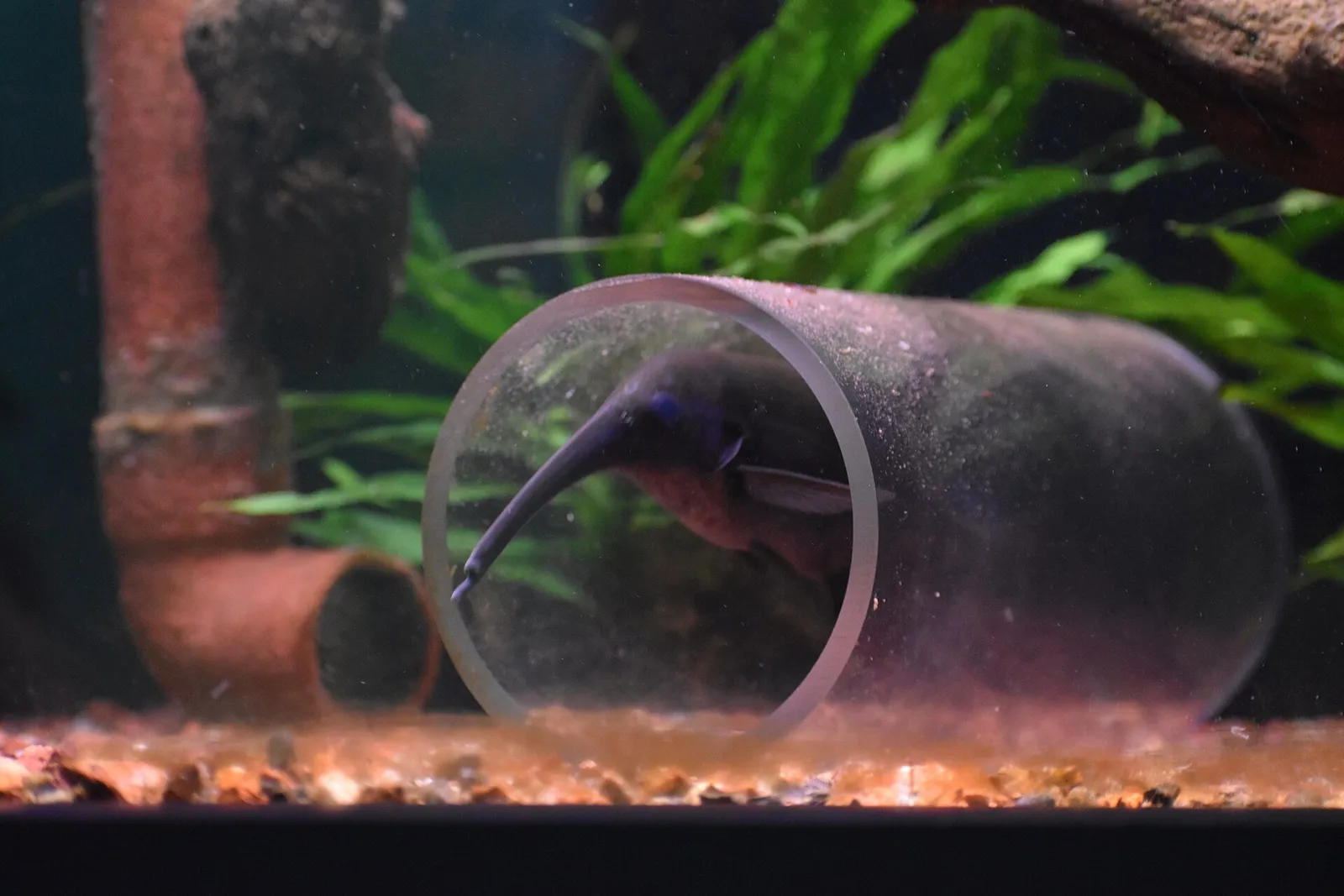
Taxonomy & naming
Campylomormyrus numenius was described by the Belgian-British ichthyologist George Albert Boulenger in 1898, part of the wave of Congo basin fish descriptions from that era of European exploration of Central Africa. It belongs to the family Mormyridae within the order Osteoglossiformes — the bonytongues, an ancient teleost lineage named for a toothed bone on the floor of the mouth that bites against a toothed plate on the roof, and one that split into a scattered, deep-time radiation across South America, Africa, southeast Asia and Australasia long before most modern fish families existed. Within Mormyridae, the genus Campylomormyrus comprises a dozen-plus Central African species distinguished less by outward appearance than by their electric organ discharge (EOD) — visually similar Campylomormyrus species are often reliably told apart only by the shape of their species-specific electric pulse, and the Catalog of Fishes (Eschmeyer, CAS) treats Campylomormyrus numenius as the currently valid name.
The genus name Campylomormyrus combines Greek kampylos, "curved, bent", with mormyrus, the old fish name behind Mormyrus and the family Mormyridae, and describes the elongated, downward-curving snout shared by the genus's members. The species epithet numenius echoes the Greek noumenios, "curlew" — a shorebird known for its long, down-curved bill — and most likely alludes to this species' own elongated, downward-arcing trunk-like snout, a naming pattern seen elsewhere in the genus.
Morphology
Campylomormyrus numenius has the elongated, laterally compressed body typical of Mormyridae, but its defining feature is the snout: a long, downward-curving, trunk-like extension of the head tipped with a small mouth, used to probe the substrate for hidden prey. That curved-snout profile is what separates Campylomormyrus from short-snouted relatives such as Gnathonemus. FishBase records 31 dorsal soft rays and 35 anal soft rays, with the single dorsal fin set well back on the body opposite the long-based anal fin and a deeply forked caudal fin — the standard elephantnose fin plan. Maximum recorded size is 25.5 in total length, making this one of the larger species in its genus and a fish that needs to be sized for accordingly.
As in all mormyrids, a weakly electric organ sits in the caudal peduncle and generates a continuous, species-specific pulse-type EOD, sensed by electroreceptors spread across the skin. Processing that constant stream of electrosensory information is handled by a greatly enlarged cerebellum (the valvula cerebelli), which is why mormyrids as a group post some of the highest brain-to-body-mass ratios of any fish. A scientific study of the genus's EOD found that Campylomormyrus numenius has a distinctive EOD ontogeny — the juvenile discharge differs measurably from the adult discharge as the fish grows, with adult EOD durations reaching around 25 milliseconds — underscoring how central the electric signal is to identifying and distinguishing this species from its close relatives.
Habitat
Campylomormyrus numenius is known from the Congo River basin of the Democratic Republic of the Congo, recorded from Pool Malebo (Stanley Pool), the middle Congo River and its tributaries, and the Lualaba. FishBase lists it as demersal and occurring only in large rivers rather than small streams or floodplain lakes, in warm, tropical water in the roughly 72–77 °F range.
No pH measurement for this species is available in the sources reviewed here, so a specific value should not be assumed. As a general guide, the Congo basin's big-river channels that this species inhabits tend to run soft, only mildly mineralised, and often tannin-stained or turbid with suspended sediment — the kind of dim, low-visibility water in which an electric sense for navigation and prey-finding is a genuine advantage over vision alone.
Feeding
Campylomormyrus numenius forages by probing soft substrate with its long, curved snout, rooting through sediment to locate hidden prey — a foraging style shared across the long-snouted mormyrids and one thought to combine tactile search with the fish's electrosense for detecting buried invertebrates. FishBase records a moderate trophic level (3.3), consistent with a benthic invertebrate feeder rather than a specialised piscivore.
In the aquarium, imported specimens are described as finicky eaters at first, needing time to settle before they will feed reliably, but they go on to accept frozen bloodworm and mysis shrimp once acclimated. Because it feeds by rooting through the bottom, it does best over soft substrate with food offered where it can be located by probing rather than competed for at the surface, and it should be kept with calm tankmates that will not out-compete a slow, still-settling new arrival.
Mating
Wild reproductive behaviour has not been documented for Campylomormyrus numenius specifically — FishBase notes plainly that its breeding behaviour is unrecorded. As in mormyrids generally, courtship is thought to be built around the electric organ discharge: the EOD literature reviewed here confirms that Campylomormyrus numenius's discharge functions in species recognition and intraspecific communication, the electrical equivalent of a species-specific call used to find and identify appropriate mates in murky water where visual signalling is of limited use.
Beyond that electrical role, almost nothing concrete is known about how, when, or where this species spawns in the wild. Mormyrids as a family are generally thought to be seasonal, flood-pulse-triggered spawners tied to the rainy-season rise of their rivers, but no species-specific account of that cycle exists for C. numenius in the sources available, and any statement about pairing, courtship display or spawning site here would be speculation rather than fact.
Breeding
Campylomormyrus numenius is essentially unknown to have been bred in captivity. It is rarely imported to begin with, the aquarium supply is wild-caught, and no aquarium breeding record or protocol appears in the sources reviewed — as is true for the great majority of mormyrids, which remain among the most poorly understood aquarium fish when it comes to reproduction.
The one documented developmental detail concerns the electric organ rather than spawning itself: juvenile Campylomormyrus numenius produce an EOD waveform that differs from the adult discharge, changing as the fish matures. Parental care, if any exists in this species, is not described anywhere in the literature reviewed; it should be treated as unknown rather than assumed. Prospective keepers should not expect to breed this fish and should source it only as a wild-collected specimen.
In the aquarium
Campylomormyrus numenius is rarely imported and, by the account of aquarium importers, challenging to maintain — a fish recommended for experienced keepers only, not a beginner's community addition. It needs clean, well-oxygenated water with strong filtration and a decent current to mimic its big-river origins, and newly imported fish are often finicky eaters that take time to settle onto frozen bloodworm and mysis. Like other scaled but electrosensitive mormyrids, it is noted as sensitive to metal-containing medications, so copper-based treatments and similar remedies should be avoided or dosed with particular caution.
Size is the other major consideration: at up to 25.5 in total length this is a large, long-lived fish that will eventually need a correspondingly large tank, not the modest setup that might suit a small elephantnose. It is described as suited to peaceful tankmates rather than an aggressive community, though — as with mormyrids generally — its behaviour toward its own species is not well documented here and should not be assumed to be sociable without direct observation. Dim lighting, soft substrate for rooting, and cover to retreat to during the day suit its natural foraging habits best.
Conservation
The IUCN Red List classifies Campylomormyrus numenius as Least Concern, an assessment most recently confirmed in the 2009–2010 review cycle; it is not considered threatened with extinction. FishBase assigns it a moderate vulnerability-to-fishing score (46 out of 100), reflecting some inherent susceptibility to overfishing pressure typical of larger, slower-maturing river fish, without indicating an active population decline.
As a Congo basin big-river specialist restricted to Pool Malebo, the middle Congo and the Lualaba, its longer-term outlook is tied to the health of those river systems — sedimentation, damming, and fishing pressure are the generic threats facing Congo basin fish communities — but nothing in the sources reviewed here points to a specific documented threat to this species beyond its current Least Concern status.