Taxonomy & naming
Campylomormyrus elephas was described by the Belgian-British ichthyologist George Albert Boulenger in 1898, from material collected at Upoto, near Lisala on the Congo River in what is now the Democratic Republic of the Congo — the species' type locality. It belongs to the family Mormyridae within the order Osteoglossiformes, the bonytongues — one of the oldest living branches of the teleost fishes, a scattered, deep-time radiation found today across four continents (South America, Africa, Southeast Asia and Australasia) and united not by shared modern habitat but by that toothed lingual bone. The Mormyridae are an exclusively African family of several hundred weakly electric species; despite a superficial resemblance, they are entirely unrelated to the electric knifefishes of South America (Gymnotiformes) — the two lineages evolved similar electric senses independently, on opposite sides of the Atlantic, and should never be conflated.
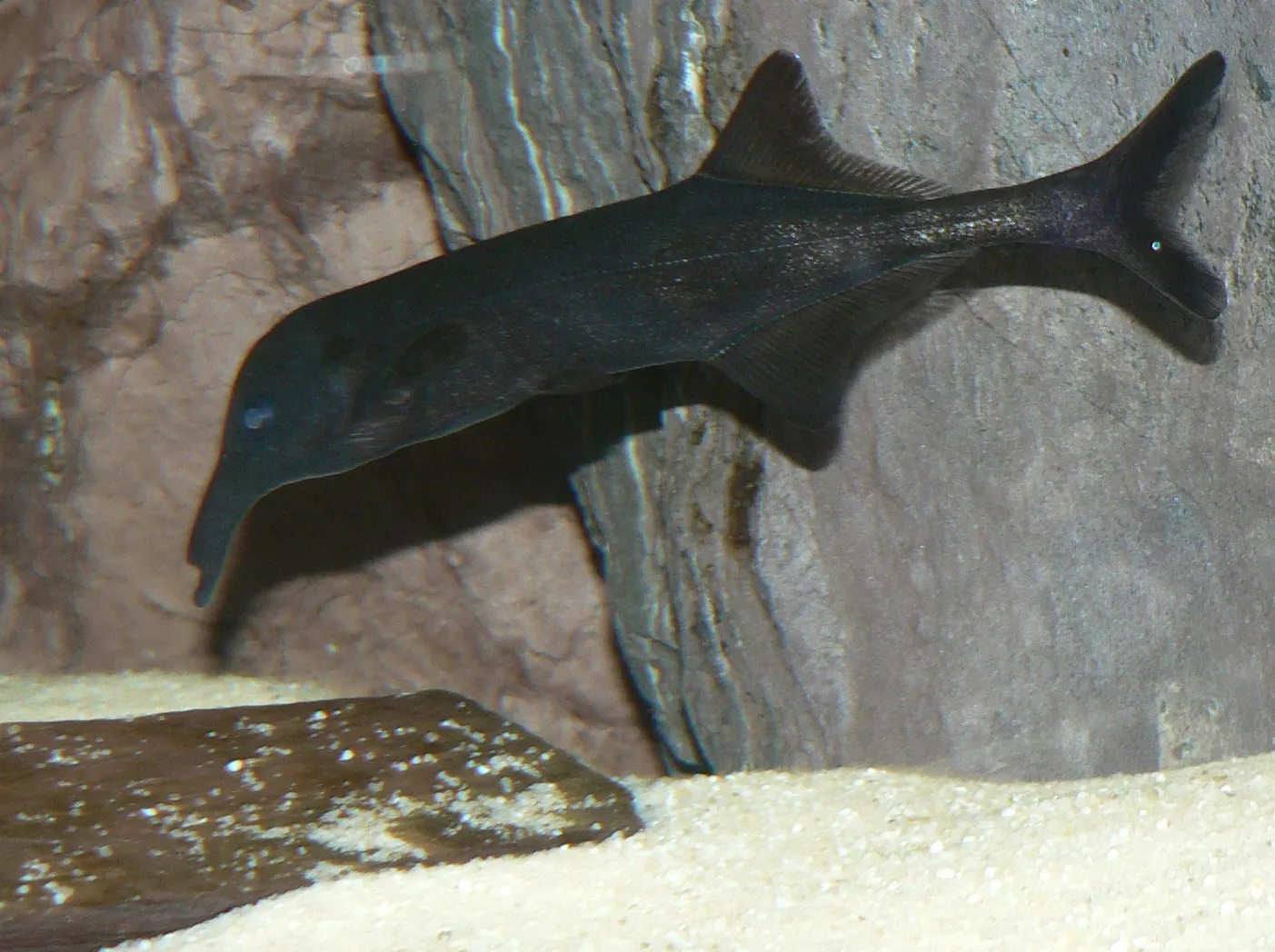
The genus name Campylomormyrus combines Greek kampylos, "curved" or "bent", with the older mormyrid genus name Mormyrus, and refers to the elongated, often downcurved snout that characterises many species in the genus. The species epithet elephas is Greek/Latin for "elephant", most plausibly a reference to the fish's own elongated, trunk-like snout — an image Boulenger reached for more than once in this genus, naming other long-snouted Campylomormyrus after mammals with prominent trunks or noses (compare C. alces, "elk/moose", and C. tamandua, named for the anteater). As with those names, Boulenger left no explicit explanation on record, so this reading should be taken as a reasonable inference rather than a documented fact.
Campylomormyrus has become something of a model genus in electric-fish research: many of its species are visually similar to one another and to species in related genera, and are reliably distinguished only by their species-specific electric organ discharge (EOD) waveform. As with other mormyrids, any identification of C. elephas based on appearance alone should be treated with appropriate caution.
Morphology
Campylomormyrus elephas reaches a reported maximum of about 15.5 in total length, placing it among the larger members of its genus. Like other Campylomormyrus its snout is drawn out into an elongated, often downcurved, tube-like extension of the jaws — a bony and cartilaginous structure rather than the soft, fleshy chin appendage (the Schnauzenorgan) seen in the unrelated genus Gnathonemus, though it serves a broadly similar function in probing soft substrate for buried prey.
As in every mormyrid, a specialised electric organ near the base of the tail generates a weak, pulse-type electric organ discharge (EOD) used for electrolocation and communication. Because that discharge is species-specific, it functions almost like an acoustic signature, and mormyrids as a group carry an outsized cerebellum and among the highest brain-to-body ratios of any fish — the physiological cost of running a constantly active electrosensory system. Detailed external colouration and finer morphological description for C. elephas are sparse in the available literature; the species is defined largely by its type description and FishBase's summary figures rather than by a well-illustrated field account.
Habitat
Campylomormyrus elephas is known from the Congo River basin, with records from the Democratic Republic of the Congo and extending into Angola; its type locality is Upoto, near Lisala on the upper Congo. It is a benthic, freshwater fish, a lifestyle shared across the family: active along the bottom, using electrolocation rather than eyesight to navigate and hunt in the turbid, sediment-laden water of the basin.
FishBase records the species' tropical freshwater, demersal habitat at roughly 79–82 °F. Beyond that baseline temperature figure, pH and finer habitat detail — flow, substrate, cover — are not documented for this species in the available sources; other Congo basin Campylomormyrus favour soft, acidic, tannin-stained water, but that specific figure has not been confirmed for C. elephas.
Feeding
Detailed wild diet has not been specifically documented for Campylomormyrus elephas. Like other mormyrids it almost certainly forages along the bottom, using its elongated snout together with active electrolocation from the tail's electric organ to locate small invertebrates buried in sediment, rather than hunting by sight.
General elephantnose and mormyrid husbandry accounts describe the group as insectivorous, taking mosquito larvae, bloodworm and tubifex-type prey, foraging mostly after dark. That pattern is a reasonable guide for this species but should be read as inference from the wider family rather than an observation specific to C. elephas.
Mating
Courtship and species or sex recognition in mormyrids runs substantially through the electric organ discharge rather than through visual display, and the pulse waveform is thought to carry information about species identity, sex and reproductive readiness. Beyond that general pattern, essentially nothing specific has been documented about courtship behaviour in Campylomormyrus elephas. Mormyrids as a group are thought to be seasonal, flood-triggered spawners, with reproductive activity tied to the rains and rising water of the African wet season, but the details — courtship sequence, spawning site, any pair-bonding — have not been described for this species.
Data on this fish's reproductive ecology are genuinely sparse; what is stated here reflects general mormyrid biology extended cautiously to a poorly studied relative, not observations specific to C. elephas.
Breeding
Mormyrids as a group are essentially not bred in aquaria and remain poorly understood in captivity, and Campylomormyrus elephas is no exception — there is no documented record of it being spawned in captivity. Wild spawning is presumed to be seasonal and flood-triggered, and the species-specific EOD likely plays some courtship or mate-recognition role, but nest site, egg-laying behaviour and any parental care have not been reliably documented for this species. Some mormyrids are thought to guard eggs among vegetation, but this has not been confirmed here.
Given how rarely this fish is even seen in the trade, any claim of captive breeding for C. elephas should be treated with strong scepticism absent solid documentation.
In the aquarium
Campylomormyrus elephas is not an established aquarium fish; it does not appear to be part of the regular ornamental trade, and no husbandry account specific to this species is available. The general principles that apply to elephantnoses and mormyrids as a family are the safest guide where a specimen is ever encountered: a dimly lit aquarium with stable water quality, hiding places, and minimal turbidity or current stress. Mormyrids are typically intolerant of being kept alone and can show aggression toward their own kind, so a suitably sized group (or careful single specimen with unrelated tankmates) is the usual recommendation, at a tropical 79–82 °F matching the wild temperature range.
At a reported maximum of around 15.5 in total length this is also a large fish that would need a substantial, mature tank, not a casual community addition. Mormyrids are notably sensitive to poor water quality and to many aquarium medications, particularly copper-based treatments, so any dosing should be conservative. Given the near-total absence of documented captive care and the size involved, C. elephas is best regarded as a public-aquarium or specialist-only prospect rather than a fish for the general hobby.
Conservation
The IUCN Red List assesses Campylomormyrus elephas as Least Concern, an assessment dated 16 February 2009, with no specific threats documented against the species.
Available conservation literature on the species is sparse, consistent with its status as a Congo basin endemic that has attracted little targeted research. As with many Congo basin fishes, the main long-term pressures are generic rather than species-specific — habitat degradation, sedimentation and water-quality decline across the river system — rather than any documented decline specific to this species. The Least Concern rating should be read as reflecting limited evidence of threat within a data-sparse picture, not as a thoroughly confirmed clean bill of health.