Taxonomy & naming
Gnathonemus petersii was described by the German-British ichthyologist Albert Günther in 1862. It sits in the family Mormyridae within the order Osteoglossiformes, the bonytongues — a scattered, deep-time radiation of fishes found on four continents (South America, Africa, Southeast Asia and Australasia) and united by that toothed lingual bone rather than by any shared modern habitat. The Mormyridae themselves are an exclusively African family of several hundred species, all weakly electric, and entirely convergent with — not related to — the electric knifefishes of South America (Gymnotiformes); the two groups evolved similar electric senses independently on opposite sides of the Atlantic.
The genus name Gnathonemus derives from Greek gnathos, "jaw", and nema, "thread", a reference to the slender, thread-like extension of the lower jaw that forms the fish's signature chin organ. The species epithet petersii honours the German naturalist Wilhelm Peters. Many mormyrids are superficially similar to one another and are reliably told apart only by their species-specific electric organ discharge (EOD), so identifications based on appearance alone — including some aquarium-trade fish sold as G. petersii — should be treated with appropriate caution.
Morphology
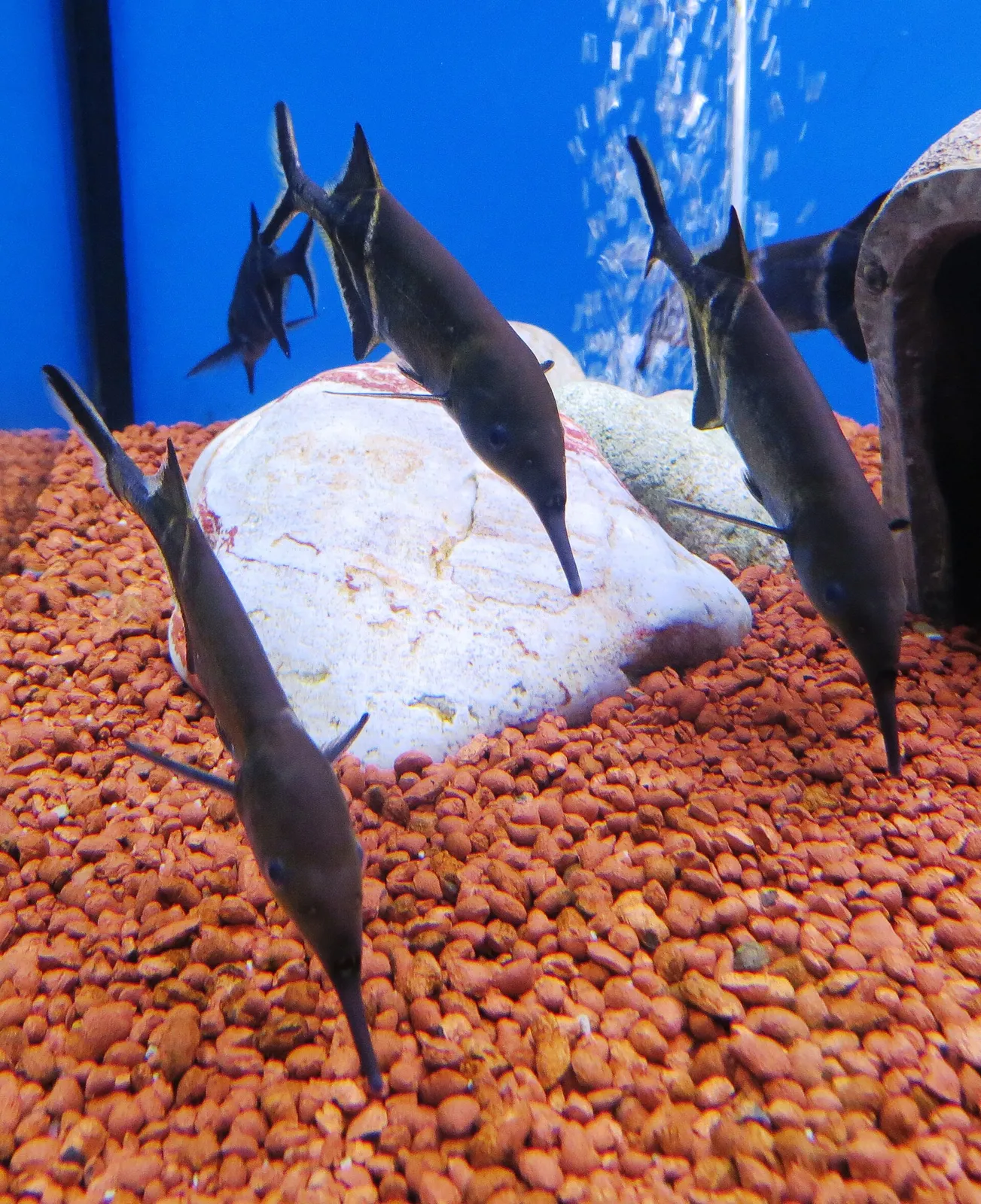
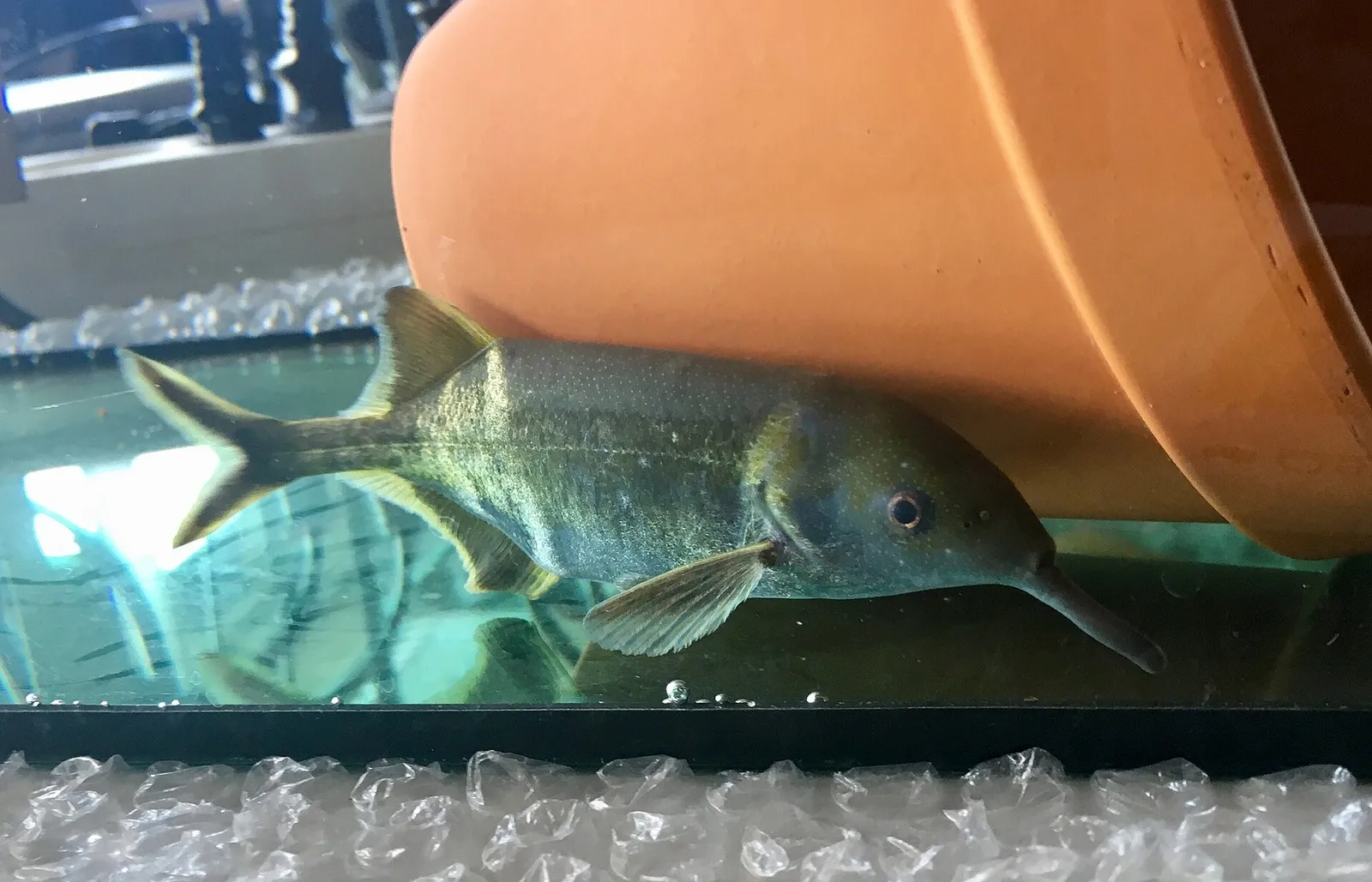
The elephantnose has a laterally compressed, gently arched body in matte blackish-brown to charcoal-grey, broken by two pale, curved vertical bars near the base of the tail. The dorsal and anal fins are set far back and mirror each other, giving the rear half of the fish a scalloped, almost fan-like profile, and the tail is small and deeply forked. The feature that gives the species its name is the Schnauzenorgan, a flexible, trunk-like extension of the lower jaw and chin, densely packed with electroreceptors and used to probe soft substrate for buried prey — it is not a mouth or a nose, though it is often mistaken for one.
An electric organ near the base of the tail generates a weak, pulse-type electric organ discharge (EOD) used for electrolocation and communication; because the discharge is species- and often sex-specific, it functions almost like an acoustic signature among mormyrids. The species is also notable for an outsized cerebellum and one of the highest brain-to-body oxygen-consumption ratios recorded in any vertebrate, the physiological cost of running such a sensitive electrosensory system — hence its reputation among aquarists and researchers alike as a genuinely "thinking" fish.
Sources differ slightly on maximum size: Seriously Fish gives roughly 9 in total length, while FishBase records fish to about 14 in standard length. Aquarium specimens are typically smaller, in the 8–9 in range, and this is a fish that plans on a mid-sized tank rather than the size-trap territory of the giant bonytongues.
Habitat
Gnathonemus petersii is widespread across West and Central Africa, with confirmed records from the Niger and Congo River basins and reported occurrences spanning Mali, Benin, Niger, Nigeria, Chad, the Central African Republic, Cameroon, the Republic of the Congo, the Democratic Republic of the Congo and Zambia. It is a fish of slow-flowing, often turbid or tannin-stained backwaters, floodplains and river margins rather than open, fast water — precisely the kind of dim, low-visibility habitat in which an electric sense outperforms eyesight.
Water across this range runs warm and on the soft, slightly acidic-to-neutral side: reported temperatures span roughly 72–82 °F and pH roughly 6.0–7.5 (FishBase gives a slightly wider pH ceiling of 8.0), consistent with soft, sediment-laden African river and floodplain water rather than hard, mineral-rich conditions. Structure in the form of submerged wood, roots and leaf litter is typical, giving the fish cover and a rich substrate to probe after dark.
Feeding
The elephantnose is a nocturnal bottom-forager. Using the Schnauzenorgan's dense electroreceptor field together with active electrolocation from the tail's electric organ, it sweeps the substrate for worms, insect larvae and other small invertebrates buried in sand or leaf litter — a foraging strategy built entirely around a sense most aquarium fish don't have, letting it hunt confidently in the dark, tannin-stained water it evolved in.
In the aquarium it takes frozen bloodworm, blackworm and brine shrimp readily and can be brought onto sinking pellets with patience, but feeding should happen after lights-out or in dim conditions to match its natural rhythm; a soft sand substrate (never sharp gravel, which can damage the sensitive chin organ) is important for both feeding behaviour and welfare.
Mating
Courtship and species/sex recognition in mormyrids run substantially through the electric organ discharge rather than through visual display: laboratory observations have recorded sex-related differences in EOD characteristics around breeding, suggesting the pulse itself carries information about sex and readiness to spawn. Beyond that, wild reproductive behaviour is poorly documented. Mormyrids in general are thought to be seasonal, flood-triggered spawners, with breeding activity tied to the rains and rising water that mark the African wet season, but the courtship sequence, spawning site and any pair-bonding in G. petersii specifically have not been well described in the literature.
Critically, the fish's own electrosensory communication is easily disrupted by the electrical and acoustic noise of a home aquarium — filters, heaters, pumps and glass-tank reflections all interfere with the weak EOD signal — which is one reason natural courtship essentially never plays out in captivity.
Breeding
Gnathonemus petersii is essentially not bred in the aquarium hobby, and its reproductive biology remains poorly understood even in the scientific literature. Wild mormyrids are believed to be seasonal, flood-triggered spawners, and the species-specific EOD likely plays a courtship or mate-recognition role, but the details of nest site, egg-laying and any parental behaviour have not been reliably documented for this species. Some mormyrids are thought to guard eggs among vegetation, but this has not been confirmed for G. petersii.
Aquarists should not expect to breed this fish and should treat any claim of captive spawning with scepticism absent solid documentation; virtually all specimens in the trade are wild-caught. This is a fish to keep and observe, not a project fish to pair up for eggs.
In the aquarium
The elephantnose is a rewarding but demanding aquarium fish that punishes shortcuts. It needs soft sand substrate (sharp gravel can injure the Schnauzenorgan), dim lighting, and abundant cover from roots, wood and plants to feel secure during the day; it becomes active and forages after dark. Water quality has to be excellent and stable — this species tolerates essentially zero ammonia or nitrite and wants nitrate kept low with regular water changes — and it is notably intolerant of many aquarium medications and of copper-based treatments in particular, so any dosing has to be approached with real caution.
It is best kept alone or, where space allows, in a properly sized group; single fish added to a tank with an existing conspecific frequently show aggression, since a solitary elephantnose defends its own territory and its own electric "signature" against others. A tank of roughly 150+ litres (40+ US gallons) with stable, mature water and quiet equipment suits a single specimen well. Tankmates should be calm, non-nippy fish that won't out-compete it for food at night and won't stress a fish whose primary sense — electrolocation — is easily disrupted by a noisy, brightly lit aquarium.
Conservation
The IUCN Red List assesses Gnathonemus petersii as Least Concern, reflecting its wide distribution across the Niger and Congo basins and beyond. It is not currently considered at risk at the species level.
As with many broadly distributed African river fishes, the main long-term pressures are generic rather than species-specific: habitat degradation, sedimentation and water-quality decline in the West and Central African rivers it inhabits. There is no evidence in the available sources of population decline driving reassessment, and the picture for this widespread, adaptable mormyrid remains reassuring for now.