Taxonomy & naming
Corydoras adolfoi was described by Warren Burgess in 1982, in Tropical Fish Hobbyist, from a small tributary of the upper Rio Negro near São Gabriel da Cachoeira, Brazil — still the type locality. It was placed in Corydoras Lacépède, 1803, the huge genus of South American armoured catfishes in the family Callichthyidae.
In 2024 Dias, Tencatt and colleagues published a large molecular-and-morphological revision of the Corydoradinae that split Corydoras into several genera, resurrecting Aspidoras, Scleromystax, Gastrodermus, Osteogaster, Brochis and Hoplisoma. Under that scheme Adolfo's cory falls into the resurrected Hoplisoma — the new combination is Hoplisoma adolfoi (Burgess, 1982), now carried by Eschmeyer's Catalog of Fishes. The change is recent and not yet universally adopted, and the hobby still overwhelmingly says 'Corydoras adolfoi,' so we keep that as the heading while noting the new genus.
The species honours Adolfo Schwartz, the Manaus-based collector and exporter who first brought it to the aquarium world — a patronym in the genitive, hence 'adolfoi.' It is one of several superficially similar saddled corys he and others sent out of the Rio Negro, and disentangling them from one another (rather than placing the genus) has been the lasting taxonomic headache.
Morphology
This is a small, neat cory, reaching roughly 2–2.5 in in standard length; like all its relatives it is armoured rather than scaled, with two rows of overlapping bony scutes down each flank and a hard, helmet-like head, and three pairs of short barbels around the downturned mouth. The snout is comparatively short and rounded.
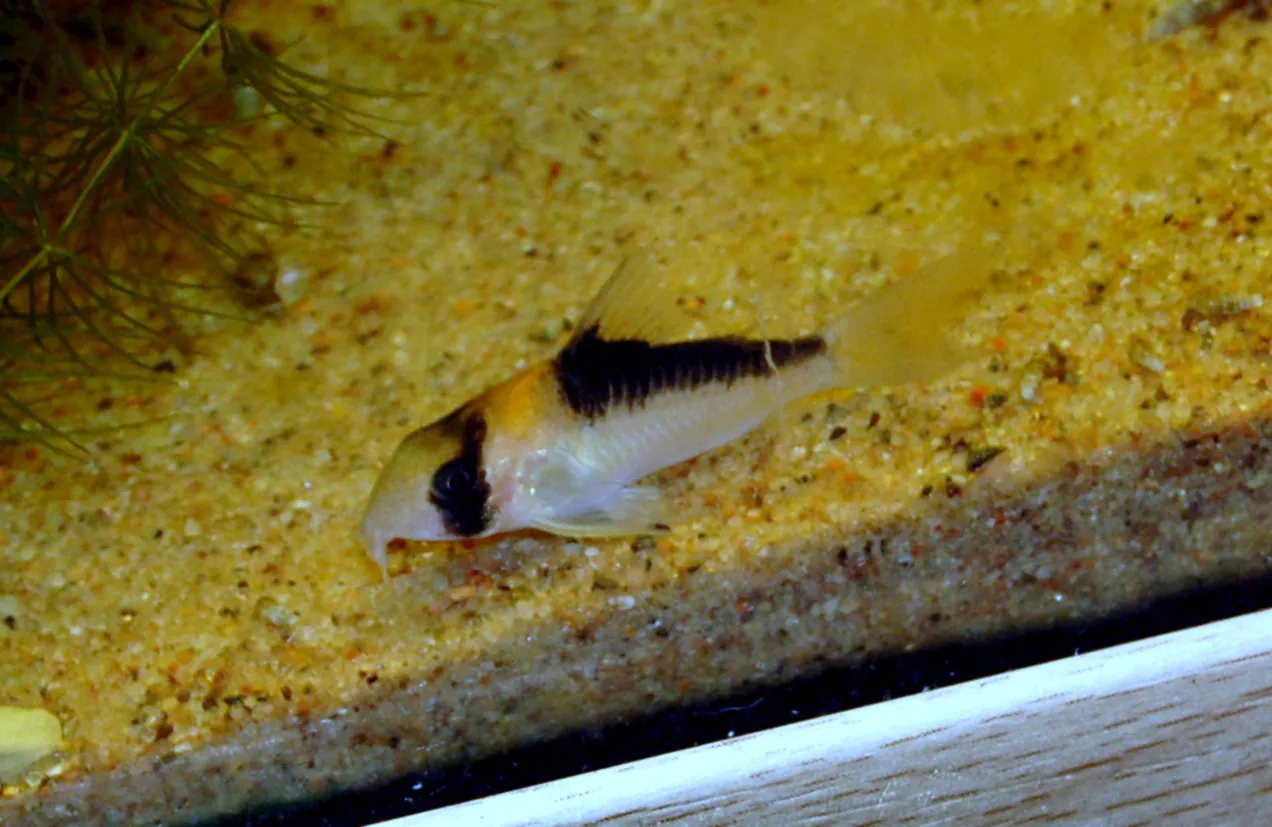
The colour pattern is what sells it. The body is a clean pearly white. A bold black bar runs across the head through the eye, like a mask. Behind it, over the nape and the front of the back, sits a broad black 'saddle' or oblique dorsal bar that runs back along the top of the body — the feature shared by the whole Rio Negro saddle-cory group. Between the eye-bar and the saddle, the patch over the head and shoulders is washed a warm orange to gold, brightest just in front of the dorsal fin. The fins are mostly clear, and as in all corys the dorsal, pectoral and adipose fins carry a stiff, mildly venomous spine. The near-identical C. duplicareus is told apart chiefly by a wider black saddle and by serrations on the pectoral-fin spine that adolfoi lacks; C. imitator (now Brochis imitator) has a distinctly longer, more pointed snout; C. burgessi differs in the shape and placement of its dorsal blotch.
Habitat
Corydoras adolfoi is restricted to the upper Rio Negro basin in Amazonas state, northern Brazil, around São Gabriel da Cachoeira and including the Rio Uaupés — a genuinely small range, which is part of what makes it less common and pricier than mass-bred corys. It is a blackwater specialist: it lives in small forest streams and the margins of flooded forest (igapó), over sand and leaf litter, in the characteristic dark, tea-stained, tannin-rich water of the Rio Negro.
Those are extreme waters by aquarium standards — very soft, very acidic and extremely low in dissolved minerals. Reported wild parameters run warm and strongly acidic, with pH as low as the 4s and conductivity barely above that of rainwater; in the aquarium it is kept around 72–79 °F and is comfortable from acidic to neutral (roughly pH 5–7) in soft water. Like other corys it is a facultative air-breather, surfacing to gulp air and absorb oxygen through a vascularised hindgut, an adaptation suited to the warm, oxygen-poor forest pools it inhabits.
Feeding
Adolfo's cory is a foraging benthic omnivore. It works the substrate continuously, sifting sand and leaf litter with its barbels to take small invertebrates, insect larvae, worms, micro-crustaceans and organic detritus, expelling clean sand through the gills. In the aquarium it accepts most sinking dried foods — pellets and tablets — alongside small live and frozen foods such as bloodworm, Tubifex, Daphnia and brine shrimp. As with all corys it needs a varied diet of its own and should never be expected to live on its tankmates' leftovers.
Mating
Adolfo's cory is an egg-laying shoaler with no pair bond and the family's distinctive 'T-position' courtship. A ready female cleans a spawning site — a leaf, a stone, the glass — and the group becomes active; a male positions himself at right angles to her head, forming the T, and she appears to take his milt into her mouth. The sperm is thought to pass rapidly through her gut to fertilise the few eggs she carries in a basket formed by her clasped pelvic fins, which she presses onto the cleaned surface. The sequence repeats, a few eggs at a time. A surplus of males to females — a 2:1 ratio is commonly recommended — improves fertilisation.
Breeding
Adolfo's cory is bred in captivity but is distinctly more demanding than the beginner corys, largely because of its blackwater origins. Conditioning on rich live and frozen foods comes first; spawning is then triggered by a large (50–70%) water change with cooler, soft, acidic water and stepped-up oxygenation and flow, mimicking the rains. Soft, acidic water matters here both to trigger spawning and for the eggs to develop well. The adhesive eggs are laid on glass, plants or wood and receive no parental care — the adults will eat them, so breeders remove the eggs or the parents. Eggs hatch in roughly three to four days; the fry, after absorbing the yolk sac, take microworm and Artemia nauplii and need excellent, clean water. Because wild fish remain part of the trade, successful captive breeding directly relieves collecting pressure on a narrow-range species.
In the aquarium
Adolfo's cory is a rewarding but slightly more exacting cory — a fish for the keeper who can give it soft, clean, gently acidic water rather than an absolute beginner's first bottom-dweller. It is strongly shoaling and is stressed kept alone or in small numbers; keep six or more (more is better) and they school and forage confidently, often mixing readily with the other saddle-patterned Rio Negro corys. A group is comfortable in a tank of around 23.5 in / 20 US gal or more, where bottom area matters more than height.
Substrate is the one non-negotiable: soft sand or very smooth, rounded fine gravel, because corys feed by sifting and sharp or coarse gravel erodes and infects their barbels. Keep the bottom clean and the water warm (about 72–79 °F), soft, well-filtered and well-oxygenated with a gentle current; tannin-stained 'blackwater' from leaf litter or botanicals suits it and helps show off the orange-and-black markings. It is utterly peaceful and belongs with tetras, pencilfish, dwarf cichlids and other calm soft-water community fish, never anything large enough to bully it. The usual cory cautions apply: the fin spines can snag in a net (a cup is safer), and a badly stressed fish can release a skin toxin that, in the small volume of a bag or bucket, can kill the whole group, so transport with care.
Conservation
Corydoras adolfoi is assessed by the IUCN as Least Concern, and is treated as a hardy, resilient fish of low vulnerability. That headline, however, sits against a narrow range and a real history of collecting pressure: it is endemic to a small part of the upper Rio Negro and is harvested for the aquarium trade, and local population declines from collection have been reported. The blackwater forest-stream habitats it depends on are also exposed to deforestation, mining and pollution in the region. Captive breeding — increasingly successful for this species — is the most direct way to take demand off wild stocks, and a restricted-range blackwater endemic like this is exactly the kind of fish whose status is worth watching even while it remains formally Least Concern.