Taxonomy & naming
The Swedish ichthyologist Sven O. Kullander described Apistogramma hongsloi in 1979, in a Zoologica Scripta paper (8(1):69–79) that treated the Apistogramma of the Orinoco drainage and erected four new species at once — hongsloi, macmasteri, viejita and iniridae. The type locality is Finca Boca de Guarrojo on the Río Guarrojo, Vichada, Colombia (roughly 4°07'N, 70°45'W); the holotype sits at the Swedish Museum of Natural History in Stockholm as NRM 11234, with a paratype series alongside it. The fish honors Thorbjörn Hongslo, an aquarist and fish-disease specialist at Sweden's National Veterinary Institute in Uppsala, who collected the type material on his own initiative.
The name is uncontested at the authority level. Eschmeyer's Catalog of Fishes and FishBase both list it as Apistogramma hongsloi Kullander 1979, with no junior synonyms. Within the speciose Neotropical genus Apistogramma (subfamily Geophaginae), specialists place it in the Apistogramma hongsloi complex of the broader Apistogramma macmasteri species group. The close relative Apistogramma macmasteri belongs to a different complex of that same group; the two coexist and are unlikely to hybridize, but their domestic strains are routinely confused on dealer tanks. Common and trade names are a tangle — Rotstrich or red-streak cichlid, red-line dwarf cichlid, redstripe dwarf cichlid — none settled enough to trust, so the binomial is the safest label. Hobbyists also tag populations with DATZ "A-numbers," Apistogramma hongsloi carrying A110 and similar forms running through A115 by locality. One caution has fueled decades of argument: "Rotstrich" properly names a deep-bodied, intensely red-and-blue domestic strain, not the wild species as a whole.
Morphology
This is a true dwarf cichlid, and reported sizes vary partly because line-bred stock outgrows wild fish. The taxonomic figure is small: Kullander's checklist gives about 1.5 in standard length for males, females to roughly 2 in, and a maximum total length near 3 in; the IUCN assessment likewise caps wild fish at about 2.5 in SL. The number keepers actually repeat is around 2.75 in total length for a good male and 1.6–2 in for a female — substantial for an Apistogramma, but no giant of the genus.
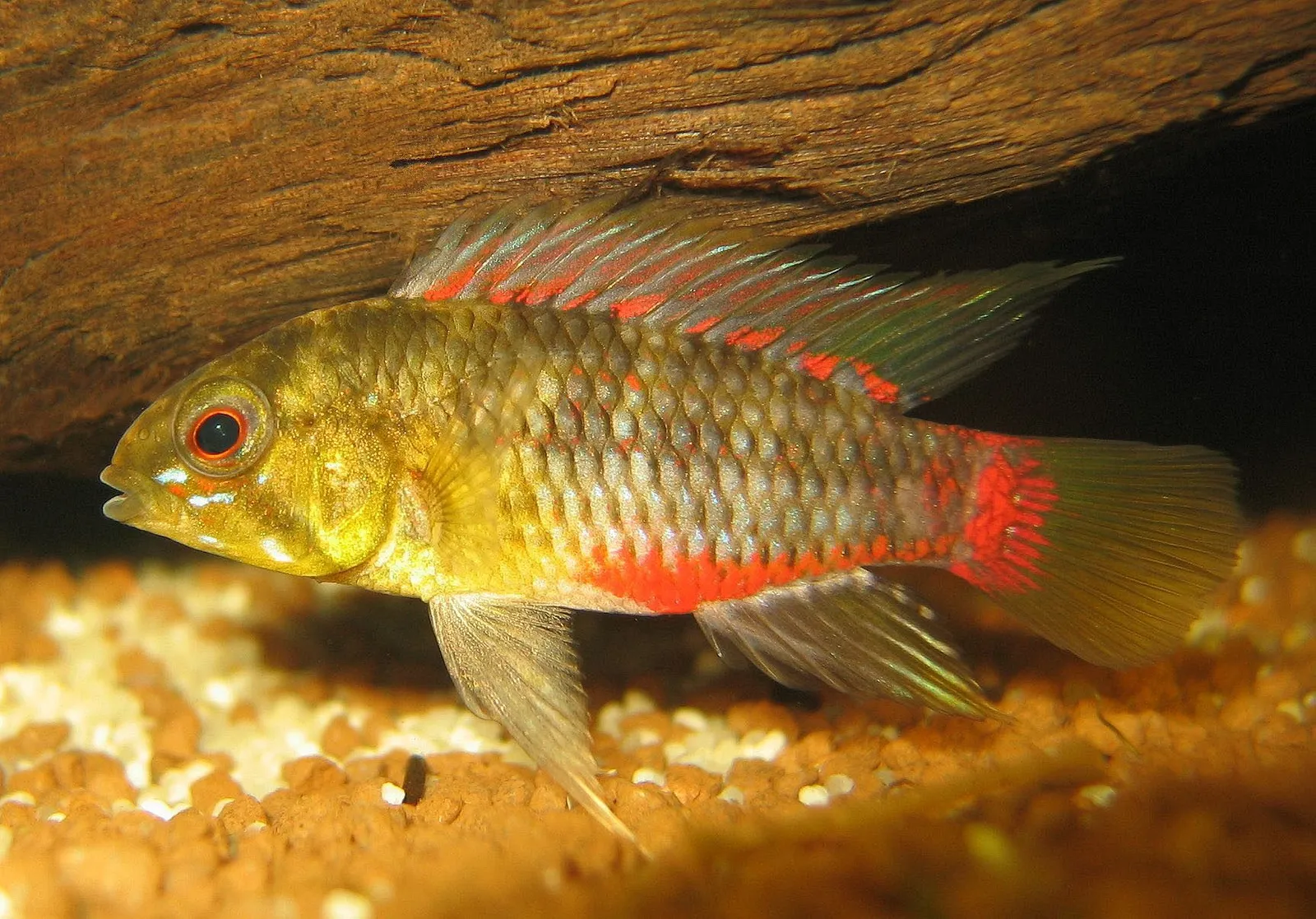
Body depth is a clue to provenance, since the classic Rotstrich strain is notably chunkier than Kullander's slender type specimens. A displaying male carries a yellow head and breast, pale sky-blue flanks, extended dorsal and anal fins, and the red caudal-peduncle patch and red streak along the base of the anal fin that give the fish its name. A dark lateral band runs the flank in an open, lattice-like pattern. Females are smaller, plainer and usually grey until they come into breeding dress, when they turn bright yellow with a bold black checkerboard or blotch pattern. Color is highly variable even within one wild population — the amount of red especially — and some Venezuelan forms, such as those from the Río Cataniapo, show black rather than red in the caudal and anal regions. Flank color alone is therefore unreliable for identifying fish in this group. The species is sexually dimorphic: males are larger, more colorful and bear extended unpaired fins, females smaller and rounder-finned.
Habitat
Apistogramma hongsloi belongs to the Orinoco basin, not the Amazon, and the taxonomic record (Catalog of Fishes, FishBase, GBIF, IUCN) is unanimous on this despite the trade's placement of the fish alongside Amazon cichlids. FishBase records it from the Vichada River drainage, the middle Meta drainage in Colombia, and the middle Orinoco; the IUCN assessment maps a wider Colombian range across the high plains ("altillanura") in the Manacacías, Bita, Tomo, Tuparro and Vichada basins, plus the Cusiana and Lipa systems, and a Venezuelan range in the Cataniapo, Suapure, Tucarigua, Chuchivero and Capanaparo rivers. Estimated area of occupancy is about 7,838 mi².
The habitat is the real story. Rather than open rivers, the fish occupies small, slow, often spring-fed forest streams and shallow pools — the kind that hold water year-round rather than drying seasonally, generally no more than a couple of metres deep. Field naturalist Ivan Mikolji, who has dived these Venezuelan streams repeatedly, describes a benthopelagic, littoral fish living over white to tan silica sand (grains roughly 0.5 in) carpeted in leaf litter, twigs, Moriche-palm debris and patches of aquatic plants such as Eleocharis. The water is soft, acidic and warm: Mikolji recorded pH under 5, very low hardness and 79–82 °F. The IUCN account, drawing on Mesa and Lasso's revision of the Orinoco Apistogramma, gives clear-water streams of very low to moderate conductivity (4.5–55.3 µS/cm) and intermediate pH (5.5–5.87), and FishBase's summary band of pH 5.5–6.0 and 73–86 °F fits comfortably. Tellingly, Mikolji notes the species seems to pick stream sections that lack larger fish — a quieter, predator-light microhabitat it shares mostly with small companions like Nannostomus pencilfish, Copella, small Aequidens and freshwater shrimp.
Feeding
Like most Apistogramma, Apistogramma hongsloi is a micro-predator that works the streambed. The IUCN assessment calls it presumably carnivorous with entomophagous (insect-eating) habits, and FishBase places it at a trophic level near 3.3. It feeds on small benthic invertebrates — insect larvae and micro-crustaceans — sifted from sand and leaf litter, and it is no fast open-water forager: keepers consistently note that it examines food and takes its time, the behavioral fingerprint of a fish that picks through detritus rather than chasing prey.
Ecologically it acts as a small, territorial bottom-dweller in tannin-stained, low-conductivity blackwater and clearwater streams. Mikolji's observations add a striking seasonal dimension. In the dry season the fish go dull and dark, hunker under leaf litter and rotting plants, and barely move — a near-dormancy in which they seem to conserve energy. When the rains return, colors brighten, feeding resumes constantly, and males begin displaying in the open over beds of green Eleocharis. The decaying leaf litter that defines the habitat also seeds the microfauna — micro-invertebrates and the biofilm grazing on them — feeding adults and fry alike, which is why the leaf-litter substrate matters ecologically as well as aesthetically.
Mating
Reports on social structure genuinely differ, and the honest reading is that Apistogramma hongsloi is more flexible than dogmatic. FishBase states the species does not appear to practice harem spawning and that the parents stay and raise young together; experienced breeders likewise describe a "pair-building" fish rather than an obligate harem-keeper, with a male patrolling a wide territory while tolerating a single post-spawning female. Other keepers run it as a loose harem of one male to several females in a large, well-structured tank. Mikolji's wild observations describe males swaying, flashing and tail-beating at rivals over open plant beds, each male keeping a favored female among several and "visiting" each brood in turn — behavior that reads as casually polygynous when space allows.
Aggression is real but situational. A breeding female becomes intensely defensive and will drive off a male several times her size, along with anything that approaches her cave; outside breeding the dynamic flips, and males may harass females persistently — which is why broken sightlines and a dark cave near the female's chosen spot come up again and again. In the wild the red caudal color, dull through the dry season, brightens as a breeding signal when the rains arrive, the same trigger that makes rainy-season warmth and soft water so effective in the tank.
Breeding
Apistogramma hongsloi is a cave-spawning substrate brooder. The female lays a clutch of roughly 60–90 reddish, adhesive eggs on the ceiling of a crevice or cavity, then guards and fans eggs and wrigglers and leads the free-swimming fry through the leaf litter, typically tending the brood for around a month; the male holds and defends the wider surrounding territory. FishBase records the female tending the clutch and the parents raising young together, and breeders confirm the same biparental, cave-based pattern that runs through the Apistogramma macmasteri group. In a home tank a coconut shell, clay flowerpot or small cave with a narrow entrance stands in for the natural cavity.
Soft, acidic water markedly raises hatch rates: hobby spawns are reported at pH as low as 4.8–5.4 with near-zero hardness, though the fish will spawn in moderately soft water around pH 6, and captive-bred strains are far more forgiving of harder water than wild imports. Eggs hatch in two to three days and the fry are free-swimming a few days later, at which point they take newly hatched brine shrimp and microworms. First-time pairs commonly lose a clutch or two before settling into reliable parenthood, and bottom-wandering tankmates — Corydoras especially — will harass a brooding female or pick off fry, so most breeders spawn the species in a species tank or with only mid- and upper-water dithers.
In the aquarium
Apistogramma hongsloi is a popular, well-established dwarf cichlid, available year-round as captive-bred stock in the red and super-red Rotstrich strains and, occasionally, as wild-type imports. Domestic strains handle water chemistry more forgivingly than wild fish, but matching the species' natural conditions still yields the best color, the longest life and the most reliable breeding.
Tank: a single pair does well in a 60-liter (about 15-gallon) tank, though 20–25 US gal gives the male room to patrol without cornering the female. A 120-liter or larger setup with two or three females to one male works as a loose harem, provided the layout is generously broken up so each female can hold a cave territory out of sight of the others. The substrate should be fine white or tan silica sand — the fish sifts the bottom exactly as it does in the forest streams of the Vichada and Cataniapo, and a bare or coarse bottom suppresses that foraging. Layer dried leaves (catappa, oak, beech) over the sand, add a few pieces of bogwood or twisted root near the edges, and give each female a dedicated spawning cave: a coconut-shell half with a small hole, a clay flowerpot on its side, or a commercial Apistogramma cave with a 1 in entrance all work.
Water: stay inside the range the species inhabits in the wild — pH 5.5–6.5, general hardness under 8 dH, temperature 75–82 °F. RO water blended with a little tap, or a dark, tannin-rich setup using catappa (Indian almond) leaves, driftwood and peat filtration, is the most dependable route to strong color and breeding. Forum accounts confirm spawns at pH as low as 4.8; keepers using harder water often report the fish surviving but faded and reluctant to breed. Line-bred strains tolerate moderate hardness better than wild imports, but there is no reason to push the limits.
Tankmates: in the wild the fish shares small, predator-light streams with pencilfish (Nannostomus), small Copella, freshwater shrimp and minor Aequidens — nothing large enough to threaten it, nothing bottom-hugging enough to invade the spawning site. That logic carries straight into the tank. Small mid- and upper-water tetras (rummy-nose, ember, cardinal) and pencilfish make ideal dithers that coax the male into displaying while keeping bottom traffic low. Avoid Corydoras catfish entirely during active breeding — they probe the cave entrance, trigger frenzied aggression from the brooding female (often at the cost of the clutch), and their nocturnal foraging stresses both sexes. Avoid any similarly sized cichlid that could read as a rival: other Apistogramma of the macmasteri group, including Apistogramma macmasteri itself, should not share the tank, both for hybridization risk and for the persistent aggression their overlapping territory signals cause.
Sexing is straightforward once the fish mature. Males are larger, deeper-bodied in line-bred strains, and carry the red caudal patch, blue flanks and extended dorsal and anal fins; females are smaller and duller, but announce readiness by turning bright yellow with a bold black blotch-or-checkerboard flank pattern and near-black pelvic fins. A brooding female defending a cave should be left alone — she can drive off a male many times her size, and repeated intrusions will make her eat the clutch. Removing the male after spawning is standard practice if the tank is small or his harassment turns persistent.
Common mistakes: the two commonest are hardening the water — from substrate, décor or undiluted high-TDS tap — and giving too little cover, which leaves a chronically stressed female that never colors up or spawns. A third is underfeeding: this is a selective, deliberate feeder that inspects food before taking it, so varied live and frozen foods (small bloodworms, daphnia, cyclops, Artemia) in small, frequent portions build far better condition and color than dry food alone, though a quality dwarf-cichlid pellet works as an accepted staple for established domestic strains. Rated moderately easy for the experienced dwarf-cichlid keeper and moderately demanding for a beginner, it rewards correct water chemistry, a sand-and-leaf-litter layout and patient feeding with a long-lived, richly colored fish that breeds with little extra prompting.
Conservation
The IUCN Red List assesses Apistogramma hongsloi as Least Concern (assessed 3 August 2020 by Lina Mesa-Salazar, reviewed by Donald Taphorn, and published in 2022). The reasoning is range breadth: the fish is well represented across the Colombian altillanura and the Venezuelan wind plains, with an estimated extent of occurrence near 54,247 mi² and an area of occupancy around 7,838 mi², and it occurs in protected areas including El Tuparro National Park and the Río Bita Ramsar wetland in Colombia and the Santos Luzardo (Cinaruco-Capanaparo) National Park and the Cataniapo basin protective zone in Venezuela. It is Not Evaluated under CITES, and FishBase rates its fishing vulnerability as low (10 of 100). The only documented use is ornamental — this is an aquarium fish, not a food fish — and much of today's trade is captive-bred line stock rather than wild collection, which blunts harvesting pressure on wild populations.
That verdict is best read against the wider Orinoquía context, not as a clean bill of health. The assessors flag localized but real pressures across the range: hydrocarbon (oil and gas) development north of the Meta and in the Cusiana–Lipa basins, mineral exploitation in the Manacacías and Cusiana and within Venezuela's Arco Minero (gold, diamond, bauxite, coltan) and the Cataniapo quartz workings, agro-industrial pulp plantations on the transformed plains, and the prolific ornamental-fish market supplying international trade through direct extraction from the habitat (Galvis et al. 2007; Ortega-Lara et al. 2015). Mikolji adds a first-hand warning that bears directly on this fish: it depends on small, spring-fed forest streams, and the smaller the stream, the more exposed it is when riparian vegetation is cleared for crops, fuel and building material. The accurate statement is the careful one — the species itself is currently secure and unthreatened at the global scale, even as the rainforest headwater habitats it occupies face localized pressure from land-use change.