Taxonomy & naming
Carl H. Eigenmann described the yellow acara in 1922 as Aequidens metae, working from fish collected at Barrigón on the Río Meta during the Carnegie Museum's survey of western South American fishes (Memoirs of the Carnegie Museum, vol. 9). The holotype sits at the California Academy of Sciences (CAS 66884, ex Indiana University 13967), with paratypes and further original material also at CAS — an unusually well-documented type series for a fish of this age. The type locality, 'Barrigón, Río Meta, Orinoco System, Colombia', is Puerto Barrigón near Puerto López in Meta department, a landing on the upper Río Meta where the Andean piedmont gives way to open llanos. (Eigenmann named a characin, Charax metae, in the very same 1922 Meta report; it shares the epithet by coincidence and is not the cichlid treated here.) The genus is the one genuinely unsettled point. Eigenmann's Aequidens long served as a catch-all for South American acaras, and Musilová, Říčan & Novák (2009) broke it up, erecting Andinoacara — within tribe Cichlasomatini — for the trans-Andean and Orinoco 'blue acara' group typified by Andinoacara pulcher. The Colombian checklists that handle this fauna first-hand — Maldonado-Ocampo and colleagues, DoNascimiento et al., the Álvarez-León fish list — carry it as Andinoacara metae. Eschmeyer's Catalog of Fishes and the IUCN Red List stay conservative, still listing it as Aequidens metae and treating the transfer as not yet formally demonstrated for this species. The atlas follows the Catalog here; FishBase and the older literature also give the binomial as Aequidens metae. No subspecies are recognised, and there are no junior synonyms.
Morphology
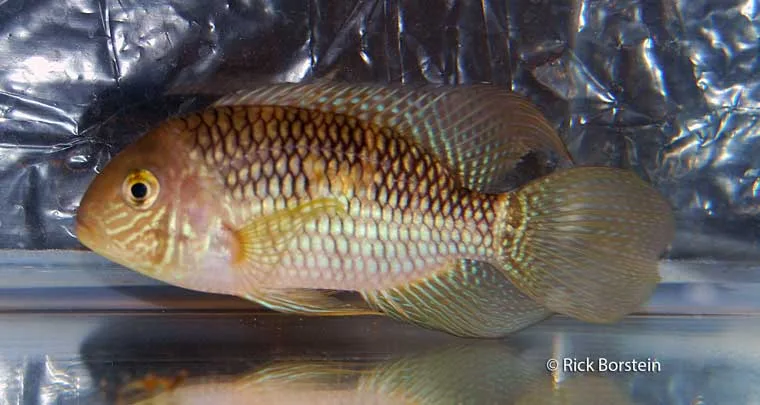
This is a small-to-medium acara. FishBase gives a maximum of 5 in standard length, and the IUCN assessment notes the fish 'does not exceed 6.5 in in total length' — figures that reconcile once you account for standard length versus total length with the tail, while aquarium fish usually settle around 4.5–6 in. The build is the familiar acara shape: moderately deep, laterally compressed, with a gently sloping forehead. Ground colour runs yellowish-green to brassy olive, the flanks carry rows of faint pearly flecks, and the lower head and belly warm to a soft yellow in a settled fish. Two dark marks give the species its 'twin-spot' name: a roundish blotch near mid-flank, sometimes ringed by a yellow halo, and a second blotch at the base of the caudal fin. A dark bar runs through the eye, as in its relatives. The dimorphism is subtle and the fish is notoriously hard to sex — experienced keepers report that males grow a little larger, carry a more rounded nuchal (forehead) profile, and trail longer filaments on the soft dorsal and anal fins, while ripe females are rounder in the body. Among its congeners, Aequidens metae is separated from the larger green and blue terrors — Andinoacara rivulatus and Andinoacara pulcher — by its smaller size, plainer build, and clean two-spot pattern rather than the iridescent facial spangling of the pulcher group.
Habitat
Aequidens metae belongs to the Orinoco basin of Colombia and Venezuela. Its range follows the Andean foothills of the Orinoco — from the upper Guaviare and Ariari south to the Meta itself, through the piedmont rivers (Orotoy, Acacías, Guatiquía, Pauto, Cusiana) and out across the high plain in drainages such as the Yucao and Manacacías — then on into the Vichada and Bita of the open llanos and the Inírida–Guaviare–Atabapo system of the Guiana Shield. In Venezuela it reaches the western plains (Aguaro–Guariquito, Manapire) and the Suapure on the Guiana side. The water tells the real story: this fish favours clear and blackwater creeks, lagoons, and the morichal swamps shaded by Mauritia flexuosa palms — habitats that are strikingly soft and acidic. Field surveys behind the IUCN assessment record very low conductivity (about 3.7–26 µS/cm) and pH from roughly 3.2 up to 6, blackwater extremes by any standard. FishBase narrows the typical envelope to pH 4.8–6.0 and 75–86 °F and places the fish in creeks and small streams. These are warm, mineral-poor, tannin-stained waters, and Aequidens metae keeps to shallow margins and slow reaches rather than deep open channels, so in the wild it lives in only the first metre or two of water.
Feeding
Direct gut-content studies of wild Aequidens metae are scarce — even seasoned hobbyist accounts note the lack of published stomach analyses — but the evidence converges on a generalist omnivore. The IUCN assessment lists it plainly as omnivorous, and FishBase's modelled trophic level of about 3.2 puts it at the low-to-mid level, in line with acara relatives that pick small invertebrates, insect larvae, crustaceans, and plant and detrital matter off the substrate and out of leaf litter and root tangles. In the blackwater creeks and morichales it inhabits, that leaf-litter and submerged-root zone is exactly where the food is, so a diet of aquatic insect larvae, micro-crustaceans, and incidental plant material is the defensible, genus-typical picture — inferred here rather than measured for this species. In captivity it is an easy feeder, taking flake, pellet, and live or frozen foods without fuss, which fits a flexible wild diet rather than any narrow specialisation.
Mating
Like the rest of Andinoacara, the yellow acara forms monogamous pairs and spawns on the substrate with both parents involved, so the unit that matters is the bonded pair and the territory it holds. By acara standards it is mild-tempered — keepers consistently rank it among the less aggressive acaras and keep it alongside similarly peaceful tankmates — but a spawning pair turns territorial and will clear and defend a patch around its chosen site. Pairs form in the usual cichlasomatine way: mutual display, lateral spreading of the fins, and shared preparation of the site. Because the sexes look so alike, the standard approach is to grow out a group of six or more juveniles and let pairs settle naturally rather than trying to hand-pick a male and female. In the wild the species reportedly breeds across the whole hydrological year rather than in a single tight season — a flexibility that suits its variable, rain-driven llanos home.
Breeding
Aequidens metae is an open or semi-open substrate spawner with shared care by both sexes — a mode documented across the genus and assumed for this species by direct analogy to its close relatives (the IUCN assessment cites Keenleyside & Bietz's classic study of Aequidens-type biparental care to make exactly this point). The pair cleans a flat surface — a stone, a slab of slate, a broad leaf, or a flowerpot in the tank — and lays the eggs in a tidy plaque; the female tends and fans them while the male patrols the perimeter, and once the eggs hatch the wrigglers are moved to pits and the free-swimming fry are shepherded and guarded by both. Hobby spawnings put the clutch at a couple hundred to several hundred eggs (reports cluster around 200–800), hatching in roughly two to three days at warm temperatures, with the fry free-swimming a day or two after that and easily raised on baby brine shrimp. The fish has a reputation as hard to breed, but breeders who have managed it suggest the trigger is simply matching its blackwater origins: soft water, warmth into the mid-80s °F (around 84–86 °F), generous live food, and large water changes. A Greater Chicago Cichlid Association account (Rick Borstein, 2012) records a pair spawning unbidden in a warm, plant- and live-food-rich summer pond — a tidy reminder that the 'difficulty' is mostly about conditions, not the fish.
In the aquarium
Aequidens metae is kept and bred in the hobby but stays uncommon — it is almost never in ordinary pet shops and moves mainly through cichlid clubs and specialist importers, so most fish you find are wild-collected rather than farmed strains. Its mild disposition and moderate size make it a genuinely manageable cichlid for a keeper willing to meet its blackwater origins at least halfway.
Tank: a single pair wants around 47–59 in (roughly 55–65 US gal), with more room if tankmates are to share the space comfortably. Floor space matters more than height — this is a bottom-oriented fish that sweeps its territory across the substrate, so favour a long, wide footprint over a tall column. Fine sand is the natural choice, since the fish digs modestly around spawning time and coarse gravel abrades the belly of a cichlid this size. Echo the morichal creeks with smooth rounded stones and slate (which double as spawning sites), driftwood tangles, and patches of leaf litter (Indian almond or oak leaves) to stain the water gently and add shelter; robust or floating plants give the pair cover, and the fish itself is not a plant-wrecker. Moderate, non-turbulent flow suits a species from slow creeks and palm swamps.
Water: this is the one area that rewards genuine effort. Wild Aequidens metae comes from some of the softest, most acidic water in the Orinoco basin — blackwater streams at pH 3.2–6 and conductivity below 25 µS/cm. Even so, the GCCA account (Borstein 2012) records the fish living, growing, and eventually spawning in Chicago tap water at pH 7.4 and moderate hardness, so it is tougher than its wild numbers suggest. A practical target is soft to moderately soft water (3–10 dGH), pH 5.5–7.0, and 77–84 °F; the warm end of that range plus generous live or frozen food is a meaningful spawning trigger. Reverse-osmosis water blended with tap, or peat filtration, helps if your supply is hard and alkaline.
Food: it accepts a wide range without complaint — quality cichlid pellets or granules as a staple, supplemented with frozen bloodworm, brine shrimp, daphnia, and small earthworms. Live food is not essential for maintenance but visibly improves condition and speeds pair bonding before a breeding attempt.
Tankmates: lean toward peaceful mid-water fish — tetras and other characids of comparable size, corydoras and other small armoured catfishes, smaller loricariids — that will not fin-nip or crowd the bottom. Other medium-to-large cichlids can work in a tank big enough to partition territories, but because Aequidens metae is one of the calmer acaras it is easily bullied in a mixed cichlid setup; avoid similarly-sized, hard-nipping, or highly aggressive species.
Common mistakes: the spawning period catches people out — an otherwise placid pair becomes territorial and chases perceived threats away from the egg plaque and fry, so give tankmates room to retreat. Sexing is genuinely hard outside of conditioning, when the subtle nuchal and fin-filament differences are often invisible in young or out-of-condition fish, so grow out a group and let pairs form naturally. Overall the difficulty is honestly intermediate: straightforward to keep healthy and feed, but needing soft warm water and patience to breed consistently. It is not a beginner's fish, though a cichlid keeper comfortable with South American blackwater species will find it rewarding.
Conservation
The IUCN Red List assesses the species (as Aequidens metae) as Least Concern, assessed on 22 October 2020 by L. Mesa-Salazar and published in 2022, on the strength of a wide distribution across the Orinoco tributaries of Colombia and Venezuela (extent of occurrence near 152,896 mi², area of occupancy about 16,448 mi²) and its presence within several protected and managed areas — among them the La Macarena AMEM special-management area, the Bita River and Estrella Fluvial de Inírida Ramsar sites in Colombia, and Aguaro-Guariquito National Park in Venezuela. It carries no CITES listing. That Least Concern verdict is real, but it is not a clean bill of health for the habitat. The assessment itself catalogues heavy and growing pressure on the Orinoco piedmont and llanos: conversion to oil-palm and rice agro-industry, extensive cattle ranching, hydrocarbon exploration blocks across much of Meta and Casanare, legal and illegal mining (gold, coltán, tin, tungsten) in the Inírida and Atabapo, and pollution from coca-processing chemicals — all set against a regional ecosystem Red List that already rates the foothill and Guiana-Shield ecosystems as Critically Endangered. The fish is also taken straight from the wild for Colombia's substantial ornamental-fish trade and eaten locally. As a soft-water, blackwater specialist tied to morichal creeks and piedmont streams, Aequidens metae is buffered by its broad range but exposed wherever those particular habitats are drained, cleared, or contaminated — the wider-basin context against which its otherwise comfortable status should be read.