Taxonomy & naming
The German cichlid specialist Uwe Römer described Apistogramma panduro in 1997, in the American Cichlid Association's hobby journal Buntbarsche Bulletin (issue 182, p. 12) — the same paper that introduced Apistogramma atahualpa. Formalizing a new species in a hobbyist bulletin rather than a peer-reviewed journal drew criticism from professional taxonomists over whether the description had been adequately reviewed, but the name has held: it is treated as valid by Kullander's authoritative 2003 South American checklist and by Eschmeyer's Catalog of Fishes. The epithet honours the brothers Jesus Victoriano and Jorge Luis Panduro Pinedo, Peruvian ornamental-fish exporters who first singled the fish out as new and sent the type specimens to Germany — the family name that also rides along as the fish's hobby tag.
The holotype (ZFMK 18610) and a paratype series sit at the Zoologisches Forschungsmuseum Alexander Koenig in Bonn, with further paratypes at the Senckenberg collection in Frankfurt (SMF 28206–08); Herder et al. (2010) later catalogued the type material. The Catalog of Fishes gives a precise type locality — small forest brooks east of Jenaro Herrera at the kilometre 26–27 markers, in the Río Ucayali drainage of Loreto, Peru — and treats the fish as a Ucayali-basin endemic. FishBase, following Kullander's more conservative entry, records the locality only as 'exact locality unknown,' a discrepancy worth flagging. In the trade the species carries the DATZ code A183 and a thicket of names: 'blue panda,' 'blue sky' and 'azure' dwarf cichlid, plus the confusing Apistogramma sp. 'pandurini' — a trade label, not the valid binomial. Römer placed the fish in the Apistogramma nijsseni group, which later hobby-literature schemes nest — Apistogramma panduro included — within the genus's Apistogramma trifasciata lineage. Apistogramma is one of the most species-rich of all Neotropical cichlid genera, with roughly 90-plus valid species and many more awaiting description, a measure of how unsettled the group's internal classification still is.
Morphology
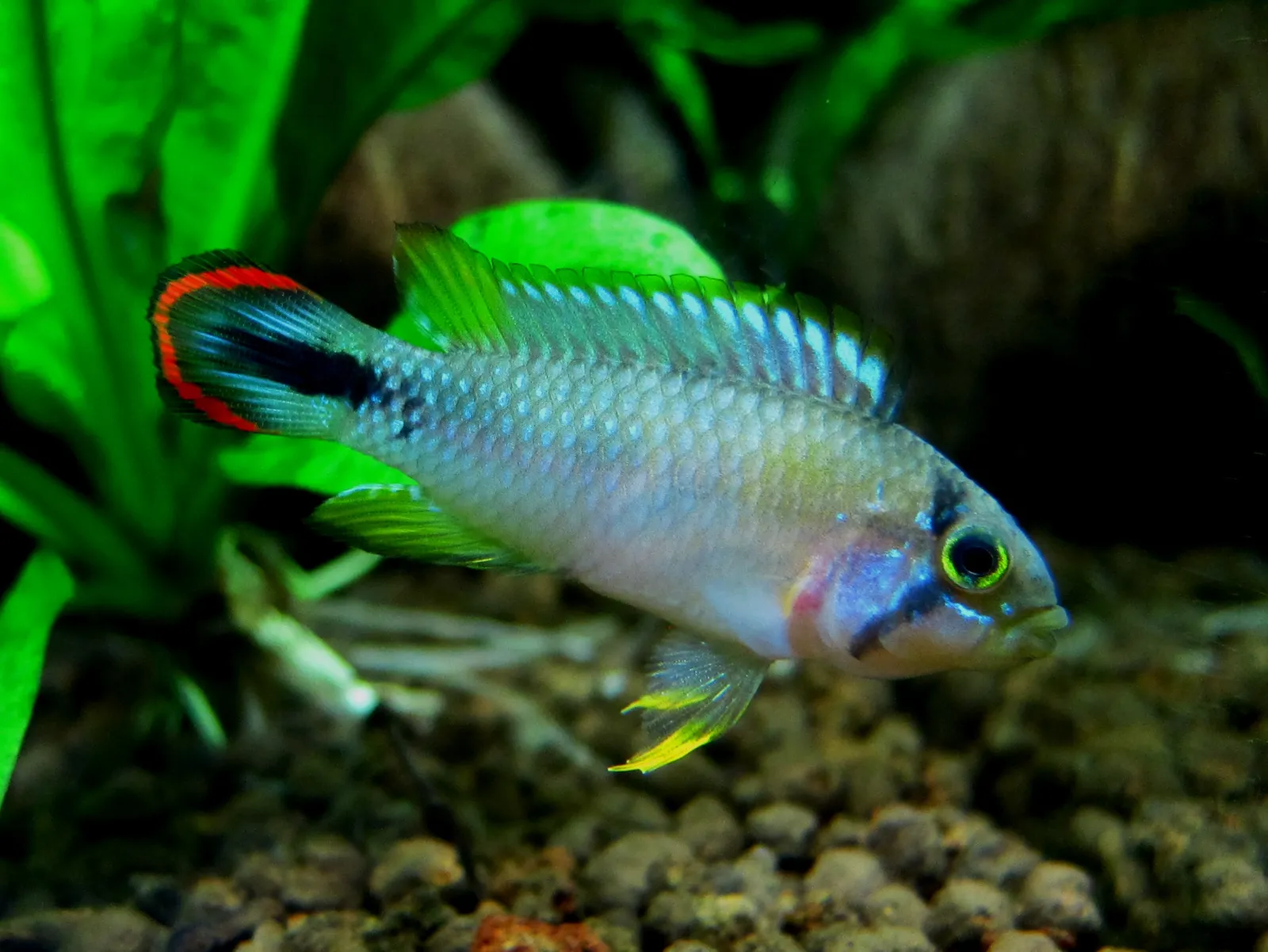
Males are the showpiece: a body washed in pale, almost luminous sky-blue, with blue anal and caudal fins, a fine red edge to the tail, and yellow-to-red tones in the paired fins. The mark Römer used to separate the species is a large, roughly triangular black blotch on the caudal peduncle that runs back into the base of the tail. Keepers have long noted that this blotch is mood-dependent — bold in a settled, dominant fish, fading to almost nothing in a stressed or spawning male — and that shifting mark is the root of much confusion with the similar Apistogramma nijsseni. The jaw is a steadier guide: in Apistogramma panduro the lower jaw projects slightly beyond the upper, where Apistogramma nijsseni has a broader, blunter mouth.
Reported maximum size depends on how it is taken. FishBase lists 1.9 in standard length; Seriously Fish cites larger total lengths of about 3 in for males and 2.2 in for females. Either way this is a genuine dwarf. Females run smaller but, unusually for the genus, are arguably as striking as the males — bright butter-yellow in spawning dress, set off by heavy black pigment across the throat and belly and by individually distinctive black flank markings. Long-term importers go further, describing wild females as polychromatic: coloured individually rather than to a single species template, each recognizable by her own pattern. Otherwise the usual dimorphism holds, with males larger, more colourful and longer-finned.
Habitat
Apistogramma panduro is endemic to the western Amazon basin of northern Peru, in the lowland drainage of the Río Ucayali and its confluence with the Río Marañón, near where the two join to form the Amazon proper. Beyond the type brooks near Jenaro Herrera, confirmed populations come from small tributaries of the Río Tahuayo, and a closely similar form from the neighbouring Río Tamshiyacu (trade-coded A184) may or may not be the same fish. This is classic Amazonian blackwater: small, shaded forest creeks, backwaters and pools stained tea-brown with tannins, running over leaf litter, sand and sunken wood where fallen leaves collect.
The water is soft and acidic in the extreme. The Norwegian aquarist Tom Christoffersen, who collected the fish in the Tahuayo and Tamshiyacu drainages in 2011, recorded very soft, strongly acidic blackwater with a pH of roughly 4 to 6 and conductivity 'as low as possible.' Seriously Fish brackets the aquarium-relevant figures at pH 4.0–6.5, hardness near zero (about 0–90 ppm) and 72–84 °F. These are shallow, leaf-floored channels; published depth figures are lacking, but the setting is the shin- to knee-deep creek typical of the genus, on the order of a metre or less. The mosaic of small, often isolated catchments around Iquitos is exactly what has driven Apistogramma's striking local speciation — and the same isolation makes individual populations vulnerable to small-scale habitat change.
Feeding
Like other members of its genus, Apistogramma panduro is a benthic micro-predator. FishBase places it at a trophic level near 3.3 and classes the genus as chiefly carnivorous, taking small benthic invertebrates — insect larvae, microcrustaceans and other tiny prey sifted from the leaf litter and substrate of its creeks. It feeds close to or directly off the bottom, which matters in the aquarium: boisterous mid-water tankmates can beat it to food, and experienced keepers note these dwarfs feed almost entirely in the lowest part of the water column.
Hobbyist experience matches that specialist's appetite. Keepers of wild-caught stock repeatedly report that imports snub flake and even frozen bloodworm at first, holding out for live foods — Artemia, Daphnia, white worms and mosquito larvae — before gradually accepting frozen and prepared diets; tank-raised fish adapt far more easily and will take good pellets. In the wild the decomposing leaf litter also feeds a layer of microfauna, a secondary food source that matters most for free-swimming fry, which graze the resulting microbe and infusoria film.
Mating
By the standards of the genus, Apistogramma panduro is relatively monogamous: once a pair bonds, several breeders report the same male and female spawning together again and again, with little need to keep a harem of females around one male. But the bond is selective and far from gentle. Females will not accept just any male — keepers describe 'pairs' that share a tank without ever regarding each other as breeding partners — and the species sits at the more aggressive end of Apistogramma.
The females are the flashpoint. Keepers of the nijsseni group describe its females as more pugnacious than most other Apistogramma, and as turning into outright 'wasps' once they are guarding a brood. Forum accounts include ripe females systematically killing pencilfish, Endler's livebearers and other small tankmates in quarters that were simply too small; the consensus is cramped footprint rather than innate savagery, since the same fish moved to a larger tank often settle. The cleanest evidence that this is a true species and not a colour form of Apistogramma nijsseni comes from Römer's own cross-breeding trials, reported through the hobby literature: in mixed tanks each species spawned only with its own kind, forced heterospecific pairings usually failed to breed at all, and the rare hybrids were largely infertile.
Breeding
Apistogramma panduro is a cave-spawning substrate breeder with maternal care. The female lays a clutch of reddish eggs on the ceiling or wall of a cave — a rock crevice, a coconut shell or a flowerpot in captivity — then guards the eggs and shepherds the fry, often in a tight herded cloud, while the male defends a larger surrounding territory. FishBase's biology note reads the same way: eggs are attached to the cave ceiling and the female tends eggs and larvae. Spawns are modest — a dozen to a few dozen fry for a young pair, more as the female matures — and females often eat their first clutches before settling into reliable spawning.
Given the right water it breeds readily: mild, very soft, acidic blackwater, as Christoffersen and others report, with dim light and plenty of caves and leaf litter. In a smaller tank the male may have to be removed after spawning, since the female can turn hyper-aggressive toward him. Like every Apistogramma studied so far, the species shows temperature-dependent sex determination — warmer water skews broods heavily toward males — so breeders after a balanced sex ratio hold spawning temperatures moderate, around 77–79 °F, rather than hot. Past the egg stage the fry are easy to grow on, grazing the microfauna of the leaf litter before taking newly hatched brine shrimp. Two things separate success from failure: a long, low tank floor rather than a tall one, since length defuses the lethal territorial aggression, and water kept genuinely soft and acidic, because hard, alkaline water yields poor spawns.
In the aquarium
Apistogramma panduro rewards a prepared keeper and frustrates an unprepared one; difficulty is low to moderate.
Tank: footprint beats volume. Give it length — 30 inches or more — because the fish defends horizontal territory, and it is cramped quarters, not bad temperament, that make females lethal and pairs turn on each other. A settled pair manages in a 60-litre tank with real floor space; a solo male in a community wants 20–30 US gal. Tall, narrow tanks make poor homes however many litres they hold.
Water: keep it soft, acidic and warm, true to the Ucayali origin. Aim for pH 5.0–6.5 and hardness below 5 °dH (conductivity under about 100 µS/cm) for reliable breeding, within a keeper-relevant range of pH 4.0–6.5, near-zero to about 90 ppm hardness and 72–84 °F; around 77–79 °F keeps brood sex ratios balanced. Wild-caught fish rarely settle into harder, alkaline tap water without a long, gradual transition — they may survive but will not spawn — while tank-raised stock is more forgiving, if still happiest below neutral.
Aquascape: mimic the creek floor with fine sand, a scattering of dried Indian almond (Catappa) or oak leaves, driftwood, and several small caves such as flowerpots on their sides, coconut-shell halves or clay tubes. The leaves earn their keep twice, leaching tannins that soften and acidify the water and feeding the microbe film that free-swimming fry need. Keep lighting dim, or shade the tank with plants such as Microsorum or Cryptocoryne.
Tankmates: a small shoal of surface dither fish — pencilfish (Nannostomus species), small hatchetfish or similar soft-water swimmers — settles the cichlids and draws them from cover, but a guarding female hunts anything small enough to read as a fry-threat. Pencilfish usually pass at 0.5–1 in of extra length, while Endler's livebearers and very small rasboras have been killed in keeper accounts, the risk dropping sharply in an 31.5 in-plus tank. Avoid bottom-dwellers: Corydoras compete for the same benthic feeding zone and blunder through cave territories, and while adult ornamental shrimp are ignored, juveniles vanish.
Sexing and grouping: from two to three months males are clearly larger, sky-blue and long-finned, females smaller and plainer silver-grey outside breeding dress. One male to one female is the honest default — the pair bond here is stronger than in many Apistogramma, and a second female in a small tank usually breeds more aggression than spawns — while only in a larger tank (47 in+) with enough caves, plants and wood does a one-male, two-to-three-female harem work.
Conservation
The IUCN Red List assesses Apistogramma panduro as Least Concern (assessed 25 April 2014 by Hernán Ortega Torres), reflecting a fish that is locally common within its range with no documented population collapse. It is not listed by CITES, and FishBase rates its fishing vulnerability as low. The main human pressure is the ornamental trade: the species is steadily popular, supplied both as wild catches from Peru and as captive-bred offspring, which have been produced widely since the first mid-1990s imports — so demand is increasingly met by tank breeding rather than wild collection.
That 'Least Concern' label should be read against the state of the habitat, not as a guarantee. Apistogramma panduro is a narrow-range blackwater endemic tied to small, often isolated forest creeks in the fast-developing Iquitos–Loreto region of Peru. Work by Beninde, Römer and colleagues (2020) flags an under-appreciated threat: small-scale deforestation strips the canopy that keeps these streams cool, shaded and tannin-rich, causing abrupt rises in water temperature. Because every Apistogramma studied so far shows temperature-dependent sex determination, that warming can skew offspring sex ratios and disrupt breeding — a population-level risk that a range-wide category does not capture. The wider Neotropical-cichlid literature (Kullander's 2003 checklist; Lowe-McConnell on Amazonian fish ecology) sets the pattern: most Amazonian dwarf cichlids are Least Concern or Not Evaluated, pressured by ornamental collection and habitat change rather than outright collapse. The honest summary is that Apistogramma panduro is secure today, but its specialized blackwater habitat is locally fragile, and deforestation around its streams is the threat worth watching.