Taxonomy & naming
The three-line cory was described by Edward Drinker Cope in 1872, in the Proceedings of the Academy of Natural Sciences of Philadelphia, from a tributary of the Río Ambyiacu (Ampiyacu) in the Peruvian Amazon — still the type locality (lectotype ANSP 8294, designated by Nijssen & Isbrücker in 1980). It was placed in Corydoras Lacépède, 1803, the huge genus of South American armoured catfishes (family Callichthyidae), and as Corydoras trilineatus it has been bred and traded worldwide. Corydoras dubius and Corydoras episcopi are treated as junior synonyms.
Corydoras had grown into a taxonomic tangle of well over 170 species that molecular work showed was not a single natural lineage. In 2024 Dias, Tencatt and colleagues published a major revision of the Corydoradinae that split the genus into several genera (including Brochis, Hoplisoma, Gastrodermus and Osteogaster), and under that scheme Eschmeyer's Catalog of Fishes now lists this fish as Hoplisoma trilineatum (Cope, 1872). The combination is recent and the hobby still says 'Corydoras trilineatus,' so we keep that heading while noting the current name.
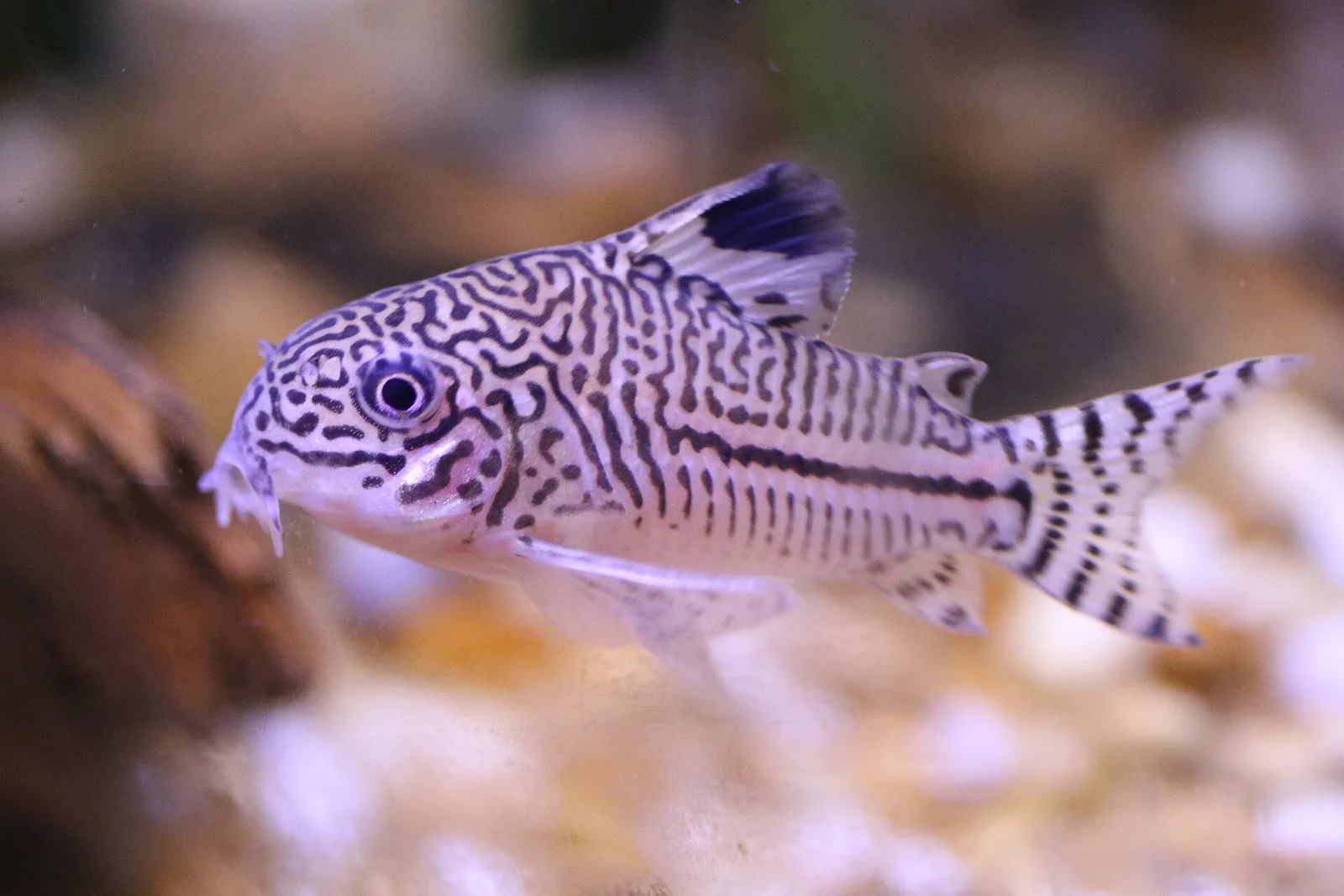
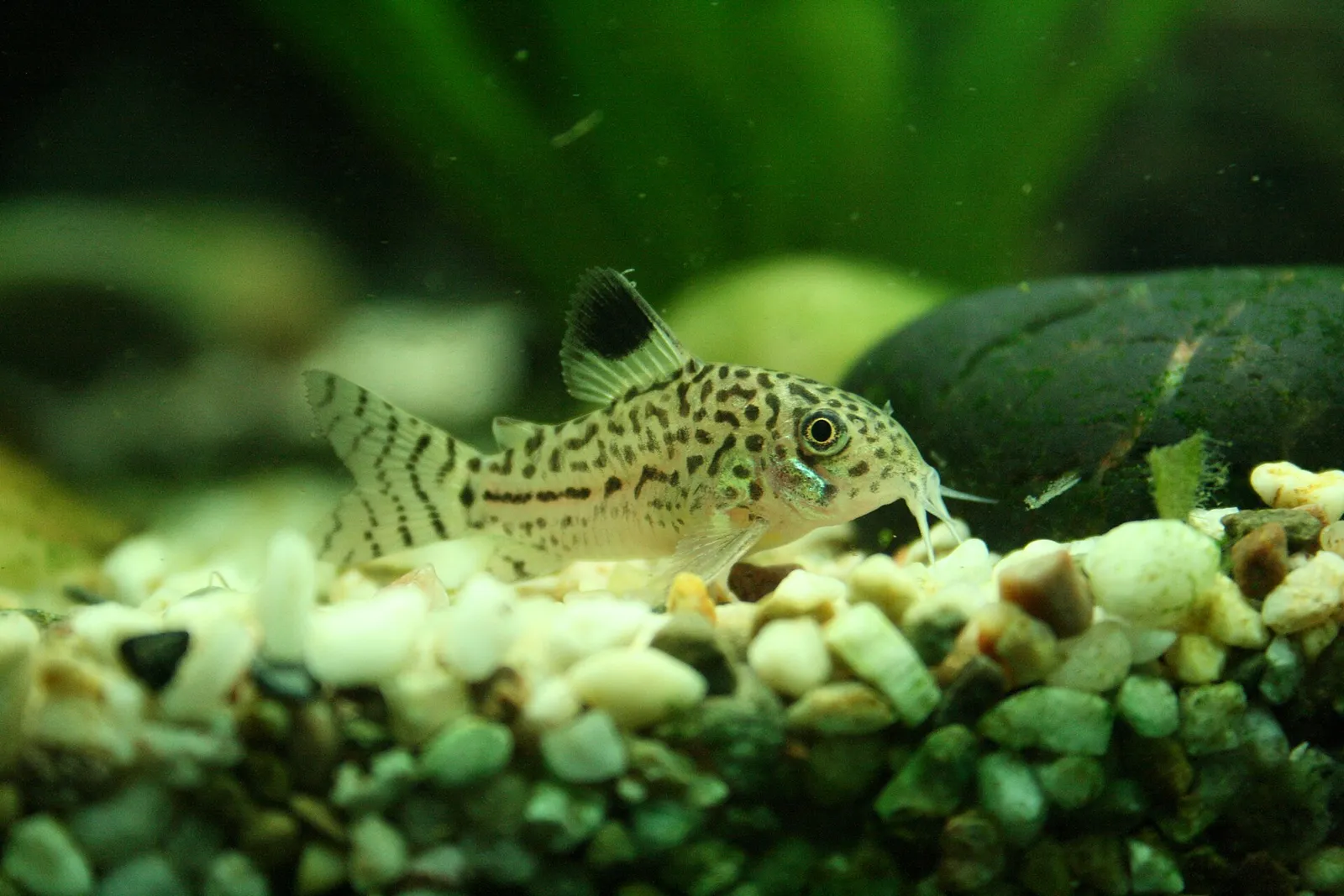
The naming story that matters most to hobbyists, though, is the 'julii' confusion. Two genuinely different species exist: C. trilineatus (Cope, 1872) of the western Amazon, and the true C. julii Steindachner, 1906, of the lower Amazon and north-eastern Brazilian coastal drainages. They look superficially alike, but the head and back patterns differ — broadly, true julii shows discrete, separate dark spots on the head while trilineatus shows those head markings joined into worm-like, reticulated lines, and trilineatus tends to a more continuous dark mid-body stripe. The honest position is this: true C. julii is uncommon in the trade, and the overwhelming majority of fish sold as 'julii' worldwide are in fact C. trilineatus. If you bought a 'julii cory,' it is almost certainly a three-line cory.
Morphology
This is a small, comparatively slender cory reaching about 2–2.5 in in standard length, with females growing larger and noticeably broader than males — a difference best judged looking down on the fish from above. Like all corys it is armoured, not scaled: two rows of overlapping bony plates (scutes) sheathe each flank, a hard bony helmet covers the blunt head, and three pairs of barbels fringe the downturned mouth used to sift the substrate.
The ground colour is a pale silvery-grey to fawn. The defining markings are a fine, dark reticulated (net-like) pattern of worm-like lines and spots over the head and upper body, and a row of dark blotches that often run together into a broken horizontal stripe along the midline — the 'three lines' of the common name refer to this striping along the body. A dark blotch typically marks the dorsal fin, and the pattern varies a good deal between individuals and populations across its range. Dorsal, pectoral and adipose fins each carry a stiff, mildly venomous spine — a defence that can give a sharp jab and tangle in a net. The reticulation versus discrete head-spotting is exactly the feature used to separate it from the true julii cory.
Habitat
Corydoras trilineatus is a fish of the western Amazon. It is recorded across the upper Amazon basin — the Peruvian Amazon (the Marañón, Ucayali and Ampiyacu among them), eastern Ecuador, south-eastern Colombia, western Brazil and parts of Bolivia; Eschmeyer's also lists coastal Suriname, though those northern records are widely regarded as doubtful and the species' core is firmly the western Amazon. It occupies smaller rivers, tributaries, quiet margins and seasonally flooded areas, typically over soft sand and leaf litter near submerged wood.
These are warm, soft, often slightly acidic tropical waters. Reported aquarium parameters span roughly 72–79 °F, a pH band from acidic to neutral (about 5.8–7.2) and soft to moderately hard water, though as a hardy adaptable fish it tolerates most reasonable conditions. Like other callichthyids it is a facultative air-breather, periodically dashing to the surface to gulp air and absorb oxygen through a vascularised hindgut, an adaptation for the warm, low-oxygen pools it meets in the dry season.
Feeding
The three-line cory is a benthic omnivore and detritivore. In the wild it forages the bottom continuously, burying its snout and barbels in sand and litter to taste out small invertebrates, insect larvae, worms, micro-crustaceans, seeds and the organic film of detritus, flushing cleaned sand back out through the gills. It is an opportunist rather than a specialist. In the aquarium it is easy to feed, readily taking sinking pellets, tablets and granules, frozen and live bloodworm, Daphnia, Tubifex and brine shrimp, and whatever its tankmates drop — but it should always have a dedicated sinking ration rather than being left to subsist on leftovers, and live or frozen foods are valuable for conditioning a group to spawn.
Mating
Like all corys, trilineatus is an egg-laying shoaler with no pair bond and the classic 'T-position' courtship. When a female ripens she cleans a spawning site — a leaf, a stone, a plant blade or the aquarium glass — and the group becomes active. A male positions himself at right angles to her head, forming a T, and she appears to take his milt directly; sperm is thought to pass rapidly through her gut to fertilise the few eggs she holds in a basket formed by her clamped pelvic fins. She carries that small clutch to the cleaned surface and presses the sticky eggs into place. The sequence repeats, a few eggs at a time, often with several males attending a single female, until dozens of eggs are scattered across the chosen surfaces.
Breeding
The three-line cory is considered one of the more readily spawned corys, and it is bred commercially in large numbers, so most fish in the trade are captive-raised. Spawning is typically triggered by conditioning a group well and then carrying out a large, cooler water change that imitates the onset of the rainy season. A productive group skews toward more males than females. The adhesive eggs — laid in small batches — receive no parental care, and the adults will eat them, so breeders move either the eggs or the parents. Eggs hatch in roughly three to five days depending on temperature; once the yolk sac is absorbed the fry take microworm, baby brine shrimp and powdered foods, and grow steadily. There are many documented hobbyist breeding reports for the species, and it is well within reach of an attentive aquarist.
In the aquarium
The three-line cory is a rewarding, hardy community fish, but it has the same real requirements as its relatives. First, it is a shoaling species and is genuinely stressed kept singly or in pairs — keep six or more and they reward you with constant, confident foraging. A group is comfortable in a tank of around 23.5 in / 20 US gal or more, where bottom area matters far more than height.
Second, substrate is functional, not decorative. Provide soft sand or very smooth, rounded fine gravel: corys feed by sifting, and sharp or coarse gravel erodes and infects the barbels, leaving the stubby, blunted faces that signal poor husbandry. Keep the bottom clean. Water should be warm but not hot (about 72–79 °F), well-filtered and oxygenated, with gentle current and regular changes; it accepts a broad pH and hardness range and prefers soft, slightly acidic water. It is utterly peaceful and an ideal companion for tetras, rasboras, dwarf cichlids and other calm community fish, and never with anything large enough to bully it. Two cautions apply to all corys: the fin spines can catch in nets (a cup is safer), and a badly distressed cory can release a skin toxin that, in the confined volume of a bag or bucket, may kill the whole group — so transport them with care. One practical note: because so much trade stock is mislabelled, a group bought as 'julii' may well be this species, and that is no bad thing — trilineatus is the hardier, more readily available fish.
Conservation
Corydoras trilineatus is assessed by the IUCN as Least Concern. It is widely distributed across the western Amazon, is generally common in suitable habitat, faces no major range-wide threats, and the bulk of fish in trade are commercially captive-bred, so collection pressure on wild populations is slight. None of that exempts it from the broad pressures on Amazonian freshwaters — deforestation, agricultural and mining run-off, sedimentation and damming all degrade the shallow marginal and flooded habitats it favours — but as a species it is in no danger. The more interesting footnote is the trade confusion itself: persistent mislabelling as 'C. julii' muddies hobby records and means the true julii cory is far scarcer in tanks than its name's ubiquity would suggest.