Taxonomy & naming
The French ichthyologist Jacques Pellegrin described this fish in 1936, but not as a full species — he named it a variety, Apistogramma pertense var. bitaeniata, in the Bulletin de la Société nationale d'Acclimatation. The epithet is plainly descriptive: Latin bi- ("two") joined to taenia ("band, stripe") with the suffix -ata gives "two-banded," for the pair of dark longitudinal stripes that run the length of the body. The genus name Apistogramma is usually read as Greek apistos ("uncertain, doubtful") plus gramma ("line, mark"), a nod to the variably developed, often broken lateral line of these dwarf cichlids.
The early naming was a tangle. Three later names — Apistogramma sweglesi Meinken, 1961, Apistogramma klausewitzi Meinken, 1962, and Apistogramma kleei Meinken, 1964 — were all eventually absorbed into Apistogramma bitaeniata as synonyms. Sven Kullander did the untangling, redescribing the species and designating a lectotype in 1980 and again in his 1986 monograph on the cichlids of the Peruvian Amazon. Pellegrin's stated type locality of "rio Madeira" was problematic — the fish was not then known from the Madeira at all — so Kullander (1980) amended it to the vicinity of Leticia, Colombia, on the Amazon proper. In the modern framework worked out by Mike Wise on apistogramma.com, the standard reference for the genus, Apistogramma bitaeniata anchors its own Apistogramma bitaeniata complex within the Apistogramma agassizii lineage of the wider trifasciata-group, a placement diagnosed mainly by the shared dark markings and by the long body and lyre-tail of breeding males.
Morphology
This is a small fish, and reports of how small disagree in a way worth flagging. The taxonomic literature is conservative: Kullander recorded a maximum of about 1.8 in standard length for a male, and FishBase follows that figure. Hobby references such as Seriously Fish quote larger maxima — males to roughly 3 in and females to 2.2 in total length — which likely reflect well-fed aquarium fish and the inclusion of the tail. Either way, a mature male is a 2-to-3-inch animal and a female is noticeably smaller.
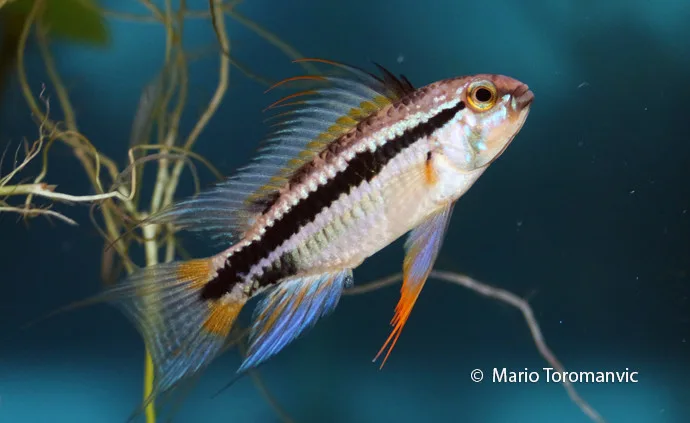
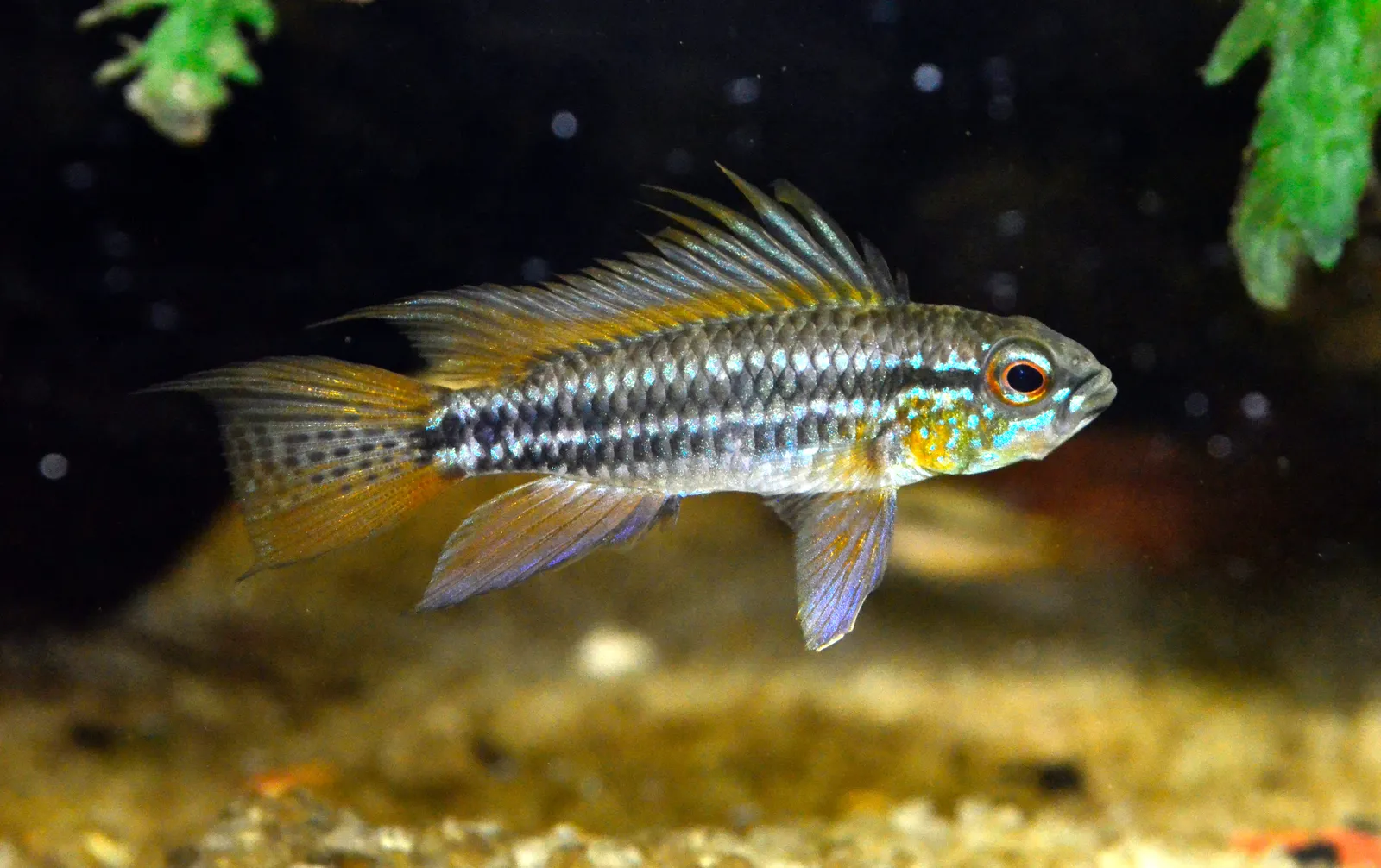
Males are the showpieces, and the sexual dimorphism is strong: a deeper body, a high-backed dorsal, distinctly extended pelvic (ventral) fins, and a lyre-shaped caudal fin with the upper and lower rays drawn out into points. Coloration depends heavily on locality — the trade loosely sorts populations into "blue," "red," "yellow," and "orange" forms, and because the species spans so many tributaries it turns up in dozens of named geographic variants. Brazilian fish tend toward more yellow on the head and a better-defined lower stripe; Peruvian fish lean blue. The two stripes that give the fish its name — one along the mid-flank, a second lower down — are the most reliable field mark separating it from look-alikes such as Apistogramma agassizii, which carries a single bold lateral band into a spade-shaped tail. Females are far plainer and smaller, but in spawning dress they turn an intense lemon yellow with bold black markings on the flank and fins — the near-universal Apistogramma signal that a clutch is on the way.
Habitat
Apistogramma bitaeniata is a western-Amazon fish, widespread across the upper basin where Peru, Brazil, and Colombia meet. FishBase draws the range narrowly — Peruvian and adjacent Brazilian blackwater systems, with vouchered collections in the lower Nanay, Mazán, and Tigre in Peru, near Leticia in Colombia, and from Igarapé Preto and Lago Tefé in Brazil. Hobby and field accounts push it much further east, through the 'Tres Fronteras' border region and down the rio Solimões toward Manaus, with disputed records as far as the Madeira and the mouth of the Tapajós. Because Pellegrin's original "rio Madeira" locality was later judged unreliable, those eastern records leave the precise eastern limit an open question.
The habitat stays consistent even where the map does not: slow tributaries, backwaters, and forest creeks where drowned leaf litter and branches collect. FishBase gives an in-situ profile of pH 5.0–6.0 and very soft water (about 2–6 dH) at roughly 73–77 °F. Most populations are true blackwater fish, living in tea-colored, acidic, ion-poor water stained by tannins from the litter. Even so, keepers report wild fish taken from murkier, near-whitewater conditions too, and just how strictly "blackwater" the species really is remains a genuine point of debate among experienced aquarists.
Feeding
In the wild Apistogramma bitaeniata is a small benthic carnivore — a micro-predator working the leaf litter and substrate for invertebrates such as chironomid (midge) larvae, small crustaceans, and other meiofauna. FishBase places it at a trophic level of about 3.3, squarely among the small insectivorous fishes rather than the higher predators. Like other members of the genus it forages by sitting and sifting rather than chasing down open-water prey, picking and mouthing food from among submerged leaves and detritus and expelling the indigestible substrate through the gills.
Its ecological role is that of a tiny, abundant link in the litter-bank food web — predator on invertebrates, prey for larger fish, and part of the dense small-cichlid guild that shares the leaf-litter zone with tetras, pencilfish, and other dwarf cichlids. Its low fishing vulnerability and modest fecundity match a small-bodied, short-lived life history typical of the genus. In the aquarium this translates into a fish that thrives on small live and frozen foods — Artemia, daphnia, cyclops, grindal and microworm, bloodworm in moderation — and that ignores most dry foods until trained; fry in particular depend on the microfauna that a deep leaf-litter bed cultivates.
Mating
Apistogramma bitaeniata has a polygynous, harem-based mating system, and it is exactly this structure that made it a favorite of behavioral biologists. A dominant male holds a large territory that overlaps the smaller territories of several females; he patrols and defends the perimeter, courts each female in turn, and leaves the brood itself to her. Courtship is the usual Apistogramma theatre of lateral display, fin-spreading, and quivering — the male flaring his lyre-tail and high dorsal while a ripening female colors up into her black-and-yellow spawning dress and retreats to a chosen cave.
The harem also supports "sneaker" males: smaller, female-mimicking individuals that suppress their own bright coloration and slip into a spawning cave to fertilize eggs while the dominant male is busy elsewhere — an alternative reproductive tactic documented across the genus. The arrangement turns volatile in confined quarters. Once a female has eggs she becomes ferociously protective of her cave and will harass or even kill the male, so keepers running a pair rather than a full harem watch for this and provide escape routes or remove him. A spacious, structure-rich layout with broken sightlines is what lets each female hold a defended cave out of sight of her neighbors and keeps the peace.
Breeding
Apistogramma bitaeniata is a cave-spawning substrate breeder with maternal, female-tending care. The female deposits a clutch of roughly 40–60 eggs on the ceiling of a cavity — a rock crevice, a hollow under wood, a snail shell, or in aquaria a small clay cave or inverted pot — and tends the eggs and resulting fry essentially alone, fanning and guarding them while the male defends the wider territory. After a few days the eggs hatch into yolk-bearing wrigglers, and within a week or so the female leads a tight school of free-swimming fry out across the litter, herding them with flicks of her body and darkening her markings as an alarm signal.
The striking detail is how sex is determined. The landmark experiments of Römer and Beisenherz (1996) showed that across dozens of Apistogramma species the temperature and pH a clutch experiences during an early sensitive window — roughly the first weeks after spawning — skew the sex ratio of the fry, with warmer, more acidic conditions tending to produce more males. This temperature-dependent sex determination (TSD) overrides simple genetic sex. It is why breeders obsess over incubation temperature, aiming for a stable band around 75–81 °F (the mid-to-high 70s °F), and why low pH and low TDS are treated as the real triggers for a viable spawn — hardness matters more than pH alone for fertilization and egg viability. The same sensitivity is what makes warming or deforestation-driven changes to stream temperatures a genuine long-term concern for wild populations.
In the aquarium
The single thing a prospective keeper has to reckon with is water chemistry: Apistogramma bitaeniata is a genuine soft-water specialist, not a fish that will tolerate moderately soft water or a pH of 6.8. Wild-caught fish and most captive-bred lines do best at pH 5.0–6.5 and conductivity under about 100 µS/cm, which in practice means RO water reconstituted with a little peat extract or blackwater concentrate, or very soft tapwater that needs no more than aging. Temperature can sit anywhere in the 73–80 °F band, with 75–79 °F the practical sweet spot for normal behavior and a successful spawn. Hard or alkaline tap water straight from the pipe — the default in most municipal supplies — will not kill the fish outright, but it suppresses color, inhibits breeding, and can shorten the lifespan noticeably. Keepers in hard-water areas who are unwilling to work with RO or rainwater are better off starting with a more forgiving Apistogramma species.
Tank: a 60-liter (roughly 15-gallon) tank is a functional minimum for a pair or harem; a 90–120-liter (24–30-gallon) tank is more comfortable, giving the male enough room to hold a territory around more than one female without constant conflict. Footprint matters more than height for a fish that lives in the bottom meter of water. Cover the floor several centimeters deep in fine sand — these fish sift and mouth the bottom constantly — and add a generous scatter of dried catappa, oak, or beech leaves, which both cultivates the infusoria and microfauna fry need and matches the blackwater creeks the fish come from. Caves are non-negotiable: small clay pots on their side, hollow coconut shells with a cut entrance, and purpose-made ceramic spawning caves all work, with at least one cave per female placed out of sightline of the others. Driftwood, twisted roots, and floating plants round out the structure and give subdominant fish somewhere to disappear.
Tankmates: in a community tank with active, nippy, or boisterous fish — tiger barbs, most larger tetras, aggressive gouramis — a pair will spend its time hiding and never color up. The classic companions are small, peaceful, soft-water schooling fish of the upper water column that double as dither fish: rummy-nose tetras, cardinal tetras, pencilfish (Nannostomus spp.), and ember tetras. Corydoras catfish that share the soft-water preference — Corydoras adolfoi, Corydoras sterbai, Corydoras panda at the lower end of the temperature range — make acceptable bottom-level companions. Other dwarf cichlids are a problem unless the tank is very large and heavily divided: two Apistogramma species together almost inevitably produces persistent territorial harassment. Avoid convicts, firemouths, and any larger cichlid.
Sexing and setup: sexing is straightforward once the fish are adult. Males are substantially larger, carry the lyre-shaped tail with its drawn-out lobes, and show the locality-dependent blue, red, or yellow palette the hobby values; females are smaller with rounded fins, but reveal themselves unmistakably when ripe, the body turning bright lemon yellow with black edging on the dorsal and caudal fins and an intensified black lateral patch. The most common beginner mistake is buying a group of unsexed juveniles and ending up with five females and no male, or the reverse — buying adults, or fish large enough to show secondary sex characters, saves a lot of frustration. A practical harem is one male with two or three females; a lone pair can work but puts more risk on the male once the female is guarding eggs, so dense structure and an exit route for him matter.
Common mistakes: difficulty is honestly medium. Apistogramma bitaeniata is not as forgiving as Apistogramma cacatuoides or Apistogramma nijsseni in tap water, and the soft-water requirement is the real barrier for many keepers. In a properly prepared soft-water tank the fish are hardy and responsive, and will breed readily with nothing more exotic than a partial water change with slightly cooler water to mimic a rain event. The recurring errors are putting the fish into hard water and then calling the species fragile; overcrowding the bottom with other substrate-dwellers; and not providing enough caves, which turns the female into a desperate aggressor and the male into a target. Done right — soft water, a leaf-littered sand floor, three or four caves per female, and a quiet shoal of tetras above — it is one of the more rewarding dwarf cichlids in the hobby.
Conservation
The IUCN Red List assessed Apistogramma bitaeniata as Least Concern (Frederico, R.G.; assessed and published 30 November 2020). It is a wide-ranging, locally common species across the western and central Amazon, faces no targeted overexploitation, and is not listed by CITES — older references, including the Cichlid Room Companion's species page, that call it "not evaluated" simply predate the 2020 assessment. The main human use is the ornamental trade: the fish is collected for aquariums and also widely captive-bred, so wild-collection pressure is modest and, where managed, can be compatible with conservation.
The honest framing is that the species is secure while its habitat is not uniformly so. As a Neotropical cichlid, Apistogramma bitaeniata belongs to the vast, still-incompletely-catalogued freshwater fauna inventoried by Kullander in the Check List of the Freshwater Fishes of South and Central America (2003) and set in ecological context by Lowe-McConnell's (1991) work on Amazon fish. These blackwater leaf-litter habitats are not collapsing the way a strained rift lake might be, but they are exposed to basin-scale pressures: deforestation, which raises and destabilizes stream temperatures; sedimentation and land-use change in headwater creeks; and the slow signature of regional warming. Because Apistogramma sex ratios are temperature-sensitive (Römer and Beisenherz 1996; and see the 2020 work explicitly linking deforestation-driven warming to skewed Apistogramma sex ratios), even moderate warming of small forest streams is a plausible long-term threat that a bare "Least Concern" label does not capture. The ornamental fishery itself, where it follows the sustainable model that has worked for cardinal tetras in the Rio Negro, can give riverside communities an economic reason to keep these forests and their blackwater creeks intact.