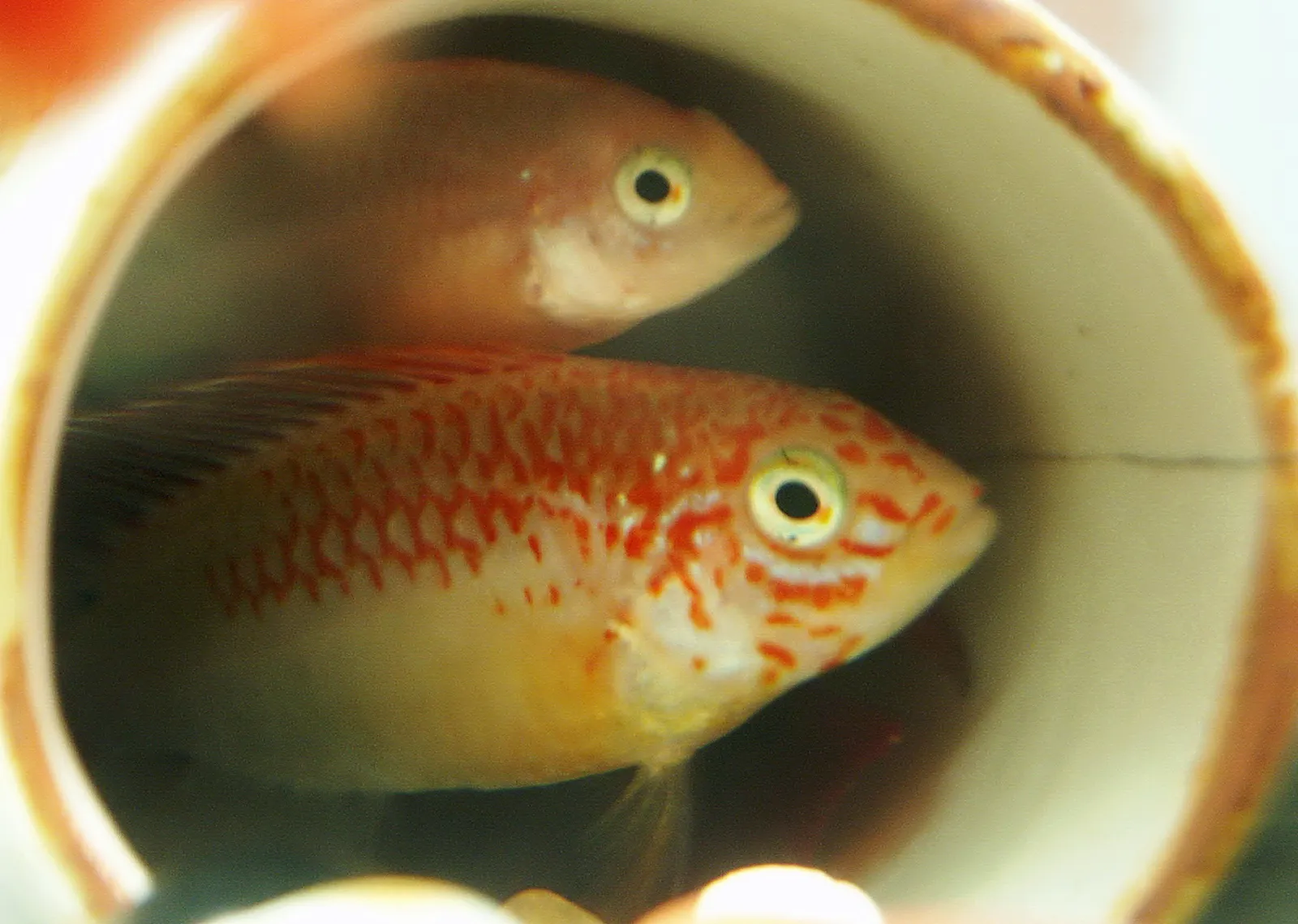
Taxonomy & naming
Apistogramma viejita was described by the Swedish ichthyologist Sven O. Kullander in 1979, in a Zoologica Scripta paper that erected four new Apistogramma from the Orinoco drainage — viejita and macmasteri among them. The original description (Kullander, 1979, Zoologica Scripta 8(1):69–79, the species on p. 73, fig. 3) was brief, and that brevity has haunted the name: it gave too few clean diagnostic characters to reliably separate viejita from its close relative macmasteri, which is the root of the decades-long identity tangle the fish is now known for. The type locality is a caño (a savanna creek) flowing into the Río Yucao in the Colombian department of Meta, at roughly 4°20′N, 72°09′W; the holotype (NRM 11231, a 1 in SL male) and a single paratype (NRM 11232) are held in the Swedish Museum of Natural History in Stockholm, both collected by T. Hongslo in 1972. Eschmeyer's Catalog of Fishes lists the species as valid and notes its range as the Orinoco basin of Colombia and Venezuela, slightly wider than FishBase's Colombia-only entry. Kullander's own 2003 checklist treatment (in Reis, Kullander & Ferraris) remains the standard nomenclatural reference for the genus.
The genus name joins the Greek apistos ("uncertain, inconstant") and gramma/gramme ("line"), an allusion to the variably developed, often incomplete lateral line that runs through the group. The epithet viejita is Spanish for "little old lady" — a folk name applied to small cichlids in eastern Colombia, sometimes read as a nod to the devoted maternal brood care these fish show. Within the genus, viejita sits in the Apistogramma macmasteri group of the Apistogramma regani lineage, part of the eartheater subfamily (Geophaginae of older classifications, Cichlinae in current usage). Apistogramma is among the most speciose of all South American cichlid genera, with on the order of ninety described species and many more undescribed forms circulating under provisional codes; viejita's own range hosts a cluster of these, including the trade forms "Rotflecken" (red-flecked, sometimes labelled "Viejita II") and "Schwarzkehl" (black-throat, "Viejita III") and code fish such as D24, D25 and D29, several of which may eventually prove to be distinct species rather than forms of viejita. One word of caution for anyone searching the literature: a 2015 "redescription" reassigning viejita to a new name, Apistogramma unipectomaculata, circulated online but was an April Fools' hoax, openly admitted by its authors; viejita Kullander, 1979 remains the valid name.
Morphology
This is a small, comparatively slender dwarf cichlid. FishBase records males to about 1 in standard length and females to roughly 2 in — figures that, as so often in Apistogramma, undersell aquarium fish, where a well-grown male with full finnage reaches a few centimetres more in total length; either way it is firmly a nano-scale cichlid. Against the deeper-bodied, higher-backed macmasteri, true viejita is a low-slung, elongate fish. Males are the showier sex, larger and more intensely coloured, with extended unpaired fins; the diagnostic feature, and the source of the "Red Edge Apisto" trade name, is a dark band edged in red along the top of the dorsal fin — a marking macmasteri lacks. A ripe or brooding female switches into a vivid yellow livery boldly marked with black on the body and face and along the leading edge of the pelvic fins, the classic alarm-and-guard coloration of a maternal Apistogramma.
Because so many look-alikes trade under the name, experienced keepers identify viejita by shape, not colour. The Apistogramma specialist Mike Wise offers a blunt field rule on the hobby forums: no bright red dorsal edge, it isn't viejita; caudal-fin extensions, it isn't viejita; deep-bodied and high-backed, it isn't viejita. The caudal-peduncle spot is the other reliable tell — short, wide and roughly squarish in viejita (variously called rectangular, trapezoid or crescent-shaped), versus the taller "D"-shaped spot of macmasteri. The species is also polychromatic, varying in colour across its range, which is part of why the trade forms above have proven so easy to confuse with it.
Habitat
Apistogramma viejita is native to the upper Meta drainage of the Orinoco basin — a llanos (tropical savanna) landscape rather than the shaded rainforest most people picture for dwarf cichlids. The type locality is a tributary of the Río Yucao in Meta, and most captive stock traces to wild fish collected around Puerto Gaitán; several colour forms occur across the upper Meta. The Orinoco is a separate river system from the Amazon, but the two share a lowland northern South American fauna and connect through the Casiquiare, so viejita belongs to the same broad Neotropical cichlid assemblage as its Amazonian congeners. (Catalog of Fishes extends the range into Venezuela, though documented Colombian localities dominate the record.)
It favours shallow, slow-moving, near-shore water with abundant riparian and emergent vegetation for cover, often in open savanna rather than forest. Field data from the type locality describe clearwater conditions — very soft, ion-poor water with electrical conductivity measured below 50 µS/cm and a temperature around 82 °F — and FishBase gives a tolerated band of roughly 73–86 °F with a lower pH bound near 5.5 and a dH ceiling around 5. As a shallow-margin fish it lives within the top metre or so of water; no deep occurrence is on record, consistent with its vegetated-shoreline habit. Recorded sympatric fishes include the eartheater Satanoperca daemon, a Mesonauta, the rummynose tetra Petitella rhodostoma, Hyphessobrycon sweglesi and an unidentified Pyrrhulina — a community of soft-water characins and cichlids typical of the llanos.
Feeding
Like other members of its genus, Apistogramma viejita is a micro-predator of the leaf litter and substrate, working the bottom of the water column. Apistogramma are chiefly carnivorous, taking small benthic invertebrates — insect larvae, microcrustaceans and other meiofauna picked or sifted from detritus and decaying leaves. FishBase places the species at a trophic level of about 3.3, the value expected of an invertebrate-feeder rather than a plant or pure-detritus specialist. In its shallow, vegetation-choked margins that diet makes it part of the small-bodied insectivore guild, sharing the shoreline with characins and other dwarf cichlids while larger eartheaters such as Satanoperca sift the open sand nearby. Its low fishing vulnerability and medium resilience (FishBase estimates a population doubling time well under five years) are those of a small, fast-maturing fish that turns over quickly in a productive habitat.
Mating
Apistogramma viejita has the harem-polygynous social system characteristic of the genus. A dominant male holds a comparatively large territory and tolerates several females within it, each defending a smaller breeding territory of her own; when females are plentiful he spawns with more than one. Toward rival males a breeding male is territorial and openly aggressive, but the species is otherwise peaceable toward other fishes and settles well into a calm community. Pair formation runs through the female: as she ripens she courts within the male's territory, claims a cave or crevice, and shifts into her bright yellow-and-black brooding dress. Wild macmasteri and viejita are found within about 31 mi of each other near Villavicencio in Colombia, and the same broad courtship and territorial pattern applies to both — one more reason the two are so easily muddled in the hobby.
Breeding
Apistogramma viejita is a cave-spawning substrate breeder. The female lays her eggs on the ceiling of a cave or crevice — in the aquarium, a flowerpot, a length of pipe, a coconut shell or a gap in the wood and leaf litter all serve — and takes on essentially all of the brood care, guarding and fanning a clutch of up to about 100 eggs. Depending on temperature the eggs hatch in roughly 36–72 hours, and the female leads the free-swimming fry a few days after that, herding them through the litter and snapping them back to cover at any threat. The male typically returns to patrolling his larger territory and courting other females, though in a single-pair tank he may help shepherd mobile fry. This maternal, cave-brooding strategy is the behavioural signature of the macmasteri group and the trait the species' folk name seems to celebrate. Captive accounts of "viejita" breeding broadly match this, with the constant caveat that most of that experience actually concerns the line-bred macmasteri sold under the name; keepers working with verified wild viejita report it spawns much as macmasteri does, while noting that fresh wild imports — soft-water fish moved through a long supply chain — can be slow to settle.
In the aquarium
First, the disclaimer that runs through everything with this species: the overwhelming majority of fish sold as Apistogramma viejita — including the familiar "Viejita Gold" and "Viejita Red" line-bred strains — are Apistogramma macmasteri, not viejita. This is not a matter of dispute; it is simply how the hobby works. A keeper who sources verified wild viejita from a specialist importer is working with a genuinely different animal, one that has received relatively little observation compared with the millions of captive macmasteri spawned under its name. What follows draws on the established care profile for the macmasteri group where viejita-specific data are thin, noting clearly where the generalisation is being made. Care for both is broadly similar; the difference is mostly one of sourcing and baseline water hardness.
A single male with two or three females can be managed in a tank of roughly 15–20 US gal (footprint at least 60 × 15.5 in), which gives the male a meaningful territory and lets each female hold a small spawning site of her own without constant conflict. Larger tanks reduce aggression and make it easier to maintain water quality. Water chemistry should match the species' origins: soft and slightly acid, with total hardness under about 5 °dH and pH in the range of 5.8–6.8. Temperature of 77–82 °F covers both field records and captive experience; the low end of that range slows metabolism and is reasonable outside of spawning periods. Wild-caught individuals arrive from genuinely ion-poor clearwater and may need a settling period in well-conditioned, tannin-stained water before they will feed freely; line-bred trade fish are considerably more tolerant of neutral, moderately hard tap water, though they do best in soft conditions.
Substrate and decor matter. Fine sand is the appropriate bottom material — these fish spend most of their time in the lower third of the water column, nosing through substrate and leaf litter, and coarse gravel or bare-bottom tanks deny them normal foraging behaviour. A generous layer of dried leaf litter (Indian almond, oak or beech) serves both biological and behavioural purposes: it acidifies and stains the water, harbours the infusoria and microcrustaceans that supplement a prepared diet, and provides visual breaks that reduce female-on-female aggression. Each female needs at least one cave she can call her own — a coconut half, a small terracotta pot turned on its side, a section of PVC pipe, or a gap in driftwood all work. Floating plants or surface vegetation to dim the light and dither fish (small, surface-active characins such as rummy-nose tetras or ember tetras) complete a setup that keeps the cichlids visible and calm rather than hidden and skittish.
Tankmates should be small, peaceful, and occupy a different part of the water column. The characin community found sympatrically in the Meta — rummy-nose and other small Hemigrammus and Hyphessobrycon — make ideal companions and reinforce the naturalistic feel of the tank. Otocinclus and small Corydoras are acceptable bottom companions. Avoid anything large enough to eat the cichlids, anything persistently aggressive toward bottom-dwellers, and other Apistogramma males unless the tank is very large and heavily divided by sight breaks. Two males in a small tank is a recipe for chronic stress and eventual injury to the subordinate fish.
In terms of difficulty, Apistogramma viejita (and macmasteri sold as such) sits at the moderate end of the genus — not a beginner fish, but not among the demanding blackwater specialists either. The main keeper mistakes are: attempting a pair in too small a tank with no backup cave, allowing hardness to creep up through repeated top-offs with hard tap water, and feeding exclusively on dried foods. A varied diet of frozen bloodworm, daphnia and cyclops alongside a quality micro-pellet keeps condition high and triggers breeding behaviour. Sexing is straightforward in adults — males are larger and distinctly finnage-extended, brooding females are unmistakably yellow-and-black — but juveniles of both sexes look similar until they are several months old. Once a female occupies a cave and shifts colour, the keeper's main job is to leave her alone: she is a competent, attentive mother and human interference is the most reliable way to cause egg-eating.
A word for keepers who want the real thing: documented, locality-data Apistogramma viejita from verified importers does occasionally appear through specialist wholesalers and hobbyist networks, particularly in Germany and the United States. These fish generally warrant softer, more carefully conditioned water than line-bred trade stock, and some patience while they settle. The reward is the actual species Kullander described — a slender, elegantly marked fish whose red-edged dorsal fin, once seen, makes every macmasteri you've previously owned look a little wider across the back.
Conservation
The IUCN Red List assesses Apistogramma viejita as Least Concern, in an assessment dated 6 August 2020 by Lina Mesa-Salazar. It carries no CITES or CMS listing, and FishBase records it in both commercial and aquarium trade while rating its fishing vulnerability low — a small, fast-reproducing fish, not a food-fishery target, and one whose ornamental demand is in any case blunted by the simple fact that very little true viejita is ever exported. That Least Concern status fits the genus-wide pattern for Orinoco and Amazon cichlids documented in the standard regional literature (Kullander 2003; Mesa-Salazar & Lasso's Colombian Apistogramma reviews): most are Least Concern or Not Evaluated, exposed to ornamental collection and habitat change rather than population collapse.
Viejita is a clearwater, savanna-stream species, which ties its fortunes to the Colombian llanos — a landscape under steady pressure from cattle ranching and large-scale agriculture, including the oil-palm and rice expansion around Puerto Gaitán, with the runoff, vegetation clearing and shoreline change that follow. The honest framing is that the species itself is not considered threatened, but its narrow range in the upper Meta makes it locally dependent on intact, vegetated savanna creeks, and decades of regional instability long kept that habitat poorly surveyed and only intermittently reachable by collectors. The one genuine conservation contribution the hobby makes here is captive maintenance of documented wild lines: because so few true viejita reach the trade, the keepers who breed verified, locality-data fish — rather than the macmasteri sold under its name — help keep the real species' genetics in circulation. None of that overstates the wild risk; it is simply the realistic picture for a Least-Concern dwarf cichlid whose main vulnerabilities are a small range and the slow erosion of llanos waterways.