Taxonomy & naming
Aristochromis christyi was described by Ethelwynn Trewavas in 1935, in the Annals and Magazine of Natural History (series 10, vol. 16), from material collected in Lake Malawi — then 'Lake Nyasa' — by the physician and explorer Cuthbert Christy during his 1925-26 expedition. Trewavas placed it in a new monotypic genus, Aristochromis, which it still occupies as the sole species: no second member has ever been validly added. The type series is a set of nineteen syntypes held at the Natural History Museum, London (BMNH 1935.6.14.2284-2296), with paralectotype material figured from the south-west arm of the lake. The genus name pairs the Greek aristos, 'best' or 'noblest', with chromis, an old name for a perch-like fish that runs through the cichlid literature; the combination is usually read as a nod to the fish's aristocratic, down-turned 'beaked' profile. The epithet christyi honours Cuthbert Christy (1863-1932) himself, the collector who brought the first specimens to the museum. The validity of the species and its monotypic genus has been upheld in the standard treatments of the lake's fauna, from Eccles & Trewavas (1989) through Konings' successive editions of Malawi Cichlids in their Natural Habitat. Within the lake's vast haplochromine flock it belongs to the non-mbuna, sand-and-open-water predators rather than the rock-dwelling mbuna.
Morphology
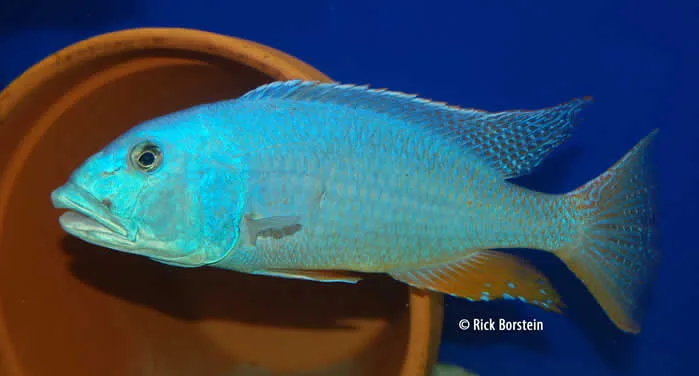
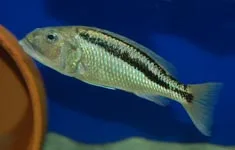
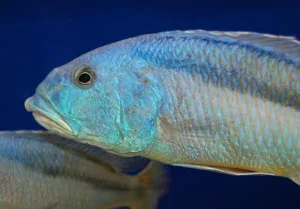
This is a large, elongate cichlid that reaches roughly 12 in total length, making it one of the bigger haplochromines of Lake Malawi; aquarium males are commonly cited around 12 in and females a little smaller. The body is streamlined for cruising, but the head is the signature: a long, pointed snout that slopes down to a large, strongly protrusible mouth, giving the profile the hooked, 'hawk-like' look that drives both the common name and the genus name. Coloration is sexually dimorphic. Dominant males develop a pale powder-blue body, often with a metallic sheen and orange-to-red anal-fin markings, while females and subordinate males are a more cryptic tan-grey, marked by two dark longitudinal lines or blotch-rows running along the upper flank — a pattern that breaks up the body against the mottled sand-and-rock background it hunts over. Subdominant males are intermediate. Beyond size and breeding colour the sexes are similar in shape, and immature fish of both sexes wear the female-type striped livery.
Habitat
Aristochromis christyi is endemic to Lake Malawi and is found lake-wide, across Malawian, Mozambican and Tanzanian waters, but it is described everywhere as uncommon rather than abundant. Its preferred ground is the intermediate or transition zone — the broken country where sandy bottoms give way to rocks — which it patrols rather than holding a fixed territory. Reported depths are shallow to moderate: FishBase gives about 7–33 ft, and field accounts place it cruising the sand-rock margin from roughly 6 to 33 feet. The water it lives in is the typical Malawi envelope — warm, alkaline and well-buffered. Lake-wide measurements put the open water near pH 7.7-8.6 and surface temperatures around 24-28 C, with steady carbonate buffering; FishBase's aquarium-oriented figures (pH ~7.4-8.4, 24-26 C, dH 7-30) sit inside that range. Unlike the rock-bound mbuna, this is a fish of open, semi-open habitat, using the structure of the reef edge as cover for ambush rather than as a grazing surface.
Feeding
The Malawi hawk is a piscivore — a fish-eater near the top of the lake's haplochromine food web, with a FishBase trophic level around 4.0. It hunts in two complementary ways: actively searching among rocks and crevices for small fish, and ambushing prey in the open. The ambush is distinctive; the predator approaches a target very slowly, sometimes tilting or rolling slightly onto its side as it closes the distance, then strikes with a rapid lunge, the large protrusible mouth shooting forward to engulf the prey. Its quarry is chiefly smaller cichlids — juveniles and the lake's many small mbuna and utaka — which the long jaws and capacious gape are well suited to swallowing whole. This is the ecological role the morphology advertises: the sloped 'beak' and big mouth are the working tools of a specialised ambush predator of the sand-rock interface, and the same strong, beaked snout — read as an adaptation to how the prey is finally seized — is shared by only two other Lake Malawi haplochromines with a broadly similar hunting style, Exochochromis anagenys and Tyrannochromis macrostoma; Aristochromis christyi is told apart from the superficially similar E. anagenys by a dark diagonal marking on the flank rather than that species' three bold blotches.
Mating
Like the great majority of Lake Malawi haplochromines, Aristochromis christyi is a polygynous maternal mouthbrooder with no lasting pair bond. Breeding is organised around dominant males, which take on the bright powder-blue, orange-finned nuptial dress and court visiting females; a single male will spawn with several females in succession. Males clear or excavate a simple spawning site — keepers report dominant males digging shallow pits in sand — and display over it to draw ripe females in. Reported aggression is comparatively restrained for so large a predator: males are described as showing relatively little hostility toward other males, and the species is generally a calm tank occupant by big-Malawi-cichlid standards, though it is easily startled and will treat any tankmate small enough to swallow as food rather than a rival.
Breeding
Reproduction follows the classic Malawi maternal-mouthbrooding pattern. After courtship over the male's site the female lays a clutch of eggs, takes them into her mouth, and collects the male's milt to fertilise them — typically using the egg-spot cues common to haplochromines. She then carries the developing eggs and larvae in her buccal cavity for roughly three to four weeks, not feeding while she broods, before releasing free-swimming fry. Because it is a large fish the broods are correspondingly large for a mouthbrooder, and the released young are relatively big and well-developed. There is no biparental care: once the female releases the fry, parental investment ends, and in the wild the juveniles disperse into sheltered, structured habitat. In aquaria the species is best spawned in a harem of one male to several (at least three) females in a spacious tank; brooding females may be stripped or allowed to release naturally, and the comparatively large fry are straightforward to grow on.
In the aquarium
Aristochromis christyi demands serious space. A single adult male reaches roughly 12 in and needs an open run of water: the practical minimum is a tank of 71 in (six feet) in length and 65 US gal, and a 380-litre (100-gallon) or larger footprint is considerably more appropriate, especially if a harem or companion cichlids are intended. Furnish the tank with a bed of coarse sand or fine aragonite, a substantial rockwork pile toward one end for the fish to use as cover and territory reference, and a long open mid-ground for cruising. Malawi's own chemistry should be replicated closely — pH 7.8–8.6, temperature 75–82 °F, and well-buffered water (general hardness 10–20 °dH is typical using Rift Valley salt mixes or buffered tap water). A robust, cycled filter providing high turnover is important; like most large predators, Aristochromis christyi produces a substantial waste load.
Choosing tankmates is the central difficulty of keeping this fish. It is a piscivore by design, and any cichlid or other fish that fits in its mouth will eventually disappear — juveniles of otherwise compatible species are especially at risk as the hawk grows. Safe companions are large, robust Lake Malawi haplochromines of similar dimensions: big Copadichromis, Sciaenochromis fryeri, Nimbochromis livingstonii, and similar open-water or semi-aggressive Haps that can hold their own. Mbuna are broadly incompatible, partly because their territory-holding aggression can stress the comparatively placid hawk and partly because small-to-medium mbuna fall squarely within its prey size range. Peacock cichlids (Aulonocara spp.) are too small and too passive for a tank that includes a 12 in ambush predator.
Despite its imposing size, Aristochromis christyi is often described by experienced keepers as one of the calmer large Malawi predators — less relentlessly aggressive toward conspecifics than many Nimbochromis, for instance, and unlikely to shred tankmates it cannot eat. However, it startles easily, and a frightened fish of this size can damage itself against glass. Providing adequate cover (the rock pile) and keeping the tank away from heavy foot traffic reduces this risk. Feed an adult on meaty, protein-rich foods: large pellets formulated for predatory cichlids, krill, prawns, earthworms, and occasional whole silversides or smelt. Live feeder fish are unnecessary and carry disease risk; the hawk adapts readily to prepared and frozen foods. Juveniles are straightforward to wean from small pellets and frozen Mysis upward.
For breeding, the standard haplochromine harem arrangement works well: one dominant male and three or more females in a sufficiently large tank. The male will dig a shallow sand pit, colour up, and court females. Females brood for roughly three to four weeks without eating; the keeper can strip at about the three-week mark or allow the female to release the fry, which are large enough at emergence to take finely crushed cichlid pellets and baby brine shrimp immediately. If a brooding female is left in the community tank she should be given the option of retreating behind the rockwork, as the male will resume courtship pressure quickly. Growing the juveniles separately prevents them from becoming targets of both the adults and any other large occupants.
The most common mistakes with this species are housing it in a tank that is simply too small (a common underestimate given how undemanding juveniles seem at 3–4 in), selecting tankmates on aggression level alone without accounting for prey size, and feeding a diet heavy in fatty mammalian proteins — beef heart, for example — which can cause lipid deposits and shorten lifespan. This is a genuinely specialist fish: rewarding for the keeper who can commit to the footprint and give it Malawi-appropriate water, but a poor fit for a general community.
Conservation
The IUCN Red List assesses Aristochromis christyi as Least Concern (2018; e.T60932A47223605), on the strength of its lake-wide distribution across Malawi, Mozambique and Tanzania and the absence of any species-specific threat, even though it is naturally uncommon. It carries no CITES listing, and ornamental collection for the aquarium trade is modest given how seldom it is exported. That favourable status, however, sits against a backdrop of mounting basin-level pressure on Lake Malawi as a whole. Reviews of the lake's limnology and fisheries document warming surface waters and strengthened stratification that reduce the mixing which brings nutrients to the productive upper layers, alongside heavy artisanal and commercial fishing, shoreline development, deforestation in the catchment and the sedimentation and nutrient loading that follow. As a predator of the shallow sand-rock margin, Aristochromis christyi is exposed to near-shore habitat degradation and to declines in the small-cichlid prey base on which it depends; none of these is recorded as an immediate danger to the species, but they are the trajectory against which its long-term outlook should be read. The lake's own status page sets out these basin-wide pressures in fuller detail.