Taxonomy & naming
George Albert Boulenger described this fish in 1908 as Paratilapia caerulea, from material taken in Lake Malawi (then Lake Nyasa) by Captain E. L. Rhoades, whose collections from the British gunboat patrolling the lake yielded a string of new Malawi cichlids in that same paper. The original description rests on a single specimen — the unique holotype, BMNH 1908.10.27.60, in the Natural History Museum, London — and the type locality is simply "Lake Nyasa." The genus Champsochromis was erected by Boulenger himself in 1915 to hold these elongate predators, with caerulea fixed as its type species by later authors (Jordan, 1920; Regan, 1922); the current combination, Champsochromis caeruleus (Boulenger, 1908), is accepted by Eschmeyer's Catalog of Fishes, FishBase and the IUCN.
One junior synonym is worth flagging: Haplochromis boultoni Nichols & LaMonte, 1931, described from a small 3 in specimen, was sunk into Champsochromis caeruleus by Eccles and Trewavas in their 1989 revision of the Malawian haplochromines. The genus holds just two species — Champsochromis caeruleus and the deeper-bodied Champsochromis spilorhynchus — and only caeruleus is regularly seen in the hobby. Champsochromis sits in the subfamily Pseudocrenilabrinae within the vast Lake Malawi haplochromine flock, the "haps" of aquarium shorthand. The trade names "trout cichlid" and "Malawi trout" are nods to its trout-like profile and cruising habit; an invalid hobby label, "Haplochromis thola," still circulates, and M. K. Oliver records a local Malawian name from Monkey Bay, "Nchyochyo," reported by Jackson in 1961.
Morphology
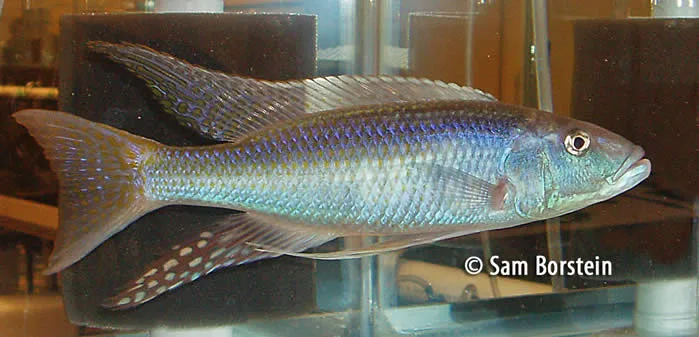
This is a strongly elongate, fusiform cichlid built for speed rather than maneuver — the body shape that earns it the "trout" tag. Reported maximum size depends on the source and on whether wild or aquarium fish are meant. FishBase lists 12.5 in total length, and Eccles & Trewavas (1989) likewise give at least about 12.5 in TL for wild fish; but specialists who keep and observe large males report substantially bigger animals, with malawi.si citing males to roughly 14–15.5 in TL and females to 10–12 in, and some hobby accounts (e.g. Sam Borstein) describing exceptional males approaching 17.5 in. The honest summary is that wild fish run to about a foot, while well-fed captive males are the largest of all and can considerably exceed that.
Color is the male's calling card. Juveniles and females are a plain, sardine-like silver crossed by a dark oblique stripe running through the body; in mature males that stripe is usually masked beneath a metallic steel- to powder-blue sheen, with orange-to-red flecking on the scales and a reddish anal fin. The species' diagnostic features are in the fins and teeth: dominant males draw the soft-rayed portions of the dorsal, anal and pelvic fins out into long trailing filaments that can stretch well past the tail, while the outer jaw teeth are widely spaced, unicuspid and slightly recurved — unlike the more crowded dentition of look-alike predators such as Buccochromis. It is separated from its only congener, Champsochromis spilorhynchus, by its more slender build: greatest body depth goes 3.8–4.6 times into the standard length, versus 3.2–3.6 times in the deeper-bodied spilorhynchus.
Habitat
Champsochromis caeruleus is a lacustrine endemic of Lake Malawi, found lake-wide; because Malawi's shoreline is shared, its range falls within the waters of Malawi, Mozambique and Tanzania. Eccles & Trewavas reported it as particularly common in the southwest arm of the lake. It is an open-water fish rather than a rock- or sand-bound specialist: it cruises the water column above sandy bottoms and intermediate (sand-and-rock) zones, occasionally over rock. Konings and malawi.si place its everyday habitat at relatively shallow depths of roughly 10–49 ft, while Eccles & Trewavas record the species down to at least 180 ft, so the depth band it occupies is broad.
The water it lives in is the classic Malawi profile — alkaline, well-buffered and warm. FishBase gives an in-situ pH range of about 7.5–8.3 and a hardness range of 5–30 dH, with temperatures around 75–79 °F; the lake's well-buffered chemistry runs to pH values of roughly 7.7–8.6 and surface temperatures of about 75–82 °F across the year. As an open-water cruiser it is tied less to a particular substrate than to the movements of its prey.
Feeding
Champsochromis caeruleus is a piscivore — a pursuit predator that overtakes smaller fish in open water rather than ambushing them or cropping the bottom. FishBase places it high in the food web, with an estimated trophic level near 4.2. Its signature prey is the usipa, the anchovy-like cyprinid Engraulicypris sardella that forms huge mid-water shoals in Malawi; Konings describes Champsochromis caeruleus following these schools and picking off individuals, and observers consistently note how fast and direct the chase is. It is a fish that earns its streamlined shape: speed in the open water is the whole hunting strategy.
In a lake whose cichlid radiation is famous for fine-grained trophic partitioning — scale-eaters, snail-crushers, sand-sifters, plankton-pickers — Champsochromis fills the role of a mobile, cruising fish-hunter that crops the abundance of small pelagic prey and smaller haplochromines. Because it is rarely caught in beach seines despite frequenting shallow sandy areas, and is only occasionally taken on hook and line, much of what is known of its wild diet comes from direct underwater observation rather than gut sampling.
Mating
Outside breeding, Champsochromis caeruleus is a largely solitary cruiser. Konings notes that juveniles occasionally form small schools but that the species usually occurs singly once it reaches about 4 in; adults are rarely seen, and when they are, it is sometimes as an apparent pair in open water. Reproduction reorganizes that solitary life around a male's spawning site. A ripe male clears a small pit or shallow nest in the sand of the intermediate habitat — circling over the spot to sweep it clean — and intensifies in color, the blue deepening and the long fin filaments held erect, to court females drawn in from the surrounding open water.
Accounts of the nest's scale vary with conditions: in the wild Konings (via Peter Baasch's observations) describes a modest cleared pit, whereas aquarium keepers report territorial males excavating broad sand depressions — Borstein measured one roughly a foot across, and malawi.si cites bowers around a metre wide and 4–8 in deep. As in nearly all Malawi haplochromines the courtship culminates with the pair descending to the spawning surface, and fertilization takes place inside the female's mouth.
Breeding
Like the great majority of Lake Malawi haplochromines, Champsochromis caeruleus is a maternal mouthbrooder: the female takes the eggs into her mouth, where they are fertilized, and incubates the developing young there through their most vulnerable stage before releasing free-swimming fry. For so large a fish the clutches are strikingly small — captive spawns of only about 30–35 eggs are typical — but the eggs themselves are exceptionally large, among the biggest recorded for any Malawi cichlid; Borstein notes that newly free-swimming fry already measure on the order of 0.5–1 in (about three-quarters of an inch). Incubation runs roughly four weeks (a held female in captivity went the full ~30 days), and the female guards the released fry for some weeks; juveniles form small shoals in shallow water until they reach about 6 in, after which they take up the solitary, cruising adult life.
The species has a hobby reputation as a poor holder that produces small, unreliable spawns, though experienced breeders dispute how universal that is — at least one keeper reports a clean full-term hold and easily raised fry. The trade-off here is the classic large-egg, low-fecundity strategy: few young, but each one large and well provisioned at release. The fry grow quickly once past the early weeks, though growth slows around the 2 in mark before accelerating again.
In the aquarium
Champsochromis caeruleus is not a fish for the average cichlid keeper, and anyone who approaches it as a large-tank novelty is likely to regret it. Adult males reach 14–15.5 in and are active, fast-swimming open-water predators; a realistic minimum footprint is a tank of 8 feet in length with a volume of 200 US gal or more — the widely cited "200-gallon" rule is a reasonable floor, not a comfortable margin. The fish needs long, unobstructed swimming lanes, so heavy rockwork should be kept to the back and sides; a deep sand substrate with a few large, smooth boulders at the margins suits the species and allows the male to excavate the broad sand pit he uses as a spawning site. Vigorous surface agitation, strong biological filtration, and regular large-percentage water changes are non-negotiable: this is a high-metabolism predator producing substantial waste.
Water chemistry must match the Lake Malawi profile. Target a pH of 7.8–8.6 and a general hardness of 10–20 dH, using a substrate and top-off water that sustain alkalinity; temperature should sit in the 75–81 °F band. These parameters are not difficult to achieve in hard-water regions, but letting pH slip below 7.5 risks both stress and suppressed immune function. Commercial Malawi buffer products, aragonite sand, and crushed coral in the sump are all commonly used to maintain stability.
Finding appropriate tankmates is one of the harder aspects of keeping this species. Because Champsochromis caeruleus is a pursuit piscivore, any fish it can swallow will eventually disappear — this rules out small haplochromines, juveniles of other species, and essentially all smaller community fish. Suitable companions are large, robust haplochromines of similar or greater body size that share the Malawi alkaline-water chemistry requirement: other large "Hap" species such as Nimbochromis, Copadichromis (provided they are not significantly smaller), and robust peacocks (Aulonocara) that approach or exceed 6 in are sometimes kept alongside it with reasonable success in very large tanks. Mbuna are generally poor matches — their diet and behavioral style differ, and the combination can produce chronic stress for the Mbuna. More than one male Champsochromis caeruleus per tank is likely to produce serious conflict without a very large, well-managed system. Keeping a single male with a group of females is the most straightforward approach.
Feeding in captivity is uncomplicated but must reflect the species' piscivorous biology. Large carnivore pellets, frozen whole fish (smelt, silversides), and high-protein frozen foods such as mysis are all accepted; the fish is not a picky feeder once settled. Feeder fish from unknown sources carry disease risk and are best avoided. Vegetable-heavy staples formulated for Mbuna or omnivorous cichlids are inappropriate here and provide inadequate protein for sustained condition. Frequency of two to three feedings per week in moderate portions suits an adult, preventing both food waste and obesity.
Breeding in the home aquarium has been achieved but is infrequent enough that it is considered a keeper milestone rather than a routine event. The male must be at full size and in prime condition; the tank must be large enough that the female can retreat after spawning without constant harassment. Clutches are small — typically around 30–35 eggs — but the fry emerge already measuring roughly 0.5–1 in and are relatively straightforward to raise on finely crushed pellet and small frozen foods from the outset. The female should be moved to a quiet holding tank if the main display is not large enough to protect her during the roughly four-week incubation. The most common keeper mistakes are underestimating tank size, attempting to keep this species with fish it will eat, neglecting water change discipline in a tank with high biological load, and misreading the species' slow acclimation as illness. Given the right setup it is long-lived, visually striking, and rewarding to watch — but the setup itself is demanding, and honest assessment of available space should precede any purchase.
Conservation
On the IUCN Red List, Champsochromis caeruleus is assessed as Least Concern (assessment dated 22 June 2018), on the grounds that it is endemic to Lake Malawi but widespread across the lake, with no evidence of a population-level decline; it carries no CITES listing. It is taken in the lake's fisheries — listed as of commercial interest for food and for the aquarium trade — but only incidentally and at low intensity, and its low fishing-vulnerability score reflects an animal that is not specifically targeted. As a wide-ranging open-water generalist it is far less exposed than Malawi's many narrow-range rocky-shore endemics.
That "Least Concern" label is best read against the strain on the lake itself rather than as an all-clear. The 2023 basin review by Chavula and colleagues in the Journal of Great Lakes Research documents a system under compounding pressure: over-fishing that has collapsed the prized chambo (Oreochromis) fishery, heavy sediment and nutrient loading off deforested catchments, and roughly 33 °F of warming in the shallow waters that strengthens stratification and tends to suppress the nutrient upwelling driving the lake's productivity. For a pelagic predator whose living depends on dense shoals of usipa and other small prey fish, the relevant risk is indirect but real: pressure on the lake's small-pelagic fishery and on overall productivity bears directly on the prey base Champsochromis caeruleus chases. The species itself is not currently threatened; the water body it depends on is under genuine and growing stress, and that is the honest framing.