Taxonomy & naming
Aulonocara sp. "Lwanda" is an undescribed form with no formal scientific name. There is no describing author, no year of publication, and no entry for it in Eschmeyer's Catalog of Fishes, because no taxonomist has published a description. It is instead an informal taxon recognised in the field and aquarium literature, principally through Ad Konings, who documents it in his Malawi cichlid books and curates its profile on the Cichlid Room Companion (where it is referenced to the 1995 second edition of Malawi Cichlids in their Natural Habitat). The placeholder name follows the standard cichlid convention — genus, the abbreviation "sp.", and a trade name in quotation marks. Konings places it within the cave-dwelling Aulonocara jacobfreibergi group, the assemblage of peacocks that breed inside caves rather than over open sand, and it is to Aulonocara jacobfreibergi that it is most directly allied. It is especially close to another undescribed cave-dweller, Aulonocara sp. "Walteri" from the Likoma and Chizumulu islands, so close that the two should never be kept together in captivity because they will hybridise. Common trade names include "Red Top" and "Red Top Lwanda." Until a formal revision is published it should be treated strictly as a Konings-recognised undescribed form, with no authority or date attached.
Morphology
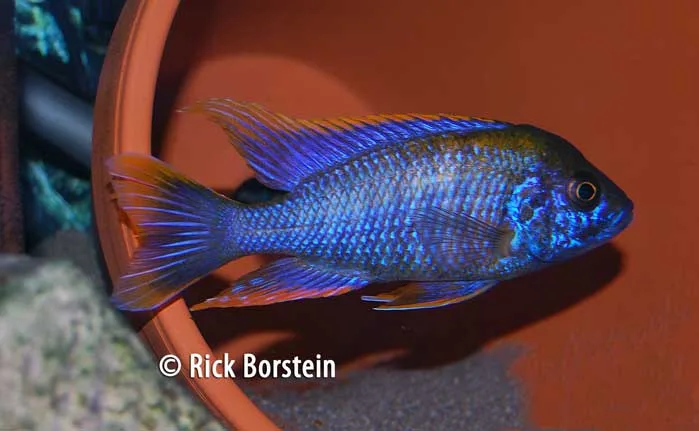
This is one of the larger peacocks. Field references following Konings give males to about 5.5 in and females to roughly 4.5 in, males running distinctly larger as is usual in the genus. The body is the laterally compressed haplochromine form, and the head carries the enlarged cephalic sensory pores diagnostic of Aulonocara, though as in the other cave-dwellers of the group these pits are somewhat less developed than in the open-sand peacocks. Sexual dichromatism is pronounced and is the whole reason for the fish's fame. Breeding males are a deep, saturated blue across the body, with bold red-orange margins on the dorsal and the other vertical fins — the "red top" that names the fish in the trade. Females are far plainer, resembling those of related cave-dwellers but slightly darker than the females of the sympatric Aulonocara stuartgranti, which is the main way to tell them apart in the field.
Habitat
Aulonocara sp. "Lwanda" has a very limited distribution at the south-eastern margin of Lake Malawi, known from Hai Reef in Tanzanian waters and from the coast near Chiwindi in Mozambique. Its biotope is the intermediate zone with a strong rocky component — a mix of sand and rock in which males live mainly in shallow rocky areas and small caves. Konings records it from shallow water, roughly 10–33 ft deep, making it a comparatively shallow cave-dweller. The water is the warm, alkaline, well-buffered medium of the lake's rocky shallows. Because the form occupies only a couple of sites and lives at depths well within reach of collectors, its restricted range translates directly into vulnerability, and it has become difficult to find in the wild where it was once a celebrated sight.
Feeding
Aulonocara sp. "Lwanda" is a carnivorous invertivore, feeding on small insect larvae and crustaceans. Like the rest of the genus it carries the enlarged head pores that let peacocks detect the movements of invertebrates in sand and sediment, and it takes its prey from the sandy floors of its caves and from sediment lying on the rocks. As a cave-associated peacock it does less of the open-sand "hovering and listening" than the sand-dwelling species and works the substrate in and around its rocky shelters instead. The prey itself is the genus-typical menu of small benthic invertebrates; the foraging is simply tied to the cave-and-rock habitat the fish occupies.
Mating
This is a cave-spawning peacock with a lek-like but cave-bound social system. Males defend small caves with a sandy bottom as breeding territories, and neighbouring territorial males may sit less than a metre apart along a productive stretch of rock. Females gather nearby on the sand and are led into a male's cave when ready to spawn. Unlike the open-sand peacocks, the male builds no spawning crater or sand dish; the spawning takes place inside the cave itself. As in the related Aulonocara jacobfreibergi, several males can sometimes be found inside a single large cave. Males are moderately assertive in defence of their caves but are not among the lake's truly aggressive cichlids.
Breeding
Aulonocara sp. "Lwanda" is a maternal mouthbrooder, following the standard haplochromine pattern. Spawning occurs inside the male's cave rather than over open sand: the female lays her eggs on the cave floor or wall and immediately takes them into her mouth, where she broods them until the fry are free-swimming, with no male or post-release parental care. Clutch sizes and brooding details for this particular form are not closely documented in the wild, but by analogy with its close relatives the female fasts through a brooding period of several weeks before releasing the young. The form breeds in captivity along the same lines as other cave-dwelling peacocks, with a single male and several females in a cave-rich tank, though it is far less commonly bred than the popular sand-dwellers because wild stock is now scarce.
In the aquarium
Aulonocara sp. "Lwanda" is a spectacular but increasingly hard-to-source fish, sold in the hobby under the "Red Top" name. Because wild numbers have fallen so far, responsible keepers should seek line-bred stock from specialist breeders rather than fuel demand for wild-caught fish.
It needs more space and far more rock than a typical open-sand peacock. A large aquarium — on the order of 105 US gal or more — with a fine sand substrate and extensive rockwork arranged into caves and sheltered passages suits it best, reproducing the cave-and-rock intermediate habitat it occupies in the lake. The standard stocking is one male with several females, or a larger group in a spacious tank. This is a moderately assertive but generally peaceable cichlid, and it should not be housed with aggressive or strongly dominant species that would bully it.
A critical husbandry point is hybridisation: Aulonocara sp. "Lwanda" must never be kept with its close relative Aulonocara sp. "Walteri," because the two will interbreed and muddy both lines. The same caution applies to mixing it with other blue-bodied, red-finned peacocks of uncertain identity, of which the trade has many.
Water chemistry should mirror Lake Malawi's rocky shallows: temperature in the mid-20s Celsius, pH roughly 7.8 to 8.6, and well-buffered water, with the soft, acidic conditions that stress Malawi cichlids strictly avoided. Diet is the varied peacock menu — a quality cichlid pellet or flake supplemented with small frozen or live invertebrates such as chironomid larvae and brine shrimp — while fatty foods, which predispose Malawi cichlids to bloat, should be kept off the list. Regular partial water changes keep nitrate in check and the fish in good colour.
Conservation
Aulonocara sp. "Lwanda" has not been evaluated by the IUCN and, as an undescribed form without a formal scientific name, has no Red List assessment of any kind. The field and aquarium literature, however, is unusually direct about its plight. Konings reports that it is very much threatened by over-collection for the ornamental fish trade, that its distribution is very limited, and that the total wild population is believed to number fewer than a thousand individuals. Once regarded as one of the most striking cichlids in Lake Malawi, it has become very difficult to find in the wild. None of this carries the formal weight of a Red List category, and no fabricated status should be attached to it — but the honest picture is of a narrowly endemic, strikingly beautiful fish whose desirability has driven its wild numbers to a dangerously low level. Sourcing captive-bred stock and avoiding wild-caught fish is the most practical thing a hobbyist can do for it.