Taxonomy & naming
The bumblebee cichlid was described in 1982 by Anthony J. Ribbink and D. S. C. Lewis as Melanochromis crabro, based on material collected from Maleri Island in the southeastern arm of Lake Malawi (13°53'S, 34°37'E), at a depth of 49–59 ft. The holotype — a male of 2.5 in standard length — is lodged at the Natural History Museum in London as BMNH 1981.11.30.23, with ten paratypes under the adjacent catalogue numbers. The paper appeared in the Netherlands Journal of Zoology, volume 32, in 1982.
Placement in Melanochromis proved short-lived. The genus Pseudotropheus Regan, 1922 was subsequently confirmed as the correct home by Maréchal (1991) in the CLOFFA checklist and has been maintained ever since in all subsequent syntheses, including Konings & Stauffer (2012) and Konings (2016). Eschmeyer's Catalog of Fishes (updated May 2026) lists the species as valid under Pseudotropheus crabro (Ribbink & Lewis 1982), with Melanochromis crabro Ribbink & Lewis 1982 and Maylandia crabro (Ribbink & Lewis 1982) as junior synonyms. The IUCN Red List notes that it previously appeared in their database under the name Maylandia crabro but was moved back to Pseudotropheus in the 2018 assessment. No further taxonomic revision has been published; Pseudotropheus crabro remains the accepted binomial.
In 1991, Jay R. Stauffer Jr. described an additional species of facultative cleanerfish in the same genus, which he noted closely resembles Pseudotropheus lanisticola and Pseudotropheus livingstonii in superficial appearance — confirming that the cleaning behaviour documented in Pseudotropheus crabro is unique within Pseudotropheus and is not shared by its new congener. This distinction reinforced the ecological singularity of crabro within the Malawi mbuna flock.
In the trade the species occasionally circulates under the informal labels "Pseudotropheus Chameleo" or "Melanochromis crabro", the latter a holdover from its original description — neither is a valid name. The established English common names, bumblebee cichlid and hornet cichlid, are used throughout the hobby and in the scientific literature (Konings 1990, Konings 1995).
Morphology
Pseudotropheus crabro is a moderately deep-bodied, laterally compressed cichlid of the typical mbuna build: rounded snout, large eyes, and a dorsal fin that runs nearly the full length of the body. In the wild, adults reach approximately 5.5 in total length (malawi.si; Konings 1995); the IUCN assessment similarly gives 4.5 in TL as the maximum observed under field conditions. CLOFFA records 3.5 in SL for the type series, a figure expected to be smaller than wild-adult TL — the discrepancy reflects measurement method and the age of the type material. Aquarium fish regularly exceed the wild figure and can reach 7 in or more under good feeding conditions, a common pattern in mbuna kept without the resource competition and energy costs of a natural rocky reef. Males are somewhat larger than females at full size.
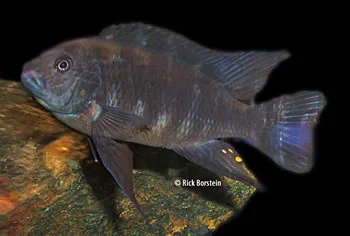
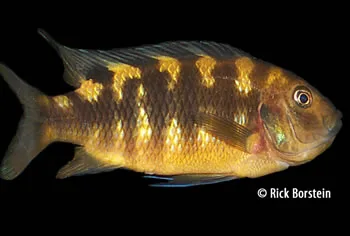
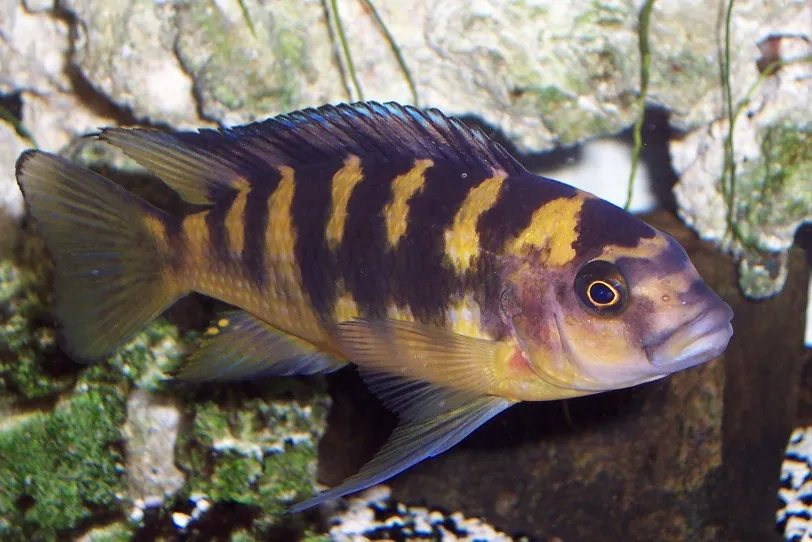
The species' signature pattern — yellow body with eight or nine dark-brown to black vertical bars — is the basis of both common names. The first bar crosses the upper lip and snout, the second passes through the eye, and subsequent bars run across the flank to a final bar at the caudal peduncle. Some populations show additional horizontal striping alongside the transverse bars. Fins in both sexes are grey to black; males frequently show subtle blue iridescence on the flanks that intensifies with breeding condition. In a second colour form, which appears during egg-stealing forays inside kampango nests, the fish loses the yellow entirely and becomes a uniform dull brown, making it nearly invisible against the dark sandy substrate and cave walls of the catfish's nest. This phase-shift is active and rapid — Konings reports it happening within seconds — and is behavioural rather than pigment-based, reversing equally quickly when the fish withdraws from the cave.
Sexual dimorphism is pronounced in colouration. Females and juveniles are pale yellow with soft brown barring and lack the male's iridescence. Breeding males deepen to a very dark brown approaching black overall, the bars all but invisible against the uniformly darkened body. Males of most populations show egg-spots on the anal fin; this character is consistent but not an infallible sexing marker in isolation.
Habitat
Pseudotropheus crabro is endemic to Lake Malawi and has a moderately wide but not continuous distribution through the southern two-thirds of the lake. It occurs along both the Malawian and Tanzanian shores and in Mozambican waters but does not extend beyond Hongi Island on the eastern shore or Mara Rocks on the western shore (IUCN 2018; malawi.si). Documented localities include Maleri Island (the type locality), Mbenji Island, Eccles Reef, West Reef, Chinyankwazi, Chiyamwezi, Likoma Island, Chisumulu Island, and Nkata Bay (FishBase; malawi.si), as well as Cobwé, Chilucha Reef, Chiofu Bay, Gome Rock, and Lion's Cove among the named colour-morphs listed on malawi.si.
The species is primarily a deep-rocky-reef fish. Most individuals are found between 10 and 148 ft depth (malawi.si; Konings 1995), though the original description fixes the type-locality depth at 49–59 ft and FishBase records that same range. It is almost never encountered in the open sandy zone. Within its depth band it shows a strong preference for large caves or overhangs beside massive boulders — not the broken cobble habitat of most mbuna but the deep, cathedral-like cavities formed by Lake Malawi's basement-granite boulder piles. This preference is inseparable from its ecology: wherever kampango are present and breeding, crabro will be found.
The lake's water chemistry at typical crabro depths is alkaline and well-buffered, as dictated by Malawi's underlying Precambrian basement and the lake's closed or semi-closed basin dynamics. FishBase records a pH range of 7.5–8.2 and temperatures of 75–79 °F for this species; the broader Malawi range measured in the rocky littoral reaches pH 7.7–8.6 and temperatures roughly 75–82 °F depending on season and depth.
Feeding
The feeding biology of Pseudotropheus crabro is the most unusual of any mbuna and has attracted more field study than any other aspect of its natural history. The species has two distinct foraging modes that together make it, as Ad Konings has written, a fish that leads a double life.
In its primary mode, Pseudotropheus crabro is a facultative cleanerfish: it removes the ectoparasitic copepod louse Argulus africanus from the skin of Bagrus meridionalis — the kampango catfish. Ribbink and Lewis (1982) documented this behaviour in the original description and it was subsequently studied by Stauffer (1991, Copeia 1991(1):141–147), who noted that the cleaning of ectoparasites from other fishes is unique among all known species of Pseudotropheus. The relationship is highly specific: Pseudotropheus crabro cleans only Bagrus meridionalis and no other host species. The cleaning association appears to operate year-round, with the cichlid shadowing individual catfish or maintaining a loose fidelity to whichever cave a kampango occupies. The catfish, in turn, appears to habituate to the mbuna and does not flee or strike when approached — a tolerance it likely extends because of the measurable benefit of parasite removal.
In its opportunistic mode, Pseudotropheus crabro is an egg predator and nest pirate. When kampango pairs are breeding, crabro exploits its privileged access inside the cave. To do so it rapidly shifts to the uniform brown coloration described above, which breaks the visual association that the catfish had formed with the bumblebee-patterned fish it had tolerated. Darkened, it moves to the nest's deepest sections and snatches eggs; when spotted it is driven out but will return repeatedly. Konings (TFH Magazine) estimates that a substantial fraction of every kampango clutch — he reckons the majority of the original 1,000–2,000 eggs — is lost to this piracy, with only a few hundred typically surviving to the wriggler stage. A supplementary, more conventional diet of aufwuchs (algal films scraped from rock surfaces) and suspended plankton rounds out the species' trophic repertoire; malawi.si reports it as omnivorous, feeding on algae, plankton, and invertebrates in addition to its parasitism and egg-predation.
Mating
Social organisation in Pseudotropheus crabro is broadly typical of mbuna: males are polygynous, each defending a territory centred on a cave or large rock recess and advertising to passing females through intensified dark breeding coloration and lateral displays. Territorial males are described by the IUCN assessment as not highly aggressive toward other species, directing their defence primarily at rival males of their own kind; within-species aggression is genuine but focused. The IUCN notes that "territorial males of Pseudotropheus crabro, which are black with a few blue dots, chase conspecifics from their domain but they are not very aggressive."
Courtship itself has rarely been directly witnessed, which is unsurprising given that the species lives predominantly in deep, dark caves and has drawn little in-situ behavioural documentation beyond its catfish association. Based on the habitat preference, spawning is presumed to occur inside the large rocky cavities that serve as both territory centres and catfish dens. The IUCN assessment notes that "spawning has not been witnessed" and adds that "since Pseudotropheus crabro spends most of the time in dark caves, spawning most probably takes place there as well." Aquarium records show the standard mbuna spawning sequence: a territorial male deepens to near-black, claims a flat spawning stone, and invites receptive females; when a female is ready she deposits eggs on the stone and immediately picks them up, then mouths the male's egg-spot-bearing anal fin to take up his milt and fertilise the eggs inside her buccal pouch.
Breeding
Pseudotropheus crabro is a maternal mouthbrooder in the Lake Malawi fashion, with all parental care provided by the female. After fertilisation in the female's mouth (the standard cichlid T-spawning sequence), the female broods the eggs and developing larvae for approximately 17–21 days at the typical lake temperature of 75–79 °F, at which point the fry are released as free-swimming juveniles. Clutch sizes reported from aquarium spawnings typically fall in the range of 20–60 eggs, though the small range is consistent with the natural cave-habitat lifestyle and the energetic costs of carrying larger clutches in the buccal cavity — this is on the lower end of mbuna fecundity, appropriate for a species whose fry are not released into open water and whose female must fast through the entire brooding period.
Brooding females are cryptic and often remain deep in cave recesses, which partly explains why field observations of reproduction are rare. In the aquarium the male may harass brooding females persistently, putting the brood at risk; providing multiple deep cave retreats and keeping a generous female-to-male ratio (malawi.si recommends at least 2–3 females per male, or a group ratio of 3 males to 7 females in larger tanks) substantially reduces this pressure. Some experienced keepers strip eggs at day 17–18 and tumble them artificially to improve yield and avoid maternal over-incubation, which can weaken fry. The female guards released fry for a few days post-release before their independence becomes complete.
In the aquarium
Pseudotropheus crabro is one of the more widely available mbuna in the hobby and an excellent choice for experienced Malawi keepers, though it is not a beginner's fish. Adults reach 5.5 in in the wild and regularly push past 6–6.5 in in well-fed aquarium conditions, so minimum tank dimensions are the same as for any mid-sized mbuna: 4 ft as an absolute floor for a single-species colony, with 5 ft or longer strongly preferred once a full social group and the inevitable rockwork are accounted for. A 300-litre (roughly 75-gallon) tank in the 150 × 19.5 in footprint is a practical target for a group of one male and four to six females. Depth of tank matters less than surface area; the species spends much of its time mid-water and inside caves rather than patrolling the open top third of the water column.
Water chemistry should replicate Lake Malawi's alkaline, well-buffered conditions closely. The target range from the species' native habitat is pH 7.7–8.6 and temperature 75–82 °F, with a general hardness above 10 °dH (roughly 180–300 mg/L as CaCO₃) as a common keeping target rather than an in-lake reading, and a carbonate hardness of 5–10 dKH to buffer pH stability. In practice, treating tap water with a Malawi salt mix or using crushed coral or aragonite sand as substrate is enough in most regions; Lake Malawi chemistry is forgiving of modest shortfalls in hardness so long as pH stays consistently above 7.7 and does not swing. Weekly water changes of 25–30%, together with efficient mechanical and biological filtration (crabro is a messy feeder), keep nitrate below the 20 ppm threshold at which stress and susceptibility to Malawi bloat both climb.
Decoration should be heavy: stacked limestone or rounded granite boulders creating genuine cave entrances and dim interior spaces are not optional — they are the species' preferred refuge and the only practical way to break sightlines among males and allow subordinate fish to escape persistent aggression. Fine sand or smooth gravel substrate is appropriate; coarse gravel can damage the oral mucosa in species that hold gravel in the mouth, and while crabro is not a sand-sifter, fine substrate is gentler overall. Driftwood and dense planting are incompatible with Malawi chemistry and are best omitted; plastic or silk plants in the background panels are a reasonable compromise for adding visual complexity without chemistry conflict.
Tankmate selection is the area where most keepers encounter problems. Within mbuna communities, Pseudotropheus crabro can be housed with similarly sized, similarly assertive mbuna species provided the tank is large enough and the rockwork dense enough — Labidochromis caeruleus (which is considerably milder), Metriaclima species, or Cynotilapia species are commonly used companions. Avoid housing crabro with closely similar-looking mbuna (yellow-barred species or other dark-barred cichlids of the same size) as visual similarity intensifies male aggression. The sexing ratio matters enormously: a lone male with insufficient females will target individual females relentlessly; aim for a minimum of three females per male, and consider four to six. Do not mix with mbuna that need quiet, low-competition conditions, nor with peaceful haplochromines that will be bullied. Confirmed egg-raiders like crabro should not share a tank with mouthbrooding females of other species that spawn at substrate level, as it will attempt to steal those eggs too — the piracy instinct appears generalized to any accessible nest situation. Other large cichlids and robust catfish (synodontid or upside-down catfish are standard cohabitants in Malawi tanks) are generally tolerated, though the species will investigate any cave-dwelling tankmate.
Feeding in the aquarium is straightforward but requires discipline. Pseudotropheus crabro is an omnivore with a strong opportunistic protein component in its wild diet, but the bulk of its energy in the lake comes from aufwuchs (algal biofilm) and the eggs it steals — not from large protein loads. The most common keeper mistake with Malawi mbuna in general, and one that applies equally to crabro, is overfeeding high-protein foods such as bloodworm, beef heart, or high-protein pelleted foods. This practice frequently triggers Malawi bloat — a rapid, often fatal inflammation of the digestive tract attributed to a proliferation of opportunistic Hexamita flagellates and associated bacteria when the gut flora is disrupted by an inappropriate protein load. Feed a quality cichlid pellet with spirulina or vegetable matter as the primary ingredient, supplement with blanched spinach or zucchini, and limit any animal-protein treats to once a week or less. If crabro is being kept with similarly inclined mbuna, competitive feeding from the surface reduces individual gorging; two or three small feeds per day are preferable to one large feeding. Beyond bloat prevention, a spirulina-enriched diet has the practical benefit of maintaining the male's yellow pigmentation; fish fed low-carotenoid diets tend to fade.
Conservation
Pseudotropheus crabro is assessed as Least Concern on the IUCN Red List (Konings & Kazembe 2018, Version 2025-2), on the grounds that it has a wide distribution within Lake Malawi, an apparently stable population, and no major widespread threats. It is listed for the native range of Malawi, Mozambique, and Tanzania, and part of its population falls within Lake Malawi National Park. Irregular collection for the ornamental aquarium trade is noted as a potential minor threat; the species circulates in the trade under the names bumblebee cichlid and, occasionally, "Pseudotropheus Chameleo".
That Least Concern status should be read against the wider pressures accumulating in the Lake Malawi/Niassa/Nyasa basin. The most comprehensive recent synthesis — Chavula et al. (2023, Journal of Great Lakes Research) — documents severe sediment and nutrient loading, compounded by climate change, agricultural run-off, and riparian deforestation across all three riparian nations. The lake's mbuna community is concentrated almost entirely in shallow rocky reef habitat: a precisely the environment most exposed to sedimentation, which smothers the biofilm algae (aufwuchs) that form the base of the mbuna food web. For a species that lives predominantly below 33 ft in large-boulder caves, Pseudotropheus crabro is somewhat buffered from the sedimentation affecting shallower rock-rubble habitat, but its dependence on a single host species — Bagrus meridionalis — creates a distinct vulnerability not shared by most mbuna: if kampango populations decline under fishing pressure (the catfish is highly prized as food and heavily fished throughout the lake), crabro loses both its cleaning host and its primary source of high-energy food during the catfish breeding season. The cichlid's Least Concern designation is therefore contingent not only on its own population but on the continued health of a second species.
The ornamental fishery that targets mbuna more broadly was assessed by Msukwa et al. (2021, Fisheries Research) using Productivity Sustainability Analysis: Pseudotropheus crabro was not among the seven high-vulnerability species, consistent with its wider distribution relative to the narrow-range endemics that topped the vulnerability list. Nonetheless, the authors note that the Malawi ornamental fishery operates with almost no species-level monitoring, and that approximately 28,000 individuals are exported annually with harvest concentrated on the Malawian side of the lake.