Taxonomy & naming
The species was described by the American ichthyologist Leonard Peter Schultz in 1944 as Petenia myersi, in the Journal of the Washington Academy of Sciences, from material collected in the Río Dedo, a tributary of the Río Orteguasa near Florencia in the Caquetá system of Amazonian Colombia. The holotype (USNM 120533) and a single paratype (USNM 120534) are held at the U.S. National Museum in Washington. The following year Henry Weed Fowler, working up the fishes of the 1945 Colombian Zoological Survey, erected the genus Caquetaia for a fish he named Caquetaia amploris; that name proved to be a junior synonym of Schultz's myersi, so the species became the type by which the genus is anchored. Modern checklists — Kullander's treatment in Reis, Kullander & Ferraris (2003), and subsequent works by Barriga Salazar (2014), Říčan et al. (2016) and DoNascimiento et al. (2017) — recognize it as Caquetaia myersi (Schultz, 1944). Caquetaia is a small genus of Cichlinae (placed by some authors in the tribe Therapsini or near the cichlasomatine 'gape-and-suck' lineage); it contains Caquetaia myersi together with Caquetaia spectabilis and Caquetaia kraussii, while the larger and more familiar aquarium basketmouths once filed here — umbrifera, the kraussii relatives — have been reshuffled by phylogenetic work. The three retained species share the genus's signature extreme jaw protrusion, which has earned Caquetaia and its relatives the nickname "trapmouths" in some aquarium literature — a description of the same jaw-throwing mechanism that elsewhere gives the group its more common English name, basketmouth.
Morphology
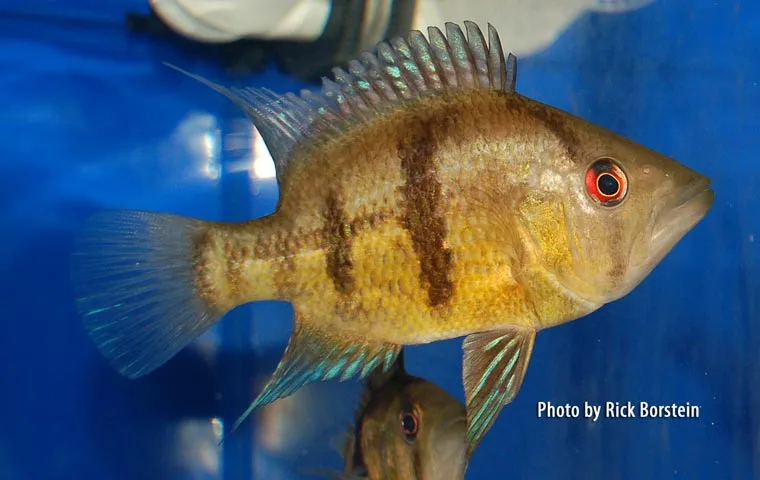
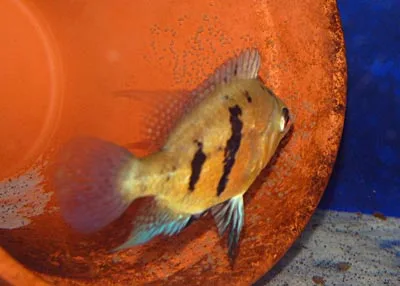
Caquetaia myersi is a moderately deep-bodied, laterally compressed cichlid reaching about 7.5 in in standard length (FishBase), making it the smallest of the basketmouths and a far more manageable animal than its relative Caquetaia spectabilis. The defining feature is the mouth: like other Caquetaia and the related Petenia, it carries jaws that protrude to an extreme degree, the whole oral apparatus telescoping forward into a tube when the fish strikes. Hobbyists who have kept it describe the closed mouth as deceptively ordinary until the fish lunges, at which point the gape and reach roughly double — an adaptation that functional-morphology studies (Waltzek & Wainwright, 2003) link to added 'ram' velocity during the capture of evasive prey. Coloration is comparatively plain: a brassy-olive to tan ground, sometimes with darker mottling or a broken lateral marking, over which breeding fish intensify. Sexual dimorphism is weak. Tonny Brandt Andersen, who bred the species, found the colour patterns of males and females so similar that he took it as a sign both parents would share brood care; the clearest cue was that his ripe female — slightly the smaller of the pair — developed a more intense yellow as spawning approached. Males tend to grow a little larger, but there is no reliable colour difference between the sexes. Live colour can run brighter than the description of a plain, brassy fish suggests: field collectors working the rivers around Florencia have described a fresh-caught 8 in specimen on sight as a "yellow-banded" cichlid before confirming it was Caquetaia myersi, and the species is also a notably fast, agile swimmer, harder to net than most of the cichlids sharing its rivers.
Habitat
The species is restricted to the western, Andean-foothill margin of the upper Amazon basin, in the Putumayo and Napo drainages and the adjacent Caquetá system, spanning southern Colombia, eastern Ecuador and (at the Putumayo border) northern Peru. The Catalog of Fishes and FishBase both confine its distribution to the Putumayo and Napo basins; the IUCN range map adds Ecuador, and the type series and Andersen's collecting were in the Caquetá drainage around Florencia. These are warm, soft, mineral-poor blackwater and clearwater streams draining off the eastern cordillera. Andersen, collecting near Florencia in 1993, found the fish in a string of small rivers — the Quebrada Mochilero, Quebrada Aguas Calientes, Quebrada Montañita and Quebrada la Granada — where he measured water temperatures from about 73–89 °F, pH spanning 6.0 to 8.5, and hardness under 2 dH. FishBase's compiled envelope is consistent and slightly tighter: pH 6.5–7.5, dH 0–2, temperature 72–86 °F. A separate field account from the same general area corroborates this: water registering no measurable carbonate hardness at all, a temperature of 76 °F, and a river bed of many rounded stones and rocks, with some stretches deep enough to form proper caves — Caquetaia myersi turned up in most of the rivers surveyed in this part of Colombia, though its speed and agility in the water made it one of the harder local cichlids to net. The fish also holds to vegetated stream margins; Andersen found a guarding parent with its fry tucked among marginal plants along one bank. This is, in short, a fish of soft, warm, gently flowing piedmont waters over a rocky, cave-riddled bed rather than the white-water main-stem Amazon.
Feeding
Caquetaia myersi is a piscivore — a ram-and-suck ambush predator whose entire jaw architecture is tuned to catching other fish. FishBase places it at a trophic level near 3.2, and the protrusible mouth, shared across the genus, is the textbook adaptation of a fish that swallows prey small enough to fit the gape. Andersen put it plainly from keeping the fish: the young 'eat a lot, grow fast and become large predatory cichlids which eat — or should I say swallow — any fishes small enough to enter their mouth.' In the wild it works the structured, vegetated stream edges where small fishes shelter, using the explosive forward thrust of the jaws to engulf prey before it can flee. There is no published evidence that it sifts substrate or grazes the way the eartheaters do; it is a straightforward predator on smaller fishes (and, in captivity, readily on any meaty food it can engulf), and within its piedmont-stream community it functions as one of the resident predatory cichlids.
Mating
Pair formation is territorial and, by the standards of large predatory cichlids, comparatively measured. Andersen watched a pair claim a flat stone as a spawning site and defend it vigorously against tankmates, the male leading the chases but the female joining in. As spawning neared, both fish performed a head-down, tail-up posture over the chosen stone while preparing the surface. He also recorded a striking courtship signal: one fish — he believed the male — would open its big mouth wide and snap it shut, producing an audible 'click' that carried outside the aquarium, and each time he saw it the female reacted, suggesting the display is part of the pre-spawning ritual that synchronizes the pair. In the rivers around Florencia the same readiness to defend was unmistakable: a snorkelling diver who drifted too near a guarding pair was met head-on by both adults in quick rushes, and Andersen was convinced they would have struck him had he not backed off. Wild observation suggests both parental strategies occur — at Aguas Calientes he saw pairs sharing the brood, but at two other sites only a single parent attended the young.
Breeding
Caquetaia myersi is a biparental open substrate spawner. FishBase summarizes the mode from aquarium observation: over 1,000 eggs are deposited on open substrate — typically a flat stone — and guarded by both parents, after which the larvae are transferred to a depression that the female digs in the sand. Andersen's first-hand account fills in the sequence. The female moved slowly across the flat stone laying rows of eggs while the male followed in the same passes to fertilize them; she then fanned the clutch with her body and fins, sweeping fresh water over the eggs and brushing the stone as she worked, while the male patrolled and drove off intruders, the female also taking part in defence. Even as the eggs were tended, she began excavating a small pit in the gravel nearby — the nursery into which the wrigglers would be moved. Andersen relayed that the adults help the larvae out of the eggshells. In the wild the brood is substantial and well grown when guarded: at Quebrada Aguas Calientes he found a parent shepherding more than 200 free-swimming fry of 0.5–1 in among bankside vegetation. The young grow quickly on heavy feeding. Despite this, the species has scarcely been propagated; Andersen's was among the few documented spawnings, and FishBase still lists the fish as essentially unknown in aquaria.
In the aquarium
Caquetaia myersi is a rarity in the hobby, kept by a small circle of dedicated South-American-cichlid enthusiasts rather than traded as a staple — FishBase flatly calls it 'unknown to aquarists,' and its plain coloration and predatory habits have kept it from popularity even where it has been imported. It is, however, keepable and has been bred, and the few first-hand reports give a clear picture. Account for adults of around 7.5 in and the explosive, space-eating feeding strike: a tank with a footprint comparable to other mid-sized predatory cichlids is appropriate, and Andersen grew his fish on in a 720-litre (about 190 US gallon) community with other Colombian cichlids such as Bujurquina. Decorate for a stream-margin predator that also needs spawning surfaces — driftwood and an arrangement of large and small stones to break up sightlines and mark territorial borders, with at least one flat stone available as a spawning site. A sand or fine-gravel bottom lets a breeding female dig the nursery pit she will move the larvae into.
Water should mirror the soft, warm piedmont streams of its range: temperature in the mid-to-upper 20s °C (the wild envelope runs 72–88 °F), pH around neutral to slightly acid (FishBase 6.5–7.5; wild populations tolerate 6.0–8.5), and low hardness (under about 2 dH). The fish tolerated a wide range in the field, so it is not delicate about exact chemistry, but very soft, warm water suits it best. Frequent water changes and ample feeding drove the fast growth Andersen reported.
The critical husbandry issue is the predatory mouth: this fish will swallow any tankmate small enough to enter its gape, so companions must be too large to be eaten and robust enough to share a tank with a territorial predator. Suitable matches are similarly sized or larger South-American cichlids that can hold their own; small tetras and other bite-sized fish are simply food. Within those limits it is not described as exceptionally aggressive outside of spawning — Andersen kept it in a mixed community — but a guarding pair defends its stone determinedly, and tankmates should have room to keep their distance. It is a fish for the keeper who wants an authentic, little-seen upper-Amazon predator rather than a colourful showpiece.
Conservation
The IUCN Red List assesses Caquetaia myersi as Least Concern, assessed on 9 October 2014 (published 2016) by P. Arguello and P. Sanchez-Duarte, with the population trend recorded as unknown. The assessment notes a distribution across the upper-Amazon drainages of Colombia and Ecuador and finds no evidence of a population-level threat that would warrant a higher category. The species carries no CITES or CMS listing and is harmless to humans. It is not a fishery or food target of note, and its negligible ornamental trade — Andersen remarked that it is 'not the most popular fish to sell to an aquarium shop' — means collecting pressure is slight. As with the wider region, the long-term backdrop is the accelerating pressure on western-Amazon piedmont streams from deforestation, agricultural expansion, road-building and gold-mining along the Andean foothills of Colombia, Ecuador and Peru; none of these is documented as a present danger to this particular cichlid, but they are the context in which a soft-water headwater specialist's status should be watched.