Taxonomy & naming
Crenicichla lacustris was described by the French naturalist and explorer Francis de Laporte, Comte de Castelnau, in 1855, originally in the genus Cychla (an early spelling of Cichla) as Cychla lacustris. The description appeared in the fish volume of his account of the French government expedition across central South America from Rio de Janeiro to Lima and on to Pará. Castelnau gave the type locality as Bahia (Salvador), but this is almost certainly an error: as Kullander & Lucena noted in their 2006 revision, no member of the lacustris group has ever been recollected north of the rio Buranhém, far south of Salvador, and Castelnau — who lived in Salvador as French consul and compiled his multi-volume itinerary there — appears to have mislabelled the provenance. The epithet, lacustris ('of lakes'), and the genus Crenicichla into which the species was later placed have endured even as several nominal forms fell into its synonymy: Crenicichla dorsocellata Haseman, 1911 (type locality rio Paraíba at Campos) and Crenicichla biocellata von Ihering, 1914 (rio Doce, Espírito Santo) were both synonymised with lacustris by Ploeg in his 1991 revision of the genus. The species is the namesake of the Crenicichla lacustris species group, a clade of coastal and La Plata pike cichlids whose monophyly molecular work has strongly confirmed. In the most recent generic reclassification of the pike cichlids (Varella, Loeb, Lima & Kullander, 2023), which raised the pike-cichlid clade to the subtribe Crenicichlina and split the assemblage into several genera, Crenicichla lacustris was retained in Crenicichla and placed in the newly erected subgenus Crenicichla (Lacustria) — the lacustris-group subgenus of about 34 species. (The species was not transferred to Wallaciia or Saxatilia; those genera/subgenera cover other lineages.) We keep the long-established binomial Crenicichla lacustris.
Morphology
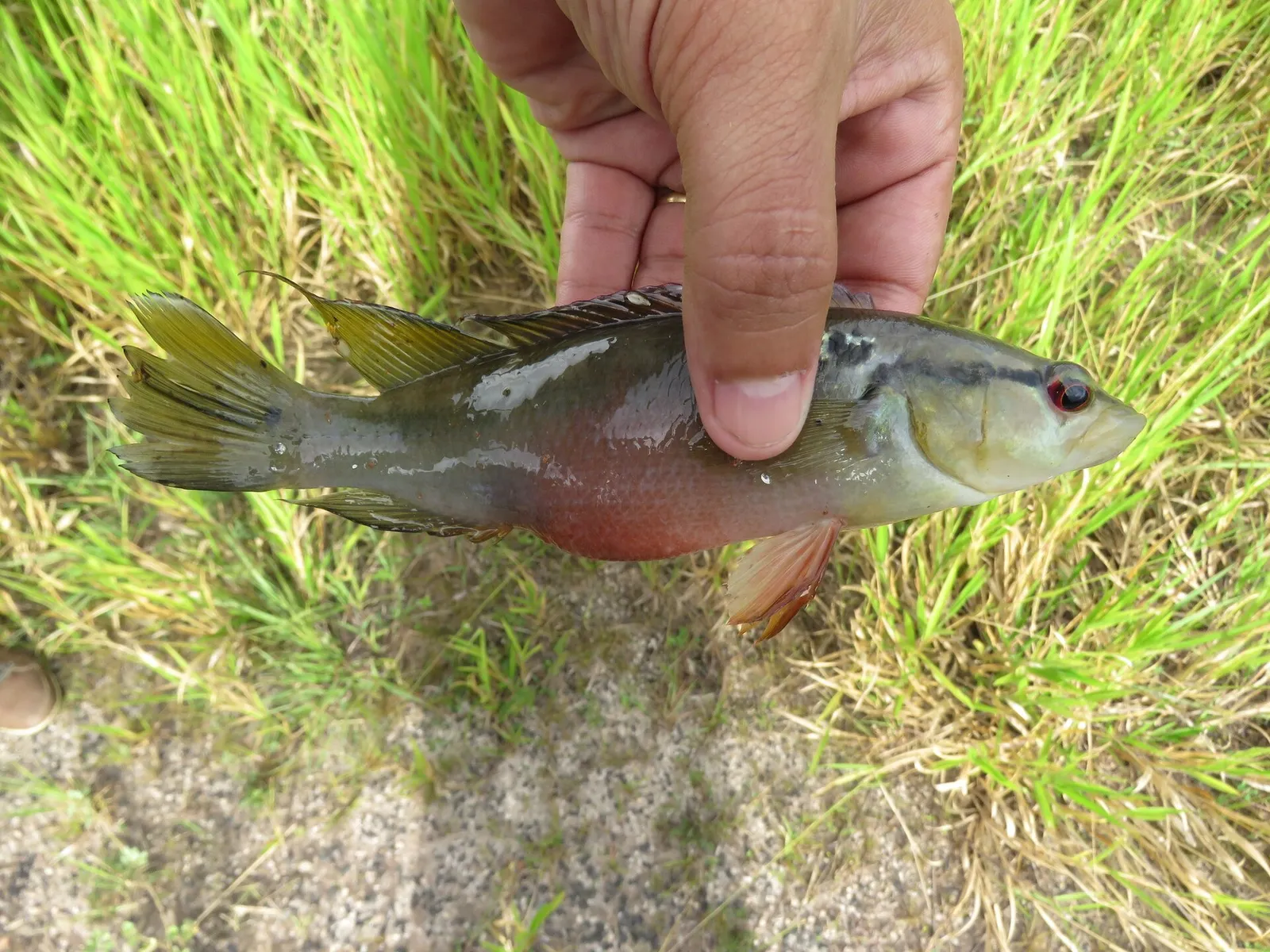
Crenicichla lacustris has the unmistakable pike-cichlid build: a comparatively elongate, cigar-shaped body (depth only about 19–24% of standard length), a long rounded snout, and a large, terminal, protrusible mouth with a prognathous lower jaw — the classic gape-and-suck arrangement of an ambush piscivore. FishBase gives a maximum size of about 14 in total length; the Kullander & Lucena material ran to roughly 9.5 in SL in the largest male and 11.5 in SL in the largest female, so wild adults are commonly in the 8–10 in range. The teeth are pointed and slightly recurved, the outer row enlarged, with several inner rows of small depressible teeth in each jaw; the preopercle is finely serrated and the flank scales strongly ctenoid. Ground colour in life is yellowish to brownish, darker on the back and paler below, with a dark preorbital and postorbital stripe through the eye and a black, ocellated caudal spot. Sexual dimorphism is real and useful: females carry a conspicuous dark horizontal band running between the lateral lines from the gill opening to the caudal peduncle, usually overlaid with five to seven vertical bars, and — most diagnostically — an ocellated black blotch with a pale margin on the middle of the dorsal fin (typically between about the 12th and 17th spines). Males, by contrast, lose much of the clean banding and instead become covered in seemingly scattered blackish spots over the body, cheek, gill cover and fins, the caudal fin in particular becoming heavily peppered with dark dots. A suborbital stripe of dark dots running down the cheek is better developed in females. Freshly photographed adults from the lagoa de Juturnaíba showed the spots as maroon to reddish, with an orange wash along the female's flank stripe.
Habitat
This is a fish of the Atlantic coastal drainages of southeastern Brazil, not the Amazon. Verified collections range from the rio Buranhém in the south of Bahia state southward to the rio Paraíba do Sul, taking in the rio São João drainage in the state of Rio de Janeiro and an isolated population in the lakes of the upper rio Doce; the species occurs all along the lower rio Paraíba do Sul downstream of the Resende area but is curiously absent from the intervening rio Mucuri. These drainages fall within the Southeastern Mata Atlântica freshwater ecoregion, a chain of short, independent coastal rivers and large coastal lagoons (such as the lagoa de Juturnaíba) draining the Atlantic Forest. Although the name lacustris evokes lakes, the species is at home both in flowing coastal rivers and in these lagoonal systems. The defining feature of its environment is climate rather than chemistry: this is a subtropical-to-warm-temperate coastal belt, and the species tolerates distinctly cooler water than its equatorial relatives. FishBase gives a preferred range of roughly 72–77 °F, and a generally circumneutral, soft-to-moderate coastal-river chemistry (about pH 6.5–7.5) is typical of the region; it is not a blackwater specialist. The lacustris group as a whole is famously cold-tolerant — its relatives reach as far south as Patagonia, the southernmost cichlids known — and temperature, more than water chemistry, defines where these fishes can live. FishBase does not publish a depth profile for the species; as an inhabitant of coastal rivers and shallow lagoon margins it is a fish of the upper few metres, broadly within the 3–33 ft band reported for the genus.
Feeding
Crenicichla lacustris is a piscivore. Like the other large pike cichlids it is built to lie in wait among cover — submerged wood, root tangles, marginal vegetation — and then to lunge, engulfing smaller fishes whole with its large protrusible mouth in a single gape-and-suck strike. The direct evidence is consistent with this: of two Crenicichla lacustris stomachs examined by Kullander & Lucena (one 6 in, one 3.5 in SL), both contained fish remains, and FishBase places the species at a trophic level of about 3.3. Broader dietary studies of the genus (reviewed by Leibel) show that non-dwarf pike cichlids depend heavily on fish, supplemented by aquatic insects, insect larvae and shrimp, with a sometimes surprising amount of incidental plant material in the gut. In its coastal-river community Crenicichla lacustris functions as one of the principal native piscine predators, cropping smaller characins, livebearers and juvenile fishes from the structured margins it favours.
Mating
Detailed in-situ reproductive observations specific to Crenicichla lacustris are scarce, and what follows is drawn partly from the well-documented behaviour of the genus. Pike cichlids are biparental and form lasting pair bonds, but pairing is the hard part: adults — especially large ones — are territorial and intolerant, and mismatched fish frequently end in harassment or death. The reliable route, as Leibel and other American Cichlid Association breeders describe, is to raise a group of size-matched juveniles together and let a compatible pair sort itself out; in pikes a working pair is usually very close in size, the male only slightly larger than the female. The conspicuous sexual differences in Crenicichla lacustris — the female's bold flank band and her ocellated dorsal-fin blotch versus the male's overall spotting — are display signals as much as diagnostic characters, and the ripe female advertising with her marked dorsal fin is part of pair formation. Once a pair has bonded, the same fish that were dangerously aggressive typically become attentive, cooperative parents and comparatively peaceful toward one another.
Breeding
No formal account of wild spawning in Crenicichla lacustris has been published, but the species breeds as its congeners do: it is a biparental, cave- and crevice-oriented substrate spawner. Large pike cichlids attach a clutch of adhesive eggs to a sheltered, concealed surface — the back wall of a cave, the underside of wood, or in aquaria the inside of a large upturned flowerpot or a length of wide pipe — where the female tends and fans the eggs while the male holds the surrounding territory. Clutches in the larger Crenicichla run to several hundred eggs (a genus-typical figure of roughly 200–500 for a fish of this size; no species-specific count is published for lacustris). Development in congeners of comparable size is well documented: eggs eye-up within about two days and hatch around four to five days post-spawn at roughly 77–79 °F, after which the female moves the wrigglers to a pit or hollow and the larvae remain there several more days before becoming free-swimming. Pike cichlids are notably devoted parents, frequently guarding and herding their fry for weeks to months — a long brood-care period for Neotropical cichlids. As a subtropical species, Crenicichla lacustris is likely cued to spawn by seasonal warming after a cooler period, and a winter cool-down followed by warming and heavy feeding on live foods is the standard captive trigger for its group.
In the aquarium
Crenicichla lacustris is rarely seen in the trade and is a fish for the dedicated pike-cichlid keeper rather than a community-tank candidate, but it is no harder than other large Crenicichla and has the advantage of being adaptable on temperature. A single adult or a bonded pair needs a large, long tank — on the order of 71 in / six feet of frontage and several hundred litres — because these are big, fast-growing, food-hungry predators that produce a heavy bioload. Over-filtration and large regular water changes (25–50% weekly is the standard pike-cichlid regimen) are essential; the genus is prone to head-and-lateral-line erosion when water quality slips. The single most important furnishing is cover: numerous caves, lengths of wide PVC pipe, and tangles of bogwood. Breeders are unanimous that abundant pipe or cave structure is the antidote to aggression — if rivals can break line of sight, intraspecific violence drops dramatically, and the same fish that would otherwise fight to the death will settle into an uneasy peace. Substrate can be sand or be dispensed with for ease of cleaning; a few large upturned flowerpots with an enlarged entrance hole double as spawning sites. Water chemistry is undemanding so long as it is kept clean: near-neutral, soft-to-moderately-hard water suits it. Temperature is where this species differs from its tropical relatives — coming from a subtropical coastal belt it is comfortable in the low-to-mid 20s °C and does not require the high-70s-to-mid-80s °F warmth many Amazonian pikes prefer; a seasonal cool period is natural for it and is in fact a breeding cue. Feed a varied carnivore diet — earthworms, prawn, mussel, and fish-based frozen and prepared foods; live feeder fish are unnecessary and risk introducing disease, and most pikes can be weaned onto good prepared foods if started young. Tankmates must be robust, too large to swallow, and not slow or long-finned; anything that fits in the mouth will eventually be eaten, and the worst mistake keepers make is pairing mismatched adults or housing this fish with timid companions in too little space.
Conservation
The IUCN Red List assesses Crenicichla lacustris as Least Concern (assessed 11 November 2020 by R.G. Frederico; published 2023, e.T186405A1812567), reflecting a relatively wide distribution across multiple coastal drainages of southeastern Brazil and no evidence of a population-level decline. It carries no CITES listing, and as a generalist predator across several river systems it is far less exposed than the many narrow-range endemics of the Atlantic Forest. (Note that some older databases, including the Cichlid Room Companion species page, still describe the fish as 'not evaluated'; the live Red List record confirms the Least Concern assessment.) That said, the coastal drainages it inhabits — the rio Paraíba do Sul above all — are among the most heavily modified and urbanised river systems in Brazil, subject to long-standing pressure from pollution, water abstraction, damming, deforestation of the Atlantic Forest, and the spread of introduced fishes. None of these is documented as a present threat to this particular species, but they are the backdrop against which the long-term outlook for the region's freshwater fauna, including this pike cichlid, must be read.