Taxonomy & naming
The French naval surgeon-naturalists Jean René Constant Quoy and Joseph Paul Gaimard described this fish in 1824 as Chromis brasiliensis, from material gathered on the circumnavigation of the corvette Uranie; the original account appears in the zoology of the Voyage autour du monde (pages 286–287). The type locality is the bay of Rio de Janeiro, Brazil — a coastal, near-marine setting that already hints at the species' unusual ecology. It was later shuffled into Acara and finally into Geophagus, and carries a long synonymy reflecting that history: Chromys unimaculata Castelnau, 1855 and Chromys unipunctata Castelnau, 1855 (both near Rio de Janeiro), Chromys obscura Castelnau, 1855 (synonymised with brasiliensis by Eigenmann in his 1910 catalogue of tropical South American freshwater fishes), Acara gymnopoma Günther, 1862 (holotype NHMUK 1842.8.18.8, Brazil), and Acara minuta Hensel, 1870 (a pool in Porto Alegre) — a species so small (largest specimen just 1.5 in, against more than 4 in for Hensel's own brasiliensis material from the same locality) that its identity with the adult fish was easy to miss at the time. Also synonymous are Geophagus tuberosus and G. olfersi, nomina nuda that Otto Müller and Franz Wilhelm Troschel had applied to Berlin Museum specimens without ever publishing a description; Jean-Pierre Gosse traced those unpublished type specimens in his 1976 revision of the genus and confirmed them as further brasiliensis material. Haseman (1911) went the other way, splitting rather than lumping: he described two further subspecies from within the range, Geophagus brasiliensis itapicuruensis and G. b. iporangensis, a piece of early taxonomic hedging against exactly the geographic variation molecular work is now resolving. The name has long been a magnet for confusion — Steindachner's 1880 'Geophagus brasiliensis' from the Río Cauca in Colombia, for instance, is now recognized as the unrelated redhump eartheater Geophagus steindachneri, a tangle dissected at length in the Buntbarsche Bulletin (no. 83).
The name is more provisional than it looks, and the honest version is worth stating plainly. When Kullander rediagnosed Geophagus in 1986, he restricted the genus to eartheaters with a specific swimbladder-and-vertebral anatomy; brasiliensis does not fit that strict definition, so it is routinely written with the genus in quotation marks — 'Geophagus' brasiliensis — and treated as incertae sedis, a placeholder pending formal revision. It anchors its own lineage, the 'brasiliensis group', which sits among the geophagine cichlids of South America but apart from both the true Geophagus and the closely allied southern genus Gymnogeophagus; long-time Geophagus author Jay Reimer, writing in the Buntbarsche Bulletin (no. 140), flatly called the species 'highly polytypic' and warned that a single fish 'that looks like Geophagus brasiliensis but couldn't be' is, almost always, exactly that. A genome-scale study by Argolo and colleagues (2020, Molecular Phylogenetics and Evolution) put numbers to that intuition: sampling 172 sites across the group's range, they concluded that the 'G.' brasiliensis complex comprises roughly ten species or independent lineages — several of them undescribed — diversified largely by ancient river captures and shifting paleodrainages rather than by adaptive specialization. In other words, the popular aquarium 'pearl cichlid' is almost certainly a bundle of closely related fishes traveling under one old name. Common names include pearl cichlid, pearl eartheater, pearlscale or mother-of-pearl cichlid, and, in Brazil, acará — though acará is applied loosely to many cichlids there.
Morphology
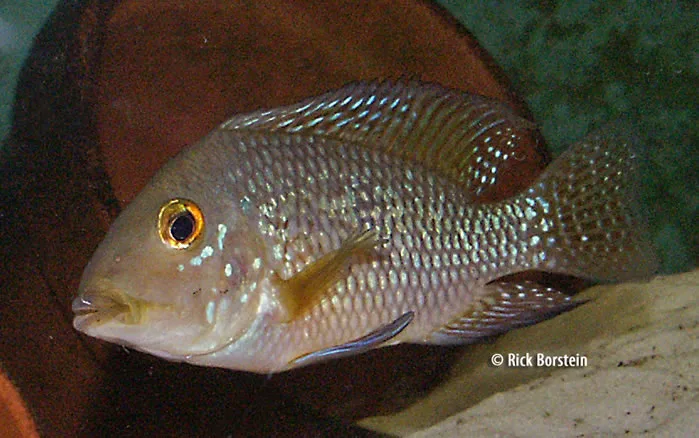
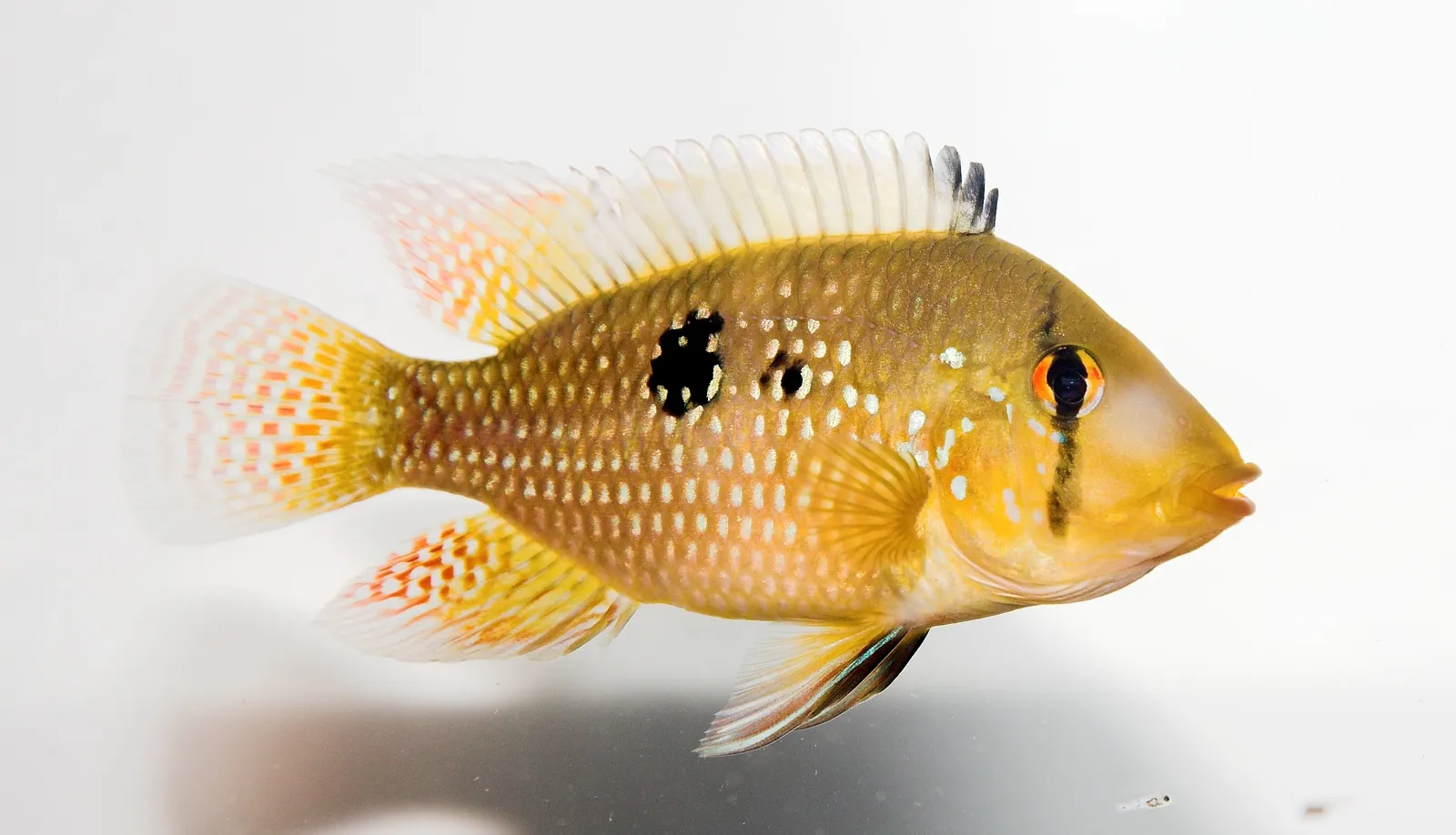
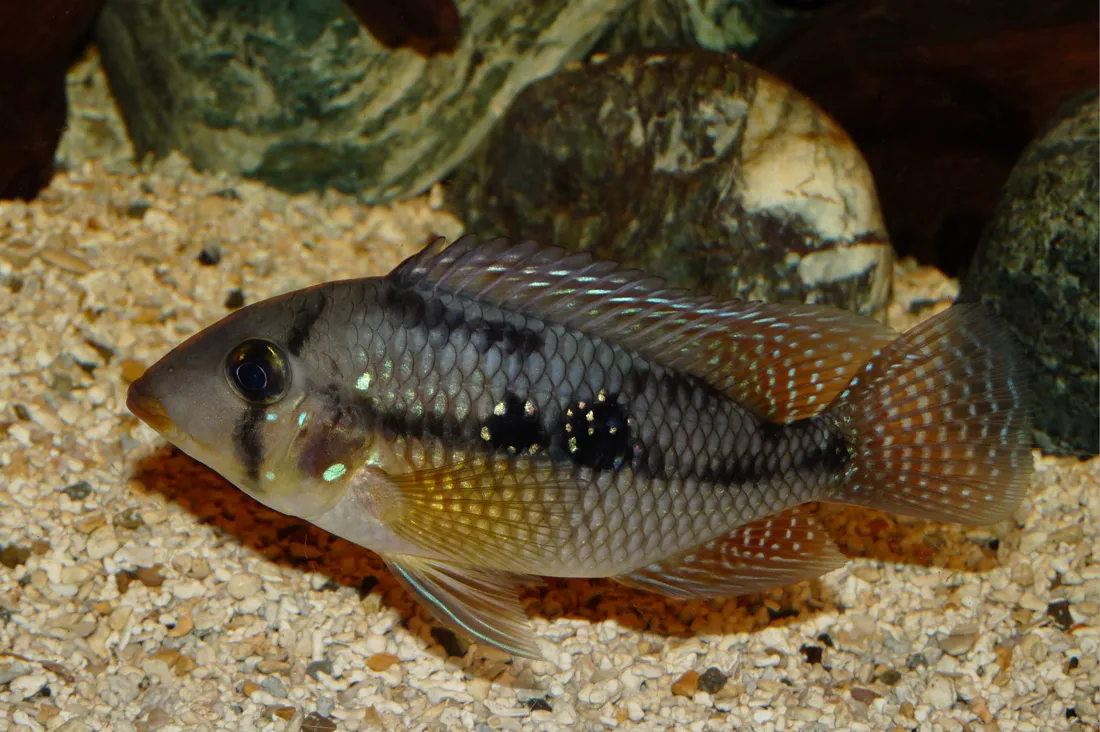
This is a deep-bodied, robustly built cichlid whose appeal is in its scaling: rows of small, gleaming blue-green to turquoise spots are scattered across the flanks, dorsal, and tail, set against a ground color that ranges from olive and bronze to vivid green or blue depending on population and mood. A dark, rounded blotch usually marks the mid-flank, and the fins are often washed yellow-red and edged or speckled with pale 'pearls'. Fin counts run to roughly XVI–XVII dorsal spines with 10–13 soft rays and III anal spines with 7–10 rays, on a body about 2.2–2.5 times as long as deep.
Size reports vary with how the fish is measured and where it lives, so it is worth being precise. FishBase lists a maximum of about 11 in total length, with a common length near 3.5 in; Seriously Fish gives males to 8–10 in and females to 5–6 in standard length. Aquarium and feral specimens commonly reach 10–12 in, and a fish exceeding 12 in was recorded from an introduced Australian population. Either way, expect a substantial fish. Sexual dimorphism is real but gradual: males grow distinctly larger and the dominant male typically develops a fleshy nuchal hump on the forehead, while females stay smaller and somewhat plainer — there are no reliable color differences, so the cue is size, head profile, and breeding state rather than pattern. Wild populations differ markedly in color, pattern, and even body shape — fish from fast tributaries are more streamlined than those from sluggish lagoons — variation that is itself part of the evidence that 'brasiliensis' is several species, the 'rogues' gallery' of flavors Reimer catalogued in the Buntbarsche Bulletin (no. 140).
Habitat
This is not an Amazon fish, and that geographic point is the heart of its story. Geophagus brasiliensis is native to the Atlantic-draining coastal river systems of eastern and southern Brazil and into Uruguay — the basins that run off the eastern escarpment straight to the sea rather than inland to the Amazon or Paraná-Paraguay heartland. Its documented core range covers the rio Paraíba do Sul basin and the many smaller coastal drainages and lagoons of Rio de Janeiro, São Paulo, Espírito Santo, Minas Gerais, Paraná, Santa Catarina and Rio Grande do Sul, reaching south into Uruguay's Río Uruguay and Río de la Plata drainages. Weidner frames the wider brasiliensis-complex range in similar terms, running from the Rio Itapicuru south to the Ribeira de Iguape — a stretch of coast that also takes in the mouth of the Rio São Francisco, at roughly 1,988 mi the longest river in the region. Populations farther north — in Bahia, Paraíba, and Pernambuco — are thought by some authors to be recent, human-mediated introductions rather than natural range. The type locality, Rio de Janeiro Bay, captures the species' affinity for the lowland, near-coastal end of these rivers.
Within those waters it is a habitat generalist of the lower and middle reaches: coastal streams, river margins, reservoirs, and especially coastal lagoons, some of which connect to the sea permanently or seasonally. That coastal life has given the fish a striking tolerance for brackish water — populations live in lagoons with real salinity, and experimental work on feral fish found it can withstand salinities approaching full seawater. In-situ chemistry is correspondingly broad: FishBase records a near-neutral pH of about 6.5–7.0 and moderate hardness (5–10 dH) for the species, while the wider tolerance spans pH 6–8 and soft to fairly hard water. Most telling for a 'tropical' cichlid is its thermal range — FishBase cites 52–99 °F, and field and tank experience put the comfortable band at roughly 64–82 °F with brief tolerance well below that. It lives in shallow, well-lit water — typically the upper few metres of these rivers and lagoons — is potamodromous, moving within freshwater systems, and is long-lived, reportedly up to about 15 years.
Feeding
Geophagus brasiliensis is a generalist omnivore, and FishBase places it low on the food web at a trophic level of about 2.6. Dietary studies describe a mixed menu of plant material and detritus, aquatic invertebrates — chironomid (midge) larvae, ostracods, and cladocerans feature heavily — plus, opportunistically, fish scales and fry. As fish grow, larger prey such as terrestrial insects and small crustaceans (including crayfish in its introduced Australian range) become a bigger share of the diet.
It earns the 'eartheater' label by taking mouthfuls of sand and fine sediment and winnowing them, expelling the inedible grains through the gill openings while retaining small invertebrates — the same substrate-sifting trick that defines the true Geophagus. The important caveat, flagged by Seriously Fish and consistent with its trophic ecology, is that brasiliensis is not as committed a benthophage as the core Geophagus species; it sifts when it suits and otherwise grazes, picks, and hunts across the water column. That flexibility is exactly why it travels so well: in southwestern Australia, where native fishes are largely carnivores, the pearl cichlid's omnivory has been singled out as a reason it establishes and competes so readily. In its native lagoons and rivers it functions as a mid-level consumer and, at smaller sizes, as prey for larger fishes and fish-eating birds.
Mating
Socially, the pearl cichlid is bold and territorial, especially the males and especially around spawning, and it will eat tankmates small enough to fit in its mouth. Keepers consistently compare its attitude to Central American cichlids or the green terror rather than to the gentler Amazonian eartheaters. Pairs form within a group as fish mature, and the dominant male signals readiness with intensified color and the growth of a fleshy nuchal hump on the forehead. Courtship and pair-bonding center on a chosen site: the pair excavates and tests pits in the substrate and cleans a flat rock or firm surface together, defending an expanding territory around it. Spawning is triggered by warmth, a water change, and a settled, mature tank — hobbyist accounts in the Buntbarsche Bulletin (no. 140) describe pairs that began digging almost immediately after a partial water change and spawned within days, at around 81 °F and a pH near 6.4. A bonded pair will then spawn repeatedly, often at roughly monthly intervals.
Breeding
The breeding mode is the point most often muddled in care sheets, so it is worth nailing down: Geophagus brasiliensis is a biparental substrate spawner, not a mouthbrooder. The female deposits adhesive eggs directly on the cleaned flat rock or firm surface — hobbyist observers have counted roughly 100 small pinkish eggs laid in the center of a substrate depression in a single bout — and both parents then guard and fan the clutch and shepherd the free-swimming fry, defending the brood vigorously against intruders. This is the cichlid family's ancestral, open/substrate-brooding strategy with shared parental care — distinct from the immediate maternal mouthbrooding of many African rift-lake cichlids, and also distinct from the delayed, larvophilous mouthbrooding seen in some of its geophagine relatives (Satanoperca, Gymnogeophagus, and certain true Geophagus), where parents pick eggs or larvae up into the mouth after an interval on the substrate. Across multiple sources the pearl cichlid's care is consistently reported as substrate guarding throughout, with no oral incubation phase.
Fecundity scales with the size of the fish: FishBase cites totals on the order of 600–800 eggs for large females, while observers of feral Australian populations report broods of roughly 150–200 fry, which spawn there from late spring into early winter. Wrigglers are typically moved between excavated pits, and within a few days the free-swimming fry follow the parents in a tight school. Pairs commonly produce successive broods at about monthly intervals once they have settled.
In the aquarium
Few large cichlids are as forgiving, and that is the pearl cichlid's reputation among hobbyists: hardy, adaptable, and undemanding about water chemistry once a tank is biologically mature — a genuinely good first eartheater. It accepts a wide pH (around 6–8), soft to moderately hard water, and a broad temperature range, and its cool tolerance means it does not need a heater pinned to the high 20s — one of the few cichlids genuinely comfortable in a cooler room. The honest counterweight is size and temperament. This is a 10–12 in fish that is territorial, boisterous, and digs; a single pair needs a tank with a footprint on the order of 150 × 17.5 in (about a 75–100 gallon footprint), and more if kept with others. Plan tankmates as robustly sized, similarly assertive fish and never as bite-sized dithers.
A soft sand substrate suits its sifting habit and protects its gills, though it is not strictly required; pair it with driftwood, roots, and a flat rock or two as spawning sites under subdued light. The fish is a strong, messy feeder, so over-filter and keep up large, regular water changes — it is sensitive to deteriorating water quality, and chronic neglect or a poor diet shows up as head-and-lateral-line erosion (HLLE) or stunted growth. Feed a varied omnivore's diet: good sinking pellets as a staple with regular live or frozen bloodworm, brine shrimp, and some vegetable matter. Two practical notes from the trade: fish sold in Europe as Gymnogeophagus australis are frequently this species, and because 'brasiliensis' spans many locality forms, mixing wild stock of unknown origin risks blending distinct lineages. Its very hardiness is also a warning — released pets have founded invasive populations on multiple continents, so it should never be turned loose.
Conservation
The IUCN Red List assesses Geophagus brasiliensis as Least Concern (assessment published 18 November 2020, by Renata Guimarães Frederico), reflecting a wide native range across many independent coastal basins, large populations, broad habitat tolerance, and use as both an ornamental and a local food fish. CITES and CMS list it as Not Evaluated, and FishBase rates its fishing vulnerability as low. By any conventional measure the species is secure and in no danger of decline.
That clean status, though, rests on shaky taxonomic ground and tells only half the geography. If the 'G.' brasiliensis complex really comprises around ten species or lineages, as Argolo et al. (2020) argue, then a single basin-wide 'Least Concern' rating can paper over narrowly distributed, undescribed forms — particularly the diversity they found concentrated in the Northeastern Mata Atlântica drainages, where individual lineages may occupy single small rivers. The eastern Brazilian Atlantic Forest streams these fish inhabit are among the most heavily altered freshwater systems in South America, fragmented by dams and pressured by urbanization, pollution, and water extraction; a wide-ranging generalist absorbs that pressure easily, but a single-river endemic hidden inside the same name does not. The flip side is the species' success as an invader: feral pearl cichlids are established in Australia (notably the Swan-Canning system of Western Australia), the United States, Taiwan, the Philippines, and Argentina's Río Iguazú, where their omnivory, aggression, salinity tolerance, and cold tolerance let them compete with and prey on native fishes. The same traits that make this an easy, rewarding aquarium fish make a released one very hard to remove — the strongest practical reason to keep it firmly in the tank.