Taxonomy & naming
George Albert Boulenger described Cyrtocara moorii in 1902 from material collected during J. E. S. Moore's expeditions to the lake he called Nyassa. The species name honors Moore, the British biologist who gathered the type specimens; the genus name blends the Greek kyrtos (bent or arched) and kara (head), a nod to the steep, humped head profile. Cyrtocara is a monotypic genus — moorii is its only member — which sets it apart in a lake whose haplochromine flock runs to hundreds of described and undescribed species.
The fish carries taxonomic baggage that still surfaces in the trade. For decades it was lumped into the catch-all genus Haplochromis and sold as "Haplochromis moorii," a name the IUCN notes was standard in the ornamental business; aquarists also recognize the colloquial "moorii." Today taxonomic authorities including the Catalog of Fishes and FishBase treat Cyrtocara moorii Boulenger, 1902 as the valid name, placing it within tribe Haplochromini of the subfamily Pseudocrenilabrinae. In Malawi it goes by several local names, among them Chinkongo, Kabale, and Gundamwala.
Morphology
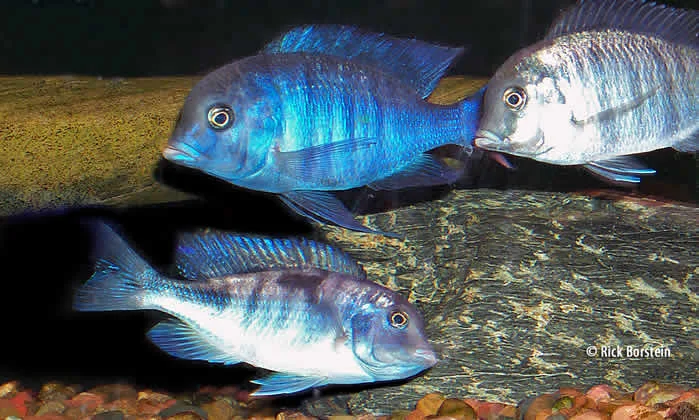
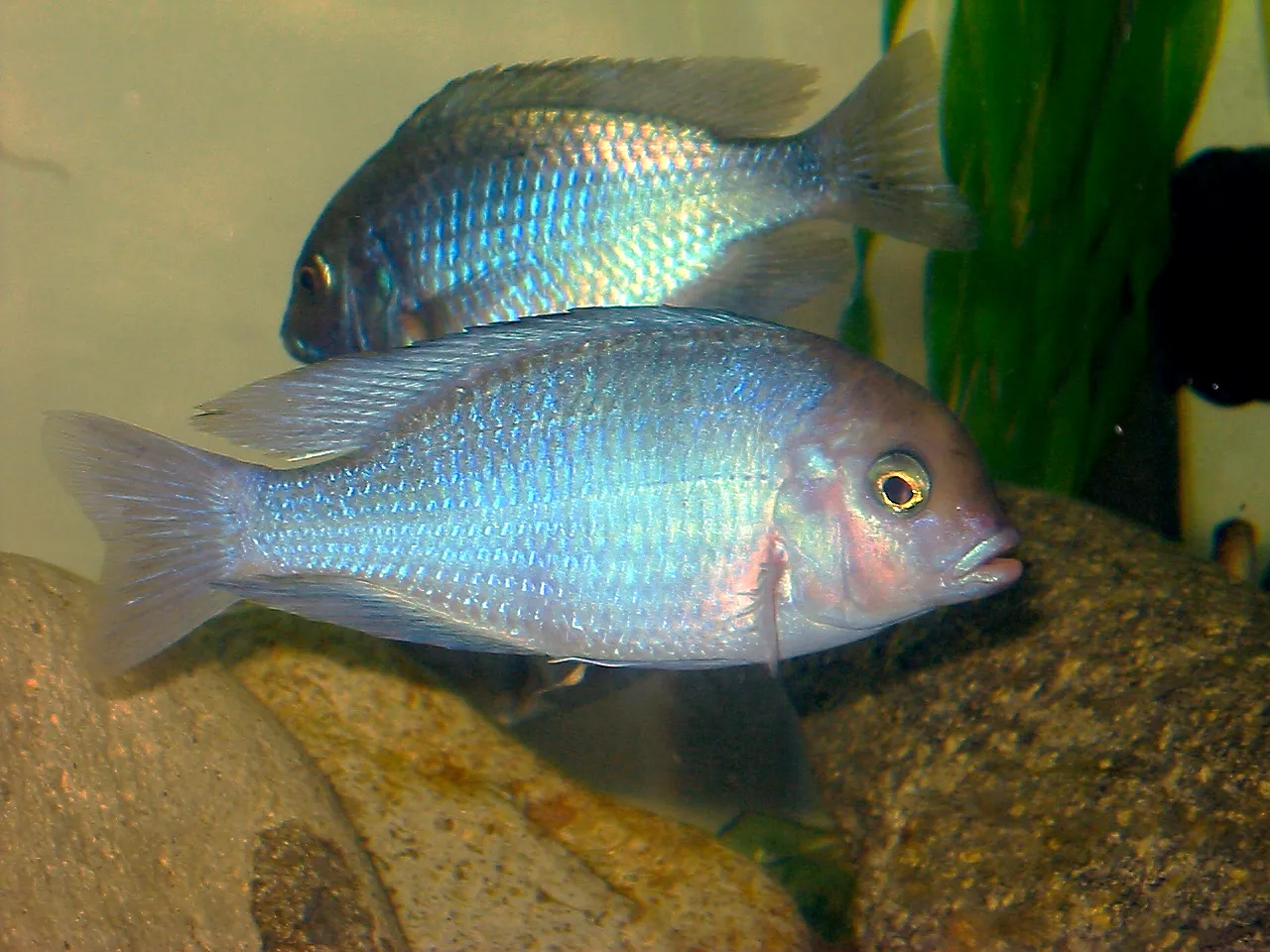
An adult blue dolphin is a solid, deep-bodied fish washed in a color that ranges from a soft sky blue to a deep royal blue depending on age, mood, and dominance, often broken by a few faint dark blotches along the flank. The signature feature is the nuchal hump — a rounded fatty swelling on the forehead that, together with the blunt face and thick lips, earns the "dolphin" nickname. The hump begins to show at around 3 in (3 in) and only reaches full prominence in larger fish.
Reported maximum size depends on the source and is worth stating honestly. FishBase lists 8 in total length; the IUCN assessment and Ad Konings's habitat work cite 9 in TL; and aquarium references commonly quote up to 10 in, with keepers describing dominant males reaching 8 in or more while females top out a little smaller. The species is effectively monomorphic — both sexes are blue and both develop the hump, with no reliable color or finnage difference — so sexing usually comes down to venting or inferring sex from size among fish of known age; at most, large dominant males carry the most pronounced hump. Dominant, displaying males turn an intense blue with a near-black outline.
Habitat
Cyrtocara moorii is a lacustrine endemic, native to Lake Malawi and the smaller, shallower Lake Malombe immediately downstream on the Shire River. Within Malawi it is widespread and, historically, was especially common along the southern part of the lake. FishBase records its range across the Malawi, Mozambican, and Tanzanian waters of this single great lake.
Unlike the rock-dwelling mbuna that hug the lake's boulder shores, the blue dolphin is a fish of open sand. It favors the intermediate and sandy zones in fairly shallow water; Konings notes that Cyrtocara moorii occurs in very shallow water and is rarely found below depths of 33 ft, while FishBase and the IUCN give a working depth band of roughly 10–50 ft. This is warm, alkaline, well-buffered water: FishBase reports a pH range of about 7.2–8.8 and temperatures near 75–79 °F, within the lake's broader 7.7–8.8 pH envelope. The open sandy-shore guild it belongs to is exactly the band of the lake most exposed to shoreline activity and to the beach-seine fishery, a point that bears directly on its conservation status.
Feeding
The blue dolphin is a carnivore that feeds on small benthic invertebrates living in and on the sand, and FishBase places it at a trophic level of roughly 3.4. What makes its feeding genuinely unusual is how it finds that food. Rather than digging for itself, Cyrtocara moorii is a commensal follower: it trails larger sand-sifting cichlids and plucks prey from the cloud of detritus those fish stir up as they work the bottom.
Konings places Cyrtocara moorii among a small guild of five conspicuously blue sand-dwellers — alongside Protomelas annectens, Otopharynx selenurus, Placidochromis electra, and Placidochromis phenochilus — that let other species do the digging. They are drawn to stirred-up sediment and follow a large sand-sifter such as Taeniolethrinops praeorbitalis, and although they appear to pick food from the cloud spilled through the host's gills, they are really searching the freshly ploughed sand for exposed invertebrates that scramble to rebury themselves. The behavior was first documented in a classic short paper by Kocher and McKaye (1983, Copeia), who watched Cyrtocara moorii shadow sand-feeders and pick food from the disturbed sediment. Strikingly, the blue dolphin treats this moving food source as a defendable resource — Kocher and McKaye found it actively driving off rivals — a rare example of a fish defending a host rather than a patch of substrate. Konings suggests the fish's vivid blue may itself be a territorial signal warning other would-be followers away from an "occupied" host.
Mating
Cyrtocara moorii spawns out on the open sand rather than at a defended nest. The IUCN, drawing on Konings, notes that males build no bowers and hold no fixed territories: spawning happens opportunistically wherever ripe males and females meet. Konings adds that the courting behavior of males indicates spawning can take place at any site, with no nest or structure built to mark it.
Dominant males signal readiness through color, intensifying to a deep royal blue edged in near-black as they display. In the aquarium that male tension is real — keepers report that introducing females reliably raises the pitch among males, and that an otherwise placid sub-adult can abruptly "snap" and need to be pulled from a community. The actual spawning sequence is the unusual part: aquarists have repeatedly observed that as soon as the female deposits a few eggs on the sand the male fertilizes them where they lie, before she takes them up — the same external-then-collect sequence Konings records for its close behavioral analogue Protomelas annectens, and a contrast to the in-mouth fertilization typical of most Malawi haplochromines.
Breeding
Like the great majority of Lake Malawi haplochromines, Cyrtocara moorii is a maternal mouthbrooder. After the eggs are fertilized on the sand the female takes them into her mouth and broods them there, typically for about three weeks (roughly 21–25 days by hobby accounts), fasting until she releases free-swimming fry; Konings notes that mouthbrooding and fry-guarding Cyrtocara moorii have been observed out on the open sand. Brood size scales with female size, from a dozen or two in small fish to substantially more in large adults.
In captivity the species is considered one of the trickier Malawi mouthbrooders to breed reliably, partly because females are skittish brooders prone to spitting or swallowing a clutch if startled — a tendency that fits the field observation that alarmed fish bolt straight into the sand. The standard productive setup is one male to several females in a large, sand-floored tank, which spreads male attention and gives gravid and holding females room to retreat.
In the aquarium
The blue dolphin is a rewarding but space-hungry fish, best treated as an intermediate-level Malawi hap rather than a beginner community pick. It grows large and slowly — keepers report a year or more from fry to a 4–5 in adult — so while a 75-gallon tank can house a young group, a single full-grown male needs the swimming room of a 125-gallon (roughly 125 US gal) or larger footprint; UK and Australian profiles converge on about 65–80 US gal as a sensible minimum for a small group. Give it fine sand to suit its natural sand-sifting habits and open swimming space, with rockwork for structure rather than as a maze.
Water should mirror the lake: alkaline and well-buffered, pH around 7.5–8.5, temperature in the mid-70s to low-80s °F (about 75–82 °F), with strong filtration to keep nitrates down in a tank of big-bodied fish. The standard social structure is one male to several females; keeping multiple adult males in anything but a very large tank invites trouble. Tankmates are best chosen among similarly sized, not-overly-aggressive haps and peacocks — pairing a placid blue dolphin with hyper-territorial mbuna is the most common stocking mistake. Konings makes the same point directly in Enjoying Cichlids, advising that Mbuna generally do not mix well with the lake's sand-dwelling and open-water feeders — Lethrinops, Aulonocara, Utaka and Cyrtocara moorii among them — because the placid sand-dweller tends simply to be outcompeted and harassed by the far more pugnacious rock-dwellers. Field and aquarium observers describe the species as comparatively peaceful for a Malawi cichlid, but the honest caveat is individual variation: aggression curves across individuals, and adding females reliably ratchets up male tension.
Conservation
The IUCN Red List assesses Cyrtocara moorii as Vulnerable (criterion A2a), in an assessment by Ad Konings dated 23 May 2018 (errata version published 2019). That is a downgrade from its earlier 2006 listing of Least Concern, and the reason is specific: the population is estimated to have fallen by more than 30% over ten years, driven by the relentless use of beach seines across the shallow sandy shores it depends on. The species is no longer a meaningful target of the ornamental trade — most aquarium fish are tank-bred — but as a food fish it is taken heavily by artisanal fishers, and its population trend is recorded as decreasing. It does gain some protection within Lake Malawi National Park. (An older Cichlid Room Companion profile still cites the superseded 2006 Least Concern figure; the current standing is Vulnerable.)
That species-level pressure sits inside a lake under broad strain. The basin review by Chavula et al. (2023, Journal of Great Lakes Research 49(6):102241) documents over-fishing — including the collapse of the prized chambo (Oreochromis) fishery — alongside rising sediment and nutrient loading from deforested, eroding catchments, and roughly +33 °F of warming in the shallow waters that strengthens stratification and curbs the mixing that drives productivity; invasive species add further risk. For a shallow, sand-zone fish like the blue dolphin, the immediate threat is the inshore seine net and the siltation and habitat degradation of exactly the near-shore band it forages in, rather than the deep-water warming that most threatens offshore species. The takeaway is measured but not reassuring: this is not a fish on the brink, but a once-common shallow-water endemic already in documented decline within a lake whose pressures are intensifying.