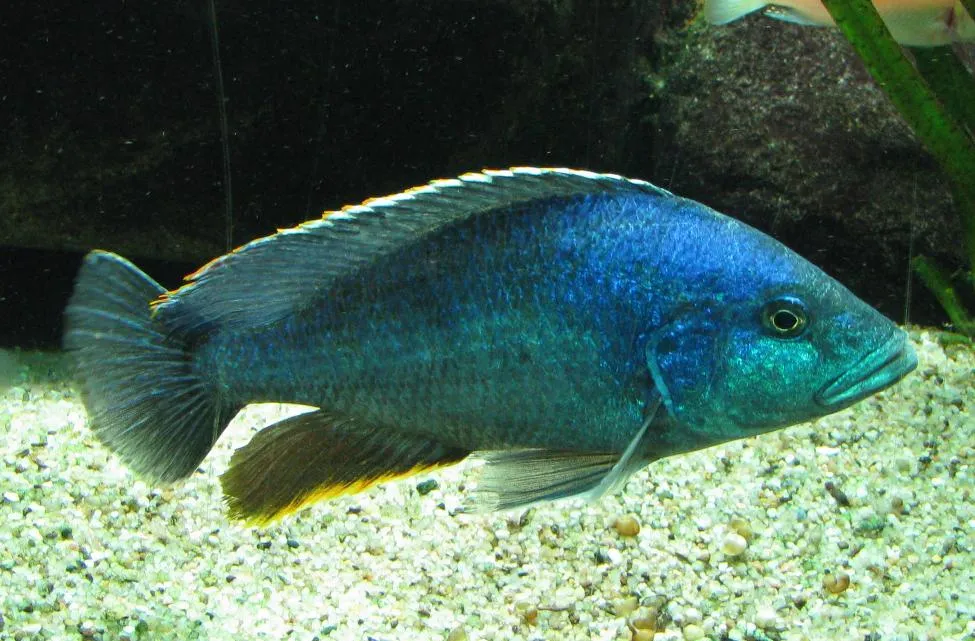
Taxonomy & naming
Charles Tate Regan described this fish in 1922 as Haplochromis polystigma in his monograph on the cichlids of Lake Nyasa (now Lake Malawi), from material collected in the lake; the lectotype is held at the Natural History Museum, London (BMNH 1921.9.6.102). It was moved to the genus Nimbochromis when Eccles and Trewavas erected that genus in 1989 for a cluster of large, blotched Malawian predators, and the combination Nimbochromis polystigma (Regan, 1922) is the name accepted today by Eschmeyer's Catalog of Fishes and FishBase.
The names are unusually literal. Nimbochromis joins the Latin nimbus, a rain cloud or storm, to chromis, an old word for a perch-like fish, a nod to the dark, cloud-like melanic blotches the genus wears; polystigma is Greek for "many spots," for the speckling scattered across the body and pectoral fins. Two later names, Haplochromis maculimanus Regan, 1922 and Haplochromis pardalis Trewavas, 1935, are carried as synonyms of this species (the IUCN assessment also lists the recombinations Nimbochromis maculimanus and Nimbochromis pardalis). In the hobby it is sold simply as the polystigma or, loosely and confusingly, as a "venustus" relative; it sits in the same small genus as the giraffe cichlid (Nimbochromis venustus) and Livingston's cichlid (Nimbochromis livingstonii).
Morphology
Against a pale, often faintly blue-grey ground, Nimbochromis polystigma is dusted with irregular dark blotches and spots that extend onto the head and across the pectoral fins, a pattern that breaks up the fish's outline and gives it the "clouded" look the genus is named for. FishBase records a maximum total length of about 9 in (9 in), and that figure is widely repeated; aquarists, however, routinely report males pushing close to 12 in (12 in) in tanks, so the realistic ceiling is somewhere in between and best treated as "nearly a foot of fish." The fin counts are typical of the genus: roughly 15 to 17 dorsal spines over 9 to 12 soft rays.
The sexes share the blotched dress for most of their lives, which is part of why juveniles and females are easy to confuse, but a breeding male transforms. As he comes into condition the brown mottling is overwritten by metallic blue across the face and flanks, often with yellow or orange in the fins. Useful field marks separating polystigma from its lookalikes include the spotted (rather than barred) pectoral fins, a speckled rather than boldly striped head, the absence of dark bars radiating from the eye, and a terminal, non-downturned mouth. It is most often mixed up with the more strongly barred Nimbochromis livingstonii and the yellower Nimbochromis venustus.
Habitat
Nimbochromis polystigma is endemic to Lake Malawi and widespread within it, recorded around the lake rather than confined to a single shore or island, which is part of why it is considered a common species; the IUCN describes its distribution as lake-wide, with its waters reaching into the Malawi, Mozambique and Tanzanian sectors of the lake, and the fish also spilling into Lake Malombe and the upper Shire River. The Catalog of Fishes lists its distribution simply as Lake Malawi, eastern Africa, and FishBase places it between roughly 8 and 15 degrees south.
It is a fish of the transitional, intermediate habitat rather than the open sand flats or the pure rocky reef. FishBase reports it as most common in mixed rock-and-sand habitats and vegetated areas, occurring in small groups around rocks with beds of the aquatic plants Vallisneria and Potamogeton; Konings places it among the species of the lake's intermediate zone, where, at a depth of roughly 70 ft (about 69 ft), rocks give way to sand and small clusters of stone break an otherwise open floor. The depth range runs from the surface down to about 250 ft, but it is usually found shallower than 115 ft. In-lake conditions are stable and alkaline: FishBase gives a pH window of about 7.5 to 8.5, with surface temperatures in the low-to-mid 70s Fahrenheit (around 23 to 25 degrees C), and lists a hardness range of dH 10 to 18 for the species. Those weed-fringed sand-rock margins are exactly the cover its ambush hunting depends on.
Feeding
This is a piscivore, a fish-eater, and a fairly high-level one: FishBase places it near a trophic level of about 4.2. In the wild it preys mainly on smaller fish, above all the juveniles of the lake's enormous cichlid radiation, and it does so with a flexibility that has made the genus a textbook example of cichlid behavioral plasticity. The IUCN assessment notes plainly that it may hunt as an individual or as part of a group. In the field, Konings describes it as normally roaming its stretch of habitat alone, without a permanently defended territory — its feeding range is large enough that other species are simply tolerated passing through, while conspecifics are more often chased off — though foraging N. polystigma, along with the related Champsochromis caeruleus and Stigmatochromis woodi, is occasionally seen working in small groups rather than solo. That is a looser, more opportunistic pattern than the coordinated "packs" sometimes described in hobby accounts.
Its most famous tactic is thanatosis, or death-feigning. The behavior was first documented in detail by Kenneth McKaye in a 1981 SCUBA study of its close relative Nimbochromis livingstonii, which lies on its side, semi-buried in the sand, and lets its blotched pattern mimic a dead, decomposing fish; scavenging juveniles approach to investigate and are seized. McKaye recorded individuals feigning death an average of seven times per half-hour. The same lie-in-wait, play-dead strategy is attributed to Nimbochromis polystigma by hobby and specialist sources, with the wrinkle that polystigma is reported to ambush from a motionless position on the substrate without necessarily rolling fully onto its side. Either way the dark mottling is doing double duty, as camouflage on the patchy bottom and as a lure. As a mid-sized roving predator of the inshore zone, it helps regulate the numbers of smaller cichlids in the rock-sand-weed community.
Mating
Socially the species is polygamous and, around spawning, sharply territorial — though even then the territory is temporary rather than a fixture, held only for the duration of a spawning bout and defended hardest when rival males are working the same stretch of habitat. The IUCN assessment describes the system tidily: territorial males defend spawning sites in the intermediate habitat, sand bowls constructed against rocks, while females guard the fry. Konings notes a curious asymmetry in how these males behave toward different audiences: they are notably shy around divers but readily aggressive toward rival conspecific males. After a male displays in his blue breeding dress and coaxes a female to spawn, the pair forms no lasting bond; he contributes nothing beyond fertilization and defense of his patch.
The transformation a breeding male undergoes, from cryptic brown blotches to vivid blue, comes with a steep rise in aggression: keepers consistently describe spawning males as bullies that will harry tankmates and rival males hard. Outside of breeding the fish is a confident, active cruiser rather than a rock-hugging skulker. Because the species is itself a swallow-anything predator, its courtship in a tank also coexists with treating any fish small enough to fit in its mouth as food, a point on which forum keepers are unanimous.
Breeding
Like the overwhelming majority of Lake Malawi haplochromines, Nimbochromis polystigma is a maternal mouthbrooder with no lasting pair bond. After spawning over the male's sand bowl, the female takes the fertilized eggs into her mouth and broods them there, incubating the eggs and sheltering the fry for the first weeks of life before releasing them; the male plays no further part. FishBase records the essentials plainly: the female takes the brood into her mouth and cares for the young, and the IUCN notes that females guard the fry.
Clutch size is not well documented for this species in particular, but it falls within the range typical of similarly sized Malawi haplochromines, on the order of dozens of comparatively large eggs per spawn, with the female fasting through the roughly three-week incubation. The IUCN gives a generation length of about two to three years, consistent with a fish that matures within a year or two and breeds repeatedly over a several-year life.
In the aquarium
Nimbochromis polystigma is a handsome, hardy, and genuinely large cichlid, and the common mistake is buying a charming 2 in (2 in) juvenile without planning for the foot-long predator it becomes. It needs a big tank, realistically a 6-ft (about 125-gallon / 470-litre) footprint or larger for a group, with open swimming room over sand and some rockwork to break sightlines. Replicate the lake's water: alkaline and well-buffered, pH around 7.8 to 8.5, in the upper 70s Fahrenheit (roughly 24 to 26 degrees C). Like all Malawi cichlids it is prone to "Malawi bloat" when water quality slips or the diet is wrong, so strong filtration, regular water changes, and a lean, protein-appropriate but not overrich diet matter.
Tankmate selection is where keepers get burned. Anything small enough to be swallowed will be eaten, full stop, so its companions must be too big to be prey but robust enough to absorb a spawning male's aggression; other large Malawi haplochromines ("haps") of similar size are the usual answer, and the smaller, feistier mbuna are a poor mix. The familiar party trick is real: do not panic the first time you find your prized fish lying "dead" on the bottom, only to have it spring back to life. This is not a beginner's community fish. It is best in the hands of someone who wants a large, characterful predator and can give it the space and tankmates to match. It is bred commercially and is readily and inexpensively available in the trade.
Conservation
On its own account, Nimbochromis polystigma is in good shape. The IUCN Red List assessed it as Least Concern (assessed 20 June 2018, an amended assessment published in 2019), reflecting a wide, lake-wide distribution across Lake Malawi, a stable population trend, and the absence of any species-specific threat; the assessors note the main pressures are subsistence fishing for food and irregular, low-volume collection for the aquarium trade, neither of which has noticeably reduced its numbers. It occurs within Lake Malawi National Park, a protected area, and is of only minor food-fishery interest, taken occasionally by hook-and-line fishers or in beach seines and exported under the trade name "Haplochromis polystigma."
That reassuring species-level picture sits inside a lake that is under real strain, and honesty requires holding both at once. The basin review by Chavula and colleagues (2023, Journal of Great Lakes Research 49(6):102241) documents mounting anthropogenic and climatic stress on the Malawi/Niassa/Nyasa system: heavy over-fishing and the collapse of the once-dominant chambo (Oreochromis) fishery, rising sediment and nutrient loading washing off deforested catchments, and warming of the shallow water by on the order of 0.7 degrees C that strengthens the lake's stratification and tends to suppress the nutrient mixing that feeds productivity, alongside the looming risk of invasive species. For an inshore, weed-and-sand-margin predator like Nimbochromis polystigma, the most direct of these pressures is the degradation of its shallow habitat: sedimentation that smothers the vegetated rock-sand seams it hunts over, and the shoreline development and nutrient runoff that go with a growing lakeside population. So the accurate statement is the careful one: the species itself is Least Concern and not currently at risk, but the lake it depends on is, and the inshore communities it belongs to are exactly where Malawi's basin-wide pressures land hardest.