Taxonomy & naming
The checkerboard cichlid was described by the German aquarist-ichthyologist Werner Ladiges in 1958, in the popular hobby journal Die Aquarien- und Terrarienzeitschrift (DATZ), as Crenicara filamentosa; the same description was reprinted as new in the more formal Internationale Revue der gesamten Hydrobiologie in 1959, which is why both years circulate in the older literature. Eschmeyer's Catalog of Fishes fixes the valid date at 1958. The holotype, a male, is held in the Zoological Museum Hamburg as ZMH H343, with a female paratype under the same number; Wilkens (1977) later designated the male as lectotype. Ladiges gave the type locality only vaguely as 'probably the upper Amazon,' a reminder that the fish reached science by way of the aquarium trade rather than a survey expedition. For three decades the species sat in Crenicara alongside all the other checkerboard-patterned cichlids, until Sven O. Kullander, who had redescribed filamentosa in a 1978 monograph, erected the genus Dicrossus in 1990 to hold the small, slender, lyretailed species, leaving the larger, deeper-bodied forms (such as Crenicara punctulata) in Crenicara. Within the eartheater subfamily Geophaginae, Dicrossus forms a small clade with Crenicara and the Guyanese Mazarunia. Today the genus contains a handful of described species — Dicrossus filamentosus, Dicrossus maculatus, Dicrossus foirni, Dicrossus warzeli, and the more recently described Dicrossus gladicauda — of which filamentosus is by far the best known in the hobby. At least two further, still-undescribed relatives are known from live imports: Dicrossus sp. "Tapajos," collected upstream of the São Luís de Tapajós rapids and carrying three longitudinal rows of black blotches rather than the two seen in filamentosus and its closest kin, and a similarly three-rowed but as-yet-unnamed population from the Rio Negro system whose blotches, unlike those of the Tapajós fish, are divided at the centre — a hint that blotch-row count and pattern may track real evolutionary lineages within the genus, though that has not been formally tested.
Morphology
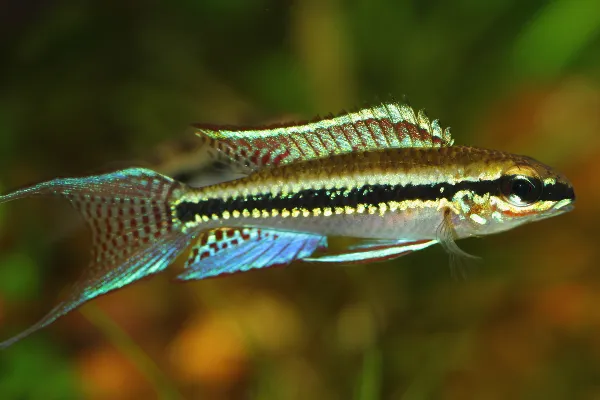
Dicrossus filamentosus is a small, elongate, laterally compressed cichlid with a blunt snout and a notably small mouth. Reported sizes vary with how length is measured and whether the fish is wild or tank-raised: FishBase lists a maximum of only 1.5 in standard length from a museum specimen, but that figure plainly under-records adult fish, and hobby and aquarium-literature sources consistently give males of about 3–3.5 in and females of about 2.5 in in total length, the male's measurement inflated by his trailing tail filaments. The ground colour is a warm copper to straw, over which run the two longitudinal rows of squared black blotches that give the fish its checkerboard name — one row along the midline and one just below the dorsal fin. The pattern is mood-dependent: a roused or displaying fish can fuse the lower row into a single dark stripe running from snout to tail base while the upper row fades, then snap back to the chessboard at rest. The genus-defining feature appears only in mature males, whose upper and lower caudal-fin lobes extend into long thread-like streamers, producing the lyre-shaped tail; the male's unpaired fins are further dressed in iridescent blue and red spotting. This is a strongly dimorphic species — females are smaller, plainer, with a simple rounded caudal fin and far less fin colour, and when in spawning condition their pelvic fins flush a solid salmon-red, an unmistakable readiness signal absent in males (whose pelvics show red-and-blue striping instead). In virgin, unspawned females that pelvic colour is instead clear to white, turning red only as the fish approaches spawning condition for the first time.
Habitat
The checkerboard cichlid is a blackwater specialist of the upper Rio Negro and the upper, western Orinoco drainage, ranging across Colombia, Venezuela, and Brazil. FishBase summarises the range as the Negro River drainage of the Amazon basin together with the Orinoco basin from the Río Inírida in Colombia downstream to Maripa in Venezuela; Eschmeyer's Catalog of Fishes lists the Orinoco drainage of Colombia and Venezuela. These are quintessential blackwater habitats — small, shaded forest streams and stream margins where the bottom is a deep litter of fallen leaves laced with branches and submerged roots, and where rooted aquatic plants are scarce except near the banks. The fish keeps to the bottom and lower water column, hanging above the leaf layer and diving into it when threatened. The water is extraordinarily soft, dark with dissolved tannins, and acidic: field and aquarium-literature sources give an in-situ pH of roughly 4.0–5.0 and a general hardness below 1 °dGH, with temperatures around 79–86 °F. FishBase's stocking note of pH 5.0–7.0 and dH 5–8 reflects tolerance under cultivation rather than the wild envelope, which is markedly more extreme. A 2024 AMAZONAS field account of a Rio Negro tributary recorded the species over fine white silica sand and a thick organic leaf-mat at 79 °F, pH 6.2, with no measurable hardness — alongside cardinal tetras and several Apistogramma. In the upper Orinoco portion of its range, aquarium-literature accounts describe it in small, slow-flowing streams where the leaf-litter and woody-debris layer runs some 19.5 in deep and rooted aquatic plants are essentially absent except right at the banks — habitat also reported to be shared there by the look-alikes Dicrossus maculatus and Crenicara punctulata (the latter with a further population recorded from Guiana). These are shallow-water fish of the stream margins and litter beds rather than the open channel.
Feeding
Dicrossus filamentosus is a micro-predator of the leaf litter, a small benthic invertivore that FishBase places at a trophic level near 3.1. In its native streams it works the layer of decaying leaves and the soft sediment beneath, picking out tiny crustaceans, insect larvae, and other micro-invertebrates dislodged as it nudges through the litter — the same litter-turning foraging that, in the wild, is shadowed by opportunistic tetras and dwarf pike cichlids snapping up what the checkerboards disturb. Its small mouth restricts it to small prey, and it is not a sand-sifter on the scale of its larger eartheater relatives. A distinctive part of the foraging technique, shared across the checkerboard cichlids, is turning the leaves themselves: the fish grips a leaf by its edge and swims upward just far enough to make it tip over, exposing whatever has settled underneath — a fish this size can flip leaves considerably heavier than itself this way, rather than simply nosing through the litter. In the aquarium this translates directly into a preference for small live and frozen foods — daphnia, newly hatched and adult brine shrimp, cyclops, and mosquito larvae — though tank-raised fish can be weaned onto fine sinking dry foods and will take spirulina-based flakes. Within the community it occupies the role of a quiet, bottom-oriented gleaner of small invertebrate life among the leaves.
Mating
Outside of breeding, checkerboard cichlids are gregarious and shy, living in loose schools and groups that shelter above the leaf litter; they are among the more peaceable dwarf cichlids and tend to lose out to pushier tankmates rather than dominate them. Reproduction is female-led from the outset. In a well-stocked tank the species naturally forms a polygynous, harem-like structure, with one male loosely overseeing several females, each holding a small territory. When a female ripens — signalled by the salmon-red flush spreading across her pelvic fins — she initiates courtship, leading the male to a spawning site she has chosen and cleaned, typically the upper face of a flat stone, a broad leaf, or a piece of submerged wood. The courtship is the elaborate, mutual display typical of cichlids, but the pair bond it produces is brief and asymmetric: once spawning is done the male shifts to a supporting role, guarding the wider territory rather than the eggs themselves, and in the confines of an aquarium — especially one with no other fish present to hold his attention — he can turn on the brood, so experienced keepers often separate the sexes after the eggs are laid unless dither fish are on hand to occupy him. This is a maternal-care system built around a single defending female, not a lasting biparental pair.
Breeding
Dicrossus filamentosus is an open-substrate (open-brooder) spawner rather than a cave or tunnel nester. Spawning is female-initiated: a ripe female leads the male to a site she has already cleaned, and lays her eggs there — described as ivory-coloured and numbering roughly 100 to 150 per spawn in aquarium-literature accounts, broadly in line with the genus-typical fecundity of roughly 60–120 eggs that FishBase gives from a wider sample. From that point care is chiefly hers: she positions herself close to the clutch and fans and guards it directly, while the male's role is peripheral rather than absent — he polices the surrounding territory and drives off intruders rather than tending the eggs himself. Keepers report it is often safer to remove him once spawning is done if the tank holds no other fish to divert his attention, since without a distraction he can turn on the brood; where dither fish are present, some breeders leave him in. At 82–84 °F the eggs hatch in about two days, after which the female moves the wrigglers to shallow pits she has prepared in the substrate; the fry become free-swimming roughly five to eight days after spawning and are then led about and defended by the female, who can extend maternal care for several weeks before she regains her red pelvic colour and is ready to spawn again. The dominant breeding obstacle is water chemistry: the eggs simply will not develop in hard or alkaline water. Wild fish demand a pH below 5 and near-zero hardness, and even captive-reared stock generally need pH around 6.0–6.5 and 1–3 °dGH (reports hold that the eggs fail to hatch much above pH 5.8), so reverse-osmosis water re-mineralised for soft-water dwarves is effectively mandatory. Tannin-rich additions such as Indian almond (Terminalia catappa) leaves both acidify the water and appear to stimulate spawning, while their antifungal compounds help protect the open clutch — a real risk, since the exposed eggs are prone to fungusing and are sometimes pulled with their substrate into a small bare incubator for artificial rearing.
In the aquarium
The checkerboard cichlid is a rewarding but demanding fish, best regarded as one for the experienced soft-water keeper rather than the beginner. Its small size is deceptive: although a single pair can be housed in a tank as small as roughly 23.5 in, the species does far better in a longer aquarium — 47 in or more — kept as a group of around a dozen with a sex ratio favouring females, which lets the natural harem structure express itself and spreads any aggression. It is decidedly a bottom-and-lower-water fish, so floor area matters more than height. The tank should be dimly lit and richly furnished with shelter: a soft, dark sand substrate, a litter of leaves, driftwood, roots, coconut shells, or short lengths of pipe, and floating plants to cut the light. Bright open tanks leave these naturally shy fish spooked and washed-out. Suitable plants are species that tolerate acid, mineral-poor water — Microsorum, Java moss, Amazon swords.
Water quality is the make-or-break factor. These fish come from soft, warm, acid blackwater and are genuinely sensitive to dissolved waste; nitrate should be kept very low and nitrite undetectable. The practical maintenance envelope is a temperature of about 79–86 °F, a pH around 4.0–6.5, and low hardness (under about 5 °dGH, and far softer for breeding). Strong filtration paired with frequent water changes keeps the water clean, but flow must be gentle — these are fish of still, quiet streams, and a brisk current stresses them. Tannin-staining from leaf litter or peat both suits the fish and recreates its biotope.
Temperamentally, Dicrossus filamentosus is peaceful to a fault, which dictates its tankmates. It is an ideal companion for other soft-water blackwater species of similar disposition — Apistogramma, small characins such as cardinal and neon tetras, pencilfish, and dwarf Crenicichla — but it will be bullied and outcompeted by anything boisterous or boisterously feeding, and should never share a tank with robust, fast cichlids or large barbs. The commonest reasons keepers fail with the species are water that is too hard or alkaline (which both stresses the adults and blocks breeding), tanks that are too bright and bare, and tankmates that monopolise the food. Feed small, varied, mostly live and frozen foods, give the fish acid blackwater and quiet company, and the checkerboard rewards the effort with one of the more charming spawning displays among the South American dwarves.
Conservation
The IUCN Red List assesses Dicrossus filamentosus as Least Concern (assessed 18 November 2020 by R.G. Frederico, published 2023), recording the population trend as unknown and listing the species from Brazil, Colombia, and Venezuela. It carries no CITES listing. The species is of no fisheries interest but is a commercial aquarium export, collected from the wild across its blackwater range; the assessment does not flag harvest as a population-level threat for so widespread a fish. As a habitat specialist tied to soft, acidic blackwater streams, however, its long-term prospects rest on the integrity of the upper Rio Negro and Orinoco drainages — among the most chemically distinctive freshwaters on Earth. The broader pressures bearing on these systems are the familiar Amazonian and Orinocan ones: deforestation of the flooded forests that supply the leaf litter and tannins these waters depend on, gold-mining and its mercury contamination, and changes to hydrology and water chemistry. None is documented as a present danger to this particular cichlid, but they are the backdrop against which the security of a blackwater specialist should be read.