Taxonomy & naming
Guianacara stergiosi was described in 2006 by Hernán López-Fernández, Donald C. Taphorn and Sven O. Kullander, in a paper in Copeia (2006, no. 3, pp. 384–395) that simultaneously named a second Venezuelan species, Guianacara cuyunii. Both fish had been recognized as undescribed forms nearly two decades earlier — a Venezuelan Guianacara was already flagged as 'yet to be described' in Kullander & Nijssen's 1989 monograph The Cichlids of Surinam, the work that erected the genus itself. The holotype (MCNG 52840, a 2 in SL specimen) was collected from the Claro River east of Los Tanques in the Caroní drainage of Bolívar State, Venezuela, with paratype lots distributed among the AMNH, ANSP, MCNG and NRM collections. The Catalog of Fishes treats the name as valid and places it in the nominotypical subgenus, Guianacara (Guianacara). The genus belongs to the eartheater subfamily Geophaginae within the Neotropical Cichlinae. For years Guianacara was thought to be the sister group of the threadfin acara Acarichthys, the two forming a small tribe Acarichthyini (Kullander, 1998); subsequent molecular work, however, told a different story. López-Fernández, Winemiller and colleagues (2010), in a multilocus phylogeny of Neotropical cichlids, recovered a strongly supported sister relationship between Guianacara and the recently rediscovered Guyanese genus Mazarunia, and concluded that the earlier Guianacara–Acarichthys grouping had been an artefact of incomplete taxon sampling. Within the genus, the species are separated almost entirely by colour-pattern details of the dark mask, the midlateral bar and the midlateral spot — features the describers noted are subtle but unambiguously stable within each species.
Morphology
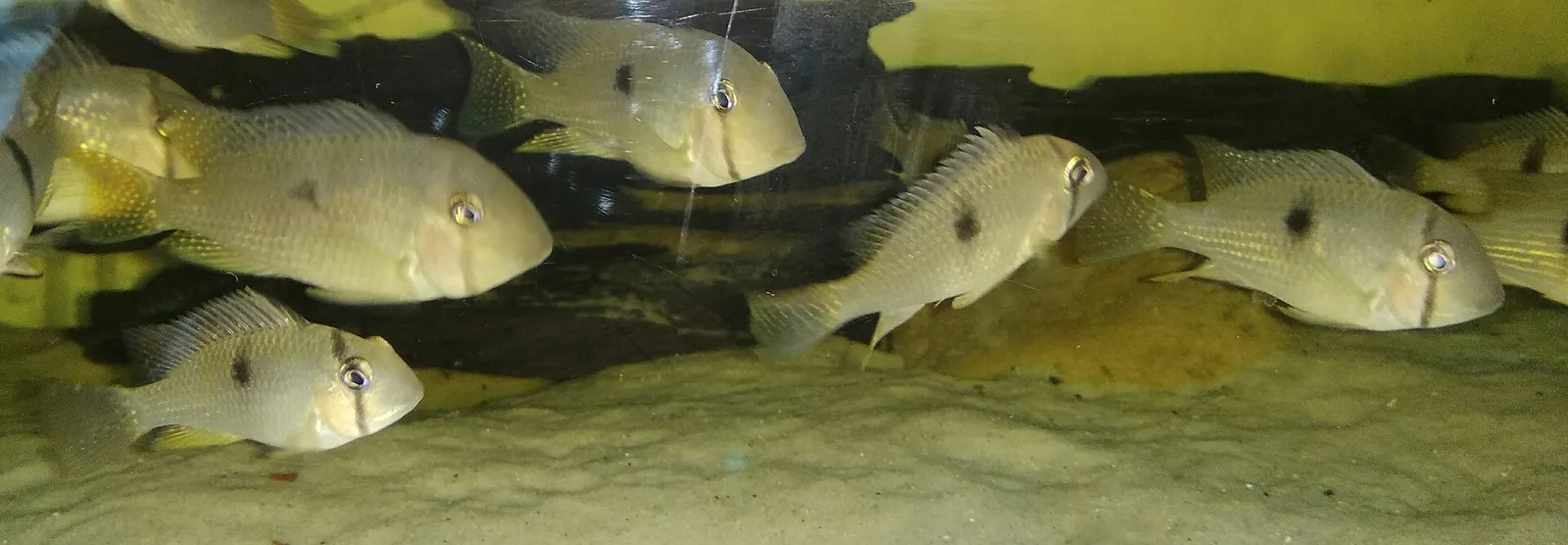
This is a small, deep-bodied cichlid: FishBase gives a maximum of 3 in standard length, and hobby accounts of the broader 'bandit acara' group describe males reaching perhaps 4.5–6 in total length with a heavy, blocky head while females stay roughly two-thirds that size or smaller. The ground colour is a muted yellowish to pinkish-green or beige, overlain in good condition with rows of iridescent gold-flecked scales and lightly spotted fins. The defining feature of the genus is the bandit's mask — a dark bar running from the nape down through the eye to the lower edge of the gill cover (the combined supra- and infra-orbital stripes). Against this, Guianacara stergiosi carries both a midlateral bar and a midlateral spot, and it is this spot that diagnoses the species: it is round (not oval as in most congeners) and sits almost entirely below the upper lateral line, with only the upper fifth of the spot touching that line. In small juveniles the bar is uniformly dark and the spot is hidden, but as the fish matures the bar progressively fades while the round spot darkens to become the strongest marking on the flank. The species also retains dark pigment in the membranes of the first few dorsal-fin spines (the dorsal-fin lappets) at all sizes — a trait lost in adult Guianacara geayi. Sexual dimorphism is present chiefly as size: males grow considerably larger and heavier-headed than the comparatively small females, a difference that becomes important in breeding.
Habitat
Guianacara stergiosi is endemic to the Venezuelan portion of the Guiana Shield, in the upper Orinoco basin. Its distribution is restricted to clearwater and blackwater tributaries and is centred on the Caroní River drainage, where it is most abundant — most collections come from the Claro and Paragua rivers — with additional records from the upper reaches of the neighbouring Caura drainage and from the poorly explored lower Aro River. Notably it is absent from the lower Caura below the Pará rapids, and it shares much of its range with the eartheater Geophagus grammepareius, the two being common together in the Caroní and the upper Caura. FishBase characterizes the species' habitat as moderately shallow, clear-to-black, acidic water with slow to moderate current over rocky bottoms. The describers' broader account of the genus fits this picture: Guianacara favour clear, soft, slightly acidic waters with a substrate of large rocks interspersed with patches of sand, often at sites with relatively brisk flow. These are upland shield rivers, draining ancient quartzite and granite, that run low in dissolved minerals — a clearwater/blackwater regime quite distinct from the white, sediment-rich waters of the Andean Orinoco. Field surveys of the upper Caura (Echevarría & González, 2018) confirm that rocky-substrate mesohabitats here support a distinctive assemblage of rock-associated specialists, the niche this cichlid occupies.
Feeding
No dedicated diet study of Guianacara stergiosi has been published, and FishBase carries no gut-content data for the species; its trophic level is given only as a model estimate (about 3.3). Inferences therefore rest on the genus and on close relatives. Guianacara are bottom-oriented foragers of rocky and sandy substrates — they take small benthic invertebrates and other items winnowed from the bed in the manner of their geophagine kin, though they are not committed sand-sifters in the mould of Satanoperca. The species' rock-and-sand habitat, with its biofilm, aquatic insect larvae, microcrustaceans and detritus accumulating among the stones, points to an opportunistic benthic invertivore that works the substrate of swift, clear shield streams. In aquaria the fish readily accept a wide range of prepared and live foods, consistent with a generalist bottom-feeding habit rather than any narrow specialization.
Mating
Wild reproductive behaviour in Guianacara stergiosi has not been documented in the literature, and what is known of mating in the genus comes almost entirely from the aquarium. Guianacara are biparental and form pairs, with a courtship in which the smaller female takes an active role: as she ripens she solicits the male and the pair settle on and defend a cavity or sheltered cleft as a spawning site. The pronounced size difference between the sexes shapes this behaviour — a female can slip into a crevice too small for a large or aggressive male, so the cave entrance itself can mediate the pair bond. Most pairs prove compatible, but the genus's general disposition is that of a moderately territorial cichlid that holds its own in a busy community rather than dominating it. Outside of spawning the fish are not exceptionally belligerent for their size.
Breeding
Guianacara stergiosi is a biparental substrate (cave/cleft) spawner; no clutch counts or wild nest descriptions specific to the species have been published, so the figures here are genus-typical. In nature the eggs are presumed to be laid on a concealed hard surface within a rocky cleft or under a stone — the rock-strewn beds the fish inhabit offer abundant such sites — and guarded by both parents, with the female tending and fanning the eggs while the male patrols the territory. In aquaria the proven method exploits the sexual size difference: an inverted clay flowerpot with its base chipped or knocked out makes an ideal cave, the altered opening sized to admit the female (and, where the male is belligerent, to keep him out). The female cleans the chamber, removes sand from the floor, and lays her eggs on the vertical inner walls; the male fertilizes them directly if he can enter, or by spraying milt through the opening above. Once a pair is settled and compatible the entrance can be enlarged so both fish share guard duty. The eggs hatch into larvae that the parents move and protect, and the free-swimming fry are guarded as a brood — the standard biparental cave-spawning pattern of the genus.
In the aquarium
Guianacara are well regarded by South American cichlid keepers as hardy, characterful 'bandit acaras,' and Guianacara stergiosi — long traded as Guianacara sp. 'Caroni,' and closely tied to the red-cheeked Guianacara sp. 'red cheek' / 'Rio Aro' form from within its range — is kept on the same terms as its congeners. A single pair is comfortable in a tank of around 47 in / four feet (roughly 55–65 US gal); the fish are not giants, but they appreciate floor space and benefit from a footprint that lets a subordinate fish retreat. Décor should echo the wild habitat: a substrate of sand with patches of smooth water-worn rock and cobble, arranged to create caves, clefts and broken sightlines, plus driftwood and a few sheltered hollows. At least one cave per fish — an inverted, base-knocked flowerpot is the classic — both reduces tension and gives a breeding female the spawning chamber she needs.
Water should be soft, slightly acidic and clean, mirroring the clear shield streams the species comes from: a temperature of roughly 75–82 °F, pH around 6.0–7.5, and low hardness suit it, and because these are fish of flowing upland water they reward good oxygenation and moderate current rather than a stagnant tank. They are unfussy feeders, taking quality sinking pellets and flake alongside frozen and live foods such as bloodworm, brine shrimp and small crustaceans; a varied diet keeps colour and condition up.
Temperament is manageable. Outside of breeding Guianacara stergiosi is only moderately territorial and mixes well in a 'rowdy' medium-sized cichlid community, holding its own against more boisterous tankmates without bullying them. Suitable companions are medium-sized, robust South Americans — other Guianacara, peaceful eartheaters, larger tetras and characins, and similarly tempered catfish. The main flashpoint is a spawning pair, which will defend its cave vigorously; in a planted, well-structured tank this is easily absorbed. The species is undemanding enough for an intermediate keeper, the chief requirements being clean soft water, a rocky-sandy aquascape and enough caves to spread out aggression.
Conservation
The IUCN Red List assesses Guianacara stergiosi as Least Concern (assessed 19 June 2017 by G. Echevarría), reflecting a species that, while narrowly endemic to the Venezuelan Guiana Shield, is reasonably common and widespread across the Caroní and Caura drainages and faces no documented species-level threat. It carries no CITES listing. The broader backdrop, however, is a region under growing pressure: the upper Caura and Caroní lie within or near zones of expanding artisanal and illegal gold mining, an activity that brings sedimentation, deforestation and mercury contamination to exactly the clear-water, rocky-bottom habitats this fish depends on. Surveys of the upper Caura (Echevarría & González, 2018) were explicitly framed as baseline data against which the impact of spreading gold-mining on the river's fish communities might later be judged. None of this is yet documented as a present danger to Guianacara stergiosi specifically, but as a clearwater shield endemic with a limited range it is the kind of species whose fortunes are tied to the integrity of these upland rivers.