Taxonomy & naming
Guianacara sphenozona was described by Sven O. Kullander and Han Nijssen in their 1989 monograph The Cichlids of Surinam (Teleostei: Labroidei), appearing on page 120 as figure 66. The holotype (RMNH 31047) is held at the Naturalis collection in Leiden, and the type locality is the Sipaliwini in the Corantijn River drainage, Nickerie District, Suriname. The species was one of three new Guianacara erected in that work — alongside owroewefi and oelemariensis — when Kullander and Nijssen split a long-misplaced lineage out of the catch-all genus Aequidens and created Guianacara to hold it together with the older Acara geayi (Pellegrin, 1902). The genus name itself simply joins "Guiana," for the principal area of distribution, to acará, the Tupí-Guaraní word for a cichlid. Within the eartheater subfamily Geophaginae, Kullander's morphological work (1998) placed Guianacara as the sister group of the threadfin acara Acarichthys, the two forming a small distinct lineage he called the tribe Acarichthyini; subsequent molecular studies (Farías et al. 1998; López-Fernández et al. 2005) have broadly supported that pairing. The genus now contains seven valid species, and Guianacara sphenozona is the nominotypical subgenus's representative in the western Guianas. Two more Venezuelan species (stergiosi and cuyunii) were added by López-Fernández, Taphorn and Kullander in 2006, and a tear-faced species (dacrya) by Arbour and López-Fernández in 2011, with several undescribed forms still known from the Branco and Trombetas drainages of northeastern Brazil. Thomas Weidner's monograph on the eartheaters offers a useful refinement of how Guianacara's brooding style should be classified relative to its tribe-mate Acarichthys: because Guianacara species attach their adhesive (l-type) eggs to vertical cave or cleft walls and never to the ceiling, and will generally accept any reasonably well-hidden site, he treats them as concealed-spawning substrate-brooders rather than true cave-brooders — a distinction he reserves for Acarichthys heckelii, whose eggs are attached directly to the roof of its tunnel chamber.
Morphology
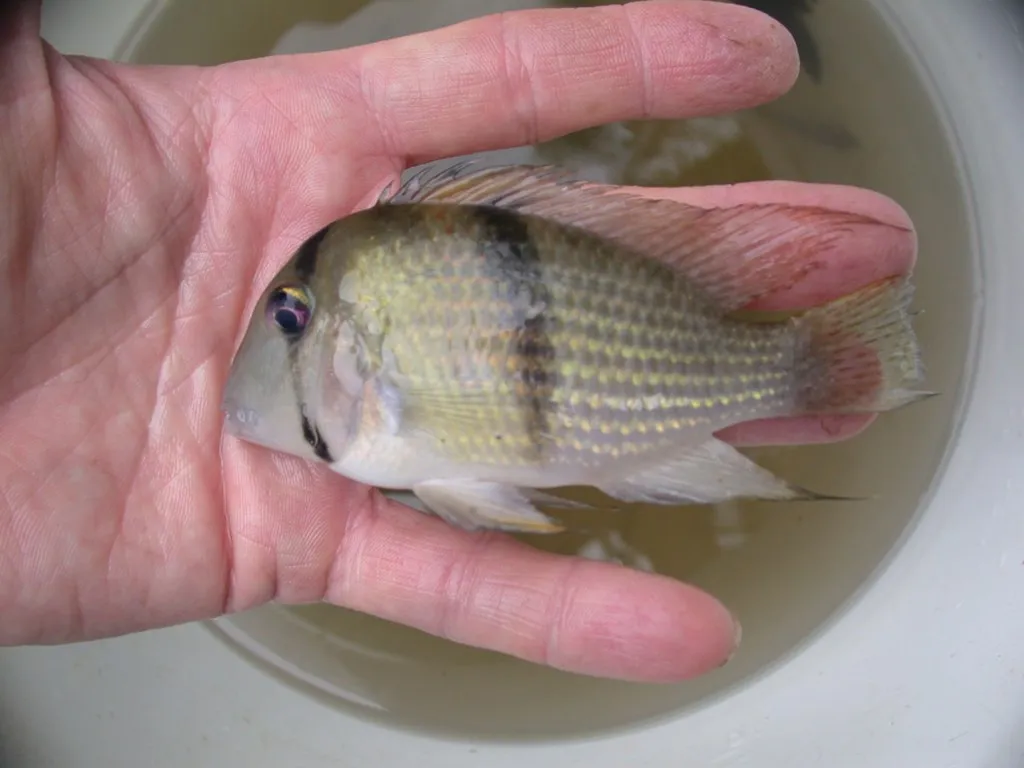
Guianacara sphenozona is a modestly sized, fairly deep-bodied cichlid; Kullander and Nijssen recorded a maximum of about 3.5 in standard length in the original description — Weidner cites the same figures directly, the largest examined male at 3.5 in SL and the largest female at 3 in SL, putting a realistic total-length ceiling around 4.5 in — though field and aquarium reports of large "bull" males with blocky, heavy heads run well beyond that in some accounts: Wayne Leibel describes wild Guianacara sphenozona males exceeding six inches in total length, a discrepancy that may reflect regional variation or simply differing definitions of a mature 'bull' male rather than any single reliable maximum. The ground colour is a subdued yellowish to pinkish-green or beige, often overlaid with rows of iridescent gold-flecked scales, and the unpaired fins are lightly spotted. Two melanic markings define the genus and, in their precise arrangement, the species. The first is the "bandit" mask: a dark bar that drops from the nape through the eye to the lower edge of the gill cover (the combined supra- and infra-orbital stripes), the feature that earns all Guianacara their hobby name. The second is the midlateral marking — a wedge-shaped vertical bar on the flank carrying a darker spot, the wedge-band that gives sphenozona its epithet. The species is distinguished from its congeners by a specific combination: it carries both the midlateral bar and a spot, the spot sits above the upper lateral line, and — diagnostically — the membranes of the first few dorsal-fin spines lack the black lappet pigment seen in several relatives (owroewefi, cuyunii, oelemariensis, stergiosi, dacrya), though this character is mood-dependent enough to be unreliable in practice — imported fish of essentially every Guianacara species show black anterior dorsal spines when in breeding condition, whatever the original description says about the resting state. As a member of the nominotypical subgenus Guianacara, sphenozona also carries the group's characteristically prolonged anterior dorsal-fin lappets. The best field character for separating live sphenozona from its close relatives is colour rather than pattern: a distinctly bluish cast to the flanks, against which the closely similar, still-unresolved 'Rio Caroni' population instead shows a plain beige-grey ground. The suborbital ('bandit mask') stripe also differs subtly between the two: in true sphenozona it runs across the cheek to the preoperculum in a slightly curved line with indistinct edges, rather than the sharper, straighter stripe of some relatives. Juveniles wear a uniformly dark bar without the discrete spot, which resolves only as the fish matures. Sexual dimorphism is pronounced in size: males grow distinctly larger and noticeably heavier-set or 'beefier' through the body than females, with the heavy nuchal hump and blocky head reported in older aquarium males, while females typically reach only about two-thirds of the male's length; no other secondary sexual characters have been reliably documented.
Habitat
The species is a Guiana Shield endemic of the western Guianas. FishBase and Kullander's 2003 checklist give its confirmed range as the Sipaliwini and middle Corantijn River drainages of Suriname, with probable occurrence in the Essequibo River basin of neighbouring Guyana — the same biogeographic pattern Leibel used to argue that the western "geayi" of the aquarium trade is in fact this fish. Kullander and Nijssen themselves did not rule out a range extending as far west as Venezuela, and Weidner reports personally catching and observing a sphenozona-like Guianacara at Paso Caruachi, a ruined stone causeway across the Rio Caroní in Venezuela, where the fish swam close to the causeway in water up to 5 ft deep; over time the structure had accumulated numerous cracks and holes that the cichlids used as refuges, and probably as breeding caves as well. Whether this Rio Caroní population is in fact Guianacara sphenozona or a separate, still-unresolved form remains an open question — field workers describe it as sharing many features with true sphenozona but differing in base colour, and it continues to circulate in the hobby simply as 'Guianacara sp. Rio Caroni' pending confirmation. These are clear-to-tea-stained Shield waters rather than the white- or blackwater of the central Amazon. Across the genus, López-Fernández, Taphorn and Kullander (2006) characterise the preferred biotope as clear, soft and slightly acidic water over a bottom of large rocks interspersed with sandy patches, frequently at sites with appreciable current — the back-eddies below cascades and rapids, and the margins of forest creeks. Bandit cichlids occur there in loose harems and work the shallow, stony banks. Reported field and recommended chemistry runs warm and soft: roughly 75–82 °F, a pH spanning the acidic-to-neutral range (about 5.5–7.2), and low to moderate hardness. Documented depth is shallow — these are fish of the creek edge and rocky shallows rather than open deep water. The genus as a whole is restricted to the rivers draining the ancient Guiana Shield, and sphenozona sits at its western end.
Feeding
Like its geophagine kin, Guianacara sphenozona is a benthic forager that takes mouthfuls of sand and fine substrate and sorts edible material from grit, supplementing this with small invertebrates and organic particles gleaned from rock surfaces and leaf litter. FishBase places its estimated trophic level near 3.3, consistent with an omnivore that leans toward small animal prey rather than a strict detritivore. In aquaria the species is unfussy and accepts the full range of small-particle foods — frozen bloodworm, mosquito larvae, Mysis, brine shrimp and daphnia, alongside flake, slow-sinking granules and cichlid pellets — which matches a wild diet of benthic invertebrates and the micro-fauna of sandy and stony creek beds. Its sand-sifting habit means it constantly reworks the bottom of its territory, an activity that is both a feeding behaviour and part of how it prepares and tends a nest site.
Mating
Guianacara sphenozona is a gregarious, harem-forming cichlid for most of the year. In the wild, adults gather in groups along shallow stony banks, typically organised as a single male attended by several females, and outside of breeding the fish are relatively peaceful and even shy. Reproduction shifts the social order toward female-centred territories built around a cave or rock cleft. When a female ripens she selects and cleans a sheltered cavity, clearing sand from beneath an overhang or out of a crevice, then actively courts the male toward it. Pairs are generally compatible and the squabbling between males in a group is usually bluster rather than serious damage, particularly where rockwork and other structure break up sightlines. This comparatively even temperament — sociable in a group, forming workable pairs without the lethal intrasexual aggression seen in some larger Neotropical cichlids — is a large part of why the bandit cichlids are considered approachable subjects despite how little of their natural biology has been formally documented.
Breeding
Guianacara sphenozona is best described, in Weidner's more precise terminology for the tribe, as a biparental concealed-spawning substrate-brooder rather than a true cave-brooder: the eggs are always attached to a vertical surface, never to the roof of a cavity, and the pair is not fussy about the exact site so long as it is reasonably well hidden from view. No spawning has been described from the wild, but the captive pattern is well established and consistent across the genus. The female cleans the vertical walls of a cave or rock cleft and deposits her eggs there; the male fertilises them, entering the cavity directly where he can or releasing milt from the opening above. Reported clutches for the genus run up to several hundred eggs — congeners are recorded laying on the order of a few hundred (to ~500) — and the female takes the lead in tending and fanning the brood while the male patrols and defends the wider territory; both parents commonly guard the free-swimming fry. The proven aquarium nest is an inverted terracotta flowerpot with the base knocked out or chipped to leave an entrance sized so the female can pass but a belligerent, larger male cannot — the classic "hidey-hole" used for cave spawners with strong sexual size dimorphism. Once a pair has bonded the entrance can be enlarged so both fish share brood care. The species is regarded as one of the more tractable cichlids to spawn in this manner, and fry are straightforward to grow on once they are free-swimming and accepting fine foods.
In the aquarium
Guianacara sphenozona — usually sold simply as a "bandit cichlid," and historically as "geayi" — is among the most rewarding and forgiving members of its genus for a keeper who respects its few real requirements. Because it is naturally gregarious and harem-living, it does best as a group of six or more rather than a lone pair; a single male with several females mirrors the wild structure and spreads any aggression. A group of this size needs room: an aquarium of roughly 47 in / four feet or more in length and at least 80 US gal is a sensible minimum, scaped to give every fish a refuge. Several pairs can be housed together at that size, but a smaller tank calls for a single pair only. Intraspecific aggression is often fairly intense, but rarely goes beyond posturing and short charges; genuine mouth-fighting is uncommon and even then it rarely leaves a mark on the loser.
The décor brief is specific. Provide a soft sand substrate (the fish sift and dig, and will undermine rockwork, so seat stones on the tank base before adding sand) together with smooth water-worn rocks and driftwood arranged into caves, clefts and visual barriers. Recreating the wild biotope pays off: a mix of calm zones and areas of moderate flow — a powerhead or a well-placed return — suits a fish of cascade back-eddies and rocky creek margins better than dead-still water. Rooted plants generally fare poorly given the constant digging; tough or attached species (Anubias, Java fern on wood) are a better bet, and aren't essential.
Water should be soft to moderately hard and warm: about 77–82 °F — Weidner puts the practical floor at 77 °F, since these fish decline below that — pH in the 5.5–7.2 range, with the lower, softer end favoured for conditioning and breeding. The species is not delicate about exact chemistry so long as organic pollution is kept slight, but does want clean, well-oxygenated water with some movement, in keeping with its flowing-creek origins. Feeding is easy — a varied diet of frozen and dried small-particle foods keeps colour and condition — and fine sinking foods let the fish express their natural sifting behaviour.
On compatibility, bandit cichlids are relatively peaceful and somewhat shy outside of spawning, so they are not suited to a tank of small fish that could be eaten, nor to boisterous bullies that would intimidate them. Medium-sized, even-tempered South American community fish — larger tetras and characins, peaceful catfish, and similarly calm cichlids — make good companions, and the species can hold its own in a moderately busy community. Weidner's one practical caveat is about feeding rather than aggression: because sphenozona competes eagerly and eats greedily, slow or timid feeders housed with it can go hungry even if they are never actually threatened, so tankmates should be agile enough to hold their own at mealtimes. Expect minor, mostly harmless jostling between males during the breeding season; ample rockwork and sightline breaks keep it from escalating. The commonest keeper mistake is buying a single "pair" of a fish that is happiest in a group, and a sandy, rock-and-current biotope it can dig and patrol.
Conservation
The IUCN Red List assesses Guianacara sphenozona as Least Concern (assessed 28 December 2020 by D.C. Taphorn and D. Rodríguez-Olarte; published 2021), with a population trend reported as stable. The assessment lists its range across Guyana and Suriname and notes no specific, quantified threats, while flagging that the species occurs in some areas affected by gold mining — the chief regional pressure on Guiana Shield freshwaters, where alluvial and small-scale gold extraction increases siltation and turbidity and introduces mercury contamination into clear-water creek systems. It carries no CITES listing and is not a fisheries target; collection for the ornamental trade is modest and not identified as a population-level concern. As a habitat-flexible fish with a reasonably broad distribution across two Shield drainages, sphenozona is far less exposed than the genus's narrow-range endemics (such as the single-river oelemariensis), but the broader trajectory of mining and deforestation across the Guianas is the backdrop against which its long-term status should be read.