Taxonomy & naming
The species was described by the German naturalist Reinhold Friedrich Hensel in 1870 as Geophagus gymnogenys, from material collected in the Rio Cadeia in Rio Grande do Sul, southern Brazil. A lectotype (ZMB 7465, in the Berlin museum) was later fixed by Gosse in his 1976 revision of the geophagine cichlids, with several paralectotypes from the same series. In 1918 Alípio de Miranda Ribeiro erected the genus Gymnogeophagus for the southern, scaleless-cheeked eartheaters, and gymnogenys has been placed there ever since; the genus is diagnosed by two derived osteological features — the absence of supraneural bones and a unique forward-directed spine on the first dorsal-fin pterygiophore — that set it apart from Geophagus proper. The species was redescribed by Reis & Malabarba in their 1988 revision of the genus (Revista Brasileira de Zoologia), which also split Gymnogeophagus into a short-bodied substrate-spawning lineage and a longer-bodied mouthbrooding lineage to which gymnogenys belongs. The name has long been applied far too broadly. Aquarists and even some authors used 'gymnogenys' as a catch-all for any blue-spangled, humped southern eartheater, and molecular work by Pereyra & García (2008) showed that material under this name actually comprised several genetically distinct clades — the 'Gymnogeophagus gymnogenys species complex'. Malabarba, Malabarba & Reis (2015) acted on that signal: describing five new species from the rio Uruguay drainage and the rio Negro (including Gymnogeophagus mekinos, long confused with gymnogenys), they formally restricted Gymnogeophagus gymnogenys in the strict sense to the laguna dos Patos and rio Tramandaí drainages of Rio Grande do Sul, Brazil, and adjacent Uruguay. Records of 'gymnogenys' from the Paraná-Paraguay system and from Argentina are now understood to refer to other, often undescribed, members of the complex. The whole gymnogenys clade is recognized by sharing the absence of an oblique bar between the eye and the nape and the presence of a black bar running down and back from near the dorsal-fin origin.
Morphology
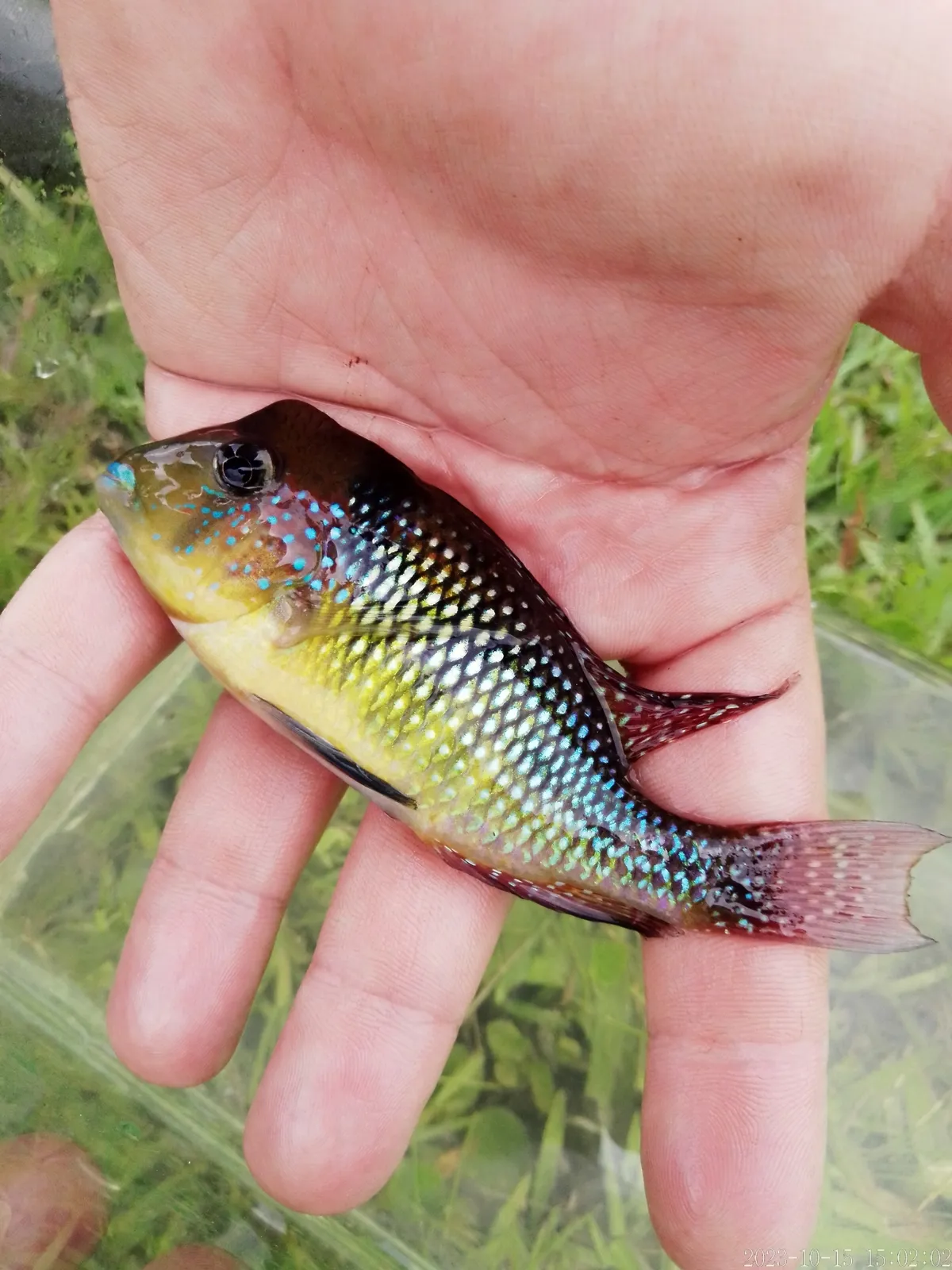
Gymnogeophagus gymnogenys is a robust, deep-bodied and laterally compressed eartheater. FishBase and Kullander's (2003) checklist give a maximum of about 6 in standard length, while an older aquarium-trade figure of roughly 10 in total length almost certainly conflates the fish with larger, related forms; a body length around 7 in is a reasonable upper expectation for well-grown wild males. Body depth is comparatively great for the genus (around 39–44% of standard length), distinguishing the species from the slimmer Gymnogeophagus mekinos. The defining feature, and the source of the name, is the cheek: the cheek and preopercle are scaleless ('naked'), exposing bare skin where most cichlids carry scales. Coloration is where the fish earns its reputation. Mature males carry rows of clearly demarcated iridescent blue spots, one centred on each scale, over a ground that ranges from olive to brassy yellow, and develop red fins and a fleshy adipose nuchal hump in breeding dress; geographic forms vary from blazing-orange-crowned eastern fish to the more yellow-humped western (rio Uruguay / rio Negro) types. The species expresses double vertical bars when stressed, a diagnostic that hobbyists have long used to separate it from the superficially similar Geophagus brasiliensis (which lacks them). In both sexes the ground colour runs from greenish beige to yellow, with a dark, sometimes squarish lateral spot at mid-flank and, mood-dependent, an oval spot just ahead of it and traces of a mid-lateral band. Males and dominant fish add an interorbital bar and a saddle-stripe at the base of the dorsal fin, the intervening zone flushing vivid yellow and, in the most developed males, swelling into the nuchal hump; the unpaired and ventral fins turn reddish and are peppered with iridescent bluish spots — a spotted pattern, notably, rather than the striped fin pattern of the related Gymnogeophagus rhabdotus — while the pectoral fins stay colourless. The upper head profile also rises more steeply than in G. rhabdotus and G. meridionalis, both of which carry a more pointed snout. Sexual dimorphism is strong: males grow larger, are far more colourful, carry the nuchal hump and have produced (filamentous) dorsal- and anal-fin tips, while females stay smaller, plainer and rounder-finned.
Habitat
In the strict sense defined by the 2015 revision, Gymnogeophagus gymnogenys is native to the laguna dos Patos and rio Tramandaí drainages of Rio Grande do Sul in southernmost Brazil, extending into the adjacent coastal and lagoon systems of Uruguay; the IUCN assessment scopes its verified range to the Patos and Tramandaí basins. Before that revision, the name was used far more broadly: Weidner's monograph (predating the 2015 split) lists the species from well over a dozen sites across coastal Rio Grande do Sul (Rio Cadeia, Rio Guaíba, Rio Piratini, a dam on the Rio Jacuí, the Taquari, Forqueta, Caí and other tributaries) and, in Uruguay, from the Arroyo de la India Muerta and the Arroyo de las Avecillas near Treinta y Tres, the Río Uruguay drainage and the Laguna Merín basin, with an isolated record from the Río Gualeguaychú in Argentina. Most of these populations, particularly the Uruguayan and Argentine ones, are now understood to belong to other, more recently split members of the gymnogenys complex rather than to the narrowly defined species, but they usefully sketch the ecological range the whole complex occupies. These are subtropical, lowland coastal drainages well south of the tropics proper, and the fish lives accordingly in a cool, strongly seasonal thermal regime. Weidner describes the typical biotope as slow-flowing to still water along the bank, among stands of submerged and emergent vegetation and sometimes under a cover of floating plants, over a predominantly muddy bottom, in soft water with a mildly acidic pH. FishBase records a preferred range of about 70–75 °F, and field accounts describe the strongly seasonal swing this implies directly: in Rio Grande do Sul, winter (June–July) water can run close to freezing, while a summer temperature around 77 °F is entirely normal — a cycle far cooler, and far more variable, than any Amazonian cichlid tolerates. It is typically found over sand or rock bottoms in clear, flowing water, from small streams to large rivers and the margins of coastal lagoons. Published in-situ chemistry specific to this species is otherwise sparse, but the genus as a whole occupies near-neutral to slightly alkaline water of moderate hardness — consistent with the calcareous coastal-plain geology of the Patos-Mirim system — rather than the soft blackwater of the Amazon. As an eartheater of shallow river and lagoon-margin habitats it occupies a shallow band of the water column, generally within the top couple of metres, though no precise depth profile has been published.
Feeding
Like its relatives, Gymnogeophagus gymnogenys is an eartheater in the literal sense: it feeds by taking mouthfuls of sand and fine sediment, sifting the load through the gill rakers to strain out edible particles and expelling the cleaned grains. FishBase places it at a trophic level of about 3.4, marking it as an omnivore that leans toward animal prey. The diet is built from benthic invertebrates — chironomid (midge) larvae, small crustaceans and other macroinvertebrates winnowed from the substrate — supplemented with organic detritus and incidental plant and algal material. Its molariform posterior pharyngeal teeth, larger than the thin anterior teeth, suggest some capacity to crush harder-shelled prey. In its coastal-stream and lagoon communities it functions as a generalist benthic forager, working the sand and leaf litter alongside other geophagines and, in Uruguayan streams, pike cichlids (Crenicichla), Australoheros and Cichlasoma. Appetite tracks the seasonal thermal cycle closely: the fish feeds normally through the warm months but takes only very small amounts once winter cooling sets in, so keepers who replicate the natural annual cycle need to cut portions right back — and remove anything uneaten promptly — during that dormant phase rather than feeding on a fixed tropical-fish schedule.
Mating
Reproduction in Gymnogeophagus gymnogenys is organized around a polygynous, male-territorial system that mirrors the mouthbrooding habit. A dominant male holds and defends a territory over open sand or rock and courts the ripe females that enter it; FishBase notes that a male will spawn with several females in succession when more than one is ready, but will pair and remain with a single female when only one is available. That polygyny has direct field support: when Tonny Brandt Andersen sampled the species from the Arroyo de la India Muerta in Uruguay, females significantly outnumbered males in the catch, leading him to conclude that individual males were holding large territories within which several females were tolerated. Females do the bulk of the brood care, so the male is largely freed to court and guard rather than tend young. Across the genus, breeding is tightly seasonal and tied to the southern summer — Uruguayan field workers report that ripe and brooding fish appear from roughly November to January, and that females captured in those months are routinely found carrying eggs or larvae in the mouth. The rising spring water temperature that follows the cool subtropical winter appears to be the principal trigger, and it is the same cue that drives males into full breeding colour and into developing the nuchal hump.
Breeding
Gymnogeophagus gymnogenys is a delayed larvophilous mouthbrooder, a reproductive mode that is uncommon among Neotropical cichlids and that places it firmly in the genus's derived mouthbrooding lineage. The female first spawns in the conventional geophagine manner — eggs are deposited on a cleaned patch of substrate and then covered with a layer of sand — and guards the developing clutch in place. As the eggs approach hatching she takes the larvae up into her mouth and broods them orally from that point, releasing free-swimming fry that dart back into her mouth at any threat (the trigger appears to be the dark circle of the parent's open mouth). This 'delayed' uptake — spawning on substrate, then transferring to the mouth around hatching — is regarded as an evolutionary intermediate between full substrate-spawning and immediate mouthbrooding, and FishBase explicitly corrects older accounts that described the species as a simple substrate spawner. Clutch sizes specific to gymnogenys are not well documented in the literature; congeneric mouthbrooders such as Gymnogeophagus balzanii lay on the order of several hundred eggs (roughly 500 reported), which is a reasonable genus-typical guide. The historical confusion in the hobby was so acute that the diagnostic test became behavioural: a southern eartheater that breeds like a convict cichlid (open substrate, biparental, no mouthbrooding) is, by definition, not the true Gymnogeophagus gymnogenys. Captive spawnings have occurred but have been described as sporadic, and seasonal cooling followed by a spring-like warming is the most reliable conditioning regime.
In the aquarium
Gymnogeophagus gymnogenys reached North American and European aquarists decades ago — Rosario LaCorte is credited with breeding coastal-Brazilian stock in the early 1970s — but it has never been a common trade fish, and most 'gymnogenys' sold over the years has in fact been Geophagus brasiliensis or another member of the complex. Anyone keeping the true fish should treat it above all as a temperate, not tropical, cichlid. This is the single most important and most commonly botched point: the southern Gymnogeophagus are adapted to cool, strongly seasonal water, and kept permanently warm in a heated tropical tank they grow listless, lose colour and are short-lived. They do best unheated, with a genuine seasonal swing — cool through winter, warming into the low-to-mid twenties in summer — which is also what conditions them to breed and pushes males into hump and colour. Weidner's own recommended regime for the species is specific: hold the fish at no more than 59 °F for at least two months during the cold season, allowing a brief drop to around 50 °F for a few days at the depth of winter, and shift the temperature up and down only slowly at the transitions to avoid shocking the fish. In mild climates they thrive in unheated indoor tanks and outdoor ponds.
Give a pair or trio a tank of at least about 55 US gal (a 50-US-gallon, 47 in footprint is a sensible minimum); this is one of the larger and more active Gymnogeophagus and it wants swimming room. A bed of fine sand is essential so the fish can sift and feed naturally, with scattered rocks, driftwood and a few sturdy roots to break sight-lines and define territories. Water should be near-neutral to slightly alkaline (pH roughly 6.5–7.5) and of moderate hardness, reflecting the coastal-plain drainages it comes from; it is not a soft-blackwater fish. Good filtration and regular water changes keep it in condition, but strong current is unnecessary.
Temperament is moderate. Outside the breeding season it is a fairly peaceful, sociable eartheater that mixes well with medium-sized tetras, Corydoras, Ancistrus and other robust, temperate-tolerant tankmates; the mouthbrooding gymnos are generally less belligerent than the substrate-spawning ones. A territorial male will, however, claim and defend a spawning area, so provide space and structure. Feeding is easy: it accepts dry, frozen and live foods readily, and a varied diet built around frozen bloodworm, small crustaceans and a quality sinking prepared food, with some vegetable content, keeps colour and condition high. The honest summary for a prospective keeper is that the husbandry is not difficult, but it is specific — get the temperature regime and the sand substrate right and the fish is rewarding; treat it as a generic tropical cichlid and it will disappoint.
Conservation
The IUCN Red List assesses Gymnogeophagus gymnogenys as Least Concern (assessed 7 November 2018, published 2022, by the Instituto Chico Mendes de Conservação da Biodiversidade (ICMBio) and P. Reis). The assessment treats the species as frequent and abundant within its range in the laguna dos Patos and rio Tramandaí basins of Rio Grande do Sul, well represented in ichthyological collections, and — as a habitat generalist — not at risk of extinction. It carries no CITES or CMS listing. The threats the assessors flag are diffuse rather than acute: sedimentation, removal of riparian vegetation and a general loss of habitat heterogeneity across the coastal-plain drainages, pressures that in the neighbouring Mirim basin are driven heavily by rice farming. A broader caveat applies to the wider 'gymnogenys' label: because the name historically masked several distinct lineages, some of which have only recently been separated out (and some of which remain undescribed), local population trends are easy to misread, and the conservation status of the narrowly defined species should be read against the still-unsettled taxonomy of the complex as a whole.