Taxonomy & naming
Gymnogeophagus terrapurpura was described in 2016 by Marcelo Loureiro, Matías Zarucki, Luiz R. Malabarba and Iván González-Bergonzoni in Neotropical Ichthyology, on the basis of coloration characters. The holotype (ZVC-P 12490, a 2.5 in SL fish) was collected in 2009 in the cañada de la Lana near Juanicó, in the río Santa Lucía basin of Canelones Department, Uruguay — a tributary system of the Río de la Plata. The authors designated an extensive paratype series of about forty specimens drawn from across the country. The fish is no newcomer to collectors; it had simply been passing under other names. Stawikowski photographed it as 'Gymnogeophagus rhabdotus' in 1983, Reis and colleagues figured the same specimen as Gymnogeophagus meridionalis in 1992, and a string of ecological and genetic studies treated it as Gymnogeophagus rhabdotus, 'Gymnogeophagus cf. meridionalis', or simply 'Gymnogeophagus sp.' before it was formally separated. Within the genus it belongs to the substrate-brooding assemblage informally called the 'Gymnogeophagus rhabdotus species group', alongside Gymnogeophagus rhabdotus, Gymnogeophagus meridionalis, Gymnogeophagus setequedas and Gymnogeophagus che. The genus Gymnogeophagus Miranda Ribeiro, 1918 is diagnosed by a unique forward-directed spine atop the first dorsal-fin pterygiophore and the absence of bony supraneurals. Distinguishing terrapurpura from its group-mates rests heavily on fin colour: it carries a lower E1 scale count (23–25 versus 26–30 in most other congeners) and a diagnostic dorsal-fin pattern of diagonal bright-blue stripes over red in the spiny section and round, elliptical and elongated blue spots in the soft section. The authors noted that two earlier manuscript names from Uruguay, 'Gymnogeophagus arcoiris' and 'Gymnogeophagus artiguensis', remain unavailable under the rules of zoological nomenclature.
Morphology
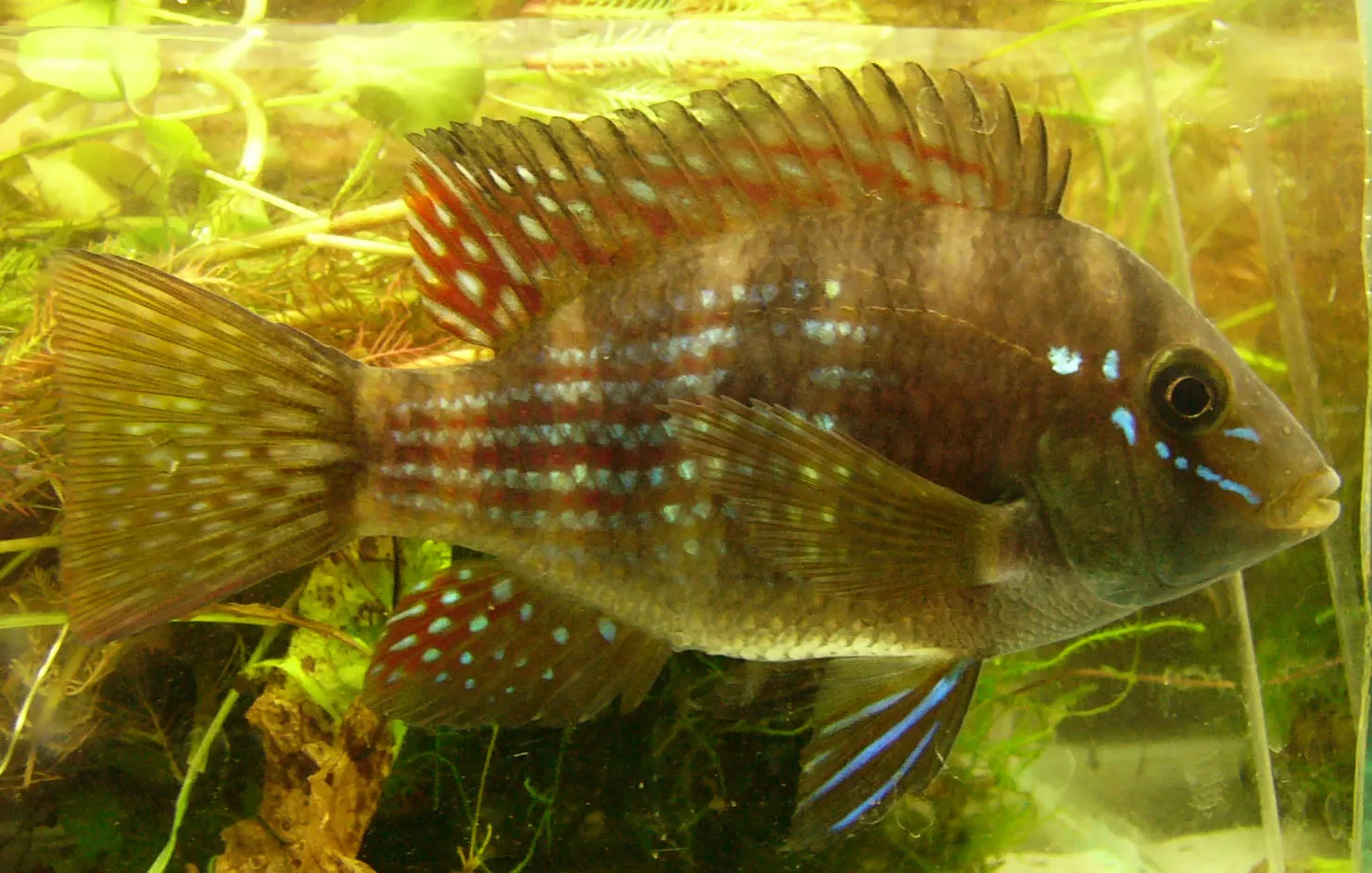
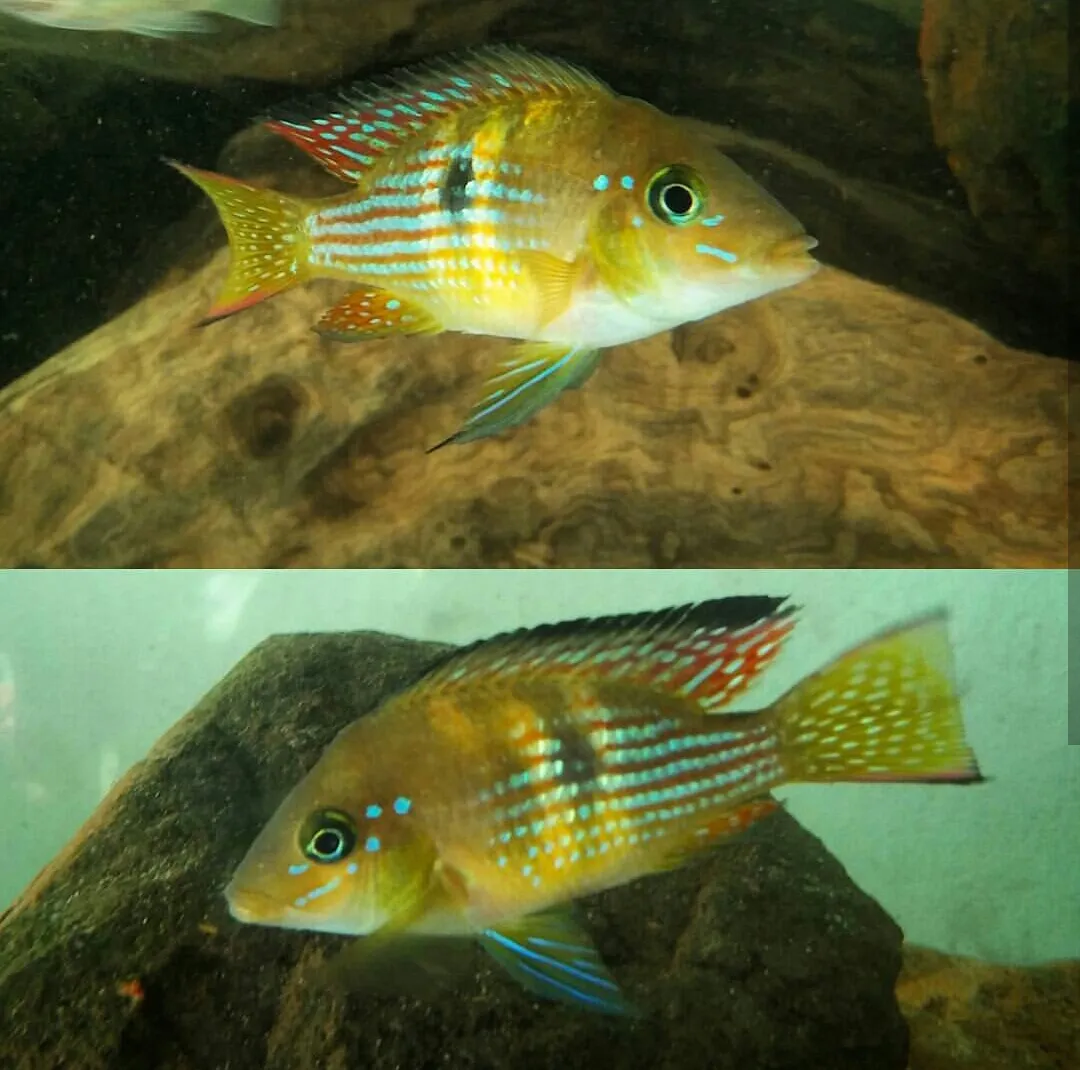
This is a small cichlid. FishBase gives a maximum of 3.5 in standard length, and the type series tops out around 3.5 in SL, with the holotype a 2.5 in fish; in body and bearing it recalls a stocky, high-finned dwarf eartheater, and aquarists encountering it for the first time often compare it to a ram. The body is laterally compressed and moderately deep, the snout pointed and nearly straight above and below, the eye small and set high near the dorsal profile, and the mouth terminal with even (isognathous) jaws. The fin counts run to 14–15 dorsal spines and 8–9 soft rays, three anal spines and 7–9 anal soft rays. Colour is what makes the fish, and what names it. In life the dorsal ground colour is light brown to olive, crossed by up to seven diffuse darker bars, the first running through the eye; a vertically elongate black blotch sits mid-flank, sometimes ringed in yellow. Six to eight bright blue horizontal bands streak the body behind the gill cover. The dorsal fin is red, striped diagonally with bright blue in the spiny portion and spotted with round, elliptical and elongate blue marks in the soft portion, its edge turning black in breeding adults; the anal fin is yellow-to-ochre proximally and red distally, dusted with small blue spots; the caudal is red, peppered with pale spots in horizontal rows. Sexual dimorphism is slight — there is no clear colour or finnage difference between the sexes, and the only consistent cue is that breeding-season males run roughly 10–50 percent larger than females. Unlike the genus's mouthbrooders, terrapurpura males do not develop a pronounced nuchal hump.
Habitat
Gymnogeophagus terrapurpura is, as far as the published record shows, endemic to Uruguay. Its range runs from the río Arapey in the middle río Uruguay basin southward through all the tributaries of the lower río Uruguay, across the río Negro system, and through the coastal drainages of the Río de la Plata estuary and the Atlantic Ocean as far east as the laguna Castillos basin. To the north of the Arapey the species drops out abruptly, replaced in the upper Uruguay tributaries by relatives. The describers point out that this distribution is now broken by the salt-water barrier of the Río de la Plata estuary, but during Pleistocene low sea-stands the coastal systems were probably linked by an exposed coastal plain, allowing freshwater fishes to spread; the fish shares its peculiar range with the pike cichlid Crenicichla scotti, hinting at a shared biogeographic history. It occupies a wide variety of habitats — shallow lakes, floodplain lagoons, rivers and streams — generally over cobble, sand or mud, in clear to somewhat turbid water. These are cool, strongly seasonal waters: the genus as a whole inhabits a temperate-subtropical climate of hot summers and cold winters, and field accounts of southern Gymnogeophagus describe winter water dropping toward 50 °F or lower while summers warm into the high twenties. The fish's own behaviour tracks this: feeding falls off sharply in autumn and winter as the water cools. The published habitats include both a low-impact lowland stream in Florida Department and a eutrophic urban lake in Montevideo, so it tolerates a fairly broad chemical envelope around neutral pH; precise in-situ chemistry was not tabulated in the description. Recorded localities are shallow — shoreline, stream and floodplain depths of roughly 0–7 ft rather than any deep-water habitat.
Feeding
Gymnogeophagus terrapurpura is an omnivore that feeds, as detailed studies of the same fish under its old names have shown, on zooplankton, benthic macroinvertebrates and — to a lesser extent — periphyton, the film of algae and associated organisms coating stones and plants. FishBase places its estimated trophic level near 3.3. Like other eartheaters it takes mouthfuls of substrate and sifts them, but it is not a dedicated deep sand-sifter; it works the bottom and the lower water column for small animal prey and grazes algal growth opportunistically. Its most distinctive trophic trait is seasonal. As water temperature falls through the southern autumn and winter the fish greatly reduces its feeding activity, slowing its metabolism in step with the cooling climate — a pattern documented both in a lowland stream and in a Montevideo lake, and one that keepers of the genus exploit by feeding sparingly through the cold months. In its communities it functions as a small, generalist benthic forager rather than a specialist.
Mating
Reproduction transforms an otherwise unobtrusive fish into an aggressively territorial one. Gymnogeophagus terrapurpura forms monogamous pairs and breeds seasonally, with the reproductive period running from November to January — the heart of the Uruguayan summer — triggered by rising water temperatures after the winter cool-down. Both members of the pair defend the territory, and the original description specifically records aggressive territorial behaviour in both males and females during the breeding season, a hallmark of the substrate-brooding gymnos as opposed to their more relaxed mouthbrooding cousins. Aquarium observers describe pairs that form in late spring and early summer, take on a darkened throat and a commanding posture, and drive all other fish — including intended dither species — out of a large share of the available space, the male policing a wide perimeter while the female centres on the eventual spawning site. Pairs are reported to be durable, re-forming and spawning repeatedly across a single warm season. There is no marked courtship dimorphism to read; the sexes look alike, and even experienced keepers often cannot tell male from female except by behaviour during a spawn.
Breeding
Unlike the mouthbrooding members of its genus, Gymnogeophagus terrapurpura is a biparental substrate brooder — the ancestral cichlid pattern. A pair cleans a surface (a stone, root or patch of firm bottom) and the female lays her eggs there in the open rather than taking them into her mouth; both parents then guard the clutch and, after hatching, herd and defend the free-swimming fry, with the female typically the more intense guardian and the male holding the wider territory. The original description does not give an egg count, but aquarium spawnings and the genus's substrate-brooding relatives (which lay on the order of 150–300 eggs per spawn) put terrapurpura's clutch in the low hundreds; a hobbyist breeding account reports up to roughly 150 fry from a spawn and three spawns across a single summer. As with all gymnos, threatened fry react to a dark visual cue, and in mouthbrooding relatives they dart into the parent's mouth — in this substrate brooder they instead bolt to the parents and the cover of the nest. Spawning is keyed to summer warmth following a genuine winter chill, and keepers find that a seasonal temperature cycle, rather than constant tropical heat, is what brings the fish into condition. First-time pairs have proven to be attentive parents, and the species breeds readily, including in unheated outdoor tubs and ponds in suitably temperate climates.
In the aquarium
Gymnogeophagus terrapurpura has reached hobbyists since shortly after its description and has a growing following among keepers of cool-water South American cichlids, but it is emphatically not a tropical fish, and that single fact drives almost everything about keeping it well. Southern Gymnogeophagus kept too warm for too long become listless and drab and burn out early; these fish want a seasonal temperature regime, doing best at roughly 61–79 °F with a distinct winter cool-down well below 68 °F — many keepers maintain them unheated, in basements, garages or outdoor tubs in mild climates, where they will even sit out brief cold snaps near freezing. Water chemistry is undemanding: near-neutral, moderately soft to moderately hard water (about pH 6.5–7.5) suits them, in keeping with the varied Uruguayan habitats they come from, and they are not blackwater fish. A pair or small group needs a tank with a footprint on the order of 35.5 in or more (the equivalent of a 30-plus US-gallon tank for the smaller gymnos, and more is better given breeding aggression). Furnish it with a sand or fine-gravel bottom so the fish can sift, plus rocks, roots and broken sightlines to let subordinate fish escape a spawning pair; sturdy, well-anchored plants are tolerated. Feeding is easy — they take quality sinking pellets, flake, and frozen or live foods such as bloodworm, daphnia and brine shrimp — but the seasonal appetite should be respected, feeding lightly or not at all through a cold winter rest. The main husbandry mistakes are keeping them at constant tropical temperatures, and underestimating breeding-season aggression: a spawning pair will dominate a large fraction of the tank and harass tankmates, so combine them with robust, non-fin-nipping companions of similar temperate tolerance, or grow them out as a group and let a pair form, removing or screening the rest. Outside of spawning they are relatively peaceful and make good community fish for an unheated aquarium.
Conservation
The IUCN Red List assesses Gymnogeophagus terrapurpura as Least Concern (assessed 18 February 2021 by M. Loureiro and J. Bessonart; published 2023). The original 2016 description had already anticipated this, reporting the species to be relatively frequent and abundant across the río Negro, the middle and lower río Uruguay, and the eastern coastal drainages of the Río de la Plata estuary and Atlantic Ocean in Uruguay, with no specific threats detected. It carries no CITES listing. The fish is widespread and ecologically flexible within its Uruguayan range, which buffers it against the kind of pressures that endanger narrow-range endemics. The broader concern for the region's freshwaters is habitat change rather than collection: the lowland streams, lagoons and coastal systems it inhabits are exposed to agricultural runoff and eutrophication (the species is already known from a eutrophic Montevideo lake), water abstraction, and rice-farming impacts that have degraded habitats elsewhere in the wider La Plata and laguna Merín systems. None of these is documented as a present danger to terrapurpura specifically, but they are the backdrop against which its long-term status should be watched.