Taxonomy & naming
The species was described by the English ecologist Geoffrey Fryer in 1956, during his doctoral fieldwork on what was then called Lake Nyasa, from rocky shores at Nkhata Bay; the holotype resides in the Natural History Museum, London (BMNH). Fryer separated it from its close relative Labeotropheus fuelleborni and named it for Ethelwynn Trewavas (1900–1993), the British Museum ichthyologist whose earlier synopsis of Lake Malawi's cichlids had advanced the field. The feminine ending "-ae" marks that the honoree was a woman.
The genus Labeotropheus (Ahl, 1927) sits in the cichlid subfamily Pseudocrenilabrinae and belongs to the mbuna, the rock-dwelling species flock of Lake Malawi. The name blends Latin labeo, "one with large lips," with a Greek root, a nod to the conspicuous mouth and feeding apparatus. For decades the genus was treated as holding only two or three species, but Pauers and Phiri's 2023 revision in Ichthyology & Herpetology described six new species, restricting the older names to better-defined populations; under that work Labeotropheus trewavasae remains valid alongside congeners such as Labeotropheus fuelleborni, Labeotropheus chlorosiglos and Labeotropheus artatorostris. Eschmeyer's Catalog of Fishes lists it as valid. In the trade it is usually sold under its scientific name or by color-form labels such as "red top."
Morphology
This is a small cichlid. FishBase gives a maximum of about 4.6 in total length, and Seriously Fish cites roughly 4.5 in (4.5 in) standard length; in practice most aquarium fish mature smaller, though Konings' Enjoying Cichlids lists a somewhat larger lakewide maximum of about 6.5 in. The defining feature is the genus hallmark: a fleshy, rounded snout that overhangs a ventrally placed mouth, with the nose and chin often visibly callused from constant scraping against rock. Compared with its stockier sister species Labeotropheus fuelleborni, Labeotropheus trewavasae is noticeably more slender, which is the quickest way to tell the two apart in a tank.
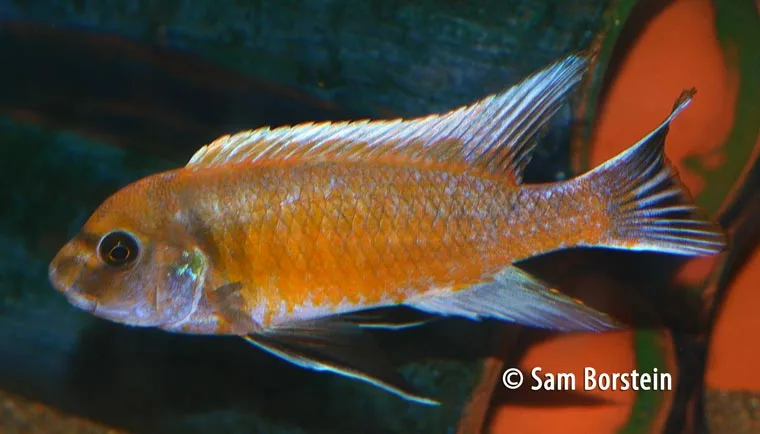
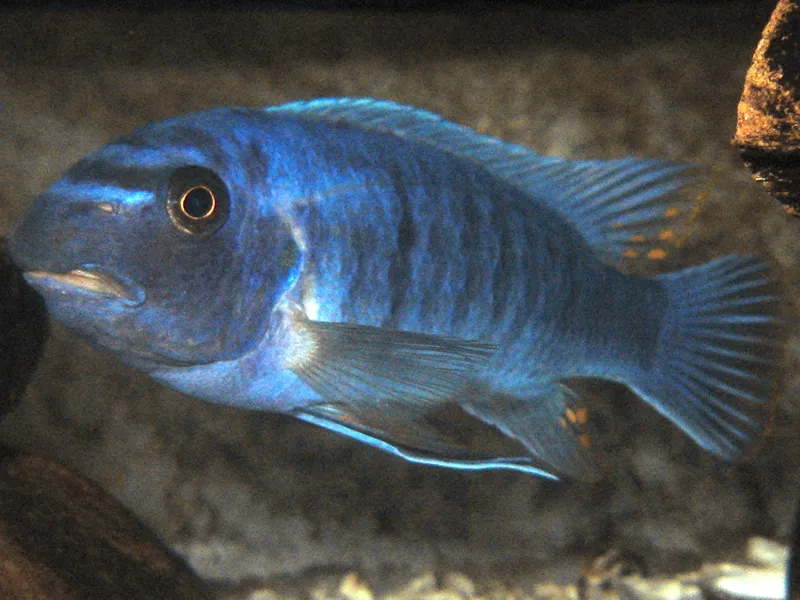
Color is where the species earns its reputation. It is extraordinarily polymorphic, with more than forty recorded color forms across the lake, and the dorsal fin is especially variable from place to place. Konings groups the male patterns into three broad types. The first, and likely ancestral, type is an entirely blue fish with distinct barring — seen in trewavasae wherever it occurs without L. fuelleborni nearby, though at Nkhata Bay, one of only two places where males of both species are entirely blue, the trewavasae form is specifically cobalt-blue rather than the navy-blue of fuelleborni there. The second, the familiar barred-blue-body-with-orange-to-red-dorsal pattern, is characteristic of southern populations such as Thumbi Island West. The third is a yellow, orange or rusty-brown wash over the flanks, belly or dorsal; where both Labeotropheus species show this pattern at the same locality, trewavasae carries it on the upper half of the flank while fuelleborni carries it on the lower half — a useful field distinction in mixed populations. Females are most often orange-blotch (OB) — a mottled orange-and-black pattern whose frequency reaches nearly 95% at some localities — with rarer plain-orange (O) females also occurring. The blue-blotch male, the celebrated "marmalade cat," is genuinely rare; collectors in the early 1970s reported finding only about one per year at the southern tip of Thumbi West. Males carry well-defined egg-spots on the anal fin; in females these are faint or absent.
Habitat
Labeotropheus trewavasae is a Lake Malawi endemic with a near lake-wide distribution, recorded along the shores and around the islands of Malawi, Mozambique and Tanzania; the IUCN notes it is absent from Mbenji Island. That absence is not an isolated gap: Konings records that most rocky reefs around the lake carry L. trewavasae, but at a specific set of islands — Likoma, Chizumulu, Kande, Mbenji, Namalenje and Mumbo — only L. fuelleborni is present, with L. trewavasae absent altogether; the rocky mainland shores, by contrast, generally hold both species side by side. It is a fish of the rocky littoral, favoring large rocks, caves and crevices, and it tolerates both sediment-free reefs and the more turbid, sediment-laden stretches.
Reports of its depth range vary, which is worth stating plainly. Ribbink and colleagues' 1983 survey found it fairly evenly distributed from the surface to about 65 ft, with records to 112 ft; FishBase lists a shallower ceiling of about 49 ft, while the IUCN assessment cites occurrence down to roughly 130 ft. The fish generally ranges deeper than Labeotropheus fuelleborni, which concentrates in the top 16 ft; that split matters ecologically as well as taxonomically, because L. fuelleborni can cross the open sandy stretches that separate rocky outcrops in shallow water, while L. trewavasae stays in deeper habitat and rarely if ever crosses open sand. Konings suggests this is why trewavasae's colour pattern changes more abruptly between neighbouring populations than fuelleborni's does — sand-locked trewavasae populations may have effectively no genetic contact with their nearest neighbours, while fuelleborni's shallow-water mobility keeps its populations in looser contact. Geographic "sister" populations separated by a hundred kilometres or more of open water, on opposite shores of the lake, sometimes carry near-identical colour morphs: a white-top/blue form of L. trewavasae found at Cape Kaiser, Tanzania, closely resembles populations nearly 62 mi away on the Malawian shore at Mpanga Rocks, Hora Mhango and Nkhata Bay, and a similar "Red Stripe" pattern recurs on both the Tanzanian and Malawian coasts more than 62 mi apart, a pattern echoed by comparable mirror-image populations in other Malawi mbuna genera. In situ the water is alkaline and well-buffered — around pH 8 — and the upper rocky zone it favors is often turbulent and oxygen-rich, conditions its body plan and feeding posture are built for.
Feeding
This is a trophic specialist, an algae scraper that grazes the aufwuchs — the carpet of filamentous algae and the small invertebrates living within it — that coats rocks in the littoral. The mechanics are elegant. With its mouth pointed down and body held parallel to the rock, the fish closes its jaws on firmly attached filaments; the fleshy snout then acts as a fulcrum, so it can shear the algae off by leverage rather than the energy-wasting body jerks other grazers rely on. Three or more rows of tricuspid teeth in the outer jaws crop the loosened algae. Because the body is slender, it can work into narrow caves and the undersides of rocks that bulkier herbivores cannot reach, and it is known to leave visible scrape marks on the stone.
Its diet is not purely vegetarian. Ribbink et al. recorded it feeding on loose aufwuchs and several categories of attached filamentous algae, but also on benthic crustaceans and plankton in varying proportions, and FishBase notes it takes small crustaceans and worms. FishBase places it around trophic level 3.3. Functionally it occupies the abundant grazer guild that converts rock-surface primary production into fish biomass — a central role in the energy budget of Malawi's rocky reefs.
Mating
Like all mbuna, Labeotropheus trewavasae is a maternal mouthbrooder, and territorial males are present and ready to spawn year-round, holding territories centered on caves among the big rocks. Interestingly, Ribbink and colleagues characterized it as only weakly territorial relative to its congener: males hold large, loosely defended patches and frequently leave them to feed elsewhere, while females, juveniles and non-territorial males drift singly or in small groups. Hobbyist experience adds a useful nuance — keepers consistently report that the species directs most of its aggression at its own kind rather than at other species, so in a mixed mbuna tank it can be comparatively well-behaved while still bullying conspecifics; Konings likewise describes it as the milder-tempered of the two Labeotropheus.
Courtship follows the classic mbuna script. A spawning male intensifies in color and displays over a cleaned site inside his cave, leading a receptive female through circling and quivering. The male's anal-fin egg-spots are central to the act: as the female mouths near his vent in the characteristic "T" position she takes in sperm that fertilizes the eggs already in her buccal cavity. It is tempting to assume the lake's extraordinary geographic patchwork of colour forms exists because the two Labeotropheus species hybridize readily and the patterns evolved to keep them apart — but the opposite is closer to the truth. Despite living sympatrically at most sites around the lake, Labeotropheus fuelleborni and L. trewavasae hybridize only very rarely: Konings records a single confirmed hybrid population, at Chidunga Rocks near Chipoka, despite decades of observation across dozens of shared localities. The likely explanation is exactly the strongly assortative mate choice this pattern would predict — females keying on the local male nuptial pattern to recognize their own species — and Konings proposes that the chance appearance of a locally divergent colour pattern, reinforced afterward by sexual selection, is what produced today's checkerboard distribution of forms in the first place: a case of reproductive character displacement between two locally sympatric sister species.
Breeding
Spawning itself is the egg-by-egg mbuna routine: the female lays a few eggs at a time, immediately turns to take them into her mouth, and repeats the cycle while the male's egg-spots draw her in to collect his milt. Reported clutch sizes run roughly 10 to 40 eggs, with captive accounts of around 19 to 25 fry common. The female then broods the developing young in her mouth for about three to four weeks, fasting throughout, before releasing free-swimming fry near the shelter of the rocks.
A charming detail noted by breeders: fry can often be sexed on release, with males emerging dark grey and females yellowish. In the aquarium the species is readily bred, but holding females need calm — a harassed or prematurely moved brooder will frequently spit or swallow her clutch, so experienced keepers leave gravid females undisturbed or move them to a quiet tank well before they are due to release.
In the aquarium
This is a rewarding but not a beginner fish, and the honest framing matters. It is hardy and readily bred, but males are persistently aggressive toward conspecifics and the species is best kept as a single male with several females. Specialists recommend at least a 200-liter (about 55-gallon) tank, and many experienced keepers want a four-foot (47 in) footprint as a practical minimum so subordinate fish have room to escape. Aquascape with stacked rock forming caves and crevices over a sandy bottom; live plants are pointless, as they will be grazed.
Water should mirror the lake: alkaline and well-buffered, roughly pH 7.6–8.8 (around 8 is ideal), with 10–25 dH as a common keeping target, and warm, about 75–82°F (75–82 °F). Diet should lean heavily vegetable — spirulina-based flakes, blanched greens — supplemented modestly with frozen or live daphnia, brine shrimp and the like; a protein-heavy diet invites the bloat that plagues mbuna. Keep it with other robust mbuna rather than gentler peacocks or utaka, which it will stress, and slight overstocking with plenty of rockwork helps spread aggression. Two cautions keepers raise often: different geographic colour forms of Labeotropheus trewavasae itself interbreed freely in a tank and will muddy a locality strain, so keep only one form per aquarium; and be patient with brooding females, which may spit or eat a clutch if harassed or moved too soon.
On mixing with Labeotropheus fuelleborni specifically: in the wild the two species hybridize only very rarely despite broad sympatry, because females key on the locally matched male colour pattern to recognize their own kind (see Mating) — but that safeguard depends on both species coming from populations that recognize each other, which a tank strips away. Konings notes it is possible to keep one male of each species together, but only if both come from the same lake locality; pairing individuals of uncertain or mismatched origin risks exactly the hybridization the wild population largely avoids, so this combination is best left to keepers who can verify provenance.
Conservation
The IUCN Red List assesses Labeotropheus trewavasae as Least Concern (assessed 22 June 2018; errata version 2019; assessors Konings and Kazembe), with a stable population trend. It is widespread across the lake — estimated extent of occurrence around 11,429 mi² and area of occupancy about 471 mi² — common at deeper rocky habitats, and it occurs within Lake Malawi National Park, which affords some protection. The assessment flags two specific, ongoing pressures: sedimentation, and extraction by the ornamental fish trade, the latter noted as continuing without an apparent decline in the population. In short, the species itself is not currently threatened.
That verdict, however, sits inside a lake under real strain, and a rocky-shore grazer is exposed to exactly the pressures the basin faces. The 2023 status review of the Lake Malawi/Niassa/Nyasa basin by Chavula and colleagues (Journal of Great Lakes Research 49(6):102241) documents heavy over-fishing and the collapse of the chambo (Oreochromis) fishery, rising sediment and nutrient loading from deforested catchments, and roughly +33 °F of shallow-water warming that strengthens stratification and suppresses the deep mixing that fuels productivity, alongside invasive-species risk. For Labeotropheus trewavasae the most direct link is sedimentation: silt smothers the rock-surface aufwuchs it grazes and degrades the clear, oxygen-rich reefs it favors, while warming and reduced mixing reshape the productivity base of the littoral. None of this has yet moved the species off Least Concern, and it would be an overstatement to call it imperiled — but its security depends on the health of a shallow rocky habitat that the basin's trajectory is steadily eroding.