Taxonomy & naming
Ethelwynn Trewavas described this species in 1935 in her foundational synopsis of the cichlid fishes of Lake Nyasa — the same paper in which she named dozens of other haplochromines that would dominate Malawi ichthyology for generations. She placed it as Haplochromis prostoma, her description noting the distinctive protrusible mouth that gives the species its epithet, at page 88 of the Annals and Magazine of Natural History (Series 10, volume 16). The primary type locality recorded by Trewavas was Vua, on the northwestern shore of what is now northern Malawi; Deep Bay was listed as a secondary locality. Six original specimens were registered at the Natural History Museum, London; Eccles and Trewavas selected BMNH 1935.6.14.1817, from Vua, as the lectotype in their 1989 revision, with BMNH 1935.6.14.1818–1822 as paralectotypes.
The species has worn three genus labels since its description. Mayland (1982) and some earlier aquarium authors placed it in Cyrtocara. Eccles and Trewavas (1989) moved it into the newly delimited Copadichromis, where it sat in the ichthyological literature through most of the 1990s and 2000s and appeared in the IUCN Red List assessments of 2006 and 2017. Konings had long argued, however, that prostoma does not belong with Copadichromis: all confirmed members of that genus have spotted or patternless flanks and none builds sand-castle spawning cones, whereas prostoma has a dark lateral stripe and males construct conspicuous sandy mounds at breeding sites. Stauffer & Konings (2006) formally transferred it to Nyassachromis, and Konings (2016) retained it there in the fifth edition of Malawi Cichlids in their Natural Habitat. The Catalog of Fishes (van der Laan & Fricke, updated May 2026) gives its current status as valid in Nyassachromis prostoma (Trewavas 1935), citing Stauffer & Konings 2006 and Konings 2016 as the supporting authorities. FishBase and the 2018 IUCN assessment use the same combination. The parenthetical authority signals that the species was originally described in a different genus — standard practice under the ICZN.
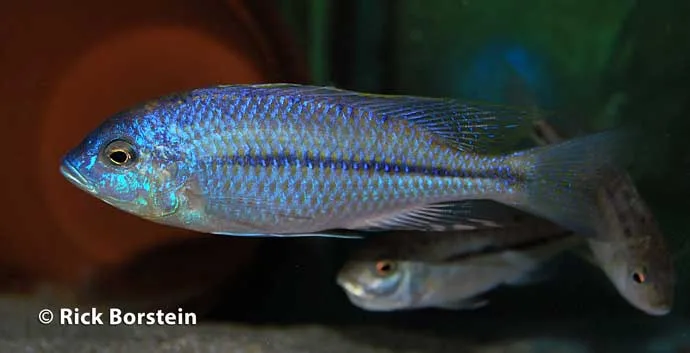
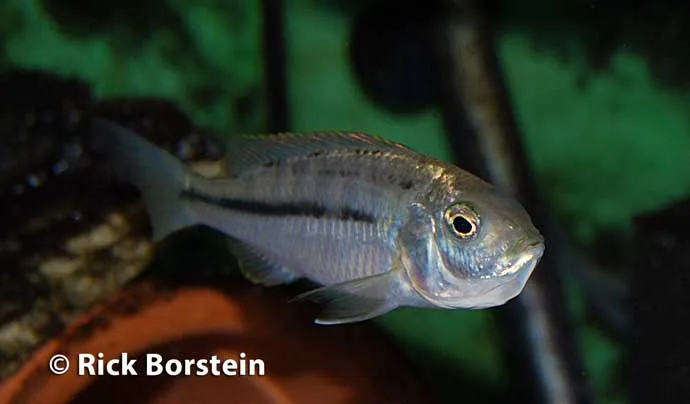
The specimen photographs known from the wild, notably Ad Konings's image of a male at Gome Rock in northern Lake Malawi, show the dark mid-lateral stripe that Konings emphasised as diagnostic for the genus placement.
Morphology
Nyassachromis prostoma is a moderately slender, laterally compressed cichlid typical of open-water haplochromines. FishBase and the CLOFFA checklist (Maréchal 1991) record the maximum size as 4.5 in TL; there are no published deviations from this figure in the primary literature, and aquarium experience broadly agrees — most adults kept by hobbyists are encountered at 3–4 in. The fish is not large by the standards of Malawi haps, which include open-water piscivores well over 12 in.
The defining morphological character is the name-giving mouth: the jaws are markedly protrusible — able to project forward as a tube when the fish strikes at plankton — more so than in most Copadichromis congeners. This is correlated with a feeding mode that relies on rapid extension and suction rather than the raking or sifting strategies of benthic invertivores.
Coloration in adult males includes a dark, continuous lateral stripe running from the eye to the base of the caudal fin; this stripe is the pigmentation feature that separates prostoma from patterned-flank Copadichromis species (which have spots rather than a solid stripe) and was central to Konings's genus reassignment. The body is otherwise silvery to pale blue, and in breeding condition males reportedly develop intensified coloration (Konings 1995, 2016). Females and non-breeding males are more cryptic, lacking the vivid stripe development of active males; in schools they are superficially similar to other plankton-feeding haplochromines overhead. Sexual dimorphism is present: males are more colorful and defend territories, while females are generally smaller and drabber and associate in feeding schools. Hobbyists in the trade occasionally see the fish offered as 'Prostoma Orange Cap', a label that refers to a color morph noted in the IUCN assessment but not formally described.
Habitat
Nyassachromis prostoma is endemic to Lake Malawi — Africa's third-largest lake by surface area (approximately 11,429 mi²), a deep, ancient rift lake shared by Malawi, Mozambique, and Tanzania. Within the lake the species has a lake-wide distribution, having been recorded from Malawi, Mozambique, and Tanzania across the full latitudinal extent of the lake (IUCN Red List, Konings et al. 2018). The IUCN estimates an extent of occurrence of roughly 11,429 mi² and an area of occupancy of around 1,042 mi², consistent with a lake-wide but unevenly distributed presence.
The preferred habitat is shallow, open, sandy and mid-water zones. The IUCN assessment notes that the species is rarely encountered in numbers below 66 ft depth, which places it firmly in the warm, well-oxygenated surface mixed layer of the lake. Breeding males are found year-round, and the species constructs its spawning sites — sand-castle mounds or cones — on sand substrate. Females and non-breeding males are consistently found in large schools feeding at mid-water or near the surface, often well away from the shoreline.
Lake Malawi's water chemistry is distinctive: carbonate hardness (KH) is higher than general hardness (GH), pH ranges from approximately 7.7 to 8.6 in the mixed surface layer, and surface temperatures vary between roughly 73 °F and 82 °F across the seasonal cycle (malawi.si; Konings 2016). No in-situ measurements specific to Nyassachromis prostoma collection sites have been published; the water parameters below reflect habitat-typical values for open-water and sandy Lake Malawi sites and are flagged as such. The depth ceiling of around 66 ft means this species lives almost entirely in the warmest, most dynamic layer of the water column.
Feeding
Nyassachromis prostoma is a zooplanktivore. The IUCN assessment states plainly that the species feeds on plankton, and that females and non-breeding males do so in large aggregated schools — a feeding strategy shared with the utaka complex (Copadichromis) and several other open-water Malawi haplochromines. Iles (1960) documented the Lake Nyasa zooplanktivore guild from material that included prostoma under its then-name Haplochromis prostoma, establishing the plankton-feeding ecology that remains the accepted account.
The protrusible, forward-directed mouth is mechanically adapted to this mode: a rapidly projecting jaw tube allows the fish to engulf individual zooplankters — chiefly copepods and cladocerans — with a precision strike, rather than ram-filtering or winnowing substrate. FishBase places the species at trophic level 3.3, consistent with a planktivore/invertivore rather than a herbivore or piscivore. In common with other plankton-feeders in the lake, prostoma is likely most active in well-lit surface water where vertically migrating zooplankton concentrations are highest.
The schooling behaviour serves both feeding efficiency and predator dilution. Groups of females and sub-dominant males sweep through open water tracking plankton patches; this makes them visible and catchable by the commercial chirimila net fishery, which the IUCN assessment identifies as a localized threat. Mouthbrooding females maintain their school membership even while holding a clutch.
A single, unconfirmed field observation hints that prostoma may occasionally solicit help from other foraging sand-dwellers rather than purely competing with them. Konings once watched a female with a visible fungal infection on her dorsal fin lay herself on the sand directly in front of a foraging "Double Spot" (a small, sand-sifting haplochromine, then placed in Maravichromis, now generally treated within Otopharynx), presenting the ailing fin — behaviour consistent with solicited cleaning, though the encounter was interrupted before he could confirm whether any cleaning actually took place. It remains an isolated anecdote rather than established behaviour, but it is a reminder that the sandy, open habitats these fish share are social as well as competitive spaces (Cichlids Yearbook, Vol. 1).
Mating
The most ecologically distinctive feature of Nyassachromis prostoma is its breeding system. Males build sand-castle-shaped spawning cones on the sandy lake floor and defend them against rival males — the behaviour that prompted Konings to argue the species belongs outside Copadichromis, where no cone-building is known (with the single exception of Copadichromis likomae). These mounds, visible on the open sand, are maintained year-round by territorial males. The arrangement constitutes a lek: males aggregate at a display and spawning site, each defending a small cone, and females visit to choose a mate and spawn, after which they depart and brood independently. Lek spawning is uncommon among Lake Malawi cichlids and is a specialisation associated with open sandy habitats where durable rocky territories are absent.
Breeding males are seen at spawning sites throughout the year, suggesting no sharply seasonal reproductive peak, though the lake's slight thermal seasonality (warmer in the austral summer) likely modulates spawning intensity. Interspecific aggression is modest compared with mbuna: hobbyists on cichlid-forum.com describe groups of Nyassachromis prostoma as easy to mix with other haps, noting that the fish do not tear fins or engage in the sustained chasing typical of rock-dwelling cichlids. Males establish temporary spawning-pit territories during courtship but are otherwise relatively peaceable. In the aquarium, a single dominant male with three to five females is the most practical ratio; males can dig and defend small pits or cone-like structures when actively spawning, which should be accommodated with a sandy substrate and minimal rockwork.
Breeding
Nyassachromis prostoma is a maternal mouthbrooder: after spawning on or near the sand cone, the female incubates the eggs and larvae buccally without any further assistance from the male. Females brooding a clutch continue to school with conspecifics rather than retreating to shelter, a pattern documented in other open-water Malawi mouthbrooders. The IUCN assessment assigns a generation length of 1–2 years, consistent with modest clutch sizes and a biologically short cycle; clutch size is not formally published for this species, but genus-typical figures for small Malawi haplochromines suggest approximately 20–50 eggs.
In captivity, breeding follows the same pattern. The fish accepts prepared foods readily — high-quality flake, small pellets, and frozen cyclops or Artemia — with no specialist feeding requirement. Water parameters should replicate the lake's alkaline, well-buffered chemistry: pH 7.7–8.5, carbonate hardness 4–8 dKH, temperature 75–81 °F. It has appeared in the hobby under both the Copadichromis and Nyassachromis labels; the trade name 'Prostoma Orange Cap' is sometimes used. The species is not a common fish in the trade — the IUCN notes only irregular collection for the ornamental market — and is predominantly encountered from captive-bred stock.
In the aquarium
Nyassachromis prostoma is rarely kept in the hobby. It surfaces occasionally at specialist cichlid dealers and aquaculture operations focused on Malawi haplochromines, but it does not appear with anything like the regularity of the common utaka Copadichromis borleyi or the popular Aulonocara peacocks. Hobbyists who do keep it tend to be Malawi-hap enthusiasts already familiar with the care requirements of open-water schooling species; for them, prostoma is an interesting behavioral outlier that rewards some patience in sourcing.
Because the species is a mid-size, open-water schooling planktivore that maxes out around 4.5 in TL, a minimum tank footprint of 48 inches is a practical starting point for a small group, and 59–71 in is more comfortable. The fish spend most of their time in open mid-water, so horizontal swimming room matters more than depth. Substrate should be fine sand — males will attempt to push it into low mound-like structures when courting, and a sandy floor is consistent with the species' natural habitat. Rockwork can be minimal; a few scattered pieces or low terraces work, but a heavily rock-scaped mbuna-style setup is neither necessary nor ideal for a fish that evolved over open sandy shallows. Good filtration and regular water changes are essential to maintain the alkaline, well-buffered chemistry Lake Malawi demands.
Water parameters should target pH 7.8–8.6, carbonate hardness 4–8 dKH, and temperature 75–81 °F — all consistent with the lake's warm, well-buffered mixed layer (see facts; values are habitat-typical for open-water Malawi sites, as no species-specific in-situ measurements have been published). Soft or acidic water is a common keeper mistake: Malawi haplochromines subjected to low pH and soft water are prone to Malawi bloat, an acute systemic illness caused by the flagellate Spironucleus vortens that rapidly becomes fatal if untreated. Keeping the water appropriately alkaline and well-buffered, avoiding overfeeding, and not offering fatty mammalian protein (common dietary triggers for bloat in Malawi haps) are the three most practical preventive measures.
Feeding presents no unusual challenges. The species accepts high-quality flake and small pellets readily, and its planktivorous diet is well served by finely crushed spirulina flake, zooplankton-based micro-pellets, and occasional small frozen foods such as cyclops nauplii, baby brine shrimp, or finely chopped Mysis. Fatty live or frozen invertebrates (bloodworm, large Artemia) should be offered only sparingly, as the gut of a planktivore is not adapted to rich animal protein in bulk. The fish feed actively in open water and compete well at the surface; shy individuals may need food to reach mid-column before it is taken by faster species.
As tankmates, Nyassachromis prostoma is best paired with other peaceful, similarly sized Malawi haplochromines — mid-tier open-water haps of the Copadichromis or Nyassachromis guilds, or smaller Aulonocara species. Aggressive mbuna (Melanochromis, large Pseudotropheus, or dominant males of mbuna-complex genera) are unsuitable: they are significantly more assertive in resource competition and will stress or injure schooling haps that lack established refugia. Mixed-sex groups of five or more reduce individual persecution of females; a ratio of one male to three or more females is a practical target. Males in breeding condition will excavate and defend a small territory around a sand pit or mound, a behavior that is easy to accommodate and interesting to observe — it is the same lek-style cone-building documented in the wild. Mouthbrooding females should ideally be moved to a dedicated holding tank once visibly brooding, both to protect the clutch and to let the female feed without harassing pursuit from the male.
Conservation
The IUCN Red List assesses Nyassachromis prostoma as Least Concern (assessed 20 June 2018; published 2018 with errata 2019; assessors: Ad Konings, J. Kazembe, P. Makocho, and A. Mailosi; reviewer: J. Snoeks). The justification is a lake-wide distribution, known occurrence across Malawi, Mozambique, and Tanzania, common sightings at some sites, and a population trend rated as 'unknown' but not suspected declining. The species occurs within Lake Malawi National Park, which provides some degree of in-situ protection.
The primary threat identified is fishing pressure: Nyassachromis prostoma's habit of aggregating in large plankton-feeding schools makes it susceptible to chirimila nets used by the utaka fishery, which targets schooling haplochromines commercially. The IUCN assessment notes that most subpopulations are out of reach of destructive beach seines because of their offshore, shallow-open-water distribution, but chirimila fishing is an ongoing localized concern. Collection for the ornamental trade is only irregular and is not considered a population-level threat at present.
At the basin scale, Lake Malawi faces compounding pressures that provide important context for any single species' status. WWF's 2018 reassessment found that 9% of the 458 fish species evaluated in the lake were at high risk of extinction — a figure driven by mbuna and narrow-range endemics rather than lake-wide species like Nyassachromis prostoma. The lake's wider threats include overfishing, deforestation and catchment erosion driving sedimentation and turbidity, climate-linked reductions in seasonal mixing and primary productivity, and declining water levels. For a shallow-water schooling planktivore like Nyassachromis prostoma, the most relevant basin-level stressor is the reduction in zooplankton productivity that can follow from reduced mixing and nutrient cycling — the same thermal stratification changes that Hecky et al. and subsequent researchers have documented in East African rift lakes. These are not yet acute threats for this species, but they form the environmental backdrop against which its Least Concern status must be read.