Taxonomy & naming
Neochromis greenwoodi was described in 1998 by Ole Seehausen and Niels Bouton in the landmark monograph 'Mbipi, the rock-dwelling cichlids of Lake Victoria' (with E. Lippitsch and H. Zwennes), published in Ichthyological Exploration of Freshwaters — a work that erected three new genera and fifteen new species in one stroke, formalising the lake's rock-dwelling radiation. The holotype came from Mwanza Gulf, off Anchor Island in Tanzanian waters at 7–10 ft depth, and is held at the Rijksmuseum van Natuurlijke Historie (now Naturalis) in Leiden. The describers placed the species in Neochromis Regan, 1920 — a genus of epilithic algae-scrapers 'closely related' to Haplochromis — and Eschmeyer's Catalog of Fishes accordingly treats the valid name as Neochromis greenwoodi Seehausen & Bouton, 1998. FishBase, following its conservative practice of lumping the Lake Victoria flock, lists the fish under the catch-all genus Haplochromis, as Haplochromis greenwoodi, and GBIF and the IUCN Red List carry that name too; the atlas follows the Catalog. That combination invites a mix-up: Haplochromis greenwoodi Bell-Cross, 1975, from the Okavango, is a different fish, now Sargochromis greenwoodi. The mbipi (a local word for the rock-cichlids) are not a single clade: molecular work has shown the 'Neochromis' algae-scrapers to be polyphyletic, assembled convergently from several lineages, so the genus boundaries within this group remain a moving target.
Morphology
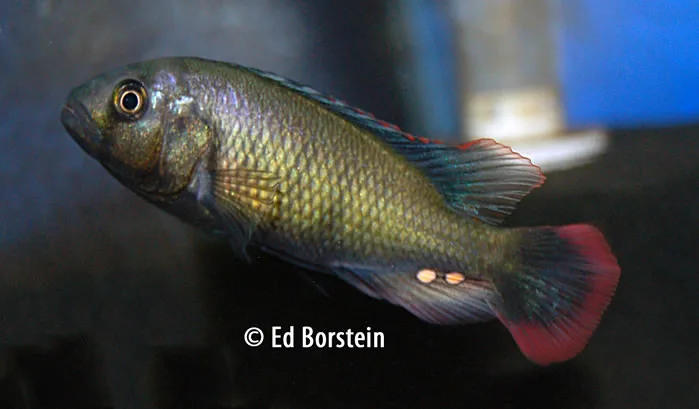
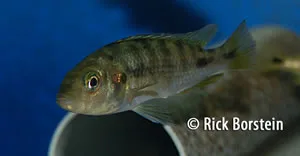
This is a small, fusiform haplochromine reaching about 5.5 in standard length in males; females are markedly smaller, to roughly 3.5 in SL. The dorsal fin carries 15–17 spines and 9–10 soft rays, the anal fin 3 spines and 8–9 soft rays, with 29–31 vertebrae. Diagnostic features given in the original description include a steep, convex dorsal head profile, a broad and sometimes squarish lower jaw, and an oral dentition built for scraping: the outer-row teeth are equally or subequally bicuspid, set contiguously and very movably implanted, backed by three to more than six rows of smaller inner teeth that form broad bands at the front of each jaw. Colour is where the species becomes genuinely interesting. Like its close relative Neochromis omnicaeruleus, Neochromis greenwoodi shows a sex-linked colour polymorphism: alongside the 'plain' (ancestral) morph — females typically a solid dark grey, dominant males developing dark, velvety nuptial colours (the IUCN file even labels it 'Velvet Black') — there occur 'blotched' morphs, including orange-blotched and black-and-white patterns that are almost entirely restricted to females. Sexual dimorphism is therefore pronounced in both size and colour.
Habitat
Neochromis greenwoodi is a rock-shore specialist confined to Lake Victoria, and within the lake to its southeastern (Tanzanian) sector — the Mwanza Gulf region and its islands such as Makobe and Anchor Island, the well-worked study grounds for Lake Victoria rock cichlids. FishBase records it as freshwater and demersal over a depth range of about 0–13 ft. It is found only on rocky shores, favouring steeply sloping large-boulder shorelines but also occurring on gently shelving shores where the boulders are large enough to provide interstices for shelter and grazing surface. The waters it lives in are warm and, since the eutrophication of Lake Victoria from the 1980s onward, often turbid and oxygen-stressed in their deeper reaches; rock-shore cichlids like this one are confined to the comparatively clear, well-lit shallows where their epilithic food grows and where colour-based mate choice still functions. As a Lake Victoria fish it inhabits alkaline, buffered water — the lake runs roughly pH 7.2–9.5 and around 73–82 °F in the inhabited surface layer.
Feeding
The species belongs to the epilithic algae-scraping guild — the 'mbipi' that work the algal turf coating the lake's boulders. Its specialised, movably implanted bicuspid scraping teeth are the tool for the job. In practice it is an opportunistic omnivore rather than a strict grazer: the describers and FishBase report it feeding on epilithic algae (predominantly diatoms but also filamentous forms), epilithic fauna, Bryozoans, insect larvae, plankton, prawns and even juvenile fishes. FishBase places it at a trophic level of about 3.2, consistent with this mixed diet. Adults forage in shoals that mix with other rock-cichlid species over the same boulders — a loose multi-species grazing assemblage typical of the mbipi community, in which dozens of closely related haplochromines partition the same few square metres of rock.
Mating
Neochromis greenwoodi is a polygynous, lek-style breeder. Mature males establish and defend territories among the boulders at depths between less than 3 ft and about 13 ft, advertising with their dark nuptial colours and courting any receptive female that passes. This species sits at the centre of one of the best-studied questions in Lake Victoria biology: how the lake's cichlids speciate so fast. The sex-linked colour polymorphism it shares with Neochromis omnicaeruleus comes with colour-based mating and aggression biases — females and males respond differently to plain versus blotched partners and rivals — and a long-term study by Magalhaes, Mwaiko and Seehausen (2010) found nonrandom mating between the colour morphs, an excess of linkage disequilibrium in the plain morph, and morph frequencies that oscillated but showed no directional drift over fourteen years. Together with negative frequency-dependent sexual selection demonstrated in earlier work, these mating biases appear to reduce gene flow between morphs and may be an engine of incipient divergence within a single rocky shore.
Breeding
Like essentially all the Lake Victoria haplochromines, Neochromis greenwoodi is a maternal mouthbrooder with no biparental care: the female alone incubates the fertilised eggs in her buccal cavity and continues to shelter the free-swimming fry in her mouth for a period after hatching, while the male contributes only gametes from his territory. After spawning the brooding female holds a small territory of her own around a cave or crevice between the boulders. Spawning is reported to occur year-round rather than in a single season. The describers give length at 50% maturity as about 3 in SL in males and 4 in SL in females. A precise wild clutch count for this species does not appear to be published; Lake Victoria rock-haplochromines of this size are typically modest-fecundity brooders carrying on the order of a few dozen eggs per clutch (commonly cited at roughly 20–60), a genus-typical figure rather than a measured one for greenwoodi specifically.
In the aquarium
This is not a fish of the general aquarium trade. Neochromis greenwoodi is rarely kept; it appears in hobbyist and conservation hands chiefly as part of programmes maintaining Lake Victoria 'survival' cichlids (it is on the CARES Preservation Program list) and in research stocks studying its colour polymorphism, not as a commercially distributed ornamental. No dedicated aquarium husbandry literature exists for it specifically, so any keeping advice has to be extrapolated from its close mbipi relatives and from general Lake Victoria rock-cichlid practice — and should be read in that light.
What the biology implies is a tank set up for a Victorian rock-grazer: alkaline, buffered water (pH on the order of 7.5–8.5) at about 75–81 °F, with a substantial rockwork aquascape of piled boulders and caves to provide the territories males defend and the crevices brooding females use. Because males are territorial and the species relies on colour-based dominance and courtship, a layout with broken sight-lines and enough rock to spread aggression is important; as with other Victorian haplochromines, keeping a single male with several females, or a larger group in a roomy tank, works better than a pair. A footprint comparable to that used for similarly sized mbumna and mbipi — on the order of a 47 in / ~65–80 US gal tank or larger — is a sensible minimum. Diet is undemanding given the omnivorous wild feeding: a spirulina- and algae-based staple to suit the grazing gut, rounded out with small frozen and live invertebrate foods. The two real cautions are conservation-genetic rather than horticultural: Lake Victoria haplochromines hybridise readily, so this species must never be mixed with congeners if the stock is to stay pure, and its defining colour polymorphism means morph composition should be managed deliberately in any breeding group.
Conservation
The IUCN Red List assesses Neochromis greenwoodi as Least Concern, assessed on 1 April 2010 by Witte, de Zeeuw and Brooks (Freshwater Biodiversity Unit), with a population trend listed as stable and a range given as Tanzania. That comparatively comfortable status sets it apart from the many Lake Victoria haplochromines driven to extinction or the brink in the late twentieth century. The lake's endemic cichlid flock — once 500-plus species — suffered a catastrophic collapse following the spread of the introduced Nile perch (Lates niloticus) from the 1980s, compounded by eutrophication, declining water clarity and falling deep-water oxygen. Rock-dwelling mbipi like greenwoodi fared somewhat better than the open-water and sand species: the structurally complex rocky shallows offered refuge from Nile perch, and a subset of the rock community persisted and in places partly recovered. The species is of no commercial fishery value (FishBase rates its fishing vulnerability low) and carries no CITES or CMS listing. The standing concerns are the lake-wide ones — continued eutrophication and turbidity (which can erode the colour-based mate choice on which these fish depend), shoreline degradation, and any resurgence of predation pressure — rather than any threat specific to this one cichlid.