Taxonomy & naming
The species was described in 1985 by Els L. M. Witte-Maas and Frans Witte as Haplochromis nyererei, in a special publication of the University of Leiden grandly titled for the man it honours: 'Haplochromis nyererei, a new cichlid fish from Lake Victoria named in honour of Mwalimu Nyerere, President of Tanzania.' The holotype (RMNH 29456) and paratypes are held mainly at the Naturalis collection in Leiden (formerly RMNH), with additional paratypes at the Natural History Museum, London, and material designated for Dar es Salaam; the original paper did not list the type series entirely cleanly, a detail later untangled by the Catalog of Fishes. The type locality is the Mwanza Gulf, in the Tanzanian south of the lake.
In 1998 Ole Seehausen and Elke Lippitsch erected the genus Pundamilia for a group of rock-dwelling Victoria haplochromines, and nyererei became its type species, Pundamilia nyererei — the name under which almost all of the modern speciation literature, and the aquarium trade, refer to it. The wider community of Lake Victoria haplochromines, however, is a notoriously unresolved 'species flock' of several hundred recently and explosively evolved forms, and many ichthyologists (and databases such as FishBase, following van Oijen and colleagues) prefer to park all of them in the catch-all genus Haplochromis Hilgendorf, 1888 until a complete revision is published. The atlas follows the Catalog of Fishes in using Pundamilia nyererei, the combination in current taxonomic use. Within the rock-cichlid ('mbipi') community, nyererei forms a sibling pair with the blue Pundamilia pundamilia — the two are so close that they remain interfertile and are distinguished above all by male nuptial colour.
Morphology
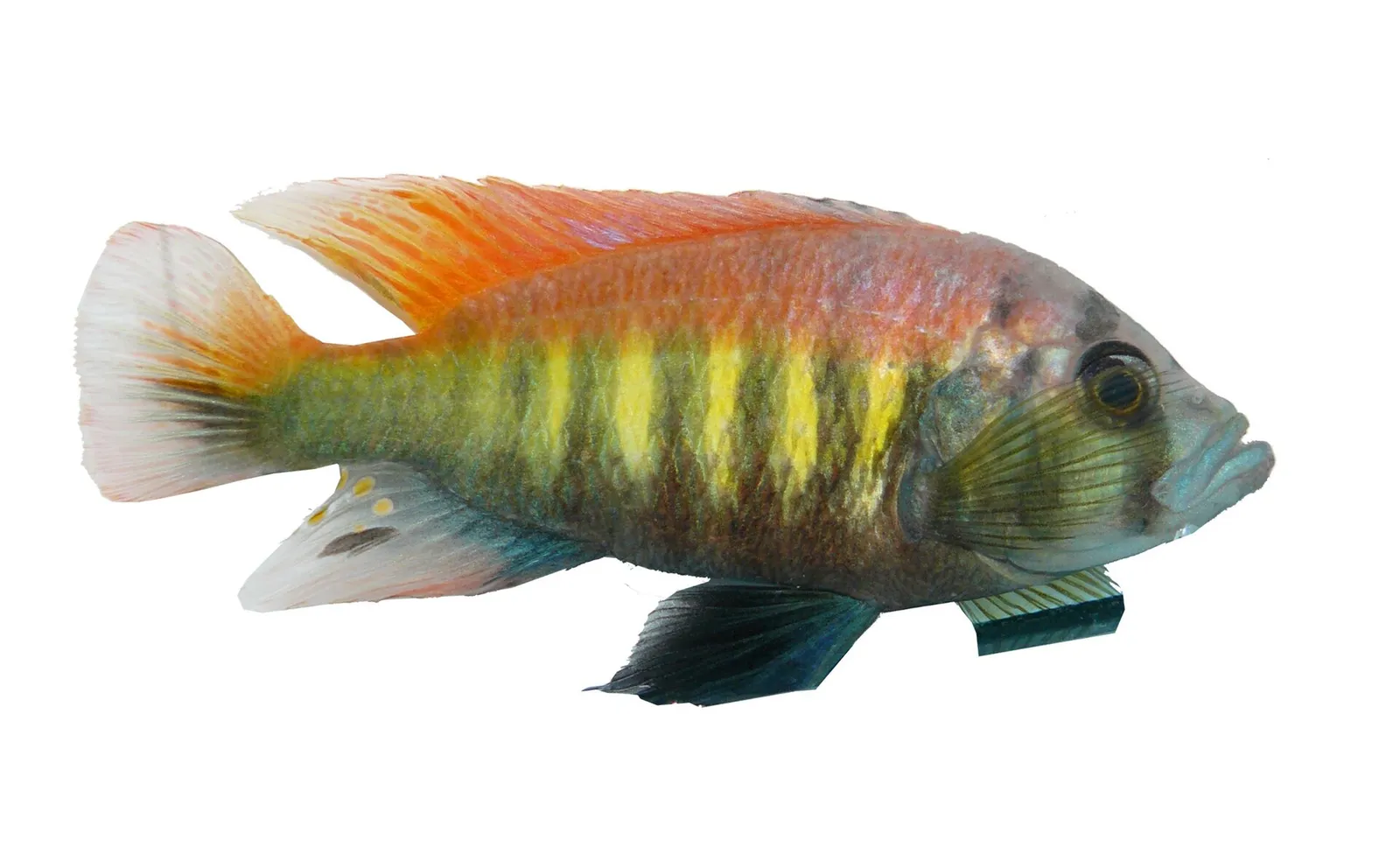
This is a small cichlid: FishBase gives a maximum of about 3 in standard length, and most accounts put adults in the 3 in SL range, so a large male is roughly the length of a finger. The body is the typical compressed, deep-bodied haplochromine form with a slightly concave forehead that is most pronounced in dominant males. The sexes could hardly be more different. A breeding male is unmistakable: the upper half of the body and the dorsal fin flame a brilliant crimson to scarlet, the flanks below are dark — purple-black to charcoal, often crossed by darker vertical bars — and the whole fish is overlaid with metallic blue on the face and fins. The anal fin carries the classic haplochromine 'egg spots,' yellow to orange ocelli that play a part in spawning. Females and juveniles, by contrast, are a drab silvery-brown with faint barring, cryptic camouflage that males abandon entirely when they hold a territory.
The redness itself is the trait at the centre of this fish's scientific fame. Male colour varies geographically — populations from different islands (Makobe, Python, Ruti, Igombe, Anchor, Luanso, 'Nansio'/Ukerewe and others) differ in the exact balance of red and yellow — which is why serious keepers and researchers always label stock with its collection site. The depth of red is condition-dependent and tied to carotenoid intake and to parasite load, making it an 'honest' signal of male quality; intermediate, hybrid-looking males turn up where the two Pundamilia species blur together.
Habitat
Pundamilia nyererei is endemic to Lake Victoria, the vast, shallow equatorial lake shared by Tanzania, Kenya and Uganda — though this species is recorded only from the southern, Tanzanian part, around the Mwanza and Speke Gulfs and a string of rocky islands, with Ukerewe Island near its northern limit. It is a rock-dweller, one of the 'mbipi' haplochromines restricted to the rocky littoral around islands and shelf-like submerged formations, and it does not cross the open sand and mud that separate one rocky island from the next. That patchiness — each island a genetic stepping-stone — is part of why the Victoria flock radiated so fast.
The water is warm, alkaline and buffered. FishBase gives a depth range of roughly 3–13 ft and temperatures of about 72–82 °F; field and aquarium sources put the comfortable band at around 73–81 °F with a pH well up the alkaline scale (about 7.2–9.0 in the lake; keepers aim for ~7.0–8.5) and dilute but buffered water. The single most important environmental axis for this fish, though, is light. On a continuous rocky slope from roughly 2–23 ft, the closely related blue Pundamilia pundamilia is most abundant in the bright, broad-spectrum shallows (about 2–7 ft), while the red nyererei predominates a little deeper, where the water column has filtered out blue and the ambient light shifts toward red — exactly the wavelengths a red fish is built to be seen in.
Feeding
Nyererei is an omnivore with a low trophic level — FishBase estimates about 2.6 — feeding chiefly on zooplankton and small aquatic invertebrates, with algae and insect material also recorded from gut contents. In the lake it works the open water just off the rocks for plankton and gleans small prey from the rocky substrate, a generalist 'micro-predator' rather than a specialist. Its place in the rock community is that of a small zooplanktivore/invertivore, taking the abundant copepods and insect larvae of the warm littoral while leaving the algae-scraping niche largely to other mbipi. In captivity that translates into an easy, unfussy fish that takes prepared foods readily but shows its best colour on a carotenoid-rich diet of small live and frozen invertebrates.
Mating
Mating in this species is the reason it is famous far beyond the aquarium. Males are polygynous and do not pair-bond: a dominant male takes a small territory among the rocks, intensifies to full red, and displays to passing females, defending the site fiercely against rival males — who he is fully capable of killing if they cannot escape. Females are choosy, and their choice is made on colour. In clear water, nyererei females prefer redder males and pundamilia females prefer bluer ones, and this single preference is enough to keep the two interfertile species reproductively isolated where they live side by side — a textbook case of speciation driven by sexual selection rather than by any barrier to hybrid fertility.
The mechanism is now understood in unusual molecular detail. Seehausen and colleagues (2008) showed that the divergence is a case of 'sensory drive': down the depth/light gradient, nyererei has evolved a long-wavelength-sensitive (LWS) visual pigment tuned to red light and pundamilia one tuned toward blue, so each species both signals in, and sees best in, the light of its own micro-habitat, and female preference and male colour co-evolve. The flip side is fragility. Seehausen, van Alphen and Witte's landmark 1997 paper showed that where eutrophication and erosion have made the water turbid, colour vision fails, the colour-based preferences break down, the species interbreed, and the distinct colour morphs — and the diversity they represent — collapse back into a hybrid swarm. Human-driven turbidity, in other words, switches off the very mechanism that built and maintains Victoria's cichlid diversity.
Breeding
Like the great majority of Lake Victoria haplochromines, nyererei is a maternal mouthbrooder with no pair bond and no paternal care. After a male's colour display lures a receptive female to his territory, she lays a few eggs at a time and immediately takes them into her mouth; she is then drawn to the yellow egg-spots on the male's anal fin and, snapping at them to gather what she takes to be more eggs, prompts him to release milt that fertilises the clutch already in her buccal cavity. The cycle repeats until she is spent. Clutches are small — a few dozen eggs, in keeping with the species' modest size; the female then broods the developing eggs and larvae in her mouth for roughly three weeks, eating nothing, before releasing fully formed, free-swimming fry that can take Artemia nauplii and powdered foods at once. Care ends there: there is no biparental tending of a brood, and a fry that strays is on its own. Spawning is readily triggered in the aquarium given a single dominant male, several females and warm, buffered water, which is one reason the species is among the few Victoria cichlids established in the hobby.
In the aquarium
Pundamilia nyererei is one of the genuine success stories of Lake Victoria conservation aquaculture: it is one of a handful of Victoria haplochromines that is actually established and bred in the hobby, prized for the searing red of a dominant male and kept by clubs and breeders precisely to maintain pure island lines as insurance against the lake's troubles. It is not difficult to keep — small, hardy, tolerant of the alkaline, buffered water it comes from — but it demands the right social setup.
A tank of about 120 x 17.5 in (roughly 60 US gallons) is a sensible minimum. Aquascape it as a rocky reef with abundant cover and broken sight-lines; this is a fish of the rocks, not of open water, and the rockwork is what lets subordinate animals survive a dominant male's aggression. Water should be alkaline and buffered (pH ~7.5–8.5) and warm, around 75–79 °F. Feed a varied diet built on small invertebrates — frozen or live Artemia, Daphnia and mosquito larvae — with some vegetable-based dried food; carotenoid-rich foods deepen the red.
The cardinal rules are social. Males are aggressive and will harass and kill rival males and over-pursue lone females, so stock a single male with a group of at least three to four females, or keep several males only in a large, heavily decorated tank where the loser can stay out of sight. Above all, never mix it with other Pundamilia or other red/blue Victoria forms, and label stock by island variant — these fish hybridise at the slightest opportunity, and a careless mixed tank destroys the pure lines that make keeping them worthwhile. They can share a tank with non-Pundamilia Victorians or with robust Malawi mbuna of similar temperament, but a well-managed single-species tank is the ideal.
Conservation
The IUCN Red List assesses Pundamilia nyererei as Least Concern (assessed 1 April 2010, published in the 2016 update; assessors F. Witte, M. P. de Zeeuw and E. Brooks), with a population described as stable. The assessment notes the species is endemic to Lake Victoria and known from surveys in Tanzania, and — pointedly for a fish whose biology is defined by colour — identifies its principal threat as hybridisation driven by decreased water transparency: the eutrophication, erosion, sedimentation and runoff that have clouded large parts of the lake and break down the colour-based mate choice that keeps the species distinct. A secondary, more prosaic threat is its capture for use as bait in the long-line fishery.
That 'Least Concern' label sits against a grim backdrop. Lake Victoria's endemic haplochromine flock — once several hundred species — suffered one of the most severe vertebrate mass declines on record after the introduced Nile perch (Lates niloticus) erupted through the lake from the 1980s, compounded by eutrophication and the loss of water clarity. Rock-dwelling mbipi like nyererei fared comparatively better than open-water forms because the perch is less effective among the rocks, and the species persists; but its long-term fate is tied to whether the lake's water can be kept clear enough for a red fish to find a red mate.