Taxonomy & naming
Petrochromis polyodon holds a place of honor in the lake's cichlid flock: it is the type species of the genus, the fish George Albert Boulenger had in front of him when he erected Petrochromis in 1898 with this species as its only member. The material came from rocks near Mpulungu, at the southern end of Lake Tanganyika, collected during the expedition of the British naturalist J. E. S. Moore, and Boulenger published the description in the Proceedings of the Zoological Society of London. The combination Petrochromis polyodon Boulenger, 1898 is the one recognized today by Eschmeyer's Catalog of Fishes and FishBase. The genus name is a literal portrait of the animal's life — Latin petra, "stone," joined to chromis, an old catch-all for a perch-like fish — while the epithet polyodon means "many-toothed," a nod to the dense brush of tiny teeth that is the whole point of the fish.
There is one junior synonym, and it carries a small geographic comedy of errors: Boulenger described Petrochromis nyassae in 1902 from a single specimen he believed had come from Lake Nyassa (now Lake Malawi). It hadn't — the fish was a Tanganyika polyodon, and Matthes and Trewavas formally folded nyassae back into Petrochromis polyodon in 1960. Petrochromis sits in the Tropheini, the rock-grazing radiation nested within the broader Haplochromini that also produced Tropheus, Simochromis and Pseudosimochromis — a flock that has repeatedly evolved scraping mouths and long guts to mine the lake's algal turf. Taxonomically the genus is still in motion: morphological and molecular revision (work from the Swedish Museum of Natural History, Karlsson & Karlsson and colleagues) has split off several look-alikes diagnosed largely by their close resemblance to polyodon — among them P. daidali, P. paucispinis (traded as 'Kasumbe') and P. heffalumpus — so "Petrochromis polyodon" as used in the hobby and older literature very likely brackets more than one biological species.
That confusion has older roots than the recent molecular splits. For decades, aquarium literature and even some scientific texts misidentified Petrochromis photographs as P. polyodon, most often confusing it with the smaller, deeper-bodied P. famula — the two were so persistently mixed up that a brown, cigar-shaped fish exported by the hundred from the northern lake was routinely sold and pictured as P. polyodon well into the 1990s, when much of it was likely P. famula instead. Ad Konings resolved the type population's identity by having the P. polyodon syntype, held from Mpulungu, photographed for comparison against Yamaoka's (1983) morphometric data, and against wild photographs of confirmed populations at the type locality: body shape and mouth form, not overall coloration, turned out to be the reliable characters (see Morphology). In the trade it is usually sold under the bare scientific name, often with a collecting locality such as 'Kantalamba' or 'Kombe' appended — worth treating with some caution given how often the name has been misapplied historically.
Morphology
This is a mid-to-large Petrochromis. FishBase gives a maximum of about 8.3 in (8.5 in) total length, with males generally outgrowing females; most tank adults settle a little under that, and Konings' Enjoying Cichlids lists a somewhat larger lakewide maximum around 10 in. Yamaoka's (1983) morphometric survey put body depth at 40.1% of standard length — distinctly more elongate than the deeper-bodied P. famula (42%), though still within the 37.6–40.8% range typical of the genus's other described species. The body is otherwise the standard Petrochromis build — robust and laterally compressed, carried over a blunt face designed to work a flat rock surface rather than chase prey.
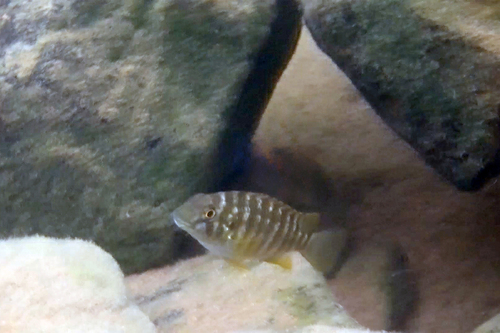
Color is variable and locality-dependent, but it is also the single least reliable way to identify this species — decades of trade and literature confusion with P. famula trace directly to trusting coloration over shape. The population at the type locality near Mpulungu, verified against the syntype, is blue-grey, green-grey, or yellow-grey, never reliably brown, and shows 8–9 vertical bars depending on mood; it occurs in comparable form lakewide. Dominant, territorial males color up hardest with blue iridescence on the head and unpaired fins, while females and subordinate fish stay plainer. The diagnostic features that actually hold up are in the mouth and fin counts. The jaws are crowded with many slender, tricuspid (three-pointed) teeth set on flexible stalks, forming a brush rather than a row of cutters, but unlike P. famula and P. orthognathus, P. polyodon cannot close its mouth completely: Yamaoka measured an average gap between the closed lips of 2.4% of standard length, so the fish habitually swims with its lips slightly parted and its teeth visibly showing even at rest — a more dependable field mark than any color pattern. In the genus revision Petrochromis polyodon is also set apart by a comparatively low dorsal-spine count (XVII to XIX, where most congeners carry XVIII to XXI), one of the few Petrochromis to dip to seventeen spines. Field identification remains genuinely hard even with these characters — several recently described congeners overlap polyodon in nearly every meristic trait, and even specialists lean on collection locality and mouth detail rather than color to tell them apart. Rare golden (xanthistic) individuals have also occasionally been recorded in wild P. polyodon, alongside P. macrognathus, Ophthalmotilapia ventralis and Perissodus microlepis; such fish are presumably more conspicuous to predators, which likely keeps the trait vanishingly rare.
Habitat
Petrochromis polyodon is a lacustrine endemic — it lives in Lake Tanganyika and nowhere else — and is recorded broadly around the lake, across all four of its bordering nations: Burundi, the Democratic Republic of the Congo, Tanzania and Zambia. Like the rest of the genus, it is a fish of the rocky littoral, the wave-washed, sunlit zone where boulders and cobble keep an algal turf growing on every exposed face. It is shallow even by rock-dweller standards: field work by Yamaoka placed it between the surface and about 23 ft (23 ft), squarely in the brightest, most productive band of the shore. FishBase describes it as benthopelagic, hovering and working over the rock either singly or in loose aggregations rather than schooling in open water.
The water it lives in is the open lake's, and it is unusual stuff. Tanganyika is hard and strongly alkaline — FishBase lists a pH range of roughly 7.2 to 8.5 and a hardness of about 10 to 20 dH for this species — and warm and remarkably stable, with the surface layer this fish occupies sitting around 73 to 79 °F (73–79 °F) year-round. That combination of clear, alkaline, oxygen-rich shallow water over clean rock is exactly what the algal turf needs, and exactly what makes this band of shoreline both rich and fragile.
Feeding
If you want to understand Petrochromis polyodon, watch it eat. It is a grazer in the strict ecomorphological sense used by researchers of these cichlids: it presses its brush of tricuspid teeth flat against the rock and scrapes, combing loose the diatoms, unicellular algae and fine organic film — the "aufwuchs" or epilithic biocover — that coat the stone, rather than nipping at longer filaments the way "browsers" such as Tropheus and Simochromis do. Yamaoka's classic study of the lake's algae-scraping cichlids rated Petrochromis polyodon as the most highly adapted of the Petrochromis for grazing diatoms off filamentous algae, the specialist's specialist. Its plumbing matches the diet — a long gut for fermenting low-value plant matter — and FishBase places it at a trophic level of about 2.0, essentially a pure herbivore.
That narrow diet sits inside one of the best-documented cases of niche partitioning in fresh water. A single Tanganyikan rock slope can carry a dozen or more algae-eating cichlids side by side, and they avoid ruinous competition by slicing the resource finely — by feeding ecomorph (grazer versus browser versus scraper), by substrate, and by depth. Stable-isotope work by Hata and colleagues showed that even closely related grazers holding feeding territories only a few meters apart draw on subtly different algal sources, the carbon signature of the periphyton shifting with depth. Within that crowded guild Petrochromis polyodon is not a passive tenant. Takamura documented a pointed interspecific relationship between Petrochromis polyodon and the browser Tropheus moorii, and earlier work found that polyodon, as one of the dominant aufwuchs-eaters, actively interferes with the feeding of related species — a reminder that on these reefs a patch of productive, well-lit rock is a contested resource worth fighting over.
Mating
On the reef, Petrochromis polyodon is territorial and combative, which follows directly from how it makes a living: a grazer that must defend a patch of algae-bearing rock has every incentive to be intolerant. Adults occur in small communities and loose aggregations over the rock, with dominant males holding and policing the best feeding-and-breeding ground while subordinate fish and females range more widely. The aggression is aimed hardest at its own kind and at other grazers after the same turf — the predictable friction of a crowded herbivore guild.
Spawning takes place within a male's rocky territory. The male competes for and defends a prime site, then courts visiting females, with the spawning event itself following the typical haplochromine sequence on or among the rocks of his domain. The female's investment begins the moment eggs are laid: she collects the fertilized eggs into her mouth immediately after spawning, at which point the male's role in reproduction is effectively complete.
Breeding
Reproduction is maternal mouthbrooding, the East African cichlid norm and the universal mode in this genus. The female takes the fertilized eggs into her mouth and incubates them there, releasing the fry only once they are free-swimming and able to fend for themselves. FishBase records that females from about 5–5.5 in standard length brood eggs from the cleavage stage all the way up to larvae of around 1.1 in (1 in) — confirming both a substantial parental investment and that the fish breed well below their maximum size. As in other mouthbrooders the male's contribution effectively ends at the spawning site, while the holding female carries and protects the brood, feeding little while her buccal cavity is full.
In the aquarium
This is a fish for the committed rift-lake keeper, not a community centerpiece, and the honest framing is to treat it like a larger, even more single-minded Tropheus. Petrochromis are among the most aggressive and food-obsessed cichlids in the hobby, and Petrochromis polyodon is no exception: it needs room, it needs numbers, and it needs discipline at the feeding dish. Experienced keepers steer toward a long six-foot tank as a practical floor for a group — call it 125 gallons (about 125 US gal) and up — heavily aquascaped with rock to break sightlines and give the fish defensible territories. The counterintuitive trick borrowed from Tropheus husbandry is to stock in a crowd rather than a timid pair or trio: density spreads aggression across many targets so no single fish is hounded to death, whereas a small group usually ends with the dominant fish eliminating the rest.
Water has to mirror the lake — hard, alkaline (pH comfortably above 8), warm, well-oxygenated and very clean, which in practice means strong filtration and generous water changes to carry the load of a tankful of constantly grazing fish. The single most important and most commonly botched point is diet. Like Tropheus, this is a long-gutted, low-protein algae specialist, and feeding it rich, protein-heavy foods such as beefheart or an excess of bloodworm invites the digestive collapse hobbyists call "bloat," which kills rift-lake herbivores fast; a spirulina- and vegetable-based diet is mandatory, not optional. Tankmates should be other large, robust, similarly herbivorous Tanganyikans on the same low-protein regime — other Petrochromis and Tropheus are the usual company — and emphatically not small, slow, or carnivore-fed fish. Given a big tank, a crowd, hard alkaline water and the right food, it is a charismatic, endlessly busy fish; given anything less, it disappoints or dies.
Conservation
On its own account, Petrochromis polyodon has recently been moved into a more worrying category. After a long-standing 2006 listing of Least Concern — the status still quoted on some hobby references — the IUCN Red List reassessed the species on 13 March 2025 as Endangered under criterion A2d, a category reserved for a population inferred to have declined substantially, here tied to the effects of exploitation. The fish is taken both as a local food fish and for the aquarium trade, but its listing is best read less as a verdict on collection alone than as a signal about the shallow rocky habitat it depends on entirely. Worth flagging plainly: this is a fresh, recent-year assessment, and the gap between it and the old Least Concern listing reflects a genuine reappraisal rather than any single new threat.
The deeper story is the lake itself. Lake Tanganyika is under sustained, basin-scale strain, and the pressures bear with unusual directness on a shallow-water algal grazer. Long-term limnology shows the surface warming and the water column stabilizing, which weakens the wind-driven mixing that lifts deep nutrients into the lit zone: O'Reilly and colleagues (Nature, 2003) inferred from sediment cores that primary productivity may have fallen by roughly 20% over the twentieth century, implying a decline in fish yields on the order of 30% — and they noted the lake's pelagic fishery supplies somewhere between a quarter and two-fifths of the animal protein for the people around its shores. Cohen and colleagues (PNAS, 2016), reading a paleoecological record spanning roughly 1,500 years, tied about 150 years of warming and intensifying stratification to measurable declines in fish and endemic benthic life, including a 38% shrinkage of oxygenated benthic habitat in their study areas. Layered on top is sedimentation: as catchments around the lake are deforested and farmed, soil washes into the littoral, clouding the water and smothering the rock. For a fish whose entire economy is the thin film of algae growing on clean, well-lit, sediment-swept stone, that is the most pointed threat of all — silt buries the grazing surface and shades out the diatoms that polyodon's brush of teeth evolved to harvest. Managing all of this falls to four sovereign nations acting together: under the Convention on the Sustainable Management of Lake Tanganyika, adopted at Dar es Salaam in June 2003, Burundi, the DR Congo, Tanzania and Zambia coordinate through the Lake Tanganyika Authority, the kind of cross-border governance the lake's problems demand and the kind that is always hard to sustain. The fair summary is that Petrochromis polyodon is a wide-ranging, resilient grazer that has nonetheless just been judged Endangered, and that it lives squarely in the shallow benthic band the lake's warming, fishery pressure and shoreline erosion are quietly degrading.