Taxonomy & naming
Retroculus xinguensis was described by the Belgian ichthyologist Jean-Pierre Gosse in 1971, in his revision of the genus published in the Bulletin de l'Institut Royal des Sciences Naturelles de Belgique (volume 47, number 43). The holotype (IRSNB 512) and its paratypes were taken from the Rio Xingu at the Cachoeira von Martius, on the northern border of Mato Grosso, Brazil — a name that anchors the species to the great rapids of the upper-middle Xingu. The same 1971 paper, which also designated a neotype for the long-confused Retroculus lapidifer (Castelnau, 1855), simultaneously described a second new species, Retroculus septentrionalis from the Rio Oyapock of the Guianas; a fourth species, Retroculus acherontos Landim, Moreira & Figueiredo, was added from the Tocantins basin in 2015.
In the same paper Gosse also resolved a long-standing nomenclatural tangle around the type species: he determined that Chromys lapidifera Castelnau, 1855 is a senior synonym of Retroculus boulengeri Eigenmann & Bray, 1894, which meant that, under the rules of zoological nomenclature, the correct combination for the genus's oldest species is Retroculus lapidifer (Castelnau, 1855) rather than the boulengeri name that had been in wide use. The genus Retroculus was first diagnosed by Eigenmann and Bray in 1894 and rediagnosed by Landim and colleagues in 2015. Its members are set apart from all other cichlids by two unique features: an epibranchial lobe supported by a thickening of the first epibranchial, and a specialised vomero-palatine apparatus on the roof of the mouth. Retroculus xinguensis itself is separated from its congeners by a combination of meristics and markings — 16-17 dorsal spines and 10-11 soft rays, 37-41 scales in the midlateral series, gill rakers absent on the fifth ceratobranchial (present in Retroculus lapidifer and Retroculus septentrionalis), and conspicuous dark bars on the caudal fin (absent or faint in the others). Despite a strong superficial resemblance to the eartheaters, molecular and morphological work (Kullander 1998; Smith, Chakrabarty & Sparks 2008; López-Fernández, Winemiller & Honeycutt 2010) places Retroculus as the earliest-diverging lineage of Neotropical cichlids and the sister group to Cichla, basal to the rest of the radiation — emphatically not a member of the Geophaginae. FishBase accordingly files the genus in its own subfamily, Retroculinae. The species carries the Brazilian Portuguese name cará-bicudo ('long-snouted cará'); it has no established English common name.
Morphology
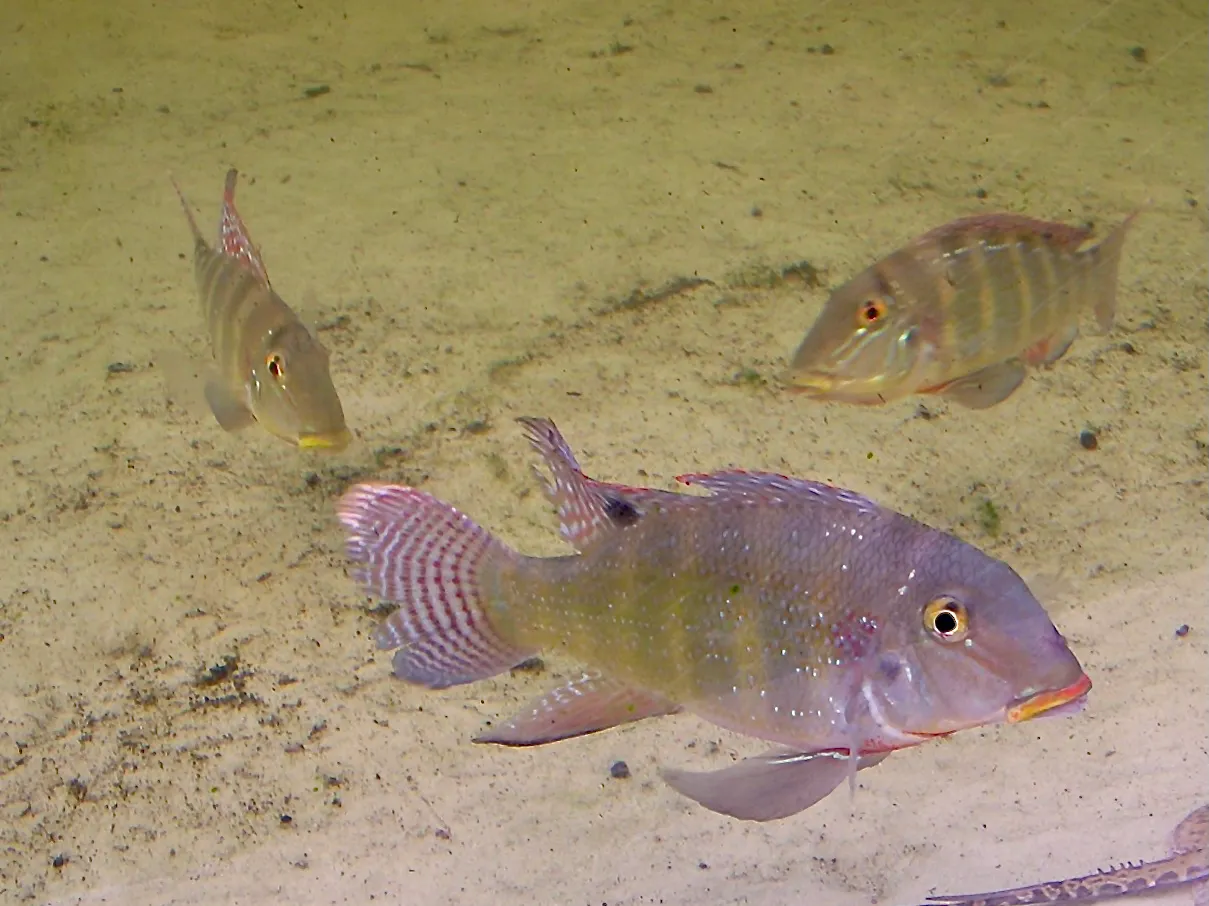
Retroculus xinguensis is a robust, somewhat dorsoventrally flattened cichlid adapted for holding station in fast water. Size reports vary with how length is measured and whether wild or aquarium fish are considered: FishBase gives a maximum of 12 in total length and a published weight of 520 g, with an alternative figure of 10 in TL also cited — a figure Weidner independently gives as well — while Kullander (2003) recorded wild specimens to about 5.5 in standard length — the discrepancy reflecting both the SL-versus-TL distinction and the larger sizes large captive or trophy fish can reach. Seriously Fish lists a maximum standard length of roughly 6–8 in. The body is base coloured in muted bronze, olive, and grey tones — cryptic against river gravel — overlaid with darker mottling, a black blotch on the anterior soft dorsal-fin rays (a genus character), and conspicuous dark bars across the caudal fin, extraordinarily regular in their spacing. Weidner, who regarded xinguensis as probably the most attractive of the three then-described Retroculus, singles out the fins of breeding males: a vivid red dorsal and ventrals, and — a feature that alone separates it from its congeners in the field — a red anal fin. The dorsal carries a reddish edge, and the genus-typical dark spot at the base of its soft rays sits about a scale's width out from the ridge of the back and reads somewhat rounder in outline than the equivalent spot in Retroculus lapidifer or Retroculus septentrionalis. The head is long with a downturned, acutely pointed snout, and the eye is set distinctively far back on it, the trait that gives the genus its name; in xinguensis the upper head profile rises rather more steeply than in its two congeners, giving the head a visibly more rounded look.
Sexual dimorphism is real but subtle. Adult males are noticeably more slender than females, the profile between the ventral and anal fins running nearly straight in males but rounded in females. Mature males develop enlarged ventral (pelvic) fins carrying a greater proportion of red pigment, which they use in territorial displays — bracing on the substrate to make themselves appear larger to a rival. Breeding fish of both sexes intensify dramatically in colour, flushing red on the sides of the head and across the dorsal, anal, and ventral fins. Juveniles and subadults show no external sexual difference and are strongly cryptic. The fish frequently 'hop' across the bottom rather than swim freely, perching on stones between bursts — a goby-like habit that earned them the informal hobby tag 'goby eartheaters.'
Habitat
This is a fish of clearwater rapids. Retroculus xinguensis is endemic to Brazil, where the bulk of records come from the lower Rio Xingu basin in the state of Pará — including the middle and lower reaches of its major tributary, the Rio Iriri — while the type locality, the Cachoeira de Martius, lies several hundred kilometres upstream on the northern edge of Mato Grosso state. Until 1993 the species was thought to be endemic to the Rio Xingu alone; that changed in 1992 when Stawikowski, Müller, Kilian, Ludwig and Schaefer collected a Retroculus in the Rio Tapajós south of São Luís de Tapajós and had the specimens confirmed by Kullander as xinguensis, extending the known range into the neighbouring Tapajós system. The species has also been recorded far downstream at Altamira, close to where the Xingu meets the Amazon itself, leading Weidner to conclude that xinguensis most likely occurs along the full length of the Rio Xingu rather than being restricted to its upper reaches. Additional, scattered records exist from the Rio Jamanxim (a major affluent of the Tapajós draining the same uplands as the Iriri), the Rio Arapiuns, and the Rio Maués Açu, so the species is generally treated as occurring across the Xingu and Tapajós drainages of the southeastern Amazon. These are clearwater rivers draining the ancient Brazilian Shield, low in dissolved solids and seasonally transparent.
The species is strictly rheophilic, living in rapids and fast-flowing channels strewn with boulders of every size, with quieter marginal pools floored in sand and gravel. The IUCN assessment notes it occupies both the rapids themselves (corredeiras) and the adjacent slower backwaters (remansos). Water is warm, well-oxygenated, and soft to moderately mineralised: FishBase records a pH floor of about 6.5 and a hardness ceiling near 2 dH, with field-relevant temperatures of 81–86 °F, while aquarium-oriented sources widen the workable envelope to pH 6.0-8.0 and 79–90 °F. The reliance on clean, fast, oxygen-rich water is the single most important fact about the species' biology — it is intolerant of stagnation and organic loading, and these constraints govern both its distribution and its difficulty in captivity. As a benthopelagic rapids fish it lives at the bottom of relatively shallow, turbulent channels rather than in deep water.
Feeding
Retroculus xinguensis is a benthic invertivore that works the gravel and rubble of fast water. Direct dietary study of its close congener Retroculus lapidifer in the Rio Araguaia (Moreira & Zuanon, 2002, Acta Amazonica) found a diet dominated by the aquatic larvae of chironomids (midges), trichopterans (caddisflies), and ephemeropterans (mayflies) — the rheophilic insect fauna that clings to and burrows among stones in running water — and the IUCN assessment notes that Retroculus xinguensis has a very similar diet. The long, downturned snout and posteriorly placed eye are adaptations for this bottom-oriented foraging: the fish takes mouthfuls of substrate and sifts them through the gills to extract edible items, in the winnowing manner that gives the genus its eartheater-like look. It is not, however, a pure sand-sifter; it also picks invertebrates directly from rock surfaces and readily seizes items carried past it in the current, and larger individuals will take small fishes. FishBase places it at a trophic level of about 3.5, consistent with a carnivorous benthic invertivore with some piscivory. In the rapids community it is one of the larger insectivorous cichlids working the boulder zone, sharing that habitat with the small Teleocichla pike-cichlids and other rheophilic specialists.
Mating
Outside of reproduction Retroculus xinguensis is sociable and lives in loose aggregations, with juveniles in particular showing strong shoaling instincts. Within a group a clear dominance hierarchy develops, the largest and most intensely coloured fish — usually a male — taking the top rank. Pairs form within this social structure rather than between isolated individuals, which is why keepers are advised to raise a group of five to eight and let pairs sort themselves out; sexual maturity is slow to arrive, often taking a year, frequently two or more.
Courtship is initiated by the male, typically several days before any eggs are laid, and is conducted through reciprocal lateral displays and fin-flaring, the enlarged red pelvic fins braced against the substrate to exaggerate the displaying fish's size. As a pair consolidates, the two work together to excavate one or more broad pits in the sand and gravel — depressions reported at around 8 in across — which become the focus of their territory. This pre-spawning digging, combined with the dramatic red nuptial flush that overtakes both partners, is the clearest outward sign that a pair has formed and is preparing to spawn. Aggression is largely confined to the breeding period and to intraspecific rivalry; toward other species the fish remains comparatively peaceful, though it will take fry-sized or smaller tankmates.
Breeding
Retroculus xinguensis is a biparental substrate spawner with a distinctive twist: it is, in effect, a pit- and stone-nesting cichlid that buries its eggs in gravel. After excavating one or more pits, the pair spawns directly onto the sand, the female extruding batches of eggs that the male fertilises in turn until 200 or more — some accounts cite 200-250 — have been laid. The eggs are large, ovoid, and extremely adhesive, becoming coated in sand grains almost immediately. The pair then gather the sand-covered eggs and either place them in, or cover them with, a pile of small pebbles and debris; this 'nest' is repeatedly picked up and relocated to fresh pits over the three to four days of incubation, after which the eggs hatch. The wrigglers are tended in the pebble pile, and once free-swimming the fry are guarded by both parents, tucked back among the stones at night and led out by day.
The pebble habit is the key to captive success. The genus name of the type species, lapidifer ('stone-bearer'), records de Castelnau's 1855 observation of fish carrying small stones one by one to build a nest, and for decades aquarists got sand-coated eggs but never free-swimming fry. The breakthrough came in 2006, when Lee Newman — after maintaining wild Xingu fish for some two and a half years on impeccable husbandry and a diet built around frozen bloodworms — added handfuls of small, manageable pebbles to the tank. Within a week the pair spawned and buried their eggs among the stones; the eggs hatched at about three and a half days, and the roughly 200-250 fry were reared on newly hatched brine shrimp, with the parents seen 'blowing' into the sand to expose food for them (Newman 2007, Cichlid News 16[1]). Parental care continues for around two weeks until the fry become fully mobile and the pebble nest is abandoned. There is no specific environmental trigger beyond first-rate water quality, a rich invertebrate diet, and the provision of suitable pebbles.
In the aquarium
Retroculus xinguensis is a specialist's fish, available in the trade only sporadically and demanding from the moment it arrives. It is wholly unsuited to a standard community tank and must be kept in a set-up that mimics a flowing river. Adults need a large footprint — Seriously Fish recommends a base of at least 210 by 23.5 in (roughly 200 US gallons) — and Newman's breeding fish were ultimately housed in a 300-gallon tank. A group of five to eight is the right starting number, both to satisfy the species' shoaling nature and to allow a pair to form; kept in twos or threes, weaker fish are bullied and the group fails to settle.
Water quality is non-negotiable. These rapids cichlids are intolerant of organic waste and require spotlessly clean, highly oxygenated, fast-moving water — additional powerheads or a linear-flow pump on top of strong filtration, with mandatory weekly water changes of 30-70% (Newman changed about 75% every 7-10 days). Recommended parameters are 79–90 °F (the species will not thrive in cool water), pH 6.0-8.0, and soft to moderately hard water (about 18-215 ppm / up to ~12 dH). The substrate should be soft sand mixed with small pebbles — the pebbles are essential if breeding is the goal — over which rocks, boulders, roots, and current-tolerant attached plants can be arranged. Wild imports are notoriously delicate and prone to white-spot (ich) in the weeks after shipping, so a long, careful quarantine is prudent.
Diet in captivity should reproduce the wild insectivore's menu: frozen and live chironomid larvae (bloodworm), Tubifex, Artemia, Gammarus, mosquito larvae, and small earthworms, plus quality dried foods with a meaningful vegetable (Spirulina) component, and gelatine-based home-made foods work well; small, frequent meals suit them better than one large feed. Temperamentally the fish is relatively peaceful outside breeding but is best housed with robust, peaceful mid-water and surface companions rather than other bottom-dwellers, and anything small enough to swallow is at risk. The recurring reasons keepers lose these fish are the same three: insufficient flow and oxygenation, accumulated dissolved waste, and post-import disease in fragile wild stock.
Conservation
The IUCN Red List assesses Retroculus xinguensis as Least Concern, in an assessment carried out by Brazil's Instituto Chico Mendes de Conservação da Biodiversidade (ICMBio), assessed 7 November 2018 and published in 2022 (assessment 140708637). The species is endemic to the Xingu and Tapajós basins and is considered frequent and abundant with a stable population, which is why it qualifies as Least Concern despite a narrow, hotspot range. It carries no CITES listing, and the assessment notes no records from formally protected areas.
The explicit threat flagged in the assessment is hydroelectric development — 'Dams & water management/use.' The Belo Monte complex on the lower Rio Xingu, together with the planned São Luiz and Jatobá projects on the lower Tapajós, directly alters the rapids habitat this rheophile depends on. The IUCN reasoning for the optimistic category is that Retroculus xinguensis occupies both rapids and slower backwaters, that the congeneric Retroculus lapidifer has been found persisting in reservoir conditions, and that the species also occurs in the Iriri and upper Xingu where no dam threats were identified. That reasoning deserves to be read against the wider evidence from the Volta Grande do Xingu — the very stretch of rapids most affected by Belo Monte. Fitzgerald and colleagues (2018, Biological Conservation) documented an exceptional concentration of endemic, rapids-adapted fishes in the Volta Grande and warned that the diversion of the river's flow into the dam's channel would strand and degrade exactly this boulder-and-current habitat. Subsequent monitoring of the de-watered Volta Grande has reported reduced flows interrupting fish reproduction and killing fish during low-water periods. For a species whose biology is built around fast, clean, oxygen-rich water over rapids, large-scale flow alteration is the central long-term concern, even where the global population presently appears secure — and the relatively rosy 2018 reading of its prospects may merit revisiting as the downstream effects of Belo Monte continue to unfold.