Taxonomy & naming
Bario sanctaefilomenae was described by the Austrian ichthyologist Franz Steindachner in 1907. The valid name is written with the authority in parentheses — (Steindachner, 1907) — indicating it was originally placed in a different genus before being transferred to Moenkhausia. Eschmeyer's Catalog of Fishes is the governing authority for valid nomenclature.
The genus Moenkhausia is one of the largest in the family Characidae, containing more than 80 recognised species distributed across tropical South America. The group is united principally by the presence of a complete lateral line and ctenoid scales — characters that distinguish it from many superficially similar tetras — though the genus is not considered fully monophyletic and revisions continue. B. sanctaefilomenae is one of the more well-studied and widely distributed members of the genus.
The species sits within the family Characidae sensu lato, the largest family of freshwater fishes. Ongoing molecular work continues to reorganise the tetras, but B. sanctaefilomenae's placement in Moenkhausia has remained stable.
This fish was long listed as Moenkhausia sanctaefilomenae; Eschmeyer's Catalog of Fishes places the species in Bario, and the current combination Bario sanctaefilomenae is followed here.
Morphology
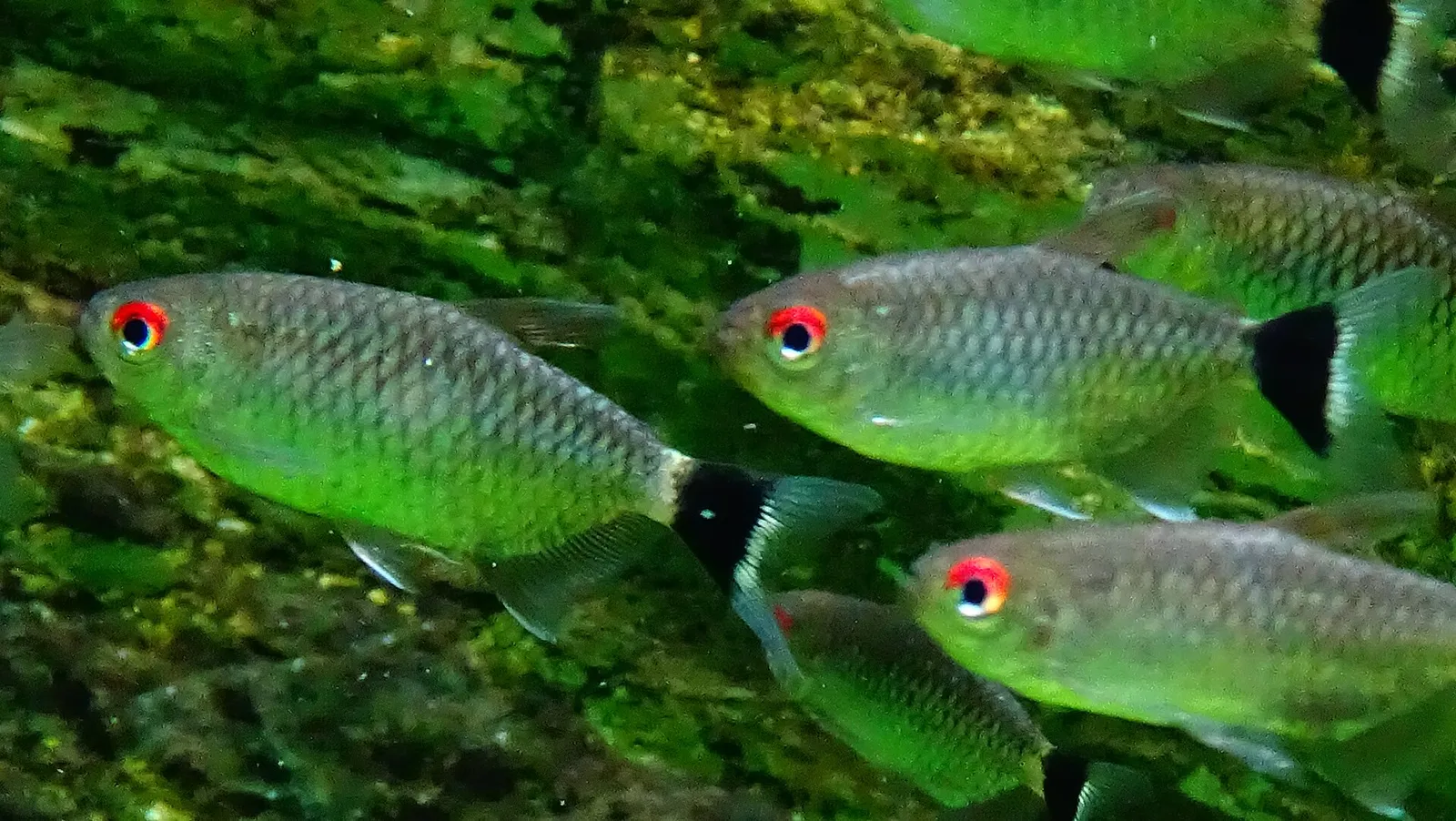
Bario sanctaefilomenae is a compact, laterally compressed tetra reaching a maximum of about 3 in standard length (SL), though most aquarium specimens are smaller. The body is deep and somewhat oval in profile, silver to pale gold in overall tone, with scales that catch the light and give the flanks a faintly metallic sheen. A dark, roughly triangular blotch marks the base of the caudal peduncle and extends onto the central rays of the caudal fin; a narrow pale band separates this dark mark from the fin's tips, producing a pattern sometimes called the 'banded tail.'
The defining feature is the eye: the upper iris is stained a vivid orange-red, forming a conspicuous half-arc visible across a tank. This characteristic, shared by a handful of related Moenkhausia species, is the source of the common name 'red-eye tetra.' Fins are generally transparent with hints of yellow, and the dorsal fin carries a small dark spot near the tip in many individuals.
Sexual dimorphism is modest. Ripe females are noticeably deeper-bodied and rounder in the belly than males, particularly when gravid; otherwise the two sexes share the same coloration and scale pattern.
Habitat
Bario sanctaefilomenae is distributed across the Paranaíba, São Francisco, upper Paraná, Paraguay, and Uruguay River basins in central and eastern South America, with the Pantanal wetlands of Brazil, Paraguay, and Argentina forming a core part of its range. It is a wide-ranging, ecologically flexible species rather than a narrow endemic.
In the Pantanal it occupies clear-water rivers and flooded-grassland channels that support dense growth of floating plants — including water hyacinth — and submerged vegetation such as sword plants (Echinodorus). The fish schools in open and semi-shaded water near surface vegetation, using plant structure for cover and as a foraging ground for small invertebrates. Water conditions across its range span a broad band: temperatures from 72–79 °F and pH from 6.0 to 8.0, with the Pantanal populations tolerating fluctuating oxygen and chemistry across wet and dry seasons.
Feeding
Bario sanctaefilomenae is an omnivore with a diet that spans the animal and plant kingdoms. In nature adults consume worms, aquatic insects and their larvae, small crustaceans, and plant matter. The species feeds actively in the water column and at the surface, taking items opportunistically as they become available through the seasonal flood pulse of its habitat.
In captivity it is straightforward to feed. High-quality dry flake or small pellets form the staple, supplemented with frozen and live foods — bloodworm, Daphnia, and brine shrimp are all accepted readily. A modest vegetable component, whether in the form of spirulina-enriched flake or blanched plant matter, rounds out the diet. The species is an active, competing feeder in a community tank and holds its own at mealtimes without aggression toward tankmates.
Mating
The red-eye tetra is an egg-scattering open spawner with no parental care. Under good conditions and with adequate conditioning, adults will spawn freely without any special trigger, though a gradual temperature rise to the upper part of the breeding range and softer, slightly acidic water will reliably induce spawning activity. Males chase and court females among fine-leaved plants or at the water surface, displaying with lateral posturing and rapid fin movement.
Spawning takes place in pairs or in small groups, with eggs scattered among vegetation or at the substrate surface. The eggs are adhesive and tend to fall into plant thickets or settle on fine-leaved surfaces. Adults show no interest in their eggs or fry and will eat both given the opportunity, making removal of the spawning adults the standard practice in managed breeding.
Breeding
Conditioning adults on a varied diet of live and frozen foods brings them into spawning condition reliably. A dedicated breeding tank of moderate size with soft, slightly acidic water — pH 6.0–7.0, hardness 1–10 °H — and a temperature raised to around 79–84 °F works well. Dim lighting and the presence of fine-leaved plants or spawning mops gives females somewhere to scatter eggs and provides some eggs with physical protection.
Eggs hatch within 24–36 hours at breeding temperatures, and the tiny fry become free-swimming three to four days after hatching. At this stage they need appropriately small first foods — infusoria, rotifers, or a commercial liquid fry food — before they can handle newly hatched brine shrimp. The adults must be removed from the breeding tank as soon as spawning is complete, as they will consume any eggs within reach. Growth of the fry is steady under good water quality and regular small feedings.
In the aquarium
Bario sanctaefilomenae is among the most adaptable community tetras available. It thrives across a broad range of water chemistries — pH 6.0–8.0 and temperatures 72–79 °F — a tolerance that reflects the varied conditions of its natural habitat and makes it compatible with a wide range of tankmates and tap-water chemistries. A group of eight or more shows its most natural, confident schooling behaviour; smaller numbers often produce a more scattered, somewhat shy fish.
The species is peaceful with fish of similar size and does not fin-nip under typical community conditions, though it can become opportunistically nippy toward long-finned or slow-moving species — particularly sluggish bettas or veil-tailed fish — if underfed or kept in a small, tight group. A planted aquarium with open swimming space and moderate flow suits it well, reproducing the vegetated riverine and floodplain habitats of the wild. Tankmates from the same river systems — other Moenkhausia, smaller cichlids such as Apistogramma, corydoras, and medium hatchetfishes — make natural companions. The fish is generally hardy and tolerant of minor lapses in water quality, making it a reasonable choice for an established community tank.
Conservation
Bario sanctaefilomenae is assessed as Least Concern (LC) on the IUCN Red List, with the assessment dated 7 November 2018. The species' broad distribution across multiple large South American river basins and floodplain systems, combined with its ecological flexibility and tolerance of variable conditions, provides substantial buffering against localised habitat loss or collecting pressure.
The red-eye tetra is commercially bred at scale throughout Southeast Asia and in parts of Europe, and most specimens in the hobby today are tank-bred rather than wild-caught. This means the aquarium trade exerts minimal pressure on wild populations. Habitat degradation in the Pantanal through agricultural conversion and water management remains a background concern for the ecosystem broadly, but the species' status is currently stable and the IUCN sees no evidence of rapid population decline.