Taxonomy & naming
Bario oligolepis was described by the German-born British ichthyologist Albert Günther in 1864 on the basis of material from South America. The specific name oligolepis derives from Greek: oligo- meaning few or small, and lepis meaning scale, referring to the conspicuously large scales that cover the flanks and give the fish a coarser, more open scalation than many of its congeners. Eschmeyer's Catalog of Fishes lists the valid name as Bario oligolepis (Günther, 1864), with parenthetical authority indicating that Günther originally placed it in a different genus before it was transferred to Moenkhausia.
Moenkhausia is a speciose Neotropical genus in the family Characidae — the tetras and characins — and B. oligolepis is one of its more recognisable members, widely encountered in both scientific collections and the ornamental trade. Several similarly translucent or spotted Moenkhausia species have been confused with it in the aquarium hobby over the years, and the name has historically been applied loosely to more than one taxon; fish sold as 'glass tetras' in the trade may include related species.
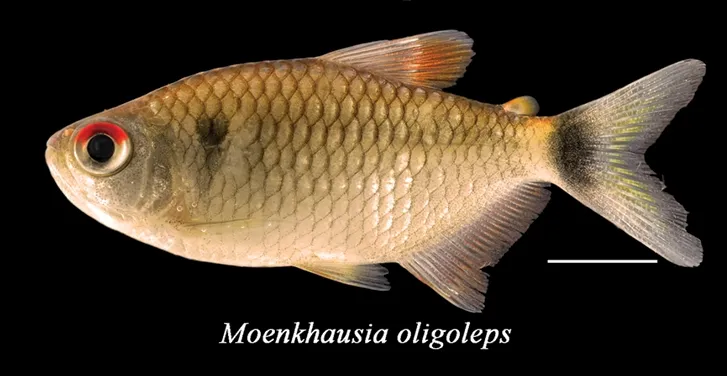
This fish was long listed as Moenkhausia oligolepis; Eschmeyer's Catalog of Fishes places the species in Bario, and the current combination Bario oligolepis is followed here.
Morphology
Bario oligolepis is a slender, laterally compressed tetra reaching around 2 in standard length (approximately 2 inches), though some sources cite specimens to 4 in SL; hobbyist-maintained fish typically remain at the smaller end of that range. The body is notably translucent, with large, somewhat sparse scales that give the flanks an almost glassy appearance — the feature from which both the scientific name and the common name derive. A well-defined dark spot marks the base of the caudal peduncle, and the iris is distinctly reddish-orange, a colour that intensifies under good conditions and is one of the species' most attractive features.
The fins are largely hyaline. Overall colouration is silvery with a faint yellowish or golden wash on the body, and the translucency exposes a dark lateral stripe running toward the caudal spot. Sexual dimorphism is subtle; ripe females are noticeably fuller-bodied when in breeding condition, but there is no reliable external colouring difference between the sexes.
Habitat
The glass tetra is distributed across a wide area of northern and central South America, with confirmed records from Venezuela, Guyana, Suriname, French Guiana, Peru, and Brazil. It inhabits slow-moving to still lowland waters: tributaries, marginal channels, floodplain lakes, and flooded forest pools with sand or silt substrates, often with driftwood, leaf litter, and a characteristic dark, tannin-stained water column that filters light and provides cover. Dense aquatic vegetation and submerged roots are frequently part of the habitat structure.
Water chemistry in these habitats tends toward soft and acidic. Seriously Fish records natural parameters of 75–82 °F, pH 5.5–7.2, and hardness of 1–12°H, consistent with the blackwater and clearwater river systems of the Guiana Shield and Amazon Basin. The species has also been reported from more alkaline conditions in parts of its range, reflecting the breadth of its distribution across varying geological substrates.
Feeding
Bario oligolepis is an omnivore in the wild, taking a diet of algae, small invertebrates, and microorganisms. It grazes plant material and biofilm from submerged surfaces and vegetation, and supplements this with small crustaceans, insect larvae, and other aquatic invertebrates. The feeding strategy is typical of generalised mid-water characids — opportunistic and varied rather than specialised.
In the aquarium it accepts a wide range of foods readily. Good-quality flake and micro-pellet foods form a practical staple, and colour and condition are improved by regular offerings of small live or frozen items such as Daphnia, brine shrimp, and bloodworm. The species is active and competitive at feeding time, and a group benefits from multiple small daily feedings rather than a single large meal.
Mating
Bario oligolepis is an egg-scattering, open-water spawner with no parental care, the typical reproductive strategy of small schooling characids. Under good conditions males pursue females with short chasing sequences, and spawning takes place among fine-leaved plants or over a substrate of fine material where the eggs can disperse and settle.
The species is reported to be gregarious and spawns readily in the aquarium, which partly accounts for its accessibility as a breeding project. There is no elaborate courtship display; receptive pairs or small groups move through vegetation releasing and fertilising eggs in brief, rapid passes. Both sexes pay no attention to the eggs after spawning, and the adults will consume eggs if given the opportunity.
Breeding
For spawning, a conditioning group of adults is typically transferred to a separate, dimly lit tank furnished with fine-leaved plants such as Java moss, Cabomba, or synthetic spawning mops over a substrate through which eggs can fall out of reach of the parents. Soft, warm water in the lower part of the natural range — around 79–82 °F with pH 5.5–6.5 — often triggers spawning, which typically occurs in the early morning.
Eggs hatch within 24–48 hours at typical spawning temperatures. The fry become free-swimming after a further three to four days once the yolk sac is absorbed, at which point they require very small first foods — infusoria, paramecia, or commercial liquid fry foods — before graduating to microworm and newly hatched brine shrimp nauplii as they grow. Adults must be removed after spawning to prevent predation on the eggs and newly hatched fry.
In the aquarium
Bario oligolepis is considered an easy species for the community aquarium. It is peaceful, active, and sociable, and like most schooling tetras benefits from being kept in groups of six or more; a larger group reduces individual stress, produces more natural behaviour, and makes the best display. A tank of 23.5 in or more in length is appropriate for a school of adults, with a mix of open swimming space and planted zones around the margins.
Water chemistry should lean toward soft and slightly acidic to neutral — pH 5.5–7.2 and hardness below 12°H — which reflects the natural habitat and tends to produce better colouration and spawning readiness. The characteristic orange iris shows most vividly against darker substrate and tannin-stained water; a blackwater-style setup with dark sand, driftwood, and dried leaves brings out the best in the fish. The species tolerates a wide range of peaceful community tankmates — other small tetras, rasboras, small corydoras, and similarly sized non-aggressive species all suit it well. It is an accessible and rewarding choice for aquarists interested in soft-water Neotropical communities.
Conservation
Bario oligolepis has not been formally assessed by the IUCN Red List, and no dedicated conservation evaluation is on record for the species. Its wide distribution across multiple countries and major river drainages in South America, combined with stable reported wild populations, suggests it is not currently under acute range-wide pressure.
Nonetheless, the broad habitat types it occupies — lowland floodplain forests, Amazonian tributaries, and Guianan blackwater systems — face ongoing deforestation, agricultural runoff, and water quality degradation across much of its range. Collection for the ornamental trade is also a factor in some localities, though the species breeds readily in captivity and tank-raised stock is widely available. As with many tropical freshwater fishes that occupy a broad but ecologically specific habitat, localised declines may occur without triggering broader conservation concern.