Taxonomy & naming
Megalamphodus sweglesi was described by the French ichthyologist Jacques Géry in 1961. The original type locality was cited as Leticia, Peru, but subsequent work — most fully documented through Seriously Fish — has corrected this to the Río Muco in the upper Río Orinoco basin of Colombia, a discrepancy common in early aquarium-trade material where provenance was loosely recorded. The valid name as accepted by the Catalog of Fishes (Eschmeyer, CAS) is Megalamphodus sweglesi (Géry, 1961), with parenthetical authority because Géry placed the species in a different generic context at description.
The species belongs to the large and taxonomically complex genus Hyphessobrycon within the family Characidae. The red phantom tetra is sometimes grouped informally with the 'phantom tetra' assemblage alongside the black phantom (Hyphessobrycon megalopterus) and the white/silver phantom; these species share overlapping body form and soft-water habitat affinities but are not formally established as a clade. No synonyms in wide use are associated with M. sweglesi.
This fish was long listed as Hyphessobrycon sweglesi; Eschmeyer's Catalog of Fishes places the species in Megalamphodus, and the current combination Megalamphodus sweglesi is followed here.
Morphology
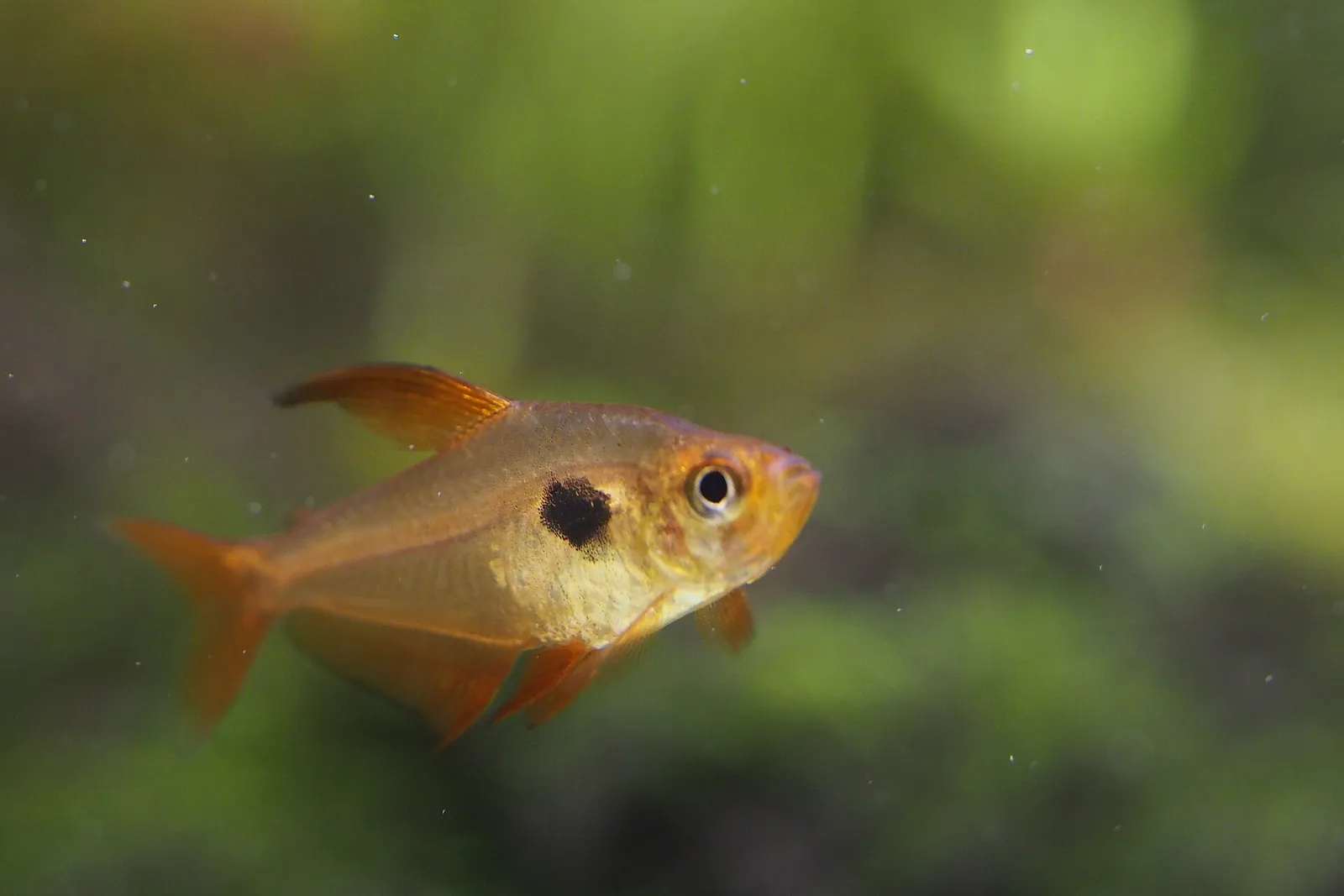
Megalamphodus sweglesi is a small, laterally compressed tetra reaching a maximum of about 1.5 in standard length. The body is moderately deep for its length, giving mature individuals a somewhat diamond-shaped profile in side view. Like other hyphessobrycons it carries the family's characteristic adipose fin, a forked tail, and a single dorsal fin; the dorsal in males is notably elongated and flag-like, extending well beyond the body in well-conditioned fish.
Coloration is the species' chief appeal. The overall body tone is translucent reddish to rosy-silver, with the red intensifying along the upper flanks and head region in dominant or displaying males. A dark shoulder spot — the humeral blotch characteristic of many Hyphessobrycon — is present and prominent. Females are plainer and stockier, their red tones more subdued, and the dorsal fin is shorter and rounded rather than elongate. The combination of the deep-red flush, the prominent shoulder spot, and the flag dorsal distinguishes M. sweglesi from closely similar species in the hobby.
Habitat
The red phantom tetra is endemic to the upper and middle Río Orinoco watershed, with a confirmed range spanning Colombia and Venezuela. Its natural haunts are minor tributaries, oxbow lakes, and flooded forest margins — particularly the morichal habitat of the Colombian and Venezuelan llanos, where stands of moriche palm (Mauritia flexuosa) shade clear, slow-moving water over sandy substrates with dense aquatic and marginal vegetation.
Water chemistry in these habitats is soft and acidic: Seriously Fish records conditions around 68 °F, pH approximately 4.5, and hardness near 18 ppm at type-locality sites. FishBase gives a wider tolerance range of 68–73 °F and pH 5.5–7.5 for the species in general. The combination of clear water, tannin staining from leaf litter and palm detritus, low mineral content, and dense vegetation structure is typical of the soft-water tetra country of the Orinoco drainage.
Feeding
In the wild Megalamphodus sweglesi is an omnivore feeding on small invertebrates including worms, insect larvae (notably chironomids), small crustaceans, and other zooplankton encountered in the water column and near the substrate. Like most small tetras it supplements animal prey with plant material and organic debris when preferred prey is scarce.
In the aquarium it is undemanding and accepts a wide variety of foods. A varied diet combining good-quality small flake or micro-pellets with frozen and live foods — Daphnia, Cyclops, bloodworm, and brine shrimp — keeps the fish in best condition and brings out the red coloration. Live and frozen chironomid larvae are particularly effective at enhancing colour in males. Freeze-dried alternatives work well as a convenience food. Small, frequent feedings suit its continuously active feeding style better than single large meals.
Mating
Megalamphodus sweglesi is an egg-scattering, open spawner with no parental care. Males are territorial in display and compete actively for female attention, erecting the elongate dorsal fin and intensifying body colour when rivals are present. A group setting with multiple males typically produces far more display behaviour and richer coloration than an isolated pair, and breeders often condition groups together to maximise spawning readiness.
Courtship follows the typical hyphessobrycon pattern: a displaying male pursues a receptive female through fine-leaved vegetation or over the substrate, with the pair making brief side-by-side contact during egg release. Adhesive eggs are scattered among plant stems and leaf litter, where they adhere by fine threads. Both parents ignore the eggs after spawning and will consume them if given the opportunity.
Breeding
The red phantom tetra breeds regularly in captivity and is widely available as tank-bred stock. A breeding setup is straightforward: a small, dimly lit tank with soft, acidic water (pH around 5.5–6.5, hardness 2–5 dH), a thin layer of dark substrate or bare bottom, and a generous mat of fine-leaved plants such as Java moss or synthetic spawning mops provides the conditions needed. A temperature of around 72–77 °F suits spawning activity.
A conditioned group is introduced in the evening; spawning typically occurs in the morning hours. The adhesive eggs are scattered through the plants and hatch in approximately 24–36 hours at typical breeding temperatures. The fry are free-swimming within a few days and initially very small, requiring infusoria or commercial liquid fry food before graduating to newly hatched brine shrimp and finely crushed flake. Adults must be removed promptly after spawning to prevent egg predation. The fry are vulnerable in early life but grow steadily; adult coloration in males begins to develop within the first few months. Serious Fish notes that fry are particularly vulnerable to predation, so isolation after spawning is essential.
In the aquarium
Megalamphodus sweglesi is a peaceful, lively, and rewarding aquarium fish best kept in a shoal of at least six individuals, preferably more. In a group, males display continuously against one another, their dorsal fins raised and red flanks flushed, making for a constantly animated and visually rich tank. A single specimen or a pair kept alone tends to be drab and withdrawn by comparison.
The species thrives in soft, slightly acidic water — pH around 5.5–6.5, hardness 2–5 dH, and temperature 68–73 °F — conditions that reflect its Orinoco blackwater origins. A tank decorated with driftwood, dried leaf litter, and fine-leaved plants to replicate the morichal environment suits it perfectly and naturally maintains the tannin-stained, low-hardness water it prefers. Subdued lighting or surface cover helps bring out the red in males. The red phantom makes an ideal companion for other small, peaceful soft-water South American species: other small hyphessobrycons, pencilfish, dwarf cichlids such as Apistogramma, and small corydoras all work well. It is an undemanding fish for any aquarist comfortable with soft-water chemistry.
Conservation
Megalamphodus sweglesi is assessed as Least Concern (LC) on the IUCN Red List, with the most recent assessment recorded in 2020. The species has a reasonably broad range across the upper and middle Orinoco watershed of Colombia and Venezuela, and no major documented threats currently drive population decline to a level that would trigger uplisting.
The ornamental fish trade has historically collected red phantom tetras from wild populations in the Orinoco system, as with many attractive small South American characids. Tank-bred stock is now widely available and accounts for the majority of specimens in the hobby, which substantially reduces wild-collection pressure. The species' blackwater habitat across the llanos and associated forests of the Orinoco basin faces longer-term pressures from land-use change, agricultural run-off, and water management, but the population as a whole appears stable at present. Sourcing captive-bred individuals remains the preferred practice for conservation-conscious aquarists.