Taxonomy & naming
Megalamphodus eques was described by Franz Steindachner in 1882, making it one of the earlier small tetras to receive formal scientific treatment. Because the original description placed the species in a genus other than Hyphessobrycon, the authority carries parentheses: (Steindachner, 1882). Eschmeyer's Catalog of Fishes (Fricke, Eschmeyer & Fong) treats Megalamphodus eques as the valid name for this species, which has accumulated an unwieldy synonymy — it has appeared in the literature under names including Cheirodon callistus, Hyphessobrycon callistus, H. serpae, and H. minor, among others, producing much confusion in the older aquarium literature.
The species belongs to the large and still somewhat unresolved genus Hyphessobrycon within the family Characidae. The common names Serpae Tetra and Callistus Tetra reflect the synonymy — 'serpae' derived from one former name, 'callistus' (Greek: most beautiful) from another. Jewel Tetra and Blood Tetra refer to the fish's colour. Regardless of trade name, all refer to the same valid species under the current Catalog of Fishes.
This fish was long listed as Hyphessobrycon eques; Eschmeyer's Catalog of Fishes places the species in Megalamphodus, and the current combination Megalamphodus eques is followed here.
Morphology
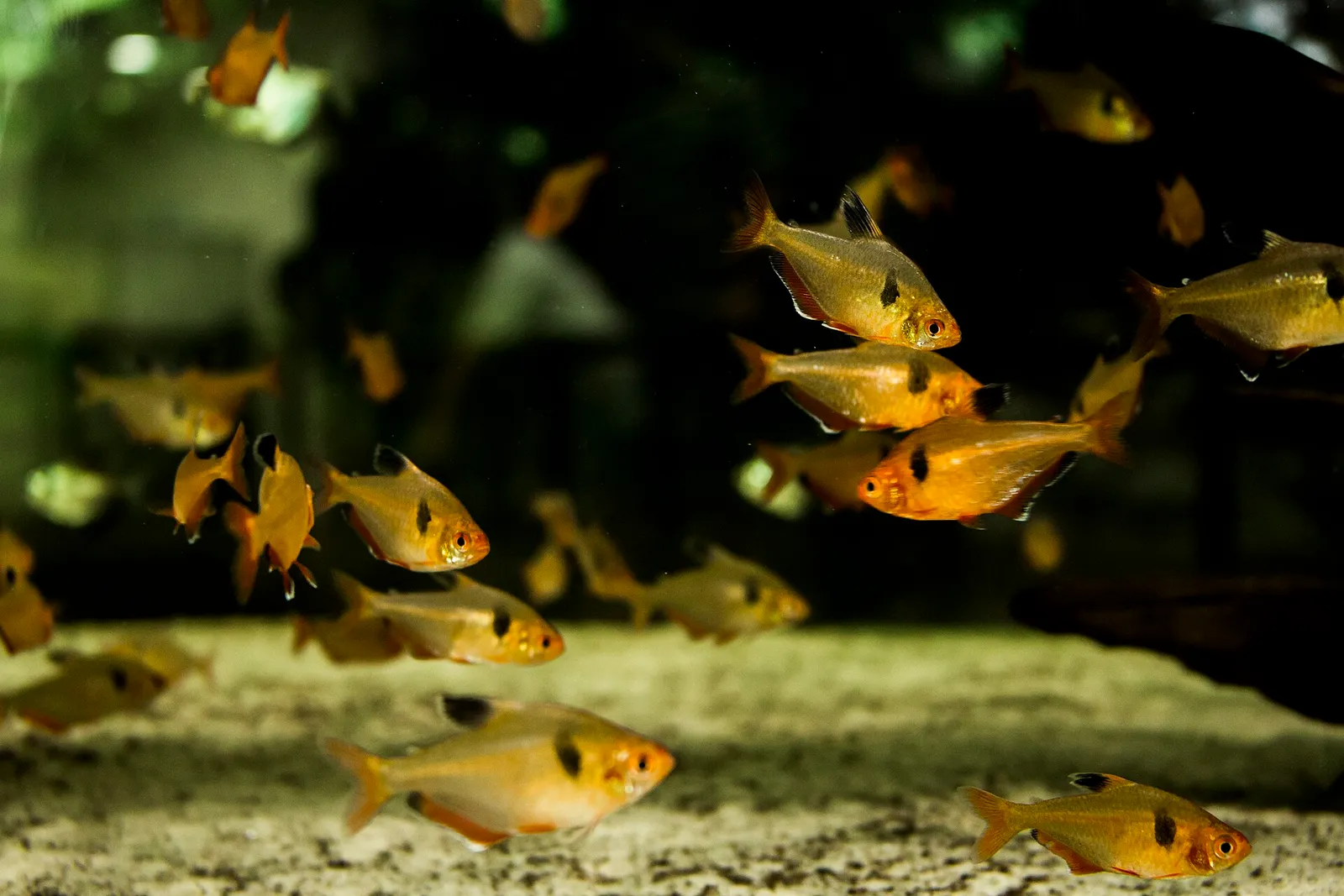
Megalamphodus eques is a compact, laterally compressed tetra reaching approximately 1.5 in standard length. The body is relatively deep and oval in profile, lending adults a chunky, almost coin-like silhouette compared with more slender tetras. The background body colour is a strong, saturated red to cherry-orange, deepest at the flanks and fading somewhat toward the belly. A black humeral spot, roughly oval to comma-shaped, sits just behind the gill cover and is the species' most consistent pattern element.
The dorsal fin is the other diagnostic feature: it is largely black or very dark, with a white or pale leading edge that makes it conspicuous in motion. The adipose fin is also dark-edged or entirely dark, and the caudal fin typically shows dark lobes. The anal fin is outlined in black with a white anterior edge. Males are generally slimmer and more intensely coloured; females are deeper-bodied when ripe, with a rounder belly profile. Intensity of red varies with condition, mood, and diet, and can fade markedly in stressed or poorly kept fish.
Habitat
In the wild, Megalamphodus eques occupies the Amazon drainage of Brazil, Peru, and Bolivia, the Guaporé River basin, and the Río Paraguay system of Brazil, Paraguay, and Argentina; an introduced population is established in French Guiana. Its IUCN range also includes Uruguay as a native locality. The species shows a strong preference for slow-moving to stagnant waters: still tributaries, backwater pools, floodplain lakes, marginal vegetation belts, and artificial ponds and reservoirs. It positions itself near the surface among dense aquatic plants, using marginal and floating vegetation as cover.
Reported water parameters across its range span a considerable breadth. FishBase records temperatures of 72–79 °F and pH 5.0–7.8 with dH up to 25, while hobbyist sources document farm-acclimated stock tolerating 68–82 °F and pH 5.0–7.5. The IUCN assessment notes its occurrence in both natural soft-acidic waters and artificial hard-water bodies, consistent with a resilient, broadly tolerant species. Its population trend is assessed as increasing, and it is described as abundant across a broad disjunct range spanning the Amazon and La Plata basins.
Feeding
Megalamphodus eques is an omnivore with a preference for small animal prey. In the wild it takes worms, small crustaceans (particularly microcrustaceans such as cladocerans and copepods), insect larvae, and terrestrial insects, supplementing this with filamentous algae and plant material. The IUCN assessment specifically notes a preference for microcrustaceans in natural populations.
In the aquarium the species accepts a broad diet and is not demanding. Quality dried flake and small pellets form a serviceable staple, but colour and condition are markedly better with regular frozen or live supplements: bloodworm, Daphnia, brine shrimp, and Cyclops all suit it well. Like many tetras it feeds actively in the middle and upper water column and competes confidently at feeding time. Small frequent meals suit it better than a single large feed.
Mating
Megalamphodus eques is an egg-scattering, open-water spawner with no parental care. Courtship is active and sometimes vigorous — males chase females energetically, displaying intensified colour and pressing close alongside a ripe female before the pair execute a rolling, side-by-side spawning drive among fine-leaved vegetation. The species has a long spawning period in the wild, consistent with tropical fish that reproduce across an extended season rather than a single annual event.
Aggressive fin-nipping is a noted behavioural trait. The Serpae Tetra ranks among the more reliably fin-aggressive small tetras in the hobby: groups will harass slow-moving, long-finned tankmates such as angelfish or bettas. Keeping a large enough group — typically at least ten to twelve specimens — distributes inter-fish tension and reduces targeted fin-nipping on individuals, while also bringing out the species' natural shoaling behaviour.
Breeding
Breeding Megalamphodus eques in captivity is straightforward, and most fish in the trade are aquarium-raised rather than wild-caught. A conditioned pair or small group introduced to a separate tank furnished with fine-leaved plants or a synthetic spawning mop will typically spawn within a day or two. Spawning is most active in the early morning. The eggs are small, semi-adhesive, and fall or settle among the plant substrate; average fecundity recorded in the IUCN assessment is approximately 192 oocytes per spawning event.
Parents show no care and will eat eggs given the opportunity, so the spawning medium or adults should be removed promptly after spawning. At temperatures in the low-to-mid 20s Celsius, eggs hatch within 24–36 hours, and the fry become free-swimming a few days later once they have absorbed the yolk sac. First foods should be infusoria or commercial liquid fry food, graduating to freshly hatched brine shrimp nauplii as the fry grow. Water quality in the rearing container must be kept high; small, frequent partial water changes suit the fragile early fry.
In the aquarium
The Serpae Tetra is an excellent, low-demand aquarium fish for its intended niche: a lively, colourful shoaling species suited to a community of similarly sized or robust tankmates. A minimum group of ten to twelve specimens in a tank of at least 31.5 in length is the baseline — smaller groups amplify fin-nipping aggression, while a proper school distributes that energy harmlessly within the group. The species does well in soft, slightly acidic to neutral water reflecting its Amazonian origins, though farm-raised stock tolerates a wider range, including moderately hard water.
Tankmates should be carefully considered. The Serpae Tetra is incompatible with slow, long-finned fish (angelfish, bettas, guppies with elaborate finnage) and will quickly damage them. Good companions are other robust mid-sized tetras, corydoras catfish, smaller loricariids, and rasboras of comparable size. A planted aquarium with open central swimming space and some driftwood, subdued lighting, and dark substrate brings out the species' reds and shows the contrast of the dorsal fin to advantage. It is hardy, long-lived relative to its size, and feeds readily — one of the classic 'first tetras' that rewards beginners while remaining interesting to experienced aquarists who keep it in proper numbers.
Conservation
Megalamphodus eques is assessed as Least Concern (LC) on the IUCN Red List, with an assessment published in 2023 by Lima, F. (assessed 04 March 2021). Population trend is listed as increasing. The species has an exceptionally broad range spanning both the Amazon and La Plata basins, tolerates a wide range of water conditions including degraded and artificial habitats, and is described as abundant throughout its native range. An introduced population established in French Guiana indicates the species' adaptability.
The combination of wide distribution, habitat flexibility, high fecundity, and a robust wild population places the Serpae Tetra among the most conservation-secure small tetras in the hobby. Collection for the ornamental trade is not considered a significant threat at the population level given its abundance, and most specimens available commercially are aquarium-raised. There are no current conservation actions specifically targeting the species, nor is there any indication that major threats are driving population decline.