Taxonomy & naming
Megalamphodus erythrostigma was described by Henry Weed Fowler in 1943 on the basis of material from South American rivers. The species is placed in the large, ecologically diverse genus Hyphessobrycon within the family Characidae. Eschmeyer's Catalog of Fishes records the valid name as Megalamphodus erythrostigma (Fowler, 1943), with parentheses indicating the species was originally described in a different genus before being transferred to Hyphessobrycon.
Hyphessobrycon is one of the most species-rich genera of Neotropical characids, and the bleeding heart tetra sits within a grouping sometimes informally called the rosy tetras — generally larger-bodied, higher-dorsalled Hyphessobrycon with pinkish or reddish tones. The species has no widely accepted synonyms in current use and is stable under its current name. Common names in the hobby include bleeding heart tetra and, less frequently, bleeding-heart tetra.
This fish was long listed as Hyphessobrycon erythrostigma; Eschmeyer's Catalog of Fishes places the species in Megalamphodus, and the current combination Megalamphodus erythrostigma is followed here.
Morphology
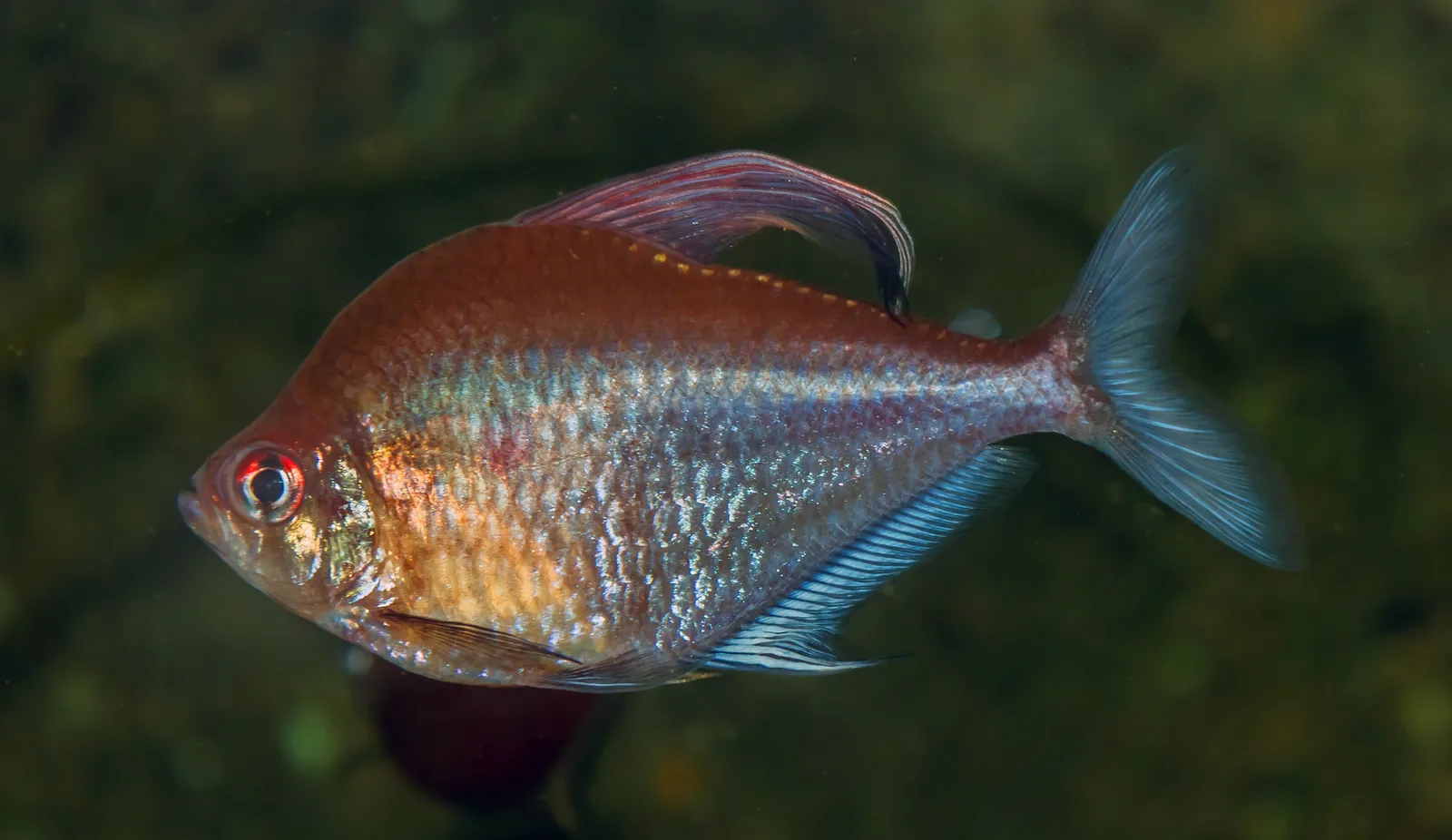
Megalamphodus erythrostigma is a moderately deep-bodied, laterally compressed tetra reaching approximately 1 in standard length, though some sources indicate adults can approach 2.5 in total length under good conditions, making it one of the larger Hyphessobrycon kept in the hobby. The body is strongly compressed laterally with a pronounced dorsal profile, and adult males develop an elongated dorsal fin that arches well above the body — a character that helps separate them from females even outside of breeding condition.
The overall colouration is pinkish to rosy with a silvery sheen, and the fish's signature feature is a bright red to crimson spot on each flank roughly at the level of the pectoral fin — the 'bleeding heart' mark that is consistent across sex and age. The dorsal fin of mature males may show a black edge. As with many characids, intensity of colour is strongly influenced by diet, water conditions, and mood; fish in optimal conditions are noticeably more vivid than those kept in hard, alkaline water or on a restricted diet.
Habitat
Megalamphodus erythrostigma is found across lowland drainages of the upper Amazon basin, with records from Brazil, Peru, and Colombia. It occupies slow-moving to standing water — flooded forest margins, heavily vegetated stream edges, and backwater areas — typically under dense riparian cover where tannins from leaf litter stain the water to a tea colour and light penetration is limited.
The species is adapted to soft, warm, acidic conditions that typify much of the upper Amazon. Water parameters recorded for its range indicate temperatures in the range of 72–79 °F, pH between 6.0 and 7.0, and very low mineral content. These blackwater or clearwater habitats are relatively nutrient-poor, and the fish browses the water column and surface film opportunistically rather than targeting concentrated prey aggregations.
Feeding
In the wild, Megalamphodus erythrostigma is an omnivore that feeds on small aquatic insects, crustaceans, and invertebrates taken from the water column and surface, along with organic detritus and plant matter. Like most Hyphessobrycon it exploits whatever food sources are available in its slow, tannin-stained habitats.
In the aquarium it accepts a wide variety of foods without difficulty. Good-quality small flake or micro-pellets form an adequate base diet, but conditioning for breeding or simply maintaining best colour calls for supplementation with live or frozen foods — Daphnia, brine shrimp, bloodworm, and Cyclops are all taken readily. As with other tetras adapted to soft, oligotrophic water, providing variety prevents nutritional deficiencies and keeps the fish in better condition over the long term.
Mating
Megalamphodus erythrostigma is an egg-scattering open spawner with no parental care, following the typical reproductive strategy of the genus. In the wild, spawning presumably takes place among fine-leaved aquatic vegetation and submerged root tangles in slow or still water. Males compete for access to females, and the elongated, flag-like dorsal fin of adult males is likely a display structure used in male–male competition and courtship.
Under aquarium conditions, ripe males will pursue females actively and attempt to drive them into spawning positions among fine-leaved plants or synthetic spawning mops. The eggs are adhesive and attach to plant material or settle on the substrate; they hatch within approximately 24–30 hours at typical spawning temperatures. Because adults show no recognition of or interest in their own eggs, any parental 'care' is simply absent — indeed, adults readily consume eggs if they encounter them.
Breeding
Breeding Megalamphodus erythrostigma in captivity follows the standard approach for egg-scattering characids. A separate, dimly lit breeding vessel with soft, warm, slightly acidic water (pH 6.0–6.8, 75–79 °F) and a base layer of fine-leaved plants such as Java moss, or synthetic mops, provides the spawning medium. Reducing light levels at the start of the spawning period is often recommended, as the species is reported to spawn most readily in subdued conditions.
Well-conditioned adults introduced to the breeding setup typically spawn within a day or two. The adhesive eggs hatch in roughly 24–30 hours, and free-swimming fry appear within a few days. Adults should be removed after spawning to prevent predation of eggs and fry. The fry are small and need appropriately fine first foods — infusoria or commercial liquid fry food before progressing to newly hatched brine shrimp and fine powdered flake as they grow. Growth is relatively slow compared to smaller tetras.
In the aquarium
The bleeding heart tetra is a peaceful, sociable species that does best in groups of six or more. Like most schooling tetras it is most comfortable — and shows its best colour — when kept in sufficient numbers to form a coherent group, and lone individuals or very small groups often remain pale and skittish. A planted aquarium with soft, acidic water, some surface cover, and low to moderate lighting replicates its natural blackwater habitat and flatters its colouration; the addition of botanicals or leaf litter to the substrate further acidifies the water and provides the tannin-staining the fish is adapted to.
Water chemistry should stay soft and slightly acidic: pH 6.0–7.0, temperature 72–79 °F. The species is intolerant of hard or alkaline water over the long term and will not thrive or colour up fully in conditions outside its preferred range. It is compatible with similarly peaceful, soft-water species — smaller Corydoras, dwarf cichlids, other Hyphessobrycon, and rasboras — but should not be mixed with fin-nipping species, as the males' long dorsal fins are vulnerable. Hardy once acclimatised, it is a moderate-difficulty species requiring stable, quality soft water rather than beginners' conditions.
Conservation
Megalamphodus erythrostigma has not been formally assessed for the IUCN Red List and carries no current Red List designation; its status is Not Evaluated (NE). Its range spans parts of Brazil, Peru, and Colombia — countries with large areas of intact lowland Amazon forest — and it is neither range-restricted nor reported as scarce by trade or survey sources, though no systematic population data appear to be available for the species.
The species has been commercially bred in captivity for many decades and is widely available as tank-raised stock in the ornamental fish trade, which substantially reduces the pressure on wild populations. Sourcing captive-bred individuals from reputable suppliers is straightforward and is the default situation for most hobbyists. As the upper Amazon basin faces ongoing pressure from deforestation, agriculture, and water quality changes, continued monitoring of soft-water characid populations in the region would be valuable, but no acute conservation concern is currently documented for this species.