Taxonomy & naming
Campylomormyrus tamandua was described by the German-British ichthyologist Albert Günther in 1864, one of the many African freshwater fishes he named during his prolific 19th-century survey work at the British Museum. It belongs to the family Mormyridae — the elephantfishes — within the order Osteoglossiformes, the bonytongues: one of the oldest living branches of the teleost fishes, a scattered, deep-time radiation found today across four continents (South America, Africa, Southeast Asia and Australasia) and united not by shared habitat but by that toothed lingual bone. The Mormyridae are an exclusively African family of several hundred weakly electric species; despite a superficial resemblance, they are entirely unrelated to the electric knifefishes of South America (Gymnotiformes) — the two lineages evolved similar electric senses independently, on opposite sides of the Atlantic, and should never be conflated.
The genus name Campylomormyrus combines the Greek kampylos, "curved" or "bent", with mormyros, an old Greek name for a fish, in reference to the elongated, often downcurved snouts that characterise the genus. The species epithet tamandua borrows the Tupi-Guarani word (via Portuguese) for the South American anteater — presumably chosen because the fish's long, tapering jaw recalls an anteater's snout, an image Günther and his contemporaries reached for more than once in this genus (compare C. elephas, named for an elephant's trunk, and C. alces, named for a moose). No explicit explanation survives from the original description, so this reading should be taken as a reasonable inference rather than a documented fact. In the trade the fish is usually sold simply as the worm-jawed mormyrid, a name applied loosely across Campylomormyrus species with this elongated jaw shape.
Morphology
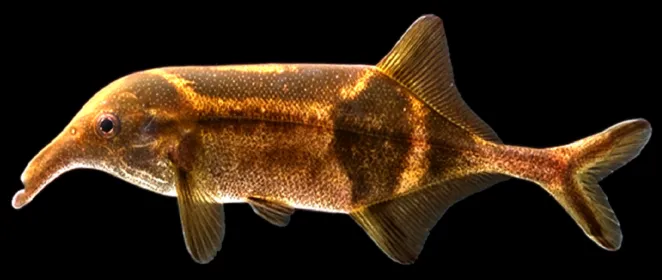
Like other Campylomormyrus, C. tamandua carries the genus's hallmark trait: both jaws are drawn out into a long, curved, tapering tube, giving the head an unmistakable worm- or trunk-like profile quite different from the soft, fleshy chin appendage (the Schnauzenorgan) of the more familiar elephantnose, Gnathonemus petersii. The mouth itself sits at the tip of this snout, small and suited to picking prey items out of sediment. The body is elongate and laterally compressed, typically grey to olive-brown with little bold pattern, and the dorsal fin sits well back on the body, mirrored by a long anal fin — the layout typical of mormyrids, which swim mainly by undulating these fins rather than the body.
Reported maximum size is around 17 in standard length (FishBase), with Seriously Fish citing a similar maximum near 15.5 in SL — a substantial mormyrid, considerably larger than small aquarium staples like G. petersii. As in every mormyrid, an electric organ in the caudal peduncle generates a continuous, weak, pulse-type electric organ discharge (EOD), and much of the body's skin is studded with electroreceptors that read the resulting field. Mormyrids as a family also carry one of the largest brain-to-body mass ratios of any vertebrate group, driven by a hugely enlarged cerebellum that processes this electrosensory stream — the physiological basis for their popular reputation as "thinking fish."
Habitat
Campylomormyrus tamandua is broadly distributed across West and Central Africa, an unusually wide spread for a mormyrid genus in which most species are narrower, single-basin endemics. FishBase lists records from the Volta, Niger, Lake Chad/Chari and Congo river basins, and Seriously Fish cites country records spanning Cameroon, Nigeria, the Democratic Republic of the Congo, Ghana, Chad, Benin, Mali, Burkina Faso and Niger — together suggesting the species tolerates a range of West African river conditions rather than being tied to a single drainage.
It inhabits tropical freshwater rivers and their margins, the kind of dim, often turbid or tannin-tinted water in which electrolocation is a genuine advantage over vision. FishBase gives a temperature range of about 72–75 °F at pH 5.0–7.0, while Seriously Fish reports a broader 73–82 °F at the same pH and soft water of roughly 0–10°dGH — together pointing to warm, soft, slightly acidic to neutral water as this species' natural range, not the harder, more alkaline water associated with some other African fish habitats.
Feeding
Like most mormyrids, C. tamandua is a nocturnal forager that relies on its electric sense as much as its eyes to find food after dark, sweeping its long, tube-like jaws over the substrate to pick out buried invertebrates. Its elongated worm-jaw is clearly built for probing soft sediment, and Seriously Fish notes it takes aquatic invertebrate prey in this way in the wild.
In the aquarium it accepts frozen and live foods readily — bloodworm, brine shrimp, earthworms and tubifex are all reported to be taken — but rarely accepts dry or flake food, so keepers should plan on a live/frozen-food diet rather than expecting it to adapt to pellets. Feeding after lights-out, in keeping with its nocturnal habits, gets the best results and avoids losing food to more assertive daytime tankmates.
Mating
Mormyrid courtship is built around the same electric organ discharge (EOD) the fish use to navigate: the pulse pattern is species-specific and individually variable, and across the genus it is thought to double as a signal of species identity, sex and reproductive readiness, with courting fish modulating their discharge near a potential mate. Whether Campylomormyrus tamandua behaves this way specifically has not been documented in the sources consulted here, but it is consistent with what is known of related mormyrids.
Beyond that general picture, the courtship and spawning behaviour of this species is not well described. Mormyrids in general are believed to be seasonal, flood-triggered spawners in the wild, timing reproduction to rising water and the food pulse that follows it, but the specifics — courtship sequence, spawning site, any pair-bonding — have not been established for C. tamandua.
Breeding
Campylomormyrus tamandua is, for practical purposes, not a fish the hobby breeds. Seriously Fish states that it has almost certainly never been bred in captivity, and mormyrid breeding in general remains poorly understood — the group's specialised electric courtship and, in some genera, reported egg-guarding among vegetation have rarely if ever been reproduced under aquarium conditions.
One commercial supplier, Aquarium Glaser GmbH, has listed "bred" stock of this species, which suggests at least occasional farm-level breeding success exists somewhere in the supply chain, but this is the exception rather than a repeatable, documented method, and wild-caught fish remain the normal source of aquarium stock. Anyone acquiring this species should expect to keep a long-term, wild-collected specimen rather than to breed it.
In the aquarium
This is a specialist fish for a soft-water, dimly lit setup rather than a general community tank. Match the wild water chemistry as closely as practical — soft and slightly acidic to neutral (pH 5.0–7.0), warm (roughly 73–82 °F) — and keep lighting subdued, since C. tamandua is nocturnal and will spend daylight hours tucked into cover such as driftwood, root tangles or dense planting, becoming active once the lights go down.
At up to around 15.5–17 in it needs a genuinely large, long aquarium as an adult, not a nano or small community setup. Seriously Fish reports it is aggressive toward other mormyrids but peaceful with unrelated tankmates, so it is generally best kept singly, or with a like-sized non-mormyrid community, rather than grouped with other Campylomormyrus or elephantnoses. Offer a soft substrate the fish can probe with its long snout, and feed frozen or live invertebrate foods after dark; it rarely if ever takes dry food.
Mormyrids as a group are notoriously sensitive to poor water quality and to some medications, so stable, well-filtered water and caution with treatments — particularly copper-based ones — matter more here than with most community fish. As with any mormyrid, use a soft net or, better, move the fish in a container to avoid damaging its sensitive skin and snout.
Conservation
The IUCN Red List assesses Campylomormyrus tamandua as Least Concern, per FishBase's summary of the assessment (dated 2019). Its wide distribution across multiple West and Central African basins — Volta, Niger, Lake Chad/Chari and Congo — works in its favour: a species spread across several major river systems is less exposed to any single localised threat than a narrow-range endemic.
No species-specific population trend or major threat is documented in the sources consulted here. The general pressures facing West and Central African river fish — damming, siltation, deforestation and water pollution — are the plausible long-term concerns for a river-dwelling mormyrid like this one, but the data needed to quantify them for C. tamandua specifically are sparse.