Taxonomy & naming
Mormyrops anguilloides was described by Carl Linnaeus in 1758, originally placed in the genus Mormyrus; it has since been reclassified into Mormyrops, and the parenthetical authority "(Linnaeus, 1758)" reflects that later change of genus. It belongs to the family Mormyridae within the order Osteoglossiformes, the bonytongues — an ancient, scattered radiation of fishes found across four continents (South America, Africa, Southeast Asia and Australasia) and united by that toothed lingual bone rather than by any shared modern habitat. The Mormyridae are an exclusively African family of several hundred weakly electric species, a lineage entirely convergent with — not related to — the electric knifefishes of South America (Gymnotiformes), which evolved a similar electric sense independently on the far side of the Atlantic.
The genus name Mormyrops combines Mormyrus, the type genus of the family (itself an old name applied to these fishes), with the Greek suffix -ops, "face" or "appearance" — literally "Mormyrus-like". The species epithet anguilloides derives from Latin anguilla, "eel", plus the suffix -oides, "resembling", a nod to the fish's elongated, eel-like body. Mormyrops anguilloides is both the largest species in its genus and the largest member of the entire family Mormyridae.
Morphology
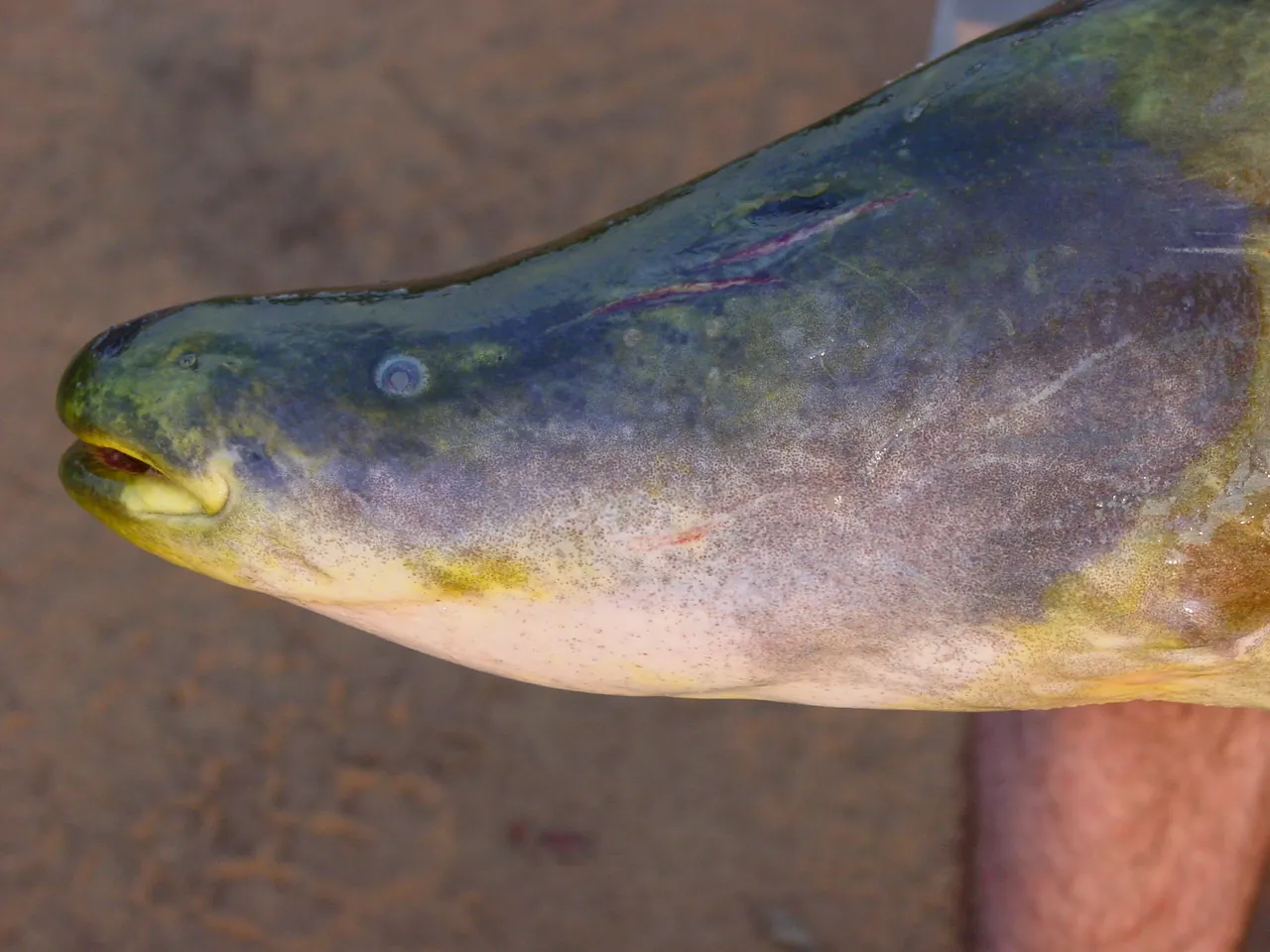
The Cornish jack has an elongated, laterally compressed body that tapers toward a small, deeply forked tail, consistent with the eel-like build implied by its epithet. Unlike the trunk-nosed elephantnoses such as Gnathonemus and Campylomormyrus, Mormyrops carries no fleshy Schnauzenorgan on the chin; instead it has a proportionately large mouth set with sharp teeth, built for seizing fish prey rather than probing soft mud for buried invertebrates. Coloration is a fairly uniform dark grey-brown to blackish-brown over the body; juveniles are reported to show faint darker vertical bands that fade with growth, a pattern seen in a number of mormyrids.
As in all Mormyridae, an electric organ near the base of the tail generates a weak, pulse-type electric organ discharge (EOD), used for electrolocation and communication in the dark, often turbid water the species inhabits. FishBase records this as the largest species in the family, reaching up to 59 in total length — several times the size of familiar aquarium mormyrids like the elephantnose (Gnathonemus petersii, to roughly 8.5–14 in) — which places it in an entirely different size class from the mormyrids typically kept in home tanks.
Habitat
Mormyrops anguilloides has one of the widest distributions of any African mormyrid, recorded from West African river systems, the White Nile, the Uebi Shebeli and Juba rivers of the Horn of Africa, the Congo basin, the Zambezi, and the rift lakes Malawi, Tanganyika and Albert (FishBase). It is a freshwater, demersal (bottom-associated) species that undertakes potamodromous movements — migrations wholly within fresh water, typically tied to seasonal flooding.
It favours dark, quiet, often turbid freshwater habitats — slow river reaches, floodplains and lake margins — where visibility is poor and an electric sense outperforms eyesight. Reported water temperature is a fairly narrow 72–75 °F (FishBase); the sources reviewed for this article do not document a specific pH range, and none is asserted here.
Feeding
The Cornish jack is a nocturnal, carnivorous predator that hunts small fish and invertebrates — an unusually piscivorous diet among the largely insectivorous Mormyridae, and one made possible by its comparatively large, toothed mouth. Like other mormyrids it relies on its electric organ discharge for electrolocation in the dark or turbid water it hunts in, sweeping its electric field over the substrate and open water to detect prey by the tiny distortions their bodies cause.
Its large adult size and predatory habits are part of why it is not a home-aquarium fish: a mature Cornish jack is a genuine threat to any tankmate small enough to swallow, and its dietary needs scale accordingly. This is one more reason the species belongs in the realm of public aquariums rather than domestic fishkeeping.
Mating
As in other mormyrids, courtship and mate or species recognition in Mormyrops anguilloides is thought to run substantially through the electric organ discharge rather than through visual display, since the EOD waveform tends to be species- and potentially sex-specific across the family. Beyond that general pattern, the courtship behaviour of this species specifically has not been well documented in the available literature.
Mormyrids in general are believed to be seasonal, flood-triggered spawners, with reproductive activity tied to the rains and rising water levels that mark the African wet season across their range. Whether Mormyrops anguilloides follows that same flood-cued pattern, and what its courtship sequence or spawning site looks like, remains data sparse.
Breeding
Mormyrops anguilloides is essentially not bred in the aquarium hobby — unsurprising given its adult size alone — and its reproductive biology in the wild is poorly understood. As with other mormyrids, breeding is presumed to be a seasonal, flood-triggered event, and the species-specific electric organ discharge likely plays some role in courtship or mate recognition, but the details of nest site, egg-laying and any parental care have not been reliably documented for this species. Some mormyrids are thought to guard eggs among vegetation, but this has not been confirmed here.
Virtually all individuals seen in the trade or in public-aquarium collections are wild-caught. This is a fish to observe, not a captive-breeding project — both because the underlying biology is barely known and because its scale makes a purpose-built breeding setup wholly impractical outside an institutional collection.
In the aquarium
Mormyrops anguilloides is not a home-aquarium fish. At up to 59 in total length it is the largest member of the entire family Mormyridae, and Practical Fishkeeping's guide to the elephantnoses singles it out as unsuited to home tanks, better placed in public aquarium displays with the scale of tank, filtration and husbandry that only an institutional collection can provide. Anyone encountering a juvenile Cornish jack in the trade should plan for that adult size from day one — this is exactly the kind of size trap that turns an appealing juvenile oddball into an animal no home tank can responsibly hold.
Beyond its size, the species carries the same general mormyrid care needs as its smaller relatives — soft, dim, quiet conditions that don't interfere with its weak electric sense, and caution with copper-based medications on what is a scaleless, electrosensitive fish — compounded by a reported aggressive temperament and genuinely predatory habits toward anything small enough to eat. None of that is a reason to attempt keeping this species in a home tank; it is a reason not to.
Conservation
The IUCN Red List assesses Mormyrops anguilloides as Least Concern, reflecting its unusually wide distribution across Sub-Saharan Africa's quiet freshwater habitats, from West African rivers through the Nile system, the Congo and Zambezi basins, to the East African rift lakes. It is not currently considered at risk at the species level.
As with many broadly distributed African river fishes, no single major documented threat is flagged for this species specifically, though the general pressures on African freshwater systems — habitat degradation, sedimentation and water-quality decline — apply across its enormous range. Its large size also exposes it to some subsistence and artisanal fisheries pressure in parts of its range, though this is not raised as a conservation concern in the sources reviewed here.