Taxonomy & naming
The slant-bar cory was described by the Dutch ichthyologists Han Nijssen and Isaäc Isbrücker in 1983, in the journal Beaufortia, as part of their work on the Corydoras of Colombia. The type locality is Lomalinda, near the Río Ariari — a tributary of the Río Guaviare in the upper Orinoco system — southeast of Villavicencio, in Colombia's Meta department. It was placed in Corydoras Lacépède, 1803, the huge genus of South American armoured catfishes (family Callichthyidae, subfamily Corydoradinae) that has long held most of the hobby's 'cory cats'. The epithet loxozonus is descriptive, built from Greek roots meaning 'oblique band' — the slanting bar that names the fish.
Corydoras eventually swelled past 170 species and proved, on molecular evidence, not to be a single natural lineage. In 2024 Dias, Tencatt and colleagues published a large phylogenetic revision (Zoological Journal of the Linnean Society, zlae053) that split the old genus into several genera — including Brochis, Hoplisoma, Gastrodermus and Osteogaster. Under that scheme the slant-bar cory becomes Hoplisoma loxozonum, and Eschmeyer's Catalog of Fishes now lists it as valid in Hoplisoma, with Corydoras loxozonus as a synonym. The new combination is recent and not yet universally used; the aquarium trade still says 'Corydoras loxozonus' (or its hobby name, the slant-bar cory), so we keep that as our heading while recording the current name.
Morphology
This is a small, fairly slender cory reaching about 2 in standard length (roughly 2–2.5 in in total length); females grow larger and fuller-bodied than males, a difference seen most easily from above. Like all corys it is armoured rather than scaled: two rows of overlapping bony plates (scutes) run down each flank and meet in a ridge along the back, the head is a hard, blunt helmet, and three pairs of short barbels fringe the downturned, sand-sifting mouth.
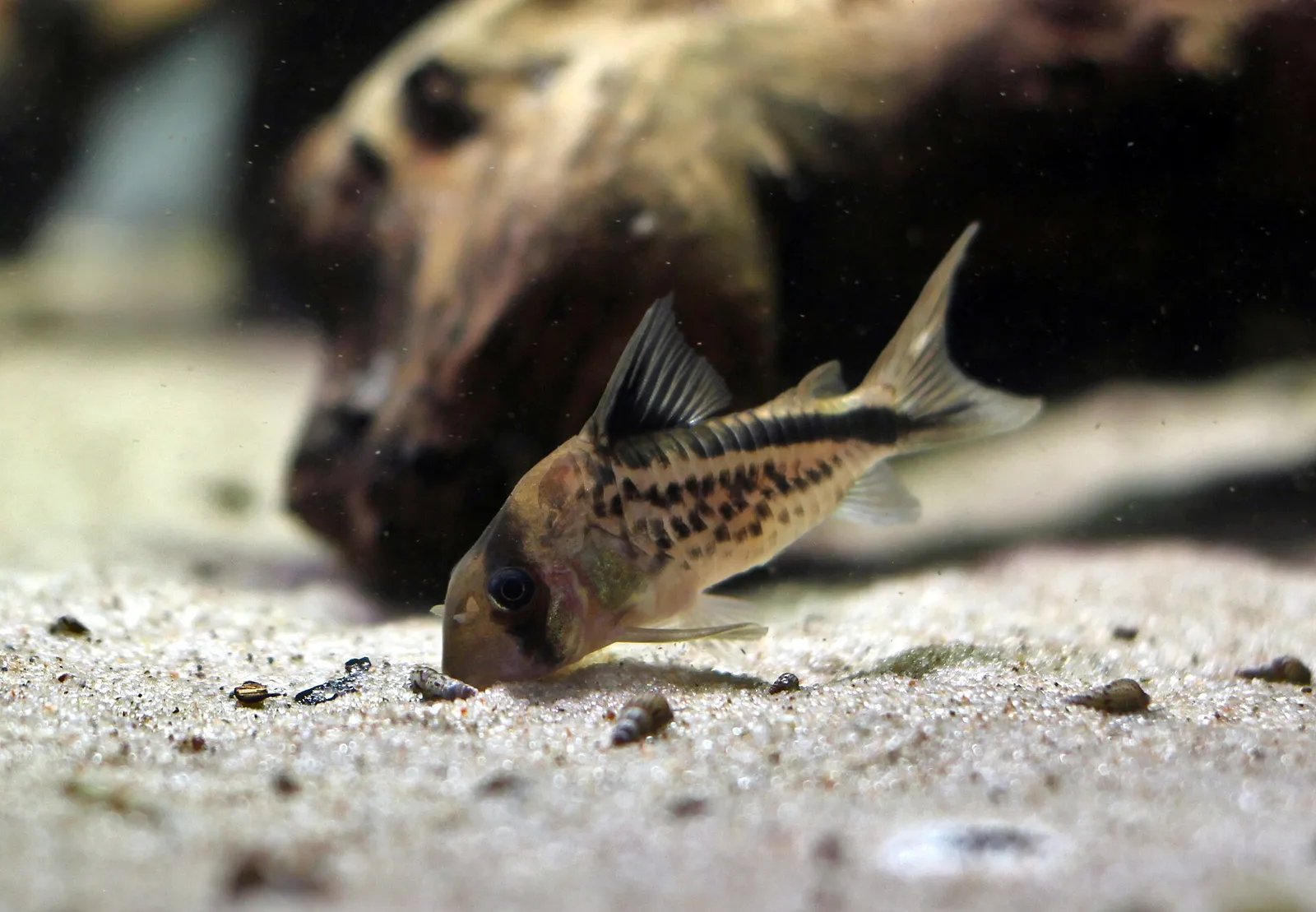
The pattern is the point. The ground colour is a clean silvery-white to pale fawn, peppered finely over the upper body, and a dark mask runs through the eye in the manner of many corys. The defining mark is a single bold dark bar that descends from the front of the dorsal fin not vertically but at a backward slant, crossing the upper flank on the diagonal — the 'slant bar' of the common name. The dorsal fin itself is largely black, especially along its leading edge and tip, and the caudal fin shows faint barring; at the base of the tail sits a warm orange-to-pinkish flush that lifts the whole fish out of plain monochrome. As in all corys the dorsal, pectoral and adipose fins each carry a stiff, mildly venomous spine that can jab a careless hand or snag in a net. The fish is essentially only kept as the wild form.
Habitat
Corydoras loxozonus is a fish of the Colombian Llanos — the eastern plains that drain to the Orinoco. It is recorded from the upper Orinoco system in Colombia: the Río Meta drainage and, around the type locality, the Río Ariari–Río Guaviare network southeast of Villavicencio. These are clear to lightly tinted plains rivers and their slow margins and tributaries, running over sand and fine sediment with leaf litter and submerged wood, in country that swings between a flooded wet season and a much-reduced dry season.
Reported water is on the cool side for a tropical cory — temperatures of roughly 70–75 °F, a pH band from about 6.0 to 8.0, and soft to moderately hard water (around 2–25 dH). The species does not relish sustained heat and is sensitive to deteriorating water, particularly accumulated nitrate. Like other corys it is a facultative air-breather, periodically darting to the surface to gulp air and absorb oxygen through a modified, vascularised hindgut — an adaptation that helps it through the warm, oxygen-poor pools of the dry-season plains.
Feeding
The slant-bar cory is a benthic omnivore. In its plains rivers it works the bottom continuously, pushing its snout and barbels into sand to taste out small invertebrates, insect larvae, worms, micro-crustaceans and the organic film of detritus, expelling cleaned sand through the gills as it sifts. It is an opportunist rather than a specialist. In the aquarium it readily takes sinking tablets, granules and larger flakes that reach the substrate, and it relishes live or frozen foods — bloodworm, white worm, grindal worm, Daphnia and Tubifex — which double as the conditioning diet for bringing a group into breeding shape. As with all corys it should be fed deliberately at the bottom and never left to subsist on what tankmates happen to drop.
Mating
Corydoras are egg-laying shoalers with no pair bond and a distinctive, well-studied courtship, and loxozonus conforms to it. When a female ripens the group grows active and she cleans a spawning site — a leaf, a stone, a plant or the aquarium glass. A male positions himself at right angles to her head in the classic 'T-position', and the female appears to take his milt; sperm is thought to pass rapidly through her gut to fertilise the few eggs she holds in a basket formed by her pelvic fins. She carries that small clutch to the cleaned surface and presses the adhesive eggs into place, and the sequence repeats a few eggs at a time until the chosen surfaces are stippled with them.
Breeding
The slant-bar cory has been bred in captivity, though it is reported less often than the easy commercial corys and asks for stable, cool, clean conditions. Spawning is generally triggered by a large, cool water change that imitates the onset of the rainy season, dropping the temperature several degrees. A conditioned group skewed toward more males than females is the usual arrangement. The adhesive eggs are laid in small batches, with clutches on the order of dozens up to roughly a hundred; the adults give no parental care and will eat the eggs, so breeders move either the eggs or the parents. Eggs hatch within a few days, and once the yolk sac is absorbed the fry take microworm, baby brine shrimp and powdered foods. Because the species is bred only modestly, a good share of fish in trade are still wild-caught Colombian imports.
In the aquarium
The slant-bar cory is a fine, peaceable aquarium fish for a keeper who can give it cool, clean water. First, it is a shoaling species and is genuinely stressed kept alone or in pairs — keep six or more, and a group rewards you with constant, confident foraging. A group settles well in a tank of around 23.5 in / 20 US gal or more, where bottom area matters far more than height.
Second, two husbandry points deserve emphasis. This is a cool-leaning cory: keep it around 70–75 °F and avoid the warm temperatures of a planted tropical tank, which it tolerates poorly. And it is noticeably sensitive to water quality — accumulated nitrate in particular — so frequent partial water changes and unhurried, well-oxygenated filtration are not optional. Provide soft sand or very smooth, rounded fine gravel, because corys feed by sifting and sharp or coarse substrate wears down and infects their barbels, leaving the blunted faces that signal poor husbandry. Border the bottom with driftwood and plants but leave an open sifting area, and keep that substrate clean. The fish is utterly peaceful and an ideal companion for tetras, rasboras, dwarf cichlids and other calm community fish that share its taste for cooler water — never anything large enough to bully it. As with all corys, the fin spines can catch in nets (a cup is safer), and a badly stressed cory can release a skin toxin that, in the confined volume of a bag or bucket, can kill the whole group, so move them with care.
Conservation
Corydoras loxozonus is assessed by the IUCN Red List as Vulnerable, under criterion B2ab(iii,v), in an assessment published in 2020. That is a markedly more concerned listing than the 'Least Concern' carried by the widespread corys of the trade, and it follows directly from the fish's biology: it has a restricted range in the Colombian Llanos, and the assessment recognises a continuing decline in the quality of its habitat and in the size of its population. The plains rivers it inhabits face real and growing pressures — agricultural expansion and cattle ranching across the Llanos, deforestation, run-off and pollution, and the broader hydrological disturbance of the Meta and Guaviare basins. For a narrowly distributed, water-quality-sensitive species, those pressures matter. The modest scale of captive breeding means the hobby still draws partly on wild stock, which makes responsible, sustainable collection and habitat protection the two levers that count for this fish's future.