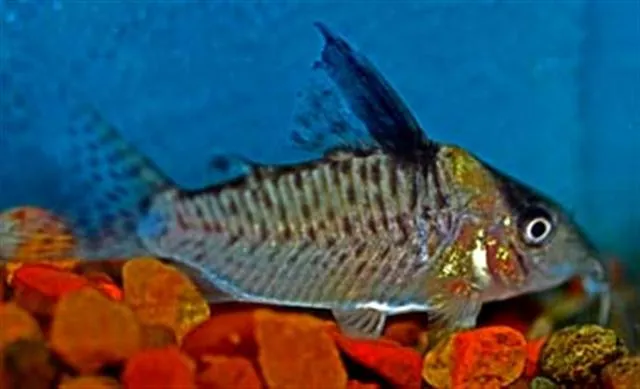
Taxonomy & naming
Corydoras delphax was described in 1983 by Han Nijssen and Isaäc Isbrücker, in their review of the Colombian corys published in the Dutch journal Beaufortia, from material taken in the Río Inírida system of Guainía, Colombia. The type locality is given precisely as Caño Bacón, near Pueblo Bretaña, at roughly 3°43′N, 67°59′W. It was placed in Corydoras Lacépède, 1803 — the vast genus of South American armoured catfishes in the family Callichthyidae — and that is the name under which it has been traded and written about for forty years.
The genus had become a catch-all of well over 170 species, and molecular work showed it was not a single natural lineage. In 2024 Dias, Tencatt and colleagues published a large phylogenetic revision that broke Corydoras into several genera, among them the resurrected Brochis Cope, 1872 — the deep-bodied, high-ray 'green corys'. Under that scheme the false blochi becomes Brochis delphax, the combination now carried by the Catalog of Fishes and Planet Catfish. The change is recent and not yet universal; the aquarium trade still overwhelmingly says 'Corydoras delphax', so we keep that as the heading while noting the current valid combination. The placement is fitting: delphax was long mistaken for the true Brochis 'blochi', which is exactly how it earned its common name.
Morphology
This is a small but notably deep-bodied, stocky cory, reaching about 2–2.5 in standard length (females larger and rounder than males). Like all corys it is armoured rather than scaled: two rows of overlapping bony plates run down each flank, the head is a hard helmet, and three pairs of barbels fringe the downturned mouth. What sets delphax apart from an ordinary Corydoras is its tall, robust profile and its resemblance to the genus Brochis — hence 'false blochi' — though it carries the normal corydoradine dorsal-fin ray count rather than the high count of a true Brochis sensu the old usage.
The body is a warm tan to greyish ground heavily overlaid with an iridescent green-to-gold sheen on the flank, brightest behind the gill cover, with the snout and upper head often darker. The fins are largely clear. The dorsal, pectoral and adipose fins each carry a stiff leading spine — the standard cory defence, mildly venomous and capable of a sharp jab, and prone to snagging in a net. The species epithet, delphax (Greek for 'piglet'), and the 'piglet cory' trade name nod to its short, blunt, rooting snout.
Habitat
Corydoras delphax is a fish of the upper Río Inírida and the upper Orinoco basin in eastern Colombia, in the broad Orinoco–Guaviare–Inírida drainage. These are warm tropical lowland waters, and the type series came from a caño (a small forest stream) feeding the Inírida — the kind of shaded, slow, tannin-stained blackwater channel characteristic of the region, running over soft sand with leaf litter and submerged wood.
The water envelope is that of a soft-water blackwater species: warm temperatures in roughly the 72–79 °F range, a pH that runs acidic to near-neutral (about 6.0–7.5), and soft to at most moderately hard water (FishBase gives a hardness band of roughly 2–25 dGH). Like other corys it is a facultative air-breather, darting to the surface to gulp air and absorb oxygen through a vascularised hindgut — an adaptation that lets corys persist in the warm, oxygen-poor margins and dry-season pools of these systems.
Feeding
The false blochi is a benthic foraging omnivore. In the wild it works the sandy bottom, burying its short snout and barbels to taste out small invertebrates, insect larvae, worms, micro-crustaceans and the organic detritus of the streambed, expelling cleaned sand through the gills as it sifts. It is an opportunist, not a specialist, which is part of why it adapts readily to captivity. In the aquarium it takes sinking dried foods — tablets, granules and larger flakes — alongside frozen and live bloodworm, Tubifex, Daphnia and grindal or white worm, the last especially useful for bringing a group into spawning condition. It should never be left to subsist on tankmates' leftovers.
Mating
Corydoras are egg-laying shoalers with no pair bond and the well-known corydoradine courtship. When a female ripens, the group becomes active and a male positions himself at right angles to her head in the classic 'T-position'; she appears to take his milt at the mouth, and sperm is thought to pass rapidly through her gut to fertilise the few eggs she clasps in a basket formed by her pelvic fins. She carries that clutch to a site she has cleaned — a plant leaf, a stone, the glass — and presses the sticky eggs into place. The sequence repeats, a few eggs at a time, until the spawn is complete. There is no pairing off: a productive group skews toward more males than females.
Breeding
Captive breeding follows the standard cory recipe and has been reported by hobbyists, though delphax is not bred in the commercial volumes of a bronze or peppered cory. Spawning is typically triggered by a large, cool water change that mimics the onset of the rainy season, with raised oxygenation and a little extra flow. A breeding group is best stocked with two or more males per female. The adhesive eggs are laid in small batches on cleaned surfaces and receive no parental care — adults will eat them, so the breeder removes either the eggs or the parents. Eggs hatch in roughly three to four days; once the fry absorb the yolk sac they take microworm, then baby brine shrimp and powdered foods, and scrupulous water changes carry them through the vulnerable first weeks.
In the aquarium
Corydoras delphax is a rewarding but slightly more demanding cory than the trade staples — a soft, warm blackwater fish rather than an anything-goes beginner's species. As a shoaling catfish it is genuinely stressed kept alone or in pairs; keep six or more and a group is confident and constantly busy. A footprint of around 90 × 12 in or larger suits a group, since bottom area matters more than height.
Substrate is not decoration. Provide soft sand or, at most, smooth rounded fine gravel: corys feed by sifting, and sharp or chipped gravel erodes and infects their barbels, leaving the stubby, blunted faces that betray poor husbandry. Keep the bottom clean. Water should be warm but not hot (about 72–79 °F), soft and acidic to neutral, well-filtered and well-oxygenated with gentle current; shaded cover from wood, rockwork and floating or tall plants helps the group settle. They are utterly peaceful and pair well with small tetras, pencilfish, dwarf cichlids and other calm soft-water community fish. Two standing cautions apply to all corys: the fin spines snag in nets, so move them in a cup or bag, and a badly stressed cory can release a skin toxin that, in the closed volume of a transport bag, can kill the whole group — so bag them with care and not too many to a bag.
Conservation
Corydoras delphax has not been formally assessed by the IUCN Red List; FishBase carries no threat ranking beyond a low vulnerability score, and the species is simply too narrowly studied for a published category. It is a regional endemic of the upper Orinoco and Inírida drainage rather than a continent-spanning generalist, which means its fate is tied to that of the Colombian blackwater rivers — habitats exposed to deforestation, alluvial gold-mining, mercury pollution and the pressures of the ornamental-fish trade, which is a significant economic activity in the upper Orinoco. None of this points to imminent danger, but a narrow-range blackwater specialist warrants more caution than a weedy, adaptable cory. Captive breeding, where breeders take it up, eases collection pressure on wild stock.